
SEO Strategy
Keywords triggering AI Overviews tend to be longer and more specific than average queries, reinforcing the importance of long-tail keyword strategies. The conversational, natural language patterns encouraged by voice search and AI chatbots have accelerated this trend toward question-based, contextual keyword targeting.
SEO Keyword Research Best Practices for 2026: The Complete B2B Guide
How AI has reshaped keyword research—and what B2B marketers need to do differently to capture the 76% of website traffic that still comes from organic search.
Effective keyword research in 2026 requires a fundamental shift from keyword-centric to intent-and-entity-focused optimisation. AI Overviews now appear in 15–30% of Google searches, yet organic search remains the dominant traffic source, generating £22 return for every £1 spent and driving 76% of all B2B website traffic. Whitehat SEO's approach combines traditional keyword targeting with AEO (Answer Engine Optimisation) and GEO (Generative Engine Optimisation) strategies to ensure visibility across both traditional search and AI-powered discovery channels.
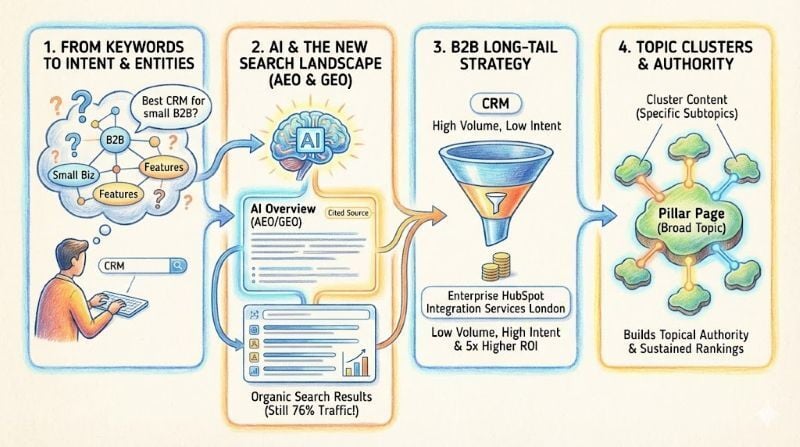
How AI has reshaped keyword research
The most significant shift in SEO for 2026 is the move from keyword-centric to intent-and-entity-focused optimisation. Google's algorithms now prioritise comprehensive topic authority over individual keyword targeting—with only 5.4% of AI Overviews containing exact query matches. This signals a fundamental departure from traditional exact-match keyword strategies.
According to Semrush's analysis of over 10 million keywords, AI Overview prevalence fluctuated considerably throughout 2025. Coverage started at 6.49% in January, peaked at 24.61% in July, then settled at approximately 15.69% by November. This volatility suggests Google continues to refine where AI-generated summaries add the most value.
Key insight for B2B marketers
The impact varies dramatically by industry. Science-related queries see AI Overviews on 25.96% of keywords, followed by Computers & Electronics at 17.92%. Conversely, Real Estate, Shopping, and Arts & Entertainment see AI Overviews on less than 3% of queries. Your sector determines how urgently you need to adapt your keyword strategy.
Whitehat SEO's SEO services now incorporate both traditional ranking factors and AI visibility metrics—because appearing in AI Overviews has become as important as ranking in position one.
AEO and GEO: The new optimisation frontier
Two emerging disciplines now complement traditional SEO. Answer Engine Optimisation (AEO) focuses on getting cited by AI-powered answer engines like ChatGPT, Perplexity, and voice assistants. Generative Engine Optimisation (GEO) optimises for appearing as sources in AI-generated responses.
The business case is compelling. Gartner predicts 25% of organic traffic will shift to AI chatbots by 2026. Currently, over 400 million people use OpenAI products weekly, and 15 million US adults already rely on generative AI as their primary search method—a figure expected to triple by 2028. AI-referred sessions jumped 527% between January and May 2025.
| Optimisation tactic | Visibility improvement |
|---|---|
| Statistics + fluency optimisation | 41%+ improvement |
| Citing authoritative sources | 115.1% visibility increase (for 5th-ranked sites) |
| Traditional keyword stuffing | Poor performance (AI uses semantic search) |
For B2B context, the stakes are particularly high: 89% of B2B buyers have adopted generative AI as a key source of self-guided information throughout their purchasing journey. Google's official position is that "good SEO is good GEO"—the same content fundamentals drive both traditional and AI-generated rankings.
Whitehat SEO's Answer Engine Optimisation service helps B2B companies structure content so AI systems can quickly identify answers, extract clean passages, and cite your brand as an authoritative source.
Zero-click searches: What the data actually shows
The zero-click phenomenon has reached critical mass. SparkToro's 2024 study found 58.5% of US Google searches and 59.7% of EU searches end without a click. For every 1,000 US Google searches, only 360 clicks go to the open web—and approximately 30% of all clicks go to Google-owned properties like YouTube, Maps, and Flights.
Mobile zero-click rates are particularly severe at 77.2% compared to 46.5% on desktop. Search Engine Land's Q1 2025 analysis showed US organic clicks dropped from 44.2% to 40.3% year-over-year, while zero-click searches rose from 24.4% to 27.2%.
The nuance matters
The relationship between AI Overviews and zero-clicks is more complex than headlines suggest. Semrush found that when tracking the same keywords before and after AI Overviews appeared, zero-click rates actually decreased slightly from 33.75% to 31.53%. This suggests the correlation may be driven by the informational nature of queries triggering AI Overviews rather than the AI Overviews themselves causing zero-click behaviour.
The strategic imperative is clear: being cited in AI Overviews is now more valuable than ranking number one. Brands cited earn 35% more organic clicks and 91% higher paid CTR than uncited competitors. Optimisation must target visibility and share of voice, not just traditional rankings.
Queries most resistant to zero-click behaviour include complex multi-step processes, topics requiring personalised advice, content requiring trust signals (reviews, testimonials), and regional or contextual variations. B2B marketers should prioritise these "zero-click proof" query types whilst also optimising for featured snippet and AI Overview inclusion.
Search intent optimisation for B2B
Search intent has replaced keyword volume as the primary targeting criterion. The four intent types—informational (seeking knowledge), navigational (looking for specific sites), commercial (researching before purchase), and transactional (ready to act)—each require distinct content approaches.
The "3Cs of Search Intent" framework remains highly effective: analyse Content Type (what format dominates results), Content Format (how top results are structured), and Content Angle (the main value proposition). This requires manual SERP analysis beyond tool-based keyword metrics.
| Funnel stage | Intent type | Example keyword |
|---|---|---|
| TOFU (Awareness) | Informational | "what is marketing automation" |
| MOFU (Consideration) | Commercial | "HubSpot vs Salesforce comparison" |
| BOFU (Decision) | Transactional | "HubSpot onboarding services London" |
A critical B2B statistic: buyers spend only 17% of their purchasing cycle interacting with sales reps, making self-service content aligned with search intent essential. The number of B2B purchase stakeholders has grown to 11.4 people on average (up from 6.8 in 2016), meaning content must address multiple decision-maker personas with distinct information needs.
Whitehat SEO's content marketing services map keyword clusters to buyer journey stages, ensuring you capture demand at every point from awareness through to purchase decision.
Why long-tail keywords deliver superior B2B results
Long-tail keywords yield 5x higher ROI and approximately 36% conversion rates compared to short-tail alternatives. This is particularly pronounced in B2B contexts where industry jargon keywords typically have low difficulty and directly target decision-makers.
The strategic progression approach works effectively: start with long-tail keywords to build initial rankings and authority, then gradually target more competitive short-tail terms as domain authority grows. Short-tail serves brand awareness at top-of-funnel; long-tail drives conversions at bottom-of-funnel.
AI search has accelerated long-tail importance
Long-tail queries (4+ words) now represent 34.71% of all Google searches and are 60% more likely to trigger AI Overviews. Voice search, which accounts for 20% of Google searches, naturally generates longer, conversational queries averaging 29 words versus 3–4 words for typed searches.
For B2B, accept that relevant keywords may have low search volume. A keyword like "enterprise HubSpot Salesforce integration" with 250 monthly searches may be far more valuable than "CRM software" with 5,400 searches because B2B-specific keywords bring more qualified leads. HelloSign's case study demonstrated a 1,308% increase in organic traffic by focusing on industry-specific keywords instead of generic high-volume terms.
At Whitehat, our SEO audit identifies the long-tail opportunities your competitors are ignoring—the keywords with high purchase intent that play directly to your strengths.
Topic clusters: The architecture that wins
Content grouped into clusters drives 30% more organic traffic and holds rankings 2.5x longer than standalone pieces. Google's June 2025 core update reinforced topical authority over legacy domain-level metrics, making topic cluster architecture essential for sustained SEO performance.
Effective cluster architecture includes:
- Pillar pages (1,500–3,000 words) covering topics comprehensively
- 8–12 cluster pages exploring specific subtopics in depth
- Strategic internal linking with descriptive anchor text connecting all pages
- Entity alignment ensuring people, places, and concepts are consistently referenced
Implementation requires: auditing existing content for cluster opportunities, identifying high-value topics aligned with business goals, mapping keywords using SERP overlap analysis, creating pillar content first, then building supporting cluster content, and implementing bidirectional internal linking with descriptive anchors.
The methodology has evolved for AI search. Current best practices emphasise semantic SEO (comprehensive topic authority over keyword targeting), entity-based coverage aligned with Google's Knowledge Graph, SERP overlap analysis to determine keyword groupings, and tracking AI visibility metrics alongside traditional rankings.
Whitehat SEO's HubSpot SEO strategy leverages topic cluster methodology within HubSpot's content tools, creating a scalable architecture that builds authority over time.
Best keyword research tools for 2026
Premium all-in-one platforms
Semrush (£100–£400/month) leads for comprehensive B2B keyword research with a 27.3 billion keyword database, AI-powered personalised metrics, keyword clustering, and unique LLM visibility tracking for AI Overviews, ChatGPT, and Perplexity. The Keyword Gap tool is particularly valuable for competitor analysis.
Ahrefs (£80–£350/month) excels in backlink analysis with 28.7 billion keywords globally and multi-platform research. The Content Gap tool identifies keyword opportunities where competitors rank but you don't. Ahrefs' clickstream data provides accurate traffic estimates beyond simple search volume.
Moz Pro (£40–£240/month) offers the most beginner-friendly interface with accurate keyword difficulty scores and the industry-standard Domain Authority metric. Its 30-day free trial makes it accessible for evaluation.
Free tools for B2B marketers
Google Keyword Planner (free with Google Ads account) provides the most accurate volume data directly from Google. Answer Socrates (free, 3 searches/day) generates 1,000+ keywords per search with built-in clustering. Google Search Console reveals actual queries driving traffic to your site—often the most actionable free keyword data available.
Whitehat SEO's recommended stack
Primary: Semrush for comprehensive keyword research, gap analysis, and AI visibility tracking. Secondary: Ahrefs for backlink analysis and content gaps. Free supplements: Google Keyword Planner for volume data, Google Search Console for actual query performance, Answer Socrates for question-based keyword clustering.
A proven keyword research process
Expert-recommended keyword research in 2025 follows this workflow:
Step 1: Start with business objectives. Identify what revenue problems you're solving and which customer personas you're targeting. Talk to sales teams about common customer questions and pain points.
Step 2: Generate seed keywords through brainstorming what customers type to find your products or services, reviewing competitor websites, analysing customer reviews and support conversations for natural language patterns, and using AI tools for expansion.
Step 3: Expand with keyword tools. Enter seeds into Semrush's Keyword Magic Tool or Ahrefs' Keywords Explorer. Use "Matching Terms" for keywords containing your seeds and "Related Terms" for semantic variations. Filter by difficulty, volume, and traffic potential.
Step 4: Analyse competitors. Use Content Gap tools to find keywords competitors rank for that you don't. Review competitor Top Pages reports to identify traffic-driving content. Analyse SERP competitors (which may differ from market competitors).
Step 5: Cluster keywords by parent topic. Use SERP overlap analysis to determine if multiple keywords can be targeted with a single page. Assign clusters to content pieces within your pillar page architecture.
Step 6: Prioritise using the KOB formula. Calculate: (Traffic Value × Relevancy Score) / Keyword Difficulty. Focus on keywords with high business value, appropriate intent, achievable difficulty, and SERP opportunity.
Step 7: Map to content types matching dominant SERP results. Ensure content type, format, and angle align with what Google currently rewards for each keyword cluster.
Common keyword research mistakes to avoid
Intent-related failures: Ignoring search intent entirely, targeting keywords where SERP results don't match your content type, and skipping intent analysis when using AI suggestion tools lead to high bounce rates and poor conversions.
Volume and competition errors: Targeting only high-volume keywords (which often have prohibitive competition and lower conversion rates), avoiding long-tail keywords that are further along the sales funnel, and ignoring keyword difficulty scores that indicate whether ranking is achievable.
AI-era mistakes: Over-relying on AI-generated keyword suggestions without strategic human oversight, ignoring voice search's conversational query patterns, not optimising for AI Overviews and zero-click SERP features, and failing to structure content for AI extraction.
Technical and strategic failures: Aiming for one keyword per content piece rather than targeting semantic clusters, keyword stuffing (harmful to both rankings and readability), not analysing actual SERPs to see what content types rank, and retrofitting keywords after content is written rather than researching first.
Process failures: Allowing clients or stakeholders to choose keywords based on vanity rather than data, not talking to actual customers to understand their language, ignoring keyword localisation for different regions, and skipping competitor analysis entirely.
Frequently asked questions
How has AI changed keyword research in 2025?
AI has shifted keyword research from targeting exact-match phrases to building comprehensive topical authority. With AI Overviews appearing in 15–30% of searches and only 5.4% containing exact query matches, success now requires semantic keyword clustering, entity alignment, and optimisation for both traditional rankings and AI citations.
What is the difference between AEO and traditional SEO?
Traditional SEO focuses on getting your website to rank in search results so people click through. AEO (Answer Engine Optimisation) focuses on getting your brand mentioned and recommended within AI responses from tools like ChatGPT and Perplexity. Both are now essential—Google's official position is that "good SEO is good GEO."
How many keywords should I target per page?
Rather than targeting individual keywords, focus on semantic clusters. A single page should target one primary keyword plus 5–10 semantically related variations. Use SERP overlap analysis to determine which keywords can be served by one page versus requiring separate content.
Are low-volume keywords worth targeting for B2B?
Absolutely. B2B-specific long-tail keywords often have low search volume but extremely high purchase intent. A keyword with 250 monthly searches that directly targets decision-makers in your industry is typically more valuable than a generic term with 5,000 searches. Long-tail keywords deliver 5x higher ROI.
How long does it take to see results from keyword optimisation?
Most B2B companies see measurable ranking improvements within 3–4 months, with significant traffic and lead growth by month 6. SEO is a compounding investment—early gains build momentum for larger results over time. Topic cluster strategies typically show 30% more traffic within 6–12 months.
References
- Semrush AI Overviews Study: What 2025 SEO Data Tells Us
- SparkToro Zero-Click Search Study 2024
- Search Engine Land: Zero-Click Searches Up, Organic Clicks Down
- HubSpot: How to Do Keyword Research
- Ahrefs: Keyword Research Guide
- Search Engine Land: B2B Keyword Research Guide
- Backlinko: SEO Statistics
- Search Engine Land: Google Algorithm Updates