
To close more B2B deals in 2026, combine data-led targeting and fast intent response with human empathy for multi-stakeholder buying committees. That means tightening ICP fit, creating decision-ready proof, and structuring content so AI tools can confidently shortlist you. This guide explains 10 tactics you can apply immediately to increase win rates.
In 2026, many shortlists form before a sales call — inside buying groups, review sites, and AI tools that summarise "best options." If your brand isn't cited accurately, you're negotiating from behind. If you want help becoming the recommended option, start with Answer Engine Optimisation (AEO) services that make your expertise extractable and quotable.
The pressure is real: Forrester reports that 86% of B2B purchases stall during the buying process, and the average deal involves 13 people across departments. That's not a "sales skill issue" — it's a systems issue: information, risk, and consensus are now the bottlenecks. If you need support building a revenue system that reduces stalls, our sales services focus on pipeline quality, lifecycle clarity, and conversion mechanics.
What you'll learn
- How to stop wasting time on the wrong leads (and why this fixes "low trust" fast)
- How to influence buying committees with proof assets that travel internally
- How to win in a world where AI tools summarise and shortlist vendors
- How to remove RevOps friction so deals don't stall mid-cycle
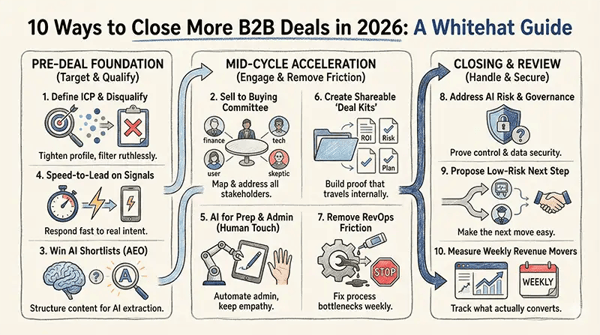
1) Align on the right lead profile (and disqualify harder)
"Close more deals" starts with a brutal truth: most pipelines are overweight with opportunities that should never have been opened. A tight ICP is a revenue lever because it improves every downstream metric — response rate, meeting quality, cycle time, and win rate. Treat qualification as a decision filter, not a polite checklist.
Practical move: define 5–7 non-negotiables (industry, trigger event, tech stack fit, budget shape, success criteria, risk constraints). Then train reps to disqualify quickly and document why. If your CRM stages don't enforce this, a HubSpot onboarding clean-up can bake qualification rules into your lifecycle so "bad fit" stops clogging the funnel.
2) Sell to the buying committee, not the loudest person in the room
Buying committees are not new — but in 2026 they're bigger, more cross-functional, and more cautious. Forrester's research highlights an average of 13 stakeholders and multi-department involvement in most B2B purchases. That means your "one perfect pitch" won't land unless it answers multiple jobs-to-be-done across the group.
Practical move: create a one-page "committee map" per deal: economic buyer, technical gatekeeper, daily users, finance/procurement, and internal skeptic. Then build stakeholder-specific proof (security, ROI, implementation plan, change management). If sales and marketing aren't aligned on who needs what, start with aligning sales and marketing teams around shared definitions and handoffs.
3) Win the "AI shortlisting" moment with AEO-ready content
In 2026, buyers don't only Google — they ask AI tools to compare vendors, summarise reviews, and propose a shortlist. Forrester notes buyers increasingly rely on self-service and autonomous interactions, and predicts widespread genAI usage in buying. If your site content isn't structured for extraction, AI will cite someone else (or worse: cite you incorrectly).
Practical move: publish "answer-first" pages (40–60 word direct answers, chunked sections, evidence, FAQ schema) and ensure your commercial pages clearly connect problems to outcomes. That's exactly what AEO is for — turning expertise into content that gets cited and recommended, not just indexed.
4) Build speed-to-lead around real buying signals
Speed matters most when it's targeted. When a buyer group is actively researching, booking demos, or revisiting pricing and case studies, you're in a narrow window where attention is available. Historic research widely cited in sales enablement shows a "first responder" advantage — but the modern version is: respond fast and respond relevantly.
Practical move: define "high intent" actions (pricing page, integration docs, proposal downloads, competitor comparisons) and route them instantly to the right owner with a clear next action. If you need to manufacture intent quickly, PPC management can capture in-market demand while you strengthen long-term organic visibility.
5) Use AI for preparation and follow-up — not for pretending to be human
AI can give reps time back, but buyers can smell "robotic personalisation" a mile off. A smarter approach is to use AI to compress admin work (research, summaries, drafting) and keep the final message human. Official HubSpot documentation shows Breeze Prospecting Agent focuses on researching qualified prospects and personalising outreach based on CRM context — useful when governed properly.
Practical move: build templates with "human checkpoints" (tone, risk, proof, and next step), then let AI draft within constraints. If you're rolling out AI and want it to improve close rates rather than create compliance headaches, use AI consultancy and implementation to set guardrails, governance, and workflows.
6) Turn proof into "decision assets" that travel inside the buyer's org
Committees don't buy because your champion loves you — they buy when the group can defend the choice. That requires assets that are easy to share: a one-page value case, a simple ROI model, a security overview, an implementation plan, and a risk reducer. Without these, deals stall while stakeholders ask the same questions repeatedly.
Practical move: build a "deal kit" library by segment (SaaS, professional services, manufacturing, etc.) so reps can assemble a credible pack in minutes. If marketing needs to support sales with better mid-funnel content, align the library to your inbound approach with inbound sales methodology principles.
7) Remove RevOps friction so deals don't stall mid-cycle
When 86% of purchases stall, your job is to identify and eliminate the "stall points": unclear next steps, missing stakeholders, legal/security gaps, procurement delays, or inconsistent information. Salesforce research has long highlighted that sellers spend a large share of time on non-selling tasks — which often means the system is stealing time from the work that actually closes deals.
Practical move: run a weekly "stalled deal review" focused on root causes (not blame), then fix the process: required fields, stage criteria, automated tasks, and clean handoffs. If your CRM is messy or reporting is unreliable, a focused HubSpot onboarding refresh can standardise lifecycle stages and improve forecast accuracy.
8) Handle the new objections: AI risk, governance, and trust
In a low-trust economy, "prove it" beats "believe us." Forrester has warned about material value leakage and risk when organisations adopt genAI without governance. Buyers now ask: Where does the data go? What's the policy? What's the risk? Who signs off? If you can't answer clearly, the deal slows down.
Practical move: create an AI governance one-pager (data handling, security posture, human review, escalation paths) and include it in your deal kit. If your offering includes AI or automation, build a credible implementation plan with AI consultancy so the buyer sees control, not chaos.
9) Make the next step unavoidable (and low-risk)
Deals die in ambiguity. If the buying group doesn't know what happens next, they default to delay — especially when they're juggling internal politics and competing priorities. Your job is to propose a next step that feels safe: a diagnostic, a scoped workshop, a pilot, or a small implementation phase with clear success criteria.
Practical move: end every interaction with a "two-option close" that respects the buyer's pace (e.g., "We can run a 2-week audit, or we can do a 60-minute stakeholder mapping session first"). For teams wanting to lift win rates quickly, our sales services can help design offers that reduce buyer risk and increase commitment.
10) Measure what actually moves revenue (weekly, not quarterly)
Most teams look at results when it's too late to act. A weekly revenue view keeps you honest and makes improvement visible: stage conversion, time-in-stage, stalled reasons, speed-to-lead for high intent, and win/loss by ICP fit. These metrics tell you where the system is breaking, not just that it broke.
Practical move: choose 5 metrics, publish them in a simple dashboard, and assign an owner for each improvement loop. If you're serious about building a growth engine that gets cited by AI and converts humans, pair AEO with a clean RevOps layer so traffic turns into pipeline.
Key data points you can use in stakeholder discussions
- 86% of B2B purchases stall during the buying process, and 81% of buyers are dissatisfied with the provider they choose (Forrester, 2024).
- The average buying decision involves 13 people and often spans multiple departments (Forrester, 2024).
- By 2025, 80% of B2B sales interactions were predicted to occur in digital channels (Gartner).
- B2B decision makers use an average of 10 interaction channels in the buying journey (McKinsey B2B Pulse Survey, 2024).
- Breeze Prospecting Agent is designed to research prospects and personalise outreach using CRM context (HubSpot documentation).
Want to Close More Deals?
Our HubSpot sales enablement services align marketing and sales teams with CRM-driven insights that shorten deal cycles and improve close rates.
Talk to Our Sales TeamFrequently Asked Questions
How can I speed up a long B2B sales cycle in 2026?
Speed up B2B sales cycles by removing friction at handoffs, arming each stakeholder with decision-ready proof (ROI, risk, implementation), and responding faster to intent signals so you engage while the buying group is still active. Focus on time-in-stage and stalled reasons weekly, not quarterly.
Is cold calling dead in 2026?
Cold calling isn't dead, but random cold calling is. The teams that win in 2026 pair outreach with a tight ICP and real intent signals so calls feel timely and relevant, not interruptive. Use AI to speed up research and prep, then keep human empathy in delivery.
How do I sell to a buying committee instead of one decision-maker?
Sell to buying committees by mapping stakeholder roles and building proof for each: ROI for finance, risk and governance for security, and implementation clarity for operations. Give your champion shareable assets (one-pagers, checklists, FAQs) that help them build consensus internally.
How does AI change B2B selling in 2026?
AI changes B2B selling by accelerating research, personalisation, and follow-up — while raising the bar for trust. Use AI to remove admin and increase speed-to-lead, then use human judgement to handle nuance, risk, and stakeholder politics. The best teams treat AI as a co-pilot, not a mask.
What is Answer Engine Optimisation (AEO) and why does it matter for sales?
AEO is structuring content so AI tools can extract, trust, and cite your answers. It matters because buyers increasingly form shortlists using AI summaries and answer engines before they ever talk to sales. AEO helps you become the option that's recommended early, not discovered late.
How do I align sales and marketing to close more deals?
Align sales and marketing by agreeing a single definition of a qualified opportunity, using shared lifecycle stages, and reviewing pipeline quality weekly. When both teams optimise for revenue outcomes (not vanity metrics), lead quality improves and deal stalls decrease.
What should I measure weekly if I want to close more deals?
Measure stage-to-stage conversion, time-in-stage, stalled-deal reasons, speed-to-lead for high-intent actions, and win/loss by ICP fit. These metrics show exactly where deals leak and which process changes create measurable revenue impact.
Ready to Grow Your Organic Pipeline?
Get a free audit and 90-day action plan from our team.
Get Your Free AuditClwyd Probert
Founder, Whitehat SEO
Clwyd Probert is the founder of Whitehat, a London-based SEO and inbound marketing agency and HubSpot Platinum Partner since 2016. He runs the largest London HubSpot User Group and advises B2B companies on connecting marketing to revenue.
Want to close more deals without adding noise to the market?
If your pipeline is stalling, your content isn't being cited, or your CRM feels like a tax — we can help. Start with AEO to win AI shortlists, or tighten your revenue system with HubSpot + sales alignment.
Talk to Whitehat about your growth plan HubSpot CRM view our pricing
References
- Forrester (2024) — The State Of Business Buying, 2024 (press release)
- Gartner (2020) — 80% of B2B sales interactions in digital channels by 2025 (press release)
- McKinsey (2024) — Five fundamental truths: How B2B winners keep growing (B2B Pulse Survey)
- Salesforce (2024) — State of Sales Report, Sixth Edition (PDF)
- HubSpot (2025) — State of Sales Report (summary page)
- HubSpot — Breeze Prospecting Agent (product page)
- HubSpot — Breeze AI (overview)