
Inbound sales • RevOps • HubSpot
How do you align sales and marketing teams for inbound sales growth?
A modern, practical playbook (inspired by Dan Tyre’s “smarketing” thinking) to turn marketing activity into sales conversations — and sales conversations into revenue.
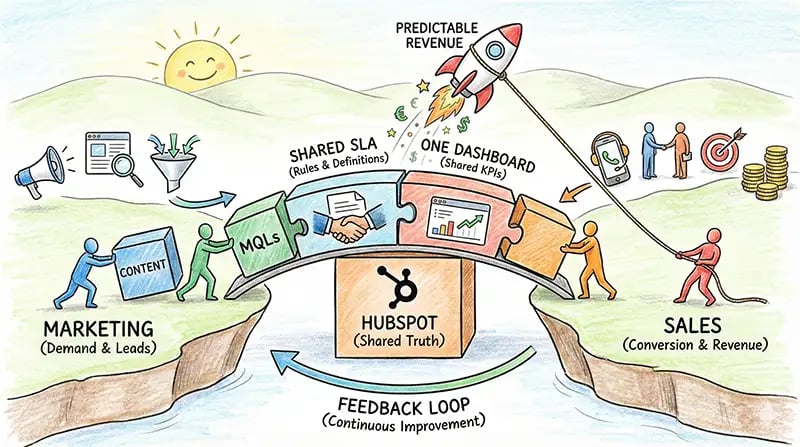
Direct answer (AEO): To align sales and marketing, agree one definition of a “good lead”, write a simple SLA (response times + acceptance criteria), track the same revenue KPIs in one CRM dashboard, and run a weekly feedback loop. When inbound content, lead routing and follow-up live in the same system, handoffs stop leaking and pipeline becomes predictable.
On this page
- Why alignment is harder (and more important) in 2025–2026
- What “alignment” actually means (in plain English)
- Inbound sales: the “help-first” engine Dan Tyre keeps banging on about
- The alignment MVP: your Sales–Marketing SLA
- Shared KPIs that stop the blame game
- How to operationalise alignment in HubSpot
- A 30-day rollout plan (you can actually stick to)
- Common mistakes (and the simple fixes)
- FAQs
- References
Key takeaways (save yourself a meeting)
- Alignment is a system (definitions, rules, data), not a motivational poster.
- Inbound sales requires speed + relevance because buyers do most research before they talk to you.
- Your SLA is the quickest win: response times, acceptance criteria, feedback loop.
- One dashboard ends most arguments. If the numbers aren’t trusted, nothing else sticks.
- HubSpot makes this easier when lifecycle stages, routing and reporting are standardised properly.
This is a full rewrite of our original piece, modernised for today’s buying behaviour and today’s tooling. The original concepts were inspired by Dan Tyre (one of HubSpot’s early leaders and a brilliant speaker) and his “smarketing” message: sales and marketing are not two teams — they’re one revenue team with different jobs.
Why alignment is harder (and more important) in 2025–2026
Buyers are self-educating harder than ever. HubSpot’s 2025 sales statistics roundup (updated 12 August 2025) highlights that 96% of prospects research companies and products before engaging a sales rep. Translation: by the time sales get involved, the prospect already has opinions — and questions — formed by content, reviews, peers, and AI summaries.
Meanwhile, the sales toolkit has exploded. HubSpot’s 2025 State of Sales (updated 29 August 2025) shows that only 8% of sales reps reported not using AI at all, and 84% said AI saves time and optimises processes. That’s great — unless marketing and sales are feeding those tools inconsistent data, inconsistent definitions, and inconsistent messaging. Then you just automate chaos.
Reality check: If marketing celebrates lead volume and sales complains about lead quality, you don’t have a people problem — you have a system design problem.
What “alignment” actually means (in plain English)
Alignment is not “sales and marketing get along”. Alignment is when:
- You share the same outcome: revenue (pipeline created, revenue won, retention).
- You agree the rules of the game: definitions for MQL/SQL (or equivalent), lifecycle stages, and what “ready for sales” looks like.
- You use one source of truth: a CRM where both teams can see what happened and why.
- You operate a feedback loop: sales disposition data flows back to marketing and changes targeting, content and nurturing.
Think of it like this: marketing builds demand and trust; sales converts demand into customers; and service protects retention and expansion. In an inbound model, these aren’t separate “departments” — they’re stages of one buyer journey.
Inbound sales: the “help-first” engine Dan Tyre keeps banging on about
The central inbound sales idea is simple: you earn attention by being useful. That means your marketing isn’t just “lead gen”; it’s education, clarity, confidence and proof. And your sales process isn’t pressure; it’s diagnosis, guidance and decision support.
HubSpot’s 2025 State of Sales points out another modern twist: 74% of sales pros believe AI is making it easier for buyers to research products. So sales doesn’t “reveal information” anymore — it helps buyers interpret information and feel confident in decisions.
Inbound sales alignment in one line: marketing and sales agree what “helpful” looks like at each stage, and they measure it the same way.
If you’re building this on HubSpot, your fastest path is usually clean foundations first: HubSpot onboarding that standardises lifecycle stages, properties, pipeline structure, and reporting — then layer in automation.
The alignment MVP: your Sales–Marketing SLA
If you do nothing else, do this: write an SLA (Service Level Agreement) between marketing and sales. Not the 40-page “nobody reads it” version — the one-page version you can enforce.
Your SLA should answer five questions:
- What is a “sales-ready” lead? (Criteria + required data fields)
- How fast will sales respond? (First-touch target + escalation rules)
- What happens next? (Follow-up cadence: tasks, sequences, calls, emails)
- When can sales reject/return a lead? (Allowed reasons, required notes)
- How will marketing improve lead quality? (Nurture, segmentation, content, targeting adjustments)
Here’s the part most teams miss: the SLA is only real if your CRM enforces it. That means response-time tracking, mandatory fields, and consistent lead disposition reasons. Otherwise it’s just vibes in a Google Doc.
Shared KPIs that stop the blame game
Most “alignment” fights are arguments about measurement. Marketing says: “Look at all these leads.” Sales says: “None of them buy.” Both might be right — because they’re looking at different slices of the same journey.
Use a shared KPI ladder (top to bottom):
- Speed-to-lead: time from conversion to first sales action (SLA compliance).
- Lead-to-meeting rate: % of inbound leads that become booked meetings.
- Meeting-to-opportunity rate: quality of meetings, not just quantity.
- Pipeline created: £ value created from inbound sources.
- Revenue won: closed-won revenue attributed to inbound (with sensible attribution rules).
- Retention/expansion signals: churn risk, renewals, upsell triggers.
Why this matters: The CMO’s ABM statistics roundup (last updated 24 April 2025) notes that 46% of businesses say they struggle with sales and marketing alignment. That struggle usually shows up as broken handoffs, untrusted data, and mismatched incentives.
How to operationalise alignment in HubSpot
HubSpot works brilliantly for alignment when you treat it like a revenue system — not just a marketing email tool. Here’s the practical checklist we use most often.
HubSpot alignment checklist
1) Standardise lifecycle stages and handoff rules
Ensure both teams use the same lifecycle logic (lead → MQL → SQL → opportunity → customer). Build rules so a “sales-ready” stage can’t happen without required fields.
2) Fix the data plumbing (before you automate)
Consistent source tracking, clean properties, and tight picklists beat “creative” free-text every day of the week. (Yes, it’s boring. Yes, it’s also where revenue leaks live.)
3) Lead routing that matches your inbound model
Route based on ICP fit, geography, product line, or account ownership. Create task queues so nothing sits idle.
4) Sales sequences that reflect buyer intent
Different intent needs different follow-up. “Demo request” is not the same as “downloaded a guide”. Build sequences around intent and objections, not generic cadence.
5) One dashboard everyone trusts
Build a shared view: speed-to-lead, conversion rates, pipeline, revenue, and lead disposition insights. If it isn’t visible, it isn’t manageable.
Need help setting this up properly? This is exactly what our sales services and inbound marketing teams are built for — aligning strategy, CRM build, and the content that supports inbound conversions.
A 30-day rollout plan (you can actually stick to)
You don’t need a re-org to get alignment. You need a short, disciplined rollout. Here’s a 30-day plan we’ve seen work repeatedly.
Week 1: Diagnose (no blame, just data)
- Map your inbound lead sources and current conversion steps.
- Pull last 90 days: lead → meeting → opportunity → revenue, plus response times.
- Create a short list of “deal killers” (missing fields, slow follow-up, wrong ICP, weak messaging).
Week 2: Define (ICP + lifecycle + criteria)
- Agree the ICP using actual win, retention, and margin data.
- Write clear lead definitions (MQL/SQL or your chosen stages) and required data fields.
- Align content to buyer questions (comparison, pricing, proof, implementation, objections).
Week 3: Implement (SLA + routing + reporting)
- Publish the one-page SLA and set enforcement rules in your CRM.
- Set up lead routing and task queues to hit SLA response times.
- Build one shared dashboard and agree the weekly review rhythm.
Week 4: Optimise (feedback loop + enablement)
- Require lead disposition reasons (e.g., no budget, wrong ICP, timing, competitor, unclear need).
- Use those reasons to adjust targeting, nurture flows and content.
- Launch/refresh sales enablement content so reps always have the next best piece of proof.
Want a clean benchmark for what “better” looks like? ZoomInfo’s February 2025 update on its Customer Impact Report claimed 91% improvement in connect rates, 55% more meetings per month, and 32% pipeline growth for teams using their platform. You don’t need ZoomInfo specifically to learn from that — the takeaway is that tight systems + clean data + consistent follow-up compound fast.
Common mistakes (and the simple fixes)
Mistake #1: “We need more leads.”
Fix: you need more of the right leads. Start with ICP and lead criteria, then optimise conversion rates before scaling volume.
Mistake #2: Sales follow-up is “best effort”.
Fix: define response times in the SLA and automate enforcement (routing, alerts, task queues). Inbound punishes delay.
Mistake #3: Reporting is optional (or “owned by marketing”).
Fix: make reporting shared infrastructure. If sales don’t trust the dashboard, alignment collapses.
Mistake #4: You try to align without content that answers buyer questions.
Fix: build content for decision-stage questions (pricing, comparison, proof, implementation). If it’s not written down, sales repeats it all day. (And prospects ask AI instead.)
If you want a practical way to blend approaches without confusing the buyer journey, this is useful: 3 ways to combine inbound marketing with outbound marketing. (Yes, you can do both — but you still need one set of definitions and one set of numbers.)
And if you’re thinking about predictable growth over time, align your teams around a flywheel mindset: how a sales flywheel can grow your business predictably.
Frequently Asked Questions
What does ‘sales and marketing alignment’ actually mean?
It means shared revenue goals, shared definitions, a written SLA, and shared reporting. If you can’t point to one dashboard and agree what’s true, you’re not aligned.
What is a sales–marketing SLA and what should it include?
Lead criteria, response times, acceptance rules, follow-up cadence, and feedback requirements (including reason codes when leads are rejected or recycled).
How do we define MQL and SQL for inbound?
Define them based on ICP fit + intent signals + required context (need, timeline, use case). “Downloaded an ebook” alone is rarely sales-ready. Match the definition to your sales motion.
What KPIs should sales and marketing share?
Speed-to-lead, lead-to-meeting, meeting-to-opportunity, pipeline created, revenue won, and a small set of quality signals (e.g., reasons leads are rejected, win rates by source, churn risk).
How do we align sales and marketing in HubSpot?
Standardise lifecycle stages and properties, enforce required fields, implement routing + task queues, build intent-based sequences, and report everything through one shared dashboard. If needed, start with structured HubSpot onboarding so the foundations are clean.
How long does alignment take?
You can stabilise definitions, dashboards and SLAs in ~30 days, but alignment is ongoing. The weekly review loop is what keeps it from drifting back into silos.
Want this built properly (without the CRM spaghetti)?
If you want a joined-up inbound engine — HubSpot setup, lifecycle design, lead routing, reporting, and the content that supports sales — we can help you implement it end-to-end.
Talk to WhitehatReferences (verified live)
Sources used for key claims and statistics in this article:
| Source | URL | Publication / Update | Claim supported | Status |
|---|---|---|---|---|
| HubSpot Blog | https://blog.hubspot.com/sales/sales-statistics | Updated: 12 Aug 2025 | 96% of prospects research before engaging sales (and related sales benchmarks). | Verified live |
| HubSpot Blog (State of Sales) | https://blog.hubspot.com/sales/hubspot-sales-strategy-report | Updated: 29 Aug 2025 | AI adoption stats and buyer research impact (e.g., only 8% not using AI; 74% say AI helps buyers research). | Verified live |
| ZoomInfo via Business Wire (press release) | https://markets.financialcontent.com/.../zoominfo-announces... | 25 Feb 2025 | Customer Impact Report figures (connect rates, meetings, pipeline growth). | Verified live |
| The CMO | https://thecmo.com/demand-generation/abm-statistics/ | Last updated: 24 Apr 2025 | Alignment challenge prevalence (e.g., 46% struggle with alignment) and alignment-related ABM stats. | Verified live |
| HubSpot Marketing Statistics | https://www.hubspot.com/marketing-statistics | Referenced reports include 2025 updates | B2B ROI channel trends (website/blog/SEO, paid social, etc.) and modern marketing benchmarks. | Verified live |
| Dan Tyre (HubSpot profile) | https://www.hubspot.com/dantyre | Live profile | Background on Dan Tyre and the “smarketing” concept that inspired the alignment approach. | Verified live |
Note: Statistics are sourced from the references above. If you’d like, we can tailor the SLA and KPI ladder to your specific sales motion (SMB vs mid-market vs enterprise) and your HubSpot portal structure. HubSpot CRM view our pricing