
Inbound sales methodology is a buyer-led approach where sales teams use personalised, helpful conversations to guide prospects through their own journey — responding to buying signals rather than cold-pitching. The model has evolved from HubSpot's 2018 flywheel to The Loop, an AI-era framework (Express, Tailor, Amplify, Evolve) built for a world where most buyers research independently before they ever speak to a rep. Done well, inbound sales turns interest into trust and trust into a compounding pipeline.
The bar has moved. Gartner's B2B research is blunt: 61% of B2B buyers now complete their purchase journey before contacting a vendor, and buyers spend only ~17% of their time meeting suppliers. Your content and brand do the early heavy lifting; sales earns its seat by adding insight a blog post can't. This guide covers what inbound sales is, how it differs from outbound, the four-stage conversation framework, how the flywheel became The Loop, why sales–marketing alignment decides the outcome, and how to implement it without upending your quarter.
Key Takeaways
• Most B2B buyers (61%) finish researching before contacting sales — inbound visibility decides whether you make the shortlist.
• Inbound sales runs on four buyer-led stages: Identify, Connect, Explore, Advise — match the conversation to the buyer's stage, not your script.
• HubSpot's model has evolved flywheel → The Loop (Express, Tailor, Amplify, Evolve) for the AI era.
• Sales–marketing alignment is the multiplier: aligned teams generate ~208% more marketing revenue, yet only ~8% achieve it.
61%
Buy before contacting sales
of B2B buyers complete their journey first (6sense / Gartner)
208%
More marketing revenue
when sales & marketing are aligned (Marketo)
94%
Use AI to research
of B2B buyers now use AI assistants when evaluating vendors
What is the inbound sales methodology?
Inbound sales is the sales side of inbound thinking: the customer's needs come first, and the salesperson behaves like a consultant rather than a closer. Your team uses real signals — pricing-page visits, downloads, repeat emails, demo requests — to understand genuine intent, then reaches out with context: not "just checking in," but "I saw you're exploring X; here's what tends to trip teams up." That small shift in wording turns a sales interaction from interruption into assistance.
Inbound vs outbound sales: what's changed?
Outbound assumes you can manufacture demand by pushing a message into someone's day. Inbound assumes demand already exists and your job is to help buyers decide with confidence. You can still do outbound — but if it doesn't feel inbound (personalised, relevant, timely), it's noise. In the UK there's an added incentive: leaning on permission-based engagement keeps your go-to-market cleaner against PECR and UK GDPR expectations.
| Topic | Outbound | Inbound |
|---|---|---|
| Start | Cold list | Buying signals |
| Message | Generic pitch | Useful context |
| Goal | Book a call | Move the buyer forward |
| Buyer feel | Interrupted | Supported |
The four stages of inbound sales: Identify, Connect, Explore, Advise
The methodology maps to the buyer's journey in four stages. If you teach your team one thing, make it this: recognise which stage the buyer is in and match the conversation to it.
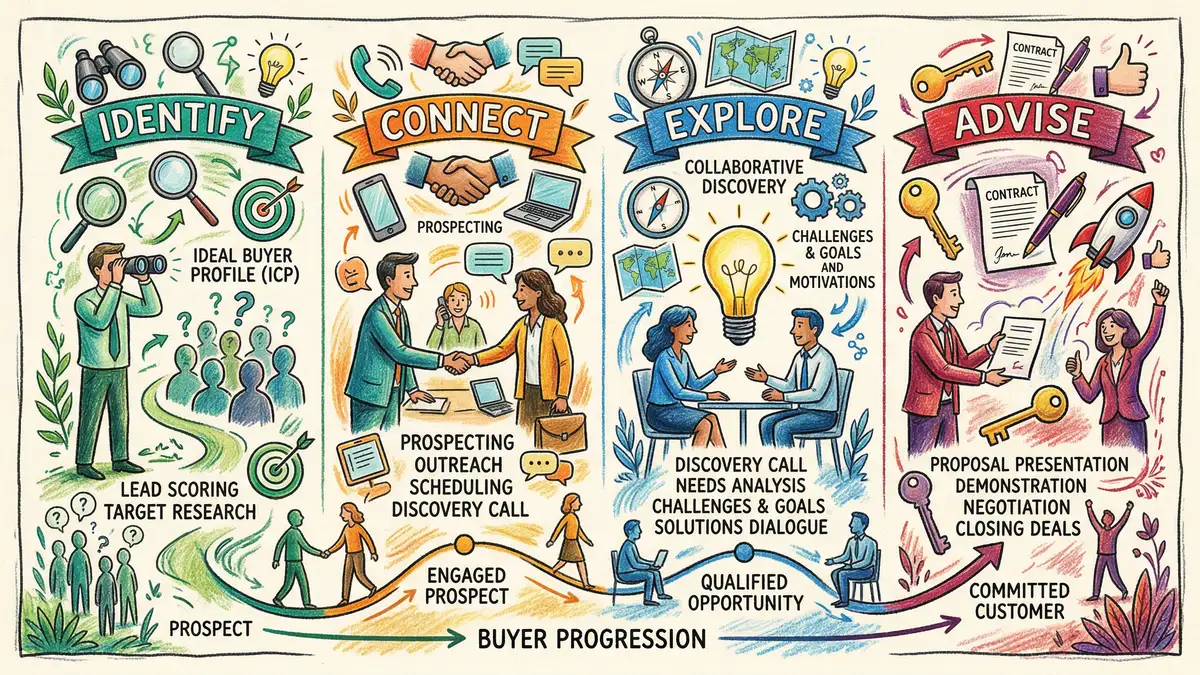
1. Identify — spot intent from behaviour (content views, repeat visits, demo requests) and prioritise the right people using lifecycle stages and lead scoring. 2. Connect — open with relevance: reference what they engaged with and offer a next step that helps them learn faster. 3. Explore — diagnose goals, blockers and decision criteria; this is where trust is won or lost. 4. Advise — recommend a path forward, even if that's "not yet." Confidence beats pressure. The buyer's questions decide the stage — your script doesn't.
From the flywheel to The Loop: how the model evolved
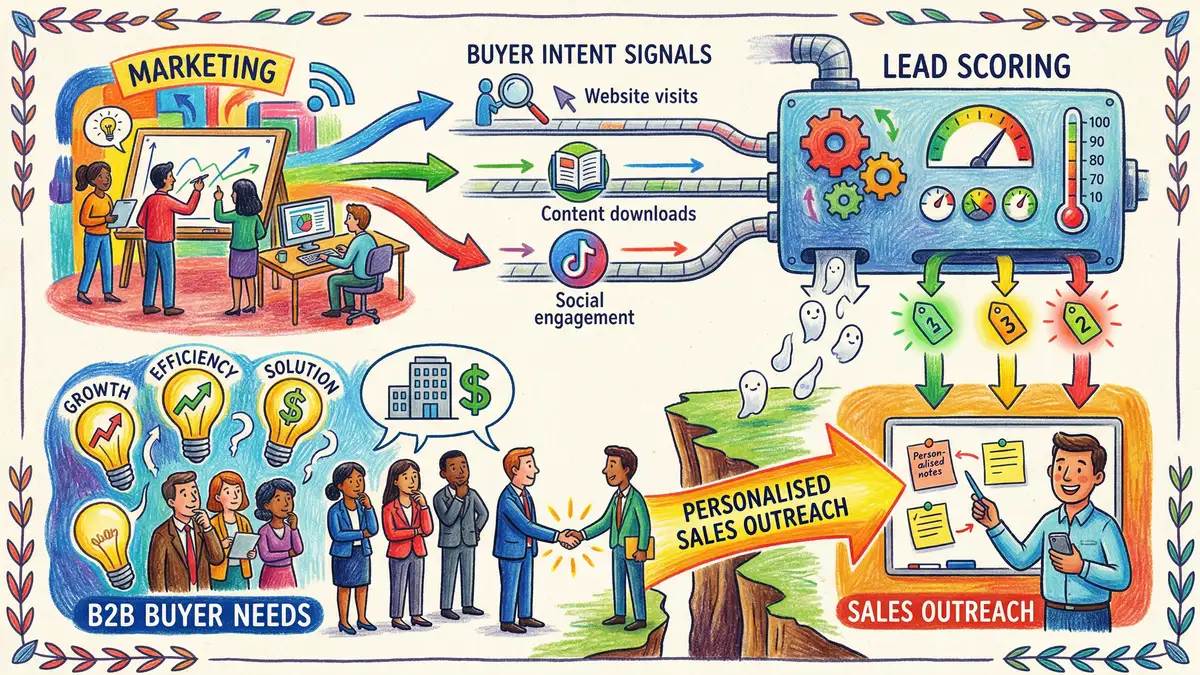
HubSpot introduced the flywheel at INBOUND 2018 to replace the funnel: instead of customers falling out of the bottom as outputs, delighted customers become the engine of new business through three stages — Attract, Engage, Delight. Its power comes from adding speed (marketing, sales and service effort) and removing friction. As co-founder Brian Halligan put it, "customers are your best channel to market."
At INBOUND 2025, HubSpot unveiled The Loop — the same customer-centric principles adapted for the AI era, where buyers research with ChatGPT, get answers in AI Overviews, and discover solutions across fragmented channels. It runs as four continuous stages:
| Stage | Focus | Key activities |
|---|---|---|
| Express | Define brand identity & voice | AI-ready style guides, documented ICP, differentiated positioning |
| Tailor | Personalise at scale | Use unified CRM data for contextual messages and AI personalisation |
| Amplify | Distribute across channels | Optimise for AI search (AEO), multi-channel distribution, creator partnerships |
| Evolve | Iterate in real time | Monitor live performance, run rapid experiments, refine continuously |
The Loop doesn't discard inbound — it threads AI through every stage. The practical takeaway for sales: if buyers complete most of their journey in AI-assisted research, your job is to be findable and citable there, then genuinely useful in the conversations that follow.
Why sales–marketing alignment decides the outcome
Neither the flywheel nor The Loop functions without alignment — yet only about 8% of companies achieve it. The payoff is large: aligned teams see roughly 208% more marketing-generated revenue, 38% higher win rates and 36% better retention. Misalignment is just as costly — most B2B content goes unused because sales never finds it. Alignment starts with shared definitions: what is an MQL, when does it become an SQL, and what response time is acceptable — documented in a simple SLA. See our guide to aligning sales and marketing teams.
How the B2B buyer journey changed in 2026
Modern buying would be unrecognisable to a sales team from a decade ago: 95% of deals are won by vendors already on the buyer's "Day One" shortlist, 81% of buyers have a preferred vendor before first contact, around 13 stakeholders and 27 touchpoints feature in a typical decision, and most B2B purchases take four months or longer. Add that 94% of buyers now use AI assistants during research, and the message is clear — your content, brand visibility and digital presence determine whether you make the shortlist long before a rep is involved. (For the demand-side playbook, see our B2B sales tips.)
How to implement inbound sales (a practical playbook)
Inbound sales fails when it's treated as "nicer words on cold calls." It succeeds when you connect intent → insight → next step:
1. Map the buyer journey simply. List the top 10 questions prospects ask before buying; group them into Awareness, Consideration and Decision; make every conversation answer the next question in sequence. 2. Instrument intent signals. Decide what counts as intent (pricing visits, compare-page views, repeat webinars) and feed it into a CRM with clear lifecycle stages and lead scoring. 3. Rebuild outreach as helpful follow-up. A small library of messages that reference behaviour and offer one useful next step — a checklist, benchmark, or 15-minute fit call. 4. Align weekly. Agree what "qualified" means, set a follow-up SLA, and review which content creates good conversations. Our HubSpot services typically reach measurable pipeline impact in 45–60 days with this structure.
The mistake that stalls most rollouts
Buying the tools before agreeing the definitions. A CRM, sequences and AI personalisation only work once sales and marketing share one ICP, one set of lifecycle stages, and one SLA. Start with clean data foundations and shared definitions — not tactics.
Want a buyer-led sales engine that actually aligns?
We help UK B2B teams implement inbound sales and HubSpot's Loop framework — shared definitions, clean CRM, and content that gets found in AI search.
Book a Free ConsultationFrequently asked questions
What are the four stages of the inbound sales methodology?
Identify, Connect, Explore and Advise. You prioritise leads showing intent, start a relevant conversation, diagnose what matters to them, and recommend the best next step — guiding buyers forward with personalised advice rather than pressure.
What is the difference between the flywheel and The Loop?
The flywheel (Attract, Engage, Delight) focuses on customer momentum and referrals. The Loop (Express, Tailor, Amplify, Evolve) adapts those principles for the AI era — explicitly building AI into personalisation, multi-channel distribution including AI-search optimisation, and real-time iteration. Both are customer-centric; The Loop adds AI-powered execution.
How is inbound sales different from outbound sales?
Inbound is triggered by buyer intent and built around the buyer's journey with context and relevance; outbound relies on interruptions like cold calls and generic pitches. With most buyers preferring self-service and avoiding irrelevant outreach, inbound earns engagement by adding insight when buyers want it.
Does inbound sales work in the UK as well as the US?
Yes — the shift to digital-first buying is global. In the UK, inbound also reduces reliance on unsolicited outreach, supporting PECR and UK GDPR expectations when processing personal data for direct marketing.
How does sales–marketing alignment impact revenue?
Aligned teams achieve around 208% more marketing-generated revenue, 38% higher win rates and 36% better retention — yet only ~8% reach true alignment. It requires shared MQL/SQL definitions, a documented SLA, unified reporting and regular feedback loops.
What is AEO and why does it matter for inbound sales?
Answer Engine Optimisation makes your content discoverable and citable by AI assistants (ChatGPT, Claude, Perplexity, Google AI Overviews). With 94% of B2B buyers using AI in research and most searches ending without a click, AEO keeps you visible during the independent research phase that now precedes most sales conversations.
Ready to build a modern inbound sales engine?
Get a free audit and a 90-day plan covering CRM setup, sales–marketing alignment, and AI-search visibility.
Get Your Free AuditAbout the author
Clwyd Probert is founder of Whitehat SEO and a HubSpot Diamond Partner, and runs the London HubSpot User Group. He helps UK and US B2B companies build revenue-ready sales and marketing systems that attract, convert and retain customers at scale. Updated June 2026 with HubSpot's INBOUND 2025 "Loop" framework and current B2B buyer data.
Sources: HubSpot — inbound sales & The Loop; Gartner B2B buying research; 6sense Buyer Experience Report; McKinsey B2B Pulse; ICO — PECR & direct marketing. Figures reflect 2025–2026 data. Last updated June 2026.