
Published: 10 November 2019 | Updated: 14 January 2026
Sales Flywheel for Predictable Business Growth: The Complete B2B Guide
The sales flywheel is a customer-centric growth model that replaces the traditional sales funnel, using momentum from satisfied customers to drive predictable revenue growth. Companies with strongly aligned sales-marketing flywheels achieve 208% higher marketing revenue, according to LinkedIn and Marketo research. This guide covers implementation frameworks validated by six years of B2B evidence.
From Funnel to Flywheel: Why Customer Momentum Matters More Than Ever
The traditional sales funnel treats customers as an output—once they've converted, they're forgotten whilst teams chase new prospects. The flywheel model inverts this logic entirely, recognising that delighted customers become your most powerful growth engine. Bain & Company research demonstrates that a 5% increase in customer retention increases profits by 25-95%, yet most B2B organisations still invest disproportionately in acquisition.
HubSpot introduced the flywheel concept at INBOUND 2018, and the evidence since then has been compelling. At Whitehat's London HubSpot User Group—the world's largest—we've observed hundreds of B2B companies transition from funnel-based to flywheel-based thinking. The organisations that succeed share a common trait: they measure customer success with the same rigour they apply to lead generation.
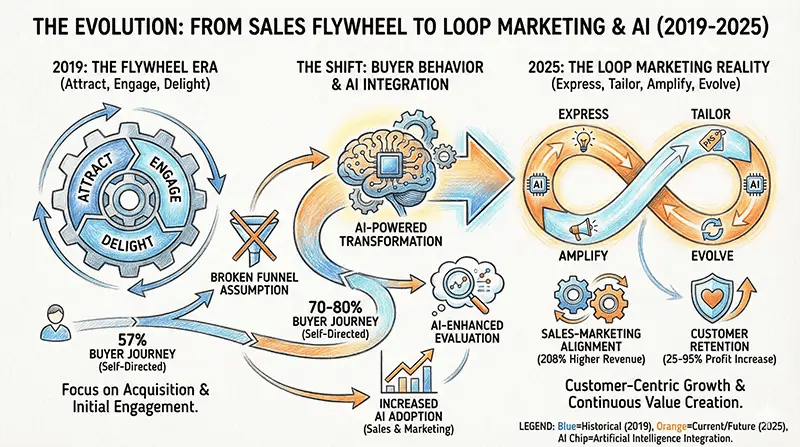
The flywheel's three stages—Attract, Engage, and Delight—create a continuous loop where force (investment in marketing, sales, and service) accelerates growth, whilst friction (poor handoffs, misaligned teams, customer frustration) slows it. McKinsey's 2024 analysis found that top-quartile retention companies achieve 24x enterprise-value-to-revenue multiples compared to 5x for bottom performers.
The B2B Buyer Journey Has Fundamentally Changed
In 2019, the widely-cited statistic suggested B2B buyers completed 57% of their journey before engaging a vendor. That figure has increased substantially. 6sense's 2024 Buyer Experience Report, surveying over 900 B2B buyers, found that modern buyers don't engage sellers until they're 70% through their purchasing journey. Even more striking: 81% have already chosen a preferred vendor before making first contact.
This shift has profound implications for how B2B marketing services must operate. Gartner's research shows buyers spend only 17% of their total purchasing time meeting with potential vendors—meaning 83% is self-directed research. The flywheel addresses this by ensuring your content, reputation, and customer advocacy work continuously, reaching buyers during the 83% when you're not in the room.
Interestingly, 6sense's 2025 data shows a slight reversal: the point of first contact shifted from 69% to 61%, attributed to AI evaluation complexity prompting earlier vendor engagement. UK and Ireland buyers specifically engage vendors at 57% completion—slightly earlier than the global average—suggesting the UK market remains marginally more receptive to proactive vendor relationships.
Speed to Lead: The Five-Minute Rule That Transforms Conversion
The MIT and Kellogg School of Management Lead Response Management Study remains one of the most replicated findings in B2B sales. Analysing over 15,000 leads, researchers found that responding within five minutes makes you 100 times more likely to make contact and 21 times more likely to qualify the lead compared to responding after 30 minutes. Velocify's 2024 data strengthens this further: responding within one minute increases conversions by 391%.
Yet the average B2B lead response time remains a troubling 42-47 hours according to Chili Piper and Kixie research from 2024-2025. This represents a massive competitive advantage for organisations with proper HubSpot onboarding and automation in place. Drift research confirms the commercial impact: 78% of buyers purchase from the first company that responds.
The flywheel philosophy extends this beyond mere response time. When your customers actively advocate for your business—through referrals, reviews, and case studies—prospects arrive pre-warmed. According to ReferralRock's 2025 data, 84% of B2B decision-makers start the buying process with a referral, and 91% of B2B buyers are influenced by word-of-mouth when making purchasing decisions.
Sales-Marketing Alignment Drives 208% Revenue Growth
The flywheel cannot spin efficiently when sales and marketing operate as separate silos. LinkedIn and Marketo research demonstrates that strongly aligned organisations achieve 208% higher marketing revenue. Aberdeen data confirms aligned companies grow 24% faster in three-year revenue and 27% faster in profit. Yet HubSpot's 2024 State of Marketing report found only 8% of companies have strong sales-marketing alignment.
The cost of misalignment is substantial: IDC estimates companies lose more than 10% of revenue annually due to poor sales-marketing coordination. A critical friction point occurs during lead handoff. Only 27% of leads ever get contacted at all, according to Kixie and SPOTIO's 2024 research. More concerning still, 48% of salespeople never make a single follow-up attempt after initial contact—yet 80% of sales require five or more follow-ups to close.
At Whitehat, we've seen these patterns repeatedly across our client base. The solution isn't simply better technology—it's establishing shared KPIs, common definitions of qualified leads, and unified reporting that connects marketing activity to revenue outcomes. Companies with mature lead management processes have sales teams following up on more than 75% of marketing-generated leads.
The Five Growth Levers That Create Disproportionate Results
Effective flywheel implementation requires understanding which variables actually drive revenue. The five fundamental levers are: active leads (people who've expressed interest), win rate (percentage of opportunities that close), average deal value (revenue per customer), repeat business (customer expansion and renewal), and profit margin (efficiency of delivery).
What makes this framework powerful is the compounding effect. If you improve each lever by just 20%, customers increase by 44%, revenue by 207%, and net profit by 248%. This mathematical reality explains why incremental improvements in retention dramatically outperform acquisition investments. SaaS Capital research confirms that for every 1% increase in revenue retention, company value increases by 12% after five years.
Win rates vary significantly by methodology and company maturity. HubSpot's 2024 data shows a 21% average across B2B, whilst RAIN Group's survey of 472 sellers found top performers achieving 47%. Winning by Design reports 17-20% for enterprise deals exceeding £100,000 ACV. Understanding your current baseline is essential before implementing improvement programmes.
Net Revenue Retention: The Metric That Separates Winners from Survivors
Net Revenue Retention (NRR) has emerged as the single most important metric for flywheel-driven businesses. NRR measures how much revenue you retain and expand from existing customers, accounting for churn, downgrades, and upsells. ChartMogul's 2024-2025 benchmarks show median B2B SaaS NRR at 101-106%, with top-quartile performers exceeding 120%.
The financial implications are dramatic. McKinsey's 2024 analysis found that companies with 113%+ NRR (top quartile) trade at 24 times enterprise-value-to-revenue multiples—nearly five times higher than bottom-quartile performers. Companies maintaining 100%+ NRR grow at 48% year-over-year, twice the rate of lower-retention companies.
For UK B2B companies implementing flywheel strategies, NRR provides a clear north star metric that connects customer success activities to board-level outcomes. A well-implemented HubSpot setup—with proper deal stages, renewal tracking, and expansion revenue attribution—makes NRR measurement straightforward and actionable.
AI Has Accelerated Flywheel Implementation
Since 2019, artificial intelligence has transformed what's possible in sales and marketing operations. HubSpot data shows AI adoption in sales nearly doubled from 24% in 2023 to 43% in 2024. Salesforce's State of Sales 2024 report, surveying 5,500 professionals across 27 countries, found that 83% of teams using AI saw revenue growth compared to 66% without AI tools.
HubSpot's Breeze AI, launched at INBOUND 2024, exemplifies how AI enhances flywheel mechanics. The platform includes Breeze Copilot (chat-based assistant), four specialised AI Agents for content, social media, prospecting, and customer service, plus Breeze Intelligence drawing from over 200 million buyer profiles. Early adopters report 95% satisfaction rates, with case studies showing 750 hours per week saved and 20% improvements in deal velocity.
However, an important counter-trend is emerging. Gartner predicts that by 2030, 75% of B2B buyers will prefer sales experiences prioritising human interaction over AI. The flywheel's emphasis on genuine customer relationships remains essential—AI should accelerate and enhance human connections, not replace them. Whitehat's approach integrates AI capabilities whilst maintaining the human expertise that builds lasting client partnerships.
HubSpot's Evolution: From Flywheel to Loop Marketing
HubSpot has continued evolving the flywheel concept since 2019. At INBOUND 2025, the company introduced "Loop Marketing"—a four-stage AI-powered framework comprising Express (define brand identity), Tailor (personalise at scale), Amplify (diversify across channels), and Evolve (iterate using AI insights).
This evolution responds to significant shifts in buyer behaviour. SparkToro's 2024 Zero Click Search Study found that 60% of Google searches now end without a click, fundamentally disrupting traditional inbound assumptions. As HubSpot CMO Kipp Bodnar stated: "The old funnel assumed customers would come to you... that playbook is broken."
The flywheel's core principles—reducing friction, applying force through customer success, and creating momentum through advocacy—remain central to Loop Marketing. What's changed is the recognition that AI enables personalisation and channel diversification at scales previously impossible. For B2B companies working with HubSpot Diamond Partners like Whitehat, this evolution creates opportunities for competitive advantage through early adoption and strategic implementation.
Practical Flywheel Implementation for UK B2B Companies
Implementing a flywheel strategy requires systematic attention to four areas: CRM structure, sales process, sales-marketing alignment, and ongoing coaching. Attempting multiple areas simultaneously typically fails—focus on one area at a time, establish it properly, then move to the next.
CRM structure provides the foundation. Your HubSpot implementation should capture the complete customer journey, from first touchpoint through renewal and expansion. Deal stages must reflect your actual sales process, lifecycle stages should trigger appropriate automation, and reporting should connect marketing activities to revenue outcomes. UK B2B digital channel revenue share reached 46% in 2023 and is projected to hit 56% by 2025, making proper digital infrastructure essential.
Sales process standardisation follows CRM structure. Document each stage of your sales motion, define qualification criteria, and establish handoff protocols between marketing and sales. According to ZoomInfo and Marketo research, companies with mature processes have sales teams following up on more than 75% of marketing-generated leads—compared to the 27% average across all companies.
Alignment workshops bring sales and marketing together around shared definitions and goals. This includes agreeing on what constitutes a Marketing Qualified Lead (MQL), establishing SLA response times, and creating shared dashboards that both teams trust. The London HubSpot User Group has featured numerous case studies from companies that achieved breakthrough results after resolving these alignment issues.
What the Research Gets Wrong About Salespeople
The perception of salespeople remains problematic. Gallup's December 2024 Honesty and Ethics Poll found only 8% rate car salespeople highly for honesty—tied near bottom with Congress and lobbyists. HubSpot's earlier research suggested just 3% of people consider salespeople trustworthy. This perception gap represents both a challenge and an opportunity for flywheel-oriented organisations.
The flywheel reframes sales from "convincing people to buy" to "helping people succeed." Modern inbound salespeople research prospects thoroughly, ask diagnostic questions, and recommend solutions—including recommending competitors when they're genuinely a better fit. This consultative approach builds trust that compounds through referrals.
Interestingly, research consistently shows women outperform men in modern sales environments. Gong Labs' AI-validated research found 86% of women hit quota versus 78% of men. Xactly's 2020-2023 study of over 37,000 salespeople found women were 1.5% better at selling, rising to 3% better in managerial roles. Chorus.ai analysis showed women achieve 33% average win rates compared to 24% for men—a difference attributed to superior listening skills.
Key Flywheel Statistics for 2026
208% — Higher marketing revenue for aligned organisations (LinkedIn/Marketo)
70% — Buyer journey completed before engaging vendors (6sense 2024)
100x — More likely to make contact when responding within 5 minutes (MIT/Kellogg)
25-95% — Profit increase from 5% retention improvement (Bain & Company)
84% — B2B decisions that start with a referral (ReferralRock 2025)
120%+ — NRR benchmark for top-quartile performers (ChartMogul)
43% — Sales teams now using AI, up from 24% in 2023 (HubSpot 2024)
Frequently Asked Questions
What is a sales flywheel?
A sales flywheel is a business growth model where customer momentum—rather than linear lead generation—drives revenue. Unlike the traditional funnel where customers "fall out" after purchase, the flywheel treats satisfied customers as force that accelerates growth through referrals, reviews, and repeat business. Companies using flywheel strategies achieve 208% higher marketing revenue.
How does the flywheel differ from a sales funnel?
The funnel treats customers as outputs—once converted, they're forgotten. The flywheel treats customers as force—their success creates momentum that attracts new prospects. Practically, this means investing in customer success with the same rigour as lead generation, and measuring retention metrics like NRR alongside acquisition metrics.
How long does flywheel implementation take?
Full flywheel implementation typically requires 6-12 months for mid-sized B2B companies. This includes CRM configuration (2-8 weeks), sales process standardisation (4-8 weeks), sales-marketing alignment workshops (ongoing), and culture shift across departments. Starting with one area and building sequentially produces better results than attempting everything simultaneously.
What metrics indicate a healthy flywheel?
Net Revenue Retention (NRR) is the primary flywheel health metric—top performers achieve 120%+, meaning existing customers generate more revenue over time. Supporting metrics include customer satisfaction scores, referral rates, lead response times under 5 minutes, and sales-marketing lead follow-up rates above 75%.
Does the flywheel work for all B2B business models?
The flywheel works best for B2B companies with recurring revenue, relationship-based sales, and meaningful customer lifetime value. Transactional businesses with short sales cycles and low repeat purchase rates may find traditional funnel approaches more appropriate. However, most B2B companies—including professional services, SaaS, and manufacturing—benefit significantly from flywheel strategies.
Sources and References
- HubSpot — The Flywheel Model
- Bain & Company — Retaining Customers is the Real Challenge
- McKinsey — The Net Revenue Retention Advantage
- Harvard Business Review — The Value of Keeping the Right Customers
- HubSpot — 97 Key Sales Statistics for 2025
- ReferralRock — 61 B2B Referral Statistics 2025
- Salesforce — State of Sales AI Statistics 2024
- ChartMogul — SaaS Retention Report: The New Normal
- Gallup — Americans' Ratings of Professions (December 2024)
- RAIN Group — Average Sales Win Rates
Ready to Build Your Sales Flywheel?
Whitehat is a HubSpot Diamond Solutions Partner helping UK B2B companies implement flywheel strategies that connect marketing to revenue. Book a free 30-minute discovery call to discuss your goals. HubSpot CRM view our pricing
Book Your Discovery Call