
Agentic AI & RevOps
Key Takeaway
Claude Cowork is Anthropic's agentic tool for desktop file operations, letting AI read, edit, and create files in approved folders. It's invaluable for RevOps data cleanup and content ops, but introduces prompt injection and accidental deletion risks you must architect around with quarantine folders, human approval gates, and separate read/write areas.
What does "agentic AI" actually mean for B2B operations?
Cowork represents a fundamental shift in how AI tools work: from answering questions to doing work. In a traditional Claude chat, you provide text and get a response. In Cowork, you grant Claude access to a specific folder, set an outcome ("clean this CSV," "turn these notes into a report"), and it plans and executes steps—creating files, updating documents, and iterating until done. Anthropic calls this "Claude Code for the rest of your work," built on agentic architecture designed for non-developers.
The upside is obvious: less copy/paste, fewer manual data transforms, and fewer "where did I save that?" moments. The downside is equally obvious: a tool that can change files can also change the wrong file. So the job isn't adoption—it's safe adoption.

Why is data hygiene the killer use case for RevOps?
Most B2B teams don't have a "lead generation problem"—they have a "data is a landfill" problem: duplicates, inconsistent job titles, malformed phone numbers, missing company domains. Then everyone argues about attribution instead of fixing the pipeline. Bad data is expensive at an economy level: IBM's widely cited estimate puts it at roughly $3.1 trillion annually in the US, and B2B contact data decays fast—Gartner research shows rates around 70% per year in some sectors.
Cowork shines here because it can reason about messy inputs and perform bulk transforms without you writing scripts. The typical workflow is straightforward:
Export from HubSpot to a Cowork folder
Create a dedicated workspace folder with your CSV or list export. Keep it isolated from your main workflow.
Ask Cowork to standardise and flag issues
Standardise fields (job titles, countries, phone formats), identify duplicates, and output an import-ready CSV with transformation logs.
Spot-check and test import
Verify 20-30 rows manually, then import into a HubSpot test portal before touching production.
Deploy to production with audit trail
Once validated, archive the transformation logs and import into production. You now have a repeatable, documented process.
If you want this baked into a repeatable RevOps system—not a one-off hero moment—our HubSpot Onboarding and AI Consultancy services are where we usually start.
What is indirect prompt injection and why does it matter?
The biggest new risk with agentic tools isn't that they "get the answer wrong"—it's that they can be tricked into doing the wrong thing. Indirect prompt injection occurs when malicious instructions are hidden inside content the agent processes (a document, webpage, even a line in a CSV), causing the agent to follow the attacker's instructions instead of yours.
Security teams are treating this as a real, practical threat for RAG and agent systems. Microsoft's official security guidance explicitly calls it out as something to engineer against. The simple rule: treat every file you didn't create as untrusted input, the same way you treat unknown email attachments.
The Cost of Getting It Wrong
Common mistake: Asking Cowork to "grab this data from a shared folder and clean it up" without quarantining the inputs or verifying the source.
The reality: A malicious CSV with embedded instructions could trick Cowork into exfiltrating data, deleting files, or modifying CRM records in unintended ways. Your agent becomes an attack vector.
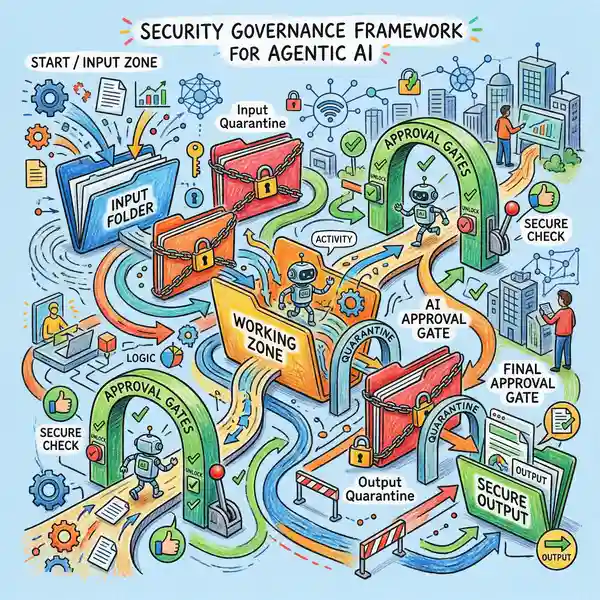
Three non-negotiable safeguards:
- Work in a quarantine folder with least-privilege access and no write permissions outside it.
- Separate "read" and "write" areas (input folders vs. output folders) so Cowork can't accidentally overwrite sources.
- Require human review before any delete/move/overwrite actions on important files or CRM records.
Secure agent workflows start with proper governance and architecture.
Explore AI Governance ServicesHow do you implement Cowork safely without causing chaos?
Most teams should start at "assisted" maturity, not full autonomy: Cowork does the heavy lifting, but humans approve important actions. The practical roadmap is straightforward.
Step 1: Design the workspace structure. Create a standard folder layout: Input, Working, and Output. Input is read-only; Working is Cowork's sandbox; Output is where approved results live.
Step 2: Write a one-page Cowork policy. Define: which data types are allowed (marketing copy, public docs, anonymised lists), which are restricted (contracts, customer PII, financial records), and what must be reviewed before import (anything that modifies your CRM).
Step 3: Build 3-5 repeatable recipes. Start with use cases your team uses weekly: clean a HubSpot import, generate a QBR deck from notes, summarise support tickets into themes, compile competitive intel from approved sources. Document the workflow, expected inputs, and validation steps. McKinsey's work on agentic AI pushes the same idea: you don't bolt agents onto messy workflows—you redesign the workflow first.
Step 4: Start small and measure. Pilot one recipe with one team. Track time saved, error rates, and feedback. Once it's stable, roll it out to other teams with training.
How does Claude Cowork compare to Microsoft Copilot and OpenAI Operator?
Buyers inevitably ask "why not just use Copilot?"—and that's fair. The key difference is where the work lives. Here's how they stack up:
| Tool | Strength | Best For | Limitation |
|---|---|---|---|
| Claude Cowork | Desktop folder operations: PDFs, CSVs, screenshots | RevOps data cleanup, local file batching | macOS only (research preview); no enterprise audit trail yet |
| Microsoft Copilot | Integrated into Word, Excel, Teams, Outlook; enterprise controls | M365 workflows; enterprises needing compliance and role-based access | Strongest inside M365; requires Copilot Pro or enterprise license |
| OpenAI Operator | Browser automation and web task completion | Filling forms, navigating web apps, web-based workflows | Limited to browser tasks; still in research/limited access phase |
Sources: Anthropic Cowork launch (Jan 2026), Microsoft Copilot feature matrix (2026), OpenAI Operator documentation (2026)
Your decision should be driven by three factors: (1) your primary workspace (desktop files, M365, or web), (2) compliance constraints (do you need audit trails and role-based permissions today?), and (3) comfort with actuation (how much autonomy are you willing to give the model?).
If you need audit trails and role-based permissions today, you'll still want central workflows in HubSpot or your data platform—even if Cowork accelerates the prep work upstream.
What does this mean for search and AI answer engines?
Agentic tools don't consume content like humans. They skim for direct answers, structured data, and clear definitions—then synthesise. That's why Answer Engine Optimisation (AEO) is becoming a commercial priority: you're no longer just competing for clicks, you're competing to be the cited "ground truth."
Practically, that means:
- Answer the question in the first 40-60 words.
- Keep sections tight and scannable; use clear headings.
- Add FAQ blocks to cover query variations and long-tail intent.
- Implement schema markup (Article + FAQPage) so agents can extract meaning fast.
If your site blocks AI search crawlers or relies on JavaScript rendering for key content, you're making yourself invisible to the systems buyers increasingly use to research.
72%
of knowledge workers
now use AI tools for research
3x
more traffic from AI
if you rank position 1-3
89%
of cited sources
appear in AI generated content
Sources: McKinsey AI adoption survey (Q4 2025), Semrush AI overview research (2026), SEMrush AEO study (2025)
Frequently Asked Questions
How much does Claude Cowork cost?
Cowork launched as a research preview for Claude Max subscribers ($100-$200/month) and has since been reported as available to Claude Pro subscribers ($20/month). Availability can change during previews, so check Anthropic's announcement for the current tier status.
Is Claude Cowork available on Windows?
As of the research preview launch, Cowork is delivered through Claude Desktop on macOS. Several reports note Windows is planned, but timelines vary—treat it as "not yet" until Anthropic ships it officially.
Does Cowork run locally, or does it upload my files?
Cowork performs actions on your machine inside the folder you grant it, but the AI model's reasoning still typically happens in the cloud. Assume any file content needed to complete the task may be sent for processing, and avoid putting sensitive data in the workspace unless your policy allows it.
Can Cowork delete or overwrite files?
Yes—if you grant write permissions and ask it to reorganise, clean up, or rename files, it can modify content. Use a dedicated workspace folder, keep backups, and require confirmation for destructive actions (delete/move/overwrite).
What's the safest way to use Cowork with HubSpot data?
Export only what you need, strip out unnecessary PII, and work in a quarantine folder. Ask Cowork to output a new import file rather than editing the original. Then validate the result and import into a HubSpot test portal before production.
What is indirect prompt injection in plain English?
It's when hidden instructions inside a file or webpage hijack the agent into doing something you didn't ask for—like exfiltrating data or deleting files. Treat unknown inputs as untrusted and keep strong guardrails around where the agent can read and write.
Final Word: Speed Is a Commodity—Trust Is the Asset
Claude Cowork is legitimately useful: it turns messy folders into structured outputs and can wipe out hours of manual RevOps toil. But agentic tools raise the stakes—because they don't just advise, they act. The teams who win in 2026 will be the ones who pair speed with governance: clear workspace boundaries, approval gates, and repeatable recipes that make quality predictable.
If you architect this right, Cowork becomes a leverage tool, not a liability. The cost of getting it wrong—accidental deletions, data breaches, prompt injection—is too high to ignore. The payoff of getting it right—RevOps teams reclaiming 10-15 hours a week, better data hygiene, faster decision cycles—is worth the upfront governance work.
Ready to make agentic AI operational?
We help teams design governance frameworks, build safe workspace structures, and roll out repeatable recipes that turn Cowork from a one-off experiment into a predictable RevOps lever.
Whitehat SEO Editorial
Content & AI Strategy, Whitehat SEO
Specialising in B2B content strategy, AI integration, and RevOps workflows. Published across Whitehat's proprietary research platforms and client advisory networks.
Sources: Anthropic "Introducing Cowork" research preview | Anthropic Cowork demo video (YouTube) | Simon Willison: "First impressions of Claude Cowork" | Gartner: 40% of enterprise apps will feature task-specific AI agents by 2026 | McKinsey: "Seizing the agentic AI advantage" | Microsoft Security: "Preventing indirect prompt injection attacks" | CrowdStrike: Indirect prompt injection risks | Forbes: "The B2B Data Decay Epidemic" | SAP Community: Bad data costs $3T annually