
Social Media Marketing • B2B Strategy
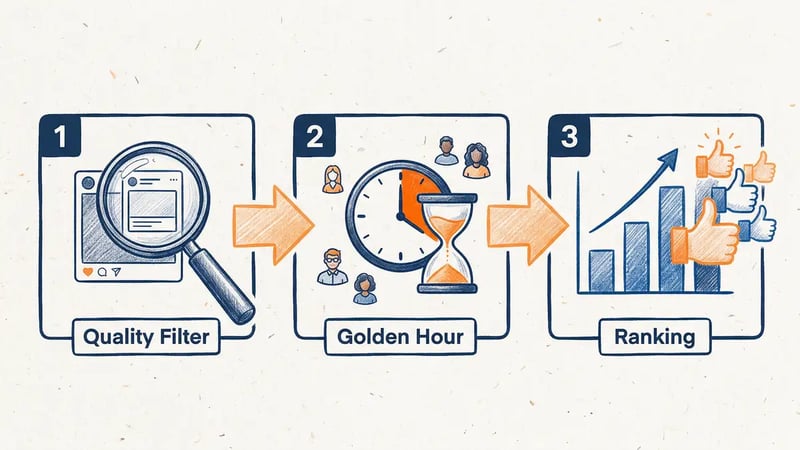
LinkedIn's 2026 algorithm evaluates content through a three-step process that prioritises knowledge-sharing over attention-grabbing tactics. First, posts undergo quality filtering that immediately classifies content as spam, low quality, or high quality. Second, during the critical "golden hour," posts are shown to a small sample audience to gauge initial interaction. Third, the algorithm ranks content based on relationship strength, topic relevance, and whether the author demonstrates expertise in the subject matter.
Algorithm Changes, Format Performance and Engagement Strategies That Actually Work
LinkedIn's algorithm has fundamentally shifted from rewarding viral content to prioritising genuine expertise and meaningful engagement. Whitehat SEO's analysis of the latest research reveals that organic reach has dropped approximately 50% year-over-year, yet personal profiles now generate 5× more engagement than company pages—creating significant opportunities for B2B brands that adapt their approach.
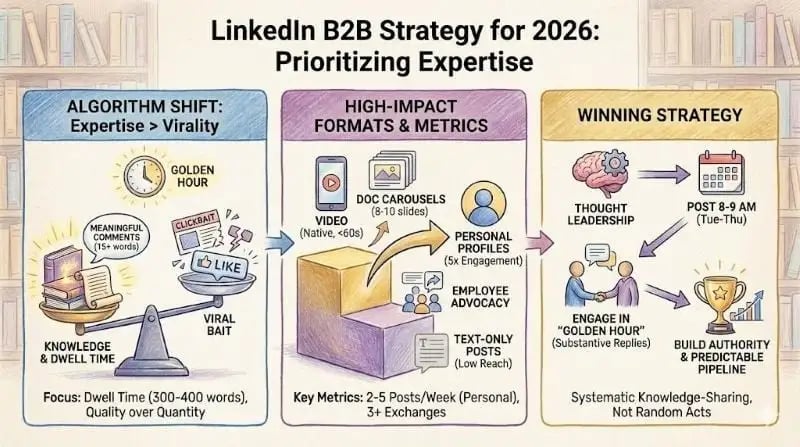
The platform explicitly announced it "is not designed for virality" and now actively penalises engagement-baiting tactics whilst rewarding content that demonstrates subject matter expertise. For B2B marketers, this represents a strategic pivot from reach-chasing to authority-building—and understanding these changes is essential for anyone serious about inbound marketing in the current landscape.
The Algorithm Now Rewards Expertise Over Virality
Dwell time has emerged as the algorithm's most powerful behavioural signal. LinkedIn measures both "on-feed dwell time" (time spent viewing whilst scrolling, triggered when 50% of a post is visible) and "after-click dwell time" (time spent reading after clicking "see more"). Posts that hold attention for longer periods receive exponentially greater distribution.
Key Algorithm Metrics for 2026
- Optimal post length: 300-400 words and 20+ sentences maximises dwell time
- Readability impact: Posts above 10th-grade reading level see 35% less reach
- Comment quality: Comments of 15+ words are twice as effective as shorter ones
- Conversation boost: Posts with 3+ comment exchanges between different participants receive 5.2× amplification
- Pod detection: LinkedIn's AI achieves 97% accuracy in detecting coordinated engagement groups
LinkedIn's June 2023 "knowledge and advice" update marked the algorithm's philosophical turning point. The platform now uses AI classification to determine whether posts contain genuine knowledge, whether authors are qualified to speak on the topic, and whether engagement is "meaningful" rather than superficial. Engagement bait phrases like "Comment YES if you agree" are actively detected and penalised.
By August 2025, LinkedIn implemented large language models to understand content context and reasoning rather than just processing numerical engagement features. For B2B marketers developing their content marketing strategy, this means authenticity and genuine expertise now directly impact distribution.
Content Formats That Drive B2B Engagement in 2026
Content format selection now significantly impacts reach, with substantial performance differences between personal profiles and company pages. The data reveals clear winners—and some formats that B2B brands should avoid entirely.
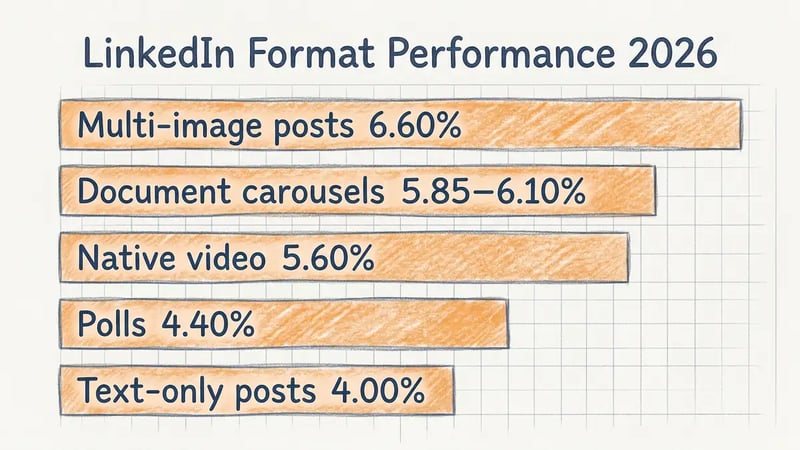
| Format | Engagement Rate | Personal Profile Multiplier | Company Page Multiplier |
|---|---|---|---|
| Multi-image posts | 6.60% | 1.18× | 1.21× |
| Document carousels | 5.85-6.10% | 1.45× | 1.40× |
| Native video | 5.60% | 1.10× | 1.05× |
| Polls | 4.40% | 1.64× | 1.19× |
| Text-only posts | 4.00% | 0.88× | 0.42× |
Video: The 69% Performance Boost
Video has seen the most significant year-over-year improvement, with a 69% performance boost compared to 2024. LinkedIn reports video uploads increased 20% whilst views grew 36%. The optimal approach: native vertical video (4:5 or 9:16 aspect ratio) under 60 seconds with captions, as 73% of video views come from mobile devices where users typically watch with sound off.
Videos achieving 70% completion rates are 3.5× more likely to be recommended by the algorithm. For B2B brands, this means shorter, value-dense video content outperforms longer-form material—a consideration worth factoring into your HubSpot social media workflow.
Document Carousels: High Impact, New Challenges
Document carousels remain highly effective but face a new challenge: the algorithm now penalises low completion rates. The optimal structure is 8-10 slides with an eye-catching visual and compelling teaser text on the first slide. Carousels average 1,387 impressions compared to just 589 for text-only posts, making them particularly valuable for frameworks, guides, and evergreen educational content.
LinkedIn Newsletters: The Underutilised Opportunity
LinkedIn newsletters represent a significant underutilised opportunity for B2B brands. With 184,000+ newsletters published on the platform and 30 million subscribers, top performers achieve 27%+ open rates—with niche topics occasionally reaching 55-60%. A striking finding: 98% of the top 100 newsletters are written by individuals, not companies, reinforcing the power of personal over corporate branding.
Optimal Posting Cadence and Timing
Research reveals consistent patterns for optimal posting strategies that B2B marketers can implement immediately. The prime posting window is Tuesday and Wednesday at 8-9 AM, with Tuesday showing engagement rates 20% higher than Friday.
2-5
Posts per week (personal profiles)
16+
Posts per month (company pages)
8-9 AM
Optimal posting time (Tue-Thu)
Posting frequency matters more than previously understood. Moving from one post per week to 2-5 posts triggers significantly broader distribution—what researchers describe as "flipping a switch" in LinkedIn's algorithm. However, posting more than once per 24 hours is counterproductive, as LinkedIn typically promotes only one post from an account in a given day.
Format rotation has become essential. Posting the same format back-to-back can suppress reach by 20%. The algorithm rewards variety, so B2B marketers should cycle through carousels, video, image posts, and text content rather than defaulting to a single format.
The first 60-90 minutes after posting remain critical. Strong early engagement triggers expanded distribution to second and third-degree connections, whilst posts receiving fewer than 500 impressions in the first hour rarely gain significant traction. Responding to comments within this window amplifies reach—a key consideration when planning your content strategy.
Personal Profiles vs Company Pages: The Performance Gap Widens
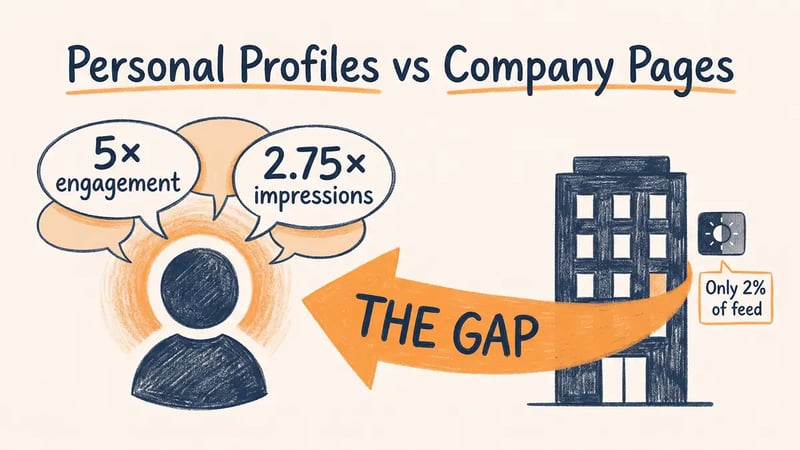
The performance gap between personal profiles and company pages has widened substantially. Personal profiles drive 2.75× more impressions and 5× more engagement than company pages—even when employees have 46% fewer followers than the company account.
What Appears in LinkedIn Feeds (2026)
- Top creator content: 31%
- Other creator content: 28%
- Promoted company content: 28%
- LinkedIn ads: 11%
- Organic company page posts: 2%
The algorithmic explanation is stark: organic company page posts represent only 2% of what appears in users' feeds. For B2B brands, this means company pages have become primarily useful for running ads (only pages can run ads), recruitment, and serving as a centralised content hub—whilst thought leadership and engagement should flow through personal profiles.
Employee Advocacy: The Critical Bridge
Employee advocacy has become the critical bridge between company messaging and audience engagement. Research shows that leads generated from employee content convert 7× more often than leads from paid channels. Employee networks are collectively 10× larger than company follower lists, and posts by employees are 2× more likely to receive engagement than brand posts.
Yet only 3% of employees share company content—but this small group generates 30% of total company engagement. This represents massive untapped potential for B2B organisations willing to invest in employee advocacy programmes. At Whitehat SEO, we've seen HubSpot onboarding clients significantly amplify their reach by training teams to share and engage authentically on LinkedIn.
LinkedIn Feature Changes B2B Marketers Need to Know
Several significant feature changes affect B2B strategy. Understanding what's changed—and what hasn't—helps you avoid wasting time on outdated tactics.
What's Changed
Creator Mode retired (February-March 2024)
Previously locked features now available to all members
Hashtag pages disabled (October 2024)
Hashtags no longer impact reach; using more than 5 hashtags now penalises distribution
External links no longer heavily penalised
Posts with links now see a modest 5% gain in reach; the "link in comments" hack no longer provides advantages
Collaborative Articles expanded significantly
Weekly readership up 270%+; contributing strategically can earn the "Community Top Voice" badge
AI Content: The Authenticity Advantage
LinkedIn's native AI tools now include content suggestions, draft assistance, and predictive career path analysis. Third-party AI tools like Taplio, Shield, and Supergrow have become mainstream, with 86% of marketers reporting increased efficiency after adoption.
However, research found that AI-generated posts average 45% fewer interactions than human-created content, and over 50% of longer LinkedIn posts are now AI-generated. This suggests authenticity remains a competitive advantage—a consideration for brands exploring AI consultancy and implementation.
Thought Leadership Now Directly Correlates with Revenue
The business case for executive LinkedIn presence has never been stronger. Research reveals that 52% of decision-makers and 54% of C-suite executives spend more than one hour weekly consuming thought leadership content.
More significantly, 61% of C-suite executives are willing to pay premium prices for organisations demonstrating clear vision through thought leadership, and 55% of decision-makers increased business with providers based on their thought leadership content.
Optimal Content Mix for B2B Thought Leaders
- Educational posts: 2-3 times weekly
- Personal stories building relatability: Weekly
- Industry insights demonstrating expertise: Weekly
- Video content: 1-2 times weekly (84% higher engagement)
Profile Optimisation Essentials
Effective executive positioning on LinkedIn follows predictable patterns. Profile optimisation requires a headline blending niche, value, and credibility; an About section using Problem-Solution-Proof-CTA structure; and a Featured section showcasing top posts, case studies, and testimonials. Profiles with professional photos receive 21× more views, making visual elements non-negotiable.
Thought Leader Ads: A New Promotional Avenue
Thought Leader Ads represent a new promotional avenue, allowing brands to sponsor organic posts from employee or executive profiles. These ads achieve dramatically lower cost-per-click at £3.31 (approximately $4.14) compared to £18.03 ($22.54) for traditional brand awareness campaigns, whilst appearing more authentic to audiences. This makes them worth exploring as part of your PPC management strategy.
Your LinkedIn B2B Action Plan for 2026
The LinkedIn landscape of 2025-2026 rewards a fundamentally different approach than the viral-chasing tactics of previous years. Here's how to adapt your strategy based on Whitehat SEO's analysis of the research:
1. Shift Resources from Company Pages to Personal Profiles
Invest in executive thought leadership and employee advocacy. Train key team members to share authentically and engage meaningfully. The 5× engagement advantage of personal profiles is too significant to ignore.
2. Prioritise Video and Document Carousels
Create short-form vertical video (under 60 seconds with captions) and 8-10 slide carousels. Avoid text-only posts on company pages entirely—they achieve only 0.42× baseline reach.
3. Maintain Consistent Posting Cadence
Post 2-5 times per week on personal profiles, focused on Tuesday-Thursday mornings (8-9 AM). Rotate formats to avoid the 20% reach suppression from posting the same format consecutively.
4. Engage Strategically in the First Hour
Be available to respond to comments within 60-90 minutes of posting. Encourage substantive comments (15+ words) and foster conversation threads between multiple participants.
5. Contribute to Collaborative Articles
Earn the "Community Top Voice" badge by contributing thoughtfully to AI-initiated discussions in your area of expertise. This credibility signal appears on your profile for 60+ days.
6. Focus on Dwell Time, Not Vanity Metrics
Create content that holds attention (300-400 words, readable at 6-9 year reading level, visually engaging) rather than content designed to provoke quick reactions. Quality of engagement now matters more than quantity.
Need help integrating LinkedIn with your wider inbound engine? Our inbound marketing services align social, SEO and HubSpot CRM so every LinkedIn engagement feeds a measurable pipeline — not a vanity dashboard.
Frequently Asked Questions
How often should B2B companies post on LinkedIn in 2026?
Personal profiles should post 2-5 times per week for optimal reach, whilst company pages need at least 16 posts per month. Companies posting weekly on their company page see 2× engagement lift compared to less frequent posting. However, posting more than once per day from the same account is counterproductive.
Should we still use hashtags on LinkedIn?
Hashtags no longer impact reach since LinkedIn disabled hashtag pages in October 2024. Research shows using more than five hashtags actually penalises distribution. If you use hashtags at all, limit them to 3-5 highly relevant tags at most.
Is it better to include links in posts or in comments?
The "link in comments" hack no longer provides advantages. Posts with links now see a modest 5% gain in reach, reversing a multi-year decline. Embed links at the end of your caption rather than hiding them in comments. Posts with 3+ links actually perform 20% better than single-link posts.
How long do LinkedIn posts stay visible in the feed?
LinkedIn has extended content lifespan from 24 hours to potentially 2-3 weeks for posts that spark meaningful conversations. Posts that continue generating quality comments and conversation threads can gain momentum over an extended period.
Should we use AI to create LinkedIn content?
Whilst 86% of marketers report increased efficiency using AI tools, AI-generated posts average 45% fewer interactions than human-created content. Use AI for efficiency in drafting and ideation, but ensure the final content reflects authentic voice and genuine expertise. Authenticity remains a competitive advantage.
The Bottom Line
The brands winning on LinkedIn in 2026 are those treating it as a knowledge-sharing platform for genuine professional value rather than another channel for promotional messaging. The algorithm's pivot toward expertise, dwell time, and meaningful conversations means B2B marketers must prioritise demonstrating genuine subject matter authority over gaming engagement metrics.
Personal profiles have become the primary vehicle for organic reach, making executive thought leadership and employee advocacy essential components of any B2B LinkedIn strategy. The 5× engagement advantage of personal profiles over company pages isn't a bug—it's a feature that rewards authentic human connection over corporate broadcasting.
At Whitehat SEO, we help B2B companies build sustainable inbound marketing strategies that integrate LinkedIn effectively with broader SEO services and demand generation efforts. If you're looking to transform your LinkedIn presence from random acts of posting into a systematic pipeline contributor, we'd love to have a conversation.
Ready to Build a LinkedIn Strategy That Delivers?
Stop the random acts of marketing. Let's talk about turning your LinkedIn presence into a predictable source of qualified leads — and how your social efforts should integrate with your broader inbound funnel.
Book a Discovery Call Get a Free SEO AuditReferences & Sources
- van der Blom, R. (2025). Algorithm Insights Report 2025. Just Connecting. richardvanderblom.com
- Socialinsider (2025). LinkedIn Benchmarks Study: Analysis of 1 Million Posts. socialinsider.io
- Hootsuite (2025). Best Time to Post on LinkedIn. blog.hootsuite.com
- Sprout Social (2025). LinkedIn Algorithm: How It Works. sproutsocial.com
- Edelman & LinkedIn (2024). B2B Thought Leadership Impact Report. edelman.com
- AuthoredUp (2025). How the LinkedIn Algorithm Works in 2025. authoredup.com
- Buffer (2024). LinkedIn Marketing Study: Analysis of 2 Million Posts. buffer.com