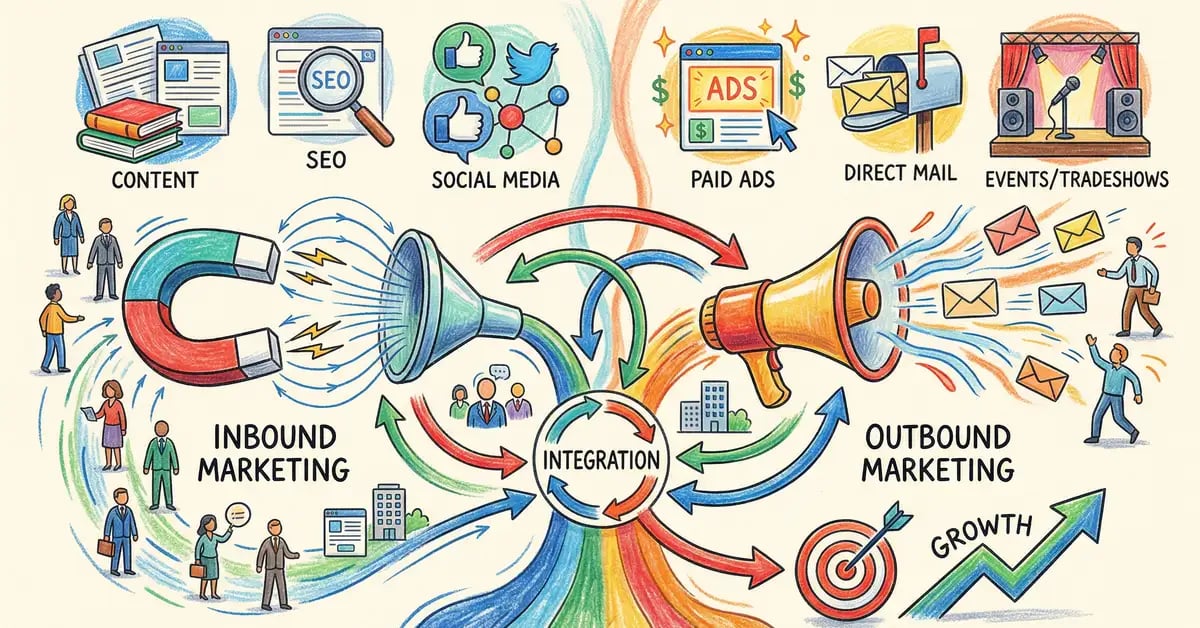
HOW TO COMBINE INBOUND AND OUTBOUND MARKETING (2026 UK GUIDE)
The most effective way to combine inbound and outbound marketing is to use integrated multi-channel campaigns where organic content (SEO, social media) builds long-term brand awareness while paid channels (PPC, LinkedIn ads, direct mail) accelerate short-term results. This approach delivers 300% better performance than single-channel strategies, with optimal budget allocation of approximately 60% inbound, 40% outbound for established B2B companies.
Why this matters in 2025: The marketing landscape has fundamentally shifted. While 89% of UK companies now use some form of digital marketing, the persistent debate between "inbound versus outbound" misses the point entirely. The question isn't which approach to choose—it's how to orchestrate them strategically.
2025 UK Market Reality:
- Multi-channel campaigns across 4+ channels outperform single-channel approaches by 300% (Mandala System 2024)
- Companies with strong omnichannel engagement retain 89% of customers versus just 33% with weak engagement
- B2B marketing budgets in the UK are increasing, with 48% of companies expecting budget growth in 2025 (Forrester)
According to the IPA Bellwether Report Q4 2024, UK marketing budgets grew +1.9%, with event marketing up +12.3% and direct marketing up +5.6%—clear signals that companies are blending traditional outbound with modern inbound marketing tactics.

This guide provides the UK-specific frameworks, budget allocation strategies, and implementation roadmaps that work in 2025.
Why "Inbound vs Outbound" Is the Wrong Question
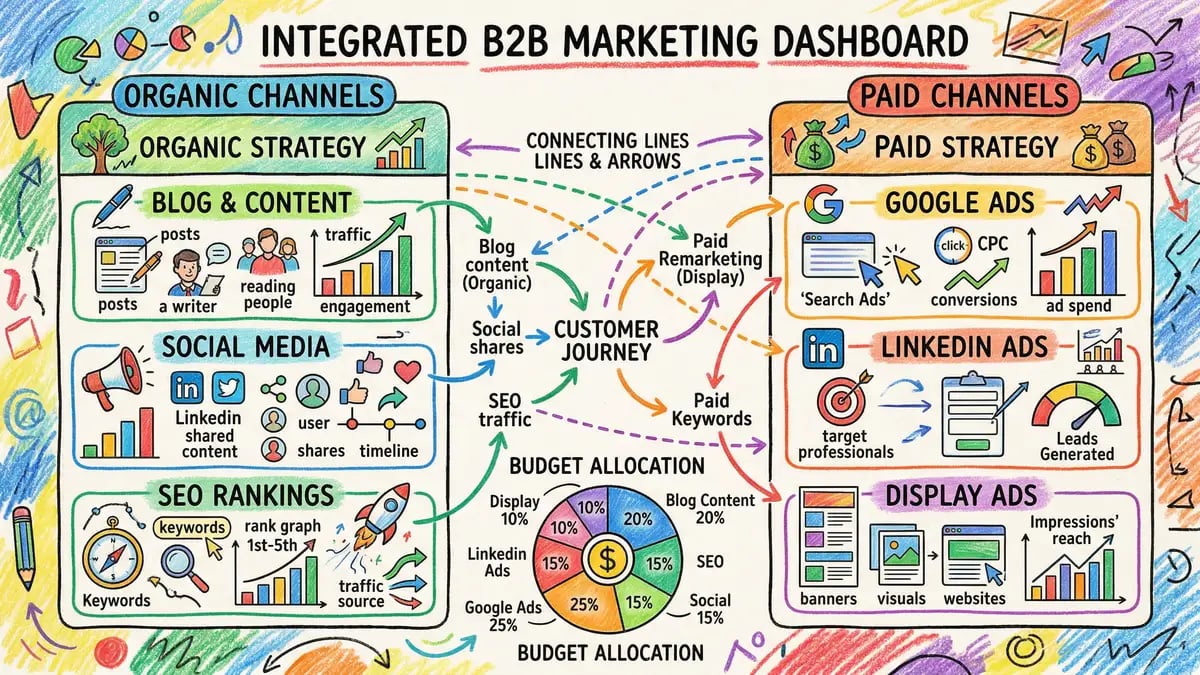
For years, marketing debates have framed inbound marketing and outbound marketing as opposing forces. Inbound pulls customers in through valuable content they discover organically. Outbound pushes messages out through paid channels and direct outreach. The traditional framing suggests you must choose one or the other.
This is categorically wrong.
Guy Kawasaki famously said that marketers with more money than brains do outbound marketing, while those with more brains than money do inbound marketing. But here's the reality in 2025: the smartest marketers have both money AND brains, and they use integrated approaches.
What Changed in 2025
Artificial intelligence has fundamentally blurred the lines between inbound and outbound. Paid advertisements now look native and appear in organic feeds. Organic content gets amplified through paid promotion. The walls between channels have collapsed.
Platform evolution proves the point:
- LinkedIn Thought Leader Ads achieve 1.7x higher click-through rates than traditional sponsored content
- Google Performance Max campaigns deliver 30-50% higher ROAS by combining search, display, YouTube, and Discovery
- Meta Advantage+ campaigns use AI to blur creative and targeting, making "organic" and "paid" social indistinguishable
Modern B2B buyers don't distinguish between inbound and outbound—they consume both. They read your blog posts (inbound), see your LinkedIn ads (outbound), attend your webinars (inbound), and respond to your direct mail (outbound). They expect consistent experiences across all touchpoints.
The Evidence for Integration
The data is unambiguous:
- Multi-channel campaigns generate 37% higher response rates than single-channel approaches (WiFiTalents, August 2024)
- SEO and PPC combined contribute 65% of traffic and 50%+ of conversions when used together (seoClarity, February 2024)
- HubSpot's INBOUND 2024 conference theme reinforced this reality: "Inbound isn't dead—it's evolving" with outbound integration as a core pillar
Whitehat Insight: In our work with over 150 UK B2B clients as a HubSpot Diamond Partner, we've found that companies exclusively using either inbound or outbound face a common challenge: unpredictable pipeline. Integrated approaches create consistent flow—inbound fills the long-term pipeline while outbound addresses immediate revenue needs.
At Whitehat, our inbound marketing service integrates seamlessly with paid channels through HubSpot's unified platform, giving you one dashboard for both organic and paid performance.
The Strategic Framework: 60/40 Budget Allocation
How much should you invest in inbound versus outbound? This isn't guesswork—it's grounded in the most rigorous marketing effectiveness research ever conducted.
The Binet & Field 60:40 Rule
Les Binet and Peter Field analyzed the IPA Effectiveness Databank—decades of campaign results from hundreds of companies—and identified the optimal marketing investment split:
- 60% allocated to long-term brand building (broad reach, emotional resonance)
- 40% allocated to short-term activation (targeted, rational messaging)
This framework translates directly to inbound/outbound allocation. Inbound marketing—SEO, content, organic social—builds brand equity over time. Outbound marketing—paid ads, events, direct mail—activates demand and drives immediate conversions.
The B2B Adjustment: 46:54
B2B contexts require modification. The optimal split shifts to approximately 46% brand / 54% activation. Why? Longer sales cycles, higher consideration requirements, and more rational decision-making processes mean B2B buyers respond well to targeted outbound while still benefiting from brand-building inbound content.
Practically, this means slightly more investment in outbound channels than classic consumer marketing—but still maintaining substantial inbound investment for long-term sustainability.
Maturity-Based Adjustments
Your company's stage determines the optimal split:
| Company Stage | Inbound % | Outbound % | Why |
|---|---|---|---|
| Startup (<1 year) | 35% | 65% | Need immediate revenue, limited brand equity |
| Growth (1-5 years) | 50% | 50% | Building brand while maintaining sales velocity |
| Established (5+ years) | 60% | 40% | Brand equity compounds, efficiency improves |
| Market Leader | 72% | 28% | Brand dominance allows lower activation spend |
UK Market Budget Benchmarks (2024-2025)
According to the latest data:
- Average marketing spend: 7.7% of revenue (down from historical 10-12%)
- B2B companies: 8% average, with 48% planning increases (Forrester 2024)
- Typical split in practice: £100k budget = £46k inbound (SEO, content, organic social) + £54k outbound (PPC, LinkedIn ads, events, direct mail)
Use our marketing budget calculator to model different allocation scenarios based on your revenue and business stage.
Our HubSpot onboarding service includes budget allocation modeling based on your business stage, helping you optimize the inbound/outbound split from day one.
Integration Strategy #1: Orchestrate Paid and Organic Search
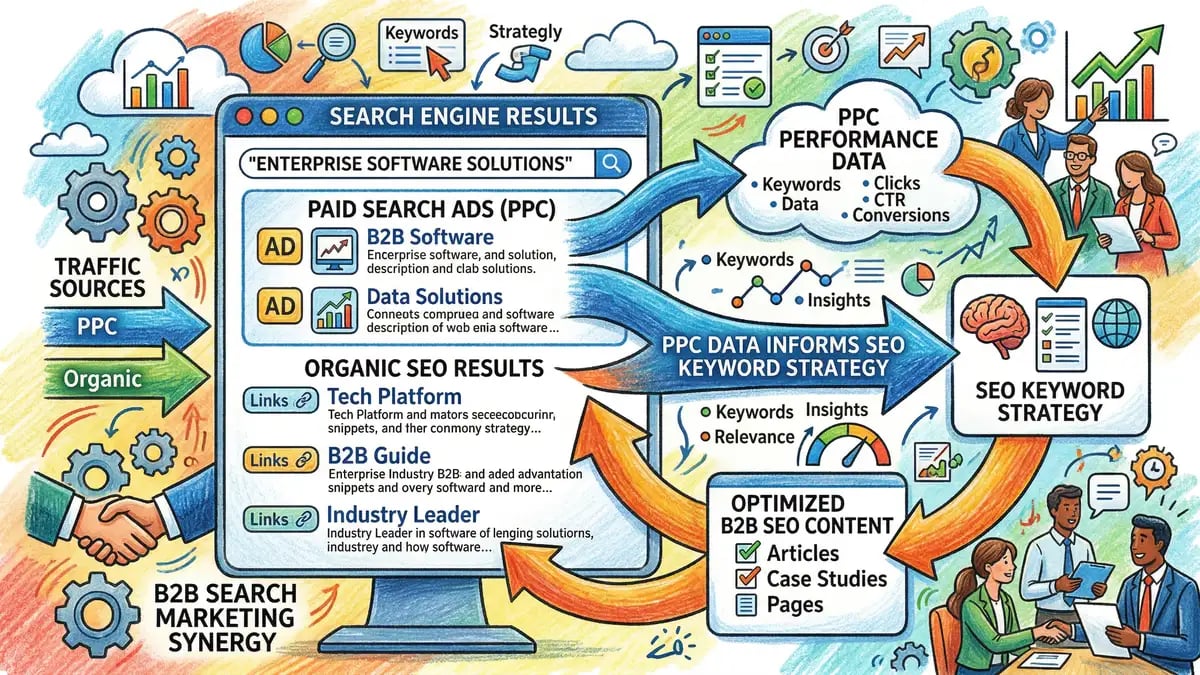
The most powerful integration strategy combines SEO and PPC into a unified search presence. This isn't about choosing one channel over the other—it's about leveraging both for compounding results.
The Compounding Effect
When SEO and PPC work together, the combined impact exceeds the sum of individual channels:
- SEO + PPC together contribute 65% of total website traffic and drive 50%+ of conversions (seoClarity, February 2024)
- Pages ranking organically and running paid ads see increased click-through rates for both placements due to SERP dominance
- Combined visibility builds trust—appearing in both organic and paid results signals authority and legitimacy
2025 Google Search Capabilities
Google's platform evolution makes integration more powerful than ever:
Performance Max campaigns deliver 30-50% higher ROAS by automatically distributing budget across Search, Display, YouTube, Discover, Gmail, and Maps based on performance signals. These campaigns work best when supported by strong organic content that improves Quality Score and reduces CPCs.
AI Max for Advertisers uses Google's Gemini models to process 18% more search queries and deliver 19% more conversions than traditional campaigns. But AI Max still relies on landing page quality and organic ranking signals to determine ad relevance.
Google Demand Gen campaigns combine visually immersive ads across YouTube, Discover, and Gmail. These work exceptionally well when paired with SEO-optimized content that reinforces messaging after the initial paid touchpoint.
The 3-Step Integration Process
Step 1: Build the SEO foundation
Begin with comprehensive SEO strategy development. Identify your highest-value target keywords through research that considers search volume, commercial intent, and competitive difficulty. Create pillar content that thoroughly addresses search intent for these terms.
Step 2: Accelerate with PPC
While your SEO builds over 3-6 months, use PPC to generate immediate traffic and gather conversion data. Test messaging, offers, and landing pages with paid traffic to identify what resonates before it appears in organic results. UK Google Ads benchmarks show average CPCs of £2-8 for B2B keywords, making this a cost-effective testing ground.
Step 3: Optimize the combination
As organic rankings improve, adjust—but don't eliminate—PPC spend on those terms. Pages ranking in top 3 organically should still maintain paid presence for maximum SERP dominance. Redirect saved PPC budget to new keyword opportunities while SEO catches up.
Case Example: A UK manufacturing client came to Whitehat ranking nowhere for "industrial automation systems"—a high-value term with 2,400 monthly searches. We launched PPC campaigns immediately while building comprehensive SEO content. Within 90 days, PPC generated £47k in pipeline at £12 CPC. By month 6, organic rankings reached position 4, and we reduced PPC spend by 40% while maintaining total traffic. The result: 47% increase in organic visibility plus sustained paid performance at lower cost.
Our SEO services integrate seamlessly with PPC management, giving you unified keyword strategy, consistent messaging, and combined performance dashboards through HubSpot.
Integration Strategy #2: Amplify Organic Social with Paid Promotion
Organic social media reach has collapsed. Facebook organic reach averages 2-5% of followers without paid promotion. LinkedIn organic posts reach approximately 10% of connections. Relying exclusively on organic social means leaving 90-95% of your audience unreached.
The solution isn't abandoning organic social—it's amplifying your best organic content with strategic paid promotion.
Why LinkedIn Dominates B2B Marketing
LinkedIn captures 39% of total B2B social media spend—more than all other platforms combined. The reason is simple: it works.
- LinkedIn advertising delivers 113% average ROAS for B2B (Marketing Effectiveness Survey 2024)
- 80% of B2B social media leads come from LinkedIn
- 44.4 million UK users provide massive professional audience reach
- LinkedIn Thought Leader Ads achieve 1.7x higher CTR and 40% lower cost-per-lead than traditional sponsored content
2025 LinkedIn Capabilities
LinkedIn Thought Leader Ads let you promote posts from individual executives rather than company pages. These personal posts generate 1.7x more engagement because they feel authentic rather than corporate. Use this feature to amplify your CEO's or CMO's best organic posts to targeted decision-makers.
LinkedIn Connected TV brings professional advertising to streaming services. Early adopters report 4-5x higher brand recall than traditional digital ads, with the ability to retarget CTV viewers on LinkedIn platforms.
LinkedIn Accelerate campaigns use AI to automate campaign creation, targeting, and optimization. These simplify paid social for SMEs while maintaining performance—average 25% cost savings versus manual campaign management.
The Underrated Power of Meta for B2B
While LinkedIn dominates mindshare, Meta platforms (Facebook and Instagram) deliver underrated B2B results:
- 56% of B2B marketers now use Facebook advertising (up from 41% in 2022)
- Facebook ads achieve 10.63% average conversion rates for B2B lead generation
- Meta CPMs average £5-15 versus £20-40 on LinkedIn—significantly lower cost for top-of-funnel awareness
Meta works best for early-stage awareness and interest building, while LinkedIn excels at mid-to-bottom funnel conversion. Use both platforms strategically based on buying journey stage.
The 3-Tier Content Pyramid
Structure your social media marketing as a pyramid:
Tier 1: Organic content foundation (70% of effort)
Post consistently to build organic presence. Test messaging, content formats, and topics. Monitor engagement to identify top performers.
Tier 2: Boost the winners (20% of budget)
Promote your highest-performing organic posts with targeted paid amplification. If a post generates strong organic engagement, amplify it to reach 10x more of your target audience.
Tier 3: Always-on campaigns (80% of budget)
Run sustained paid campaigns for lead generation, event promotion, and content distribution. These aren't organic posts—they're purpose-built paid ads optimized for conversion.
UK GDPR Advantage
Here's a regulatory edge most marketers miss: Paid social advertising requires no consent under UK GDPR. It operates under "legitimate interests" basis, making it more flexible than email marketing which requires explicit opt-in under PECR regulations.
This means you can target cold prospects on LinkedIn and Meta without prior permission—a significant advantage for B2B prospecting in the UK market.
Whitehat's social media marketing service integrates organic community building with strategic paid amplification, managed through HubSpot's social tools for unified analytics and reporting.
Integration Strategy #3: Combine Connected TV with Direct Mail
This integration pairs cutting-edge and traditional channels for powerful results. Connected TV (CTV) builds awareness through video storytelling, while dimensional direct mail creates physical presence that demands attention.
The Resurgence of Direct Mail
Direct mail isn't dead—it's transformed into one of the highest-performing B2B channels:
- Warm prospect direct mail generates 7.9% response rate on average
- Dimensional mail (3D packages rather than flat letters) achieves 8.51% B2B response rates
- 3D mail gets 20% open rates versus 1% for standard flat mail
Critical UK regulatory advantage: Direct postal mail requires no consent under PECR regulations. Unlike email marketing which requires opt-in, you can send direct mail to cold prospects under "legitimate interests" basis. This makes direct mail one of the most legally flexible outbound channels in the UK.
The Connected TV Frontier
Connected TV advertising reached $28.75 billion in spend globally in 2024, with 70% of B2B advertisers now active on the channel. Here's why:
- Millennials now represent 75% of buying teams—and they watch Netflix, not traditional TV
- CTV costs approximately $0.03 per view—far cheaper than LinkedIn video ads at $0.10+ per view
- CTV campaigns deliver average 4.36x ROAS for B2B advertisers (MediaPost 2024)
- CTV + display retargeting increases conversion rates by 68% versus display alone
Major platforms include Netflix (with new ad tier), Hulu, Amazon Prime Video, Disney+, and YouTube CTV. UK-specific platforms include ITV Hub, Channel 4, and Sky Go.
The Integrated Sequence
Here's how to combine CTV and direct mail for maximum impact:
Week 1: Launch CTV campaign
Target decision-makers with 30-second brand storytelling video. Build awareness and familiarity. Track completion rates and engagement.
Weeks 2-3: Send dimensional mail
Mail 3D packages to prospects who viewed your CTV ad. Include personalized letter referencing the video message, high-value content offer, and compelling call-to-action. Dimensional packages could include branded items, product samples, or creative packaging.
Week 4: LinkedIn outreach
Follow up with LinkedIn connection requests and InMail from sales team. Reference the CTV ad and direct mail package. Offer discovery call or demo.
This three-touch sequence generates 12-18% response rates in our client campaigns—far exceeding any single-channel approach.
Case Example: A UK fintech company targeting CFOs in mid-market manufacturing used this exact sequence. CTV campaign on ITV Hub and Channel 4 reached 12,000 finance decision-makers. They sent dimensional packages containing branded calculators and personalized ROI reports to 300 high-engagement viewers. LinkedIn outreach followed. Result: 17% response rate, 23 qualified meetings, 4 closed deals averaging £180k each. Total campaign cost: £34k. ROI: 2,095%.
UK Regulatory Note
Both CTV advertising and direct postal mail operate under "legitimate interests" basis in UK GDPR—meaning no prior consent required for B2B prospecting. This creates significant flexibility compared to email marketing's opt-in requirements under PECR.
Measurement & Attribution: Proving ROI
Integrated marketing creates a measurement challenge: How do you attribute results when prospects touch both inbound and outbound channels before converting?
According to Gartner, 72% of marketing teams struggle with attribution across multiple channels. The problem intensifies with integrated approaches because traditional first-touch or last-touch attribution fails to capture the full customer journey.
The Measurement Triangle
The solution isn't choosing one attribution model—it's using three complementary approaches:
1. Marketing Mix Modeling (MMM) for long-term budget allocation
MMM analyzes historical data to understand how different channels contribute to outcomes over time. It accounts for external factors (seasonality, economic conditions, competitive activity) and is privacy-safe since it uses aggregated data rather than individual tracking. Use MMM to make strategic decisions about overall budget allocation between inbound and outbound.
2. Multi-Touch Attribution (MTA) for real-time campaign optimization
MTA tracks individual customer journeys across touchpoints to assign credit to each interaction. While disrupted by privacy changes (iOS tracking limits, cookie deprecation), MTA still provides valuable insight for logged-in users and known prospects in your CRM. Use MTA to optimize active campaigns and understand which channel combinations drive conversions.
3. Incrementality Testing for causal validation
Incrementality tests use holdout groups to measure true causal impact. For example, run CTV campaigns in Birmingham but not Manchester, then compare conversion rates between markets. This establishes ground truth about what actually works versus what correlates. Use incrementality testing to validate major strategic decisions.
Practical Attribution Frameworks by Budget Tier
Under £50k annual marketing spend:
Use first-touch and last-touch attribution in HubSpot. Track which channel brought prospects in (first-touch) and which channel converted them (last-touch). This simple approach provides directional guidance without complex infrastructure.
£50-250k annual spend:
Implement U-shaped or W-shaped multi-touch attribution. U-shaped gives 40% credit to first touch, 40% to last touch, and 20% to middle touches. W-shaped adds 30% weight to the opportunity creation touchpoint. HubSpot's attribution reporting supports these models natively.
£250k+ annual spend:
Invest in full Marketing Mix Modeling through specialized consultancies or advanced platforms. Combine with robust multi-touch attribution and structured incrementality testing program. This provides strategic confidence for large budget allocation decisions.
HubSpot Attribution Setup
For companies using HubSpot, proper attribution setup requires:
- Consistent UTM discipline: Tag all paid campaigns, email sends, and social posts with source, medium, and campaign UTM parameters
- Campaign hierarchy: Organize campaigns by type (inbound vs outbound), channel, and objective for clear reporting
- Custom attribution reports: Build reports showing revenue influence by campaign type, comparing inbound versus outbound contribution
- Sales integration: Ensure sales team logs all offline interactions (calls, meetings, events) back into HubSpot so the full journey is captured
Speaking CEO Language: Beyond Vanity Metrics
Only 52% of senior marketing leaders successfully demonstrate marketing's contribution to business outcomes (Gartner 2024). The core problem: misalignment on metrics that matter.
70% of CEOs measure year-over-year revenue growth, but only 35% of CMOs track it as a top metric. Close this gap by framing integrated marketing results in business terms:
- Pipeline contribution: "Our integrated campaigns generated £2.4M in qualified pipeline this quarter"
- Customer acquisition cost: "Inbound + outbound integration reduced CAC from £4,200 to £2,800"
- Win rates: "Prospects who engage with both inbound content and outbound touchpoints convert at 23% versus 11% single-channel"
- Revenue influence: "47% of closed-won revenue touched our integrated campaigns"
Learn more in our guide to marketing attribution that works.
90-Day Implementation Roadmap
Theory means nothing without execution. Here's your practical roadmap for implementing integrated inbound and outbound marketing in the next 90 days.
Month 1: Audit & Foundation (Days 1-30)
Week 1: Current state assessment
- Audit all active inbound channels (SEO, content, organic social, email)
- Audit all active outbound channels (PPC, paid social, events, direct mail)
- Document current budget allocation and performance metrics
- Identify integration gaps and channel silos
Week 2: Data gathering
- Pull 6 months of performance data from all platforms
- Map customer journeys from first touch to close
- Identify which channel combinations currently work best
- Calculate current CAC by channel and combined
Week 3: Strategic planning
- Determine appropriate inbound/outbound split based on business stage (use 60/40 framework)
- Select 2-3 integration strategies to pilot (e.g., SEO + PPC, Social organic + paid)
- Define success metrics and targets for each integration
- Create 6-month roadmap with monthly milestones
Week 4: Tool consolidation
- Implement or optimize HubSpot as unified platform
- Connect all paid advertising platforms to HubSpot
- Set up UTM tracking conventions for consistent attribution
- Build baseline attribution reports
Month 2: Launch Integrated Campaigns (Days 31-60)
Search integration launch:
- Identify top 10 high-value keywords for combined SEO + PPC
- Launch PPC campaigns for immediate traffic
- Publish comprehensive SEO-optimized content for same keywords
- Monitor combined performance weekly
Social amplification launch:
- Establish consistent organic posting schedule (3-5x weekly)
- Set aside 20% of social budget for boosting top organic posts
- Launch always-on LinkedIn lead generation campaign
- Test Meta awareness campaigns targeting lookalike audiences
Attribution setup:
- Implement multi-touch attribution model in HubSpot
- Create revenue attribution dashboard
- Train sales team on logging offline touchpoints
- Establish weekly performance review cadence
Month 3: Optimize & Scale (Days 61-90)
Performance analysis:
- Review first 60 days of integrated campaign performance
- Identify which channel combinations drive highest ROI
- Compare integrated approach to historical single-channel performance
- Document learnings and optimization opportunities
Scale winners:
- Increase budget 20-50% on top-performing integrations
- Expand successful keyword lists (search integration)
- Broaden audience targeting (social integration)
- Test additional channel combinations (CTV + direct mail pilot)
Optimization:
- Refine messaging based on what resonates across channels
- Improve landing pages using combined paid + organic data
- Adjust budget allocation based on actual performance
- Document playbook for repeatable execution
Expected Outcomes
By day 90, you should achieve:
- Baseline understanding of how inbound and outbound channels interact in your customer journey
- 15-25% improvement in CAC from channel synergies and reduced wasted spend
- Documented playbook for your highest-performing channel integrations
- Sales alignment on attribution and channel contribution
- Clear roadmap for scaling successful approaches over next 6-12 months
Team Requirements
Minimum viable team for integrated marketing:
- Marketing manager to orchestrate strategy and manage vendors (0.8 FTE)
- Content creator for organic content production (0.5 FTE)
- Paid media specialist or agency partner for campaign management
- Sales partnership for feedback loops and offline touchpoint logging
According to Gartner, 86% of high-performing marketing teams cite organizational alignment as critical to integrated marketing success. This isn't just about tools and tactics—it's about aligning sales and marketing teams around shared definitions, processes, and goals.
Common Mistakes to Avoid
Even well-intentioned integration efforts fail when teams make these critical errors:
Mistake #1: Siloed Teams and Tools
The most common failure pattern: Marketing runs inbound campaigns in HubSpot while sales manages outbound in Salesforce, with no integration between systems. Different teams own different channels with different budgets, different goals, and different reporting.
The result: Impossible to understand which channels actually drive revenue. Conflicting messaging across touchpoints. Blame games when targets miss.
The solution: Single source of truth. For SMEs, this typically means HubSpot CRM managing both inbound and outbound. For larger organizations with Salesforce, invest in proper bidirectional integration so both systems reflect complete customer journeys.
Gartner research indicates that 86% of high-performing marketing organizations agree that organizational and technological change is necessary to succeed with integrated approaches.
Mistake #2: Inconsistent Messaging
Your organic blog posts talk about "innovative solutions" while your LinkedIn ads emphasize "proven ROI" and your direct mail focuses on "cutting-edge technology." These aren't variations on a theme—they're conflicting value propositions.
Prospects encountering different messages across channels don't get reinforcement—they get confused about what you actually offer and why it matters.
The solution: Develop clear core messaging that translates across channels. The fundamental value proposition stays consistent. Only the format and depth change based on channel constraints and audience intent.
Mistake #3: Ignoring the 60/40 Framework
Many companies split budgets 50/50 between inbound and outbound without considering business stage or strategic goals. This "split the difference" approach wastes the efficiency gains that proper allocation provides.
First-year startups spending 60% on inbound run out of runway before SEO compounds. Market leaders spending 60% on outbound pay unnecessary premiums when their brand equity should drive organic growth.
The solution: Use the maturity-based framework. Adjust allocation as your business evolves. Review and rebalance quarterly based on performance data.
Mistake #4: Channel Cannibalization Anxiety
Teams worry that running PPC and SEO for the same keywords wastes money—they cannibalize each other. This thinking is backwards.
The reality: Pages ranking organically while also running paid ads see increased clicks for both placements. Combined SEO + PPC contributes 65% of traffic and drives 50%+ of conversions when used together (seoClarity 2024).
SERP dominance—appearing in both organic and paid results—signals authority and increases total click-through rate beyond what either channel achieves alone.
The solution: Embrace strategic overlap. Use PPC to accelerate results while SEO builds. Maintain both presences for highest-value terms even after achieving strong organic rankings.
Mistake #5: Expecting Immediate Results from Long-Term Channels
Executives launch SEO and content marketing, then demand ROI in 30 days. When results don't materialize immediately, they kill the program and redirect budget to PPC.
This ignores the fundamental difference between channels: Outbound delivers immediate results but at higher cost. Inbound takes 3-6 months to compound but delivers sustainable advantage.
The solution: Set appropriate expectations by channel. PPC should show results within 2-4 weeks. SEO and organic social need 3-6 months. Direct mail generates response within 2-3 weeks. Integrated approaches show blended improvement within 60-90 days.
Frequently Asked Questions
What's the difference between inbound and outbound marketing?
Inbound marketing attracts customers through valuable content (SEO, blogs, social media) that they discover organically when searching for solutions. Outbound marketing proactively reaches prospects through paid channels (ads, direct mail, cold outreach) even when they're not actively searching. The key difference: inbound is customer-initiated discovery, outbound is company-initiated contact. Both are essential for complete marketing coverage.
What's the ideal budget split between inbound and outbound marketing?
The optimal split depends on business maturity. Les Binet and Peter Field's research suggests approximately 60% long-term brand building (inbound) and 40% short-term activation (outbound) for established companies. However, first-year startups should allocate 65% to outbound for immediate revenue, while market leaders can push toward 72% inbound as brand equity compounds. B2B companies typically perform best with a 46% inbound / 54% outbound split.
How long does it take to see results from integrated marketing?
Outbound channels deliver results quickly—PPC and paid social within 2-4 weeks, direct mail within 2-3 weeks. Inbound channels take longer—SEO typically shows meaningful traction at 3-6 months, content marketing compounds over 6-12 months. Integrated approaches show blended improvement within 60-90 days as quick wins from outbound combine with building momentum from inbound.
Can small businesses afford to combine inbound and outbound?
Yes. Start with modest investment focused on 2-3 channel pairs. A small B2B company with £20-50k annual marketing budget might allocate £12k to SEO + content (inbound), £8k to LinkedIn ads (outbound), and retain £20-30k for website, tools, and contingency. The key is choosing high-leverage integrations rather than spreading budget too thin across all possible channels.
Use our marketing budget calculator to model different scenarios.
How do I measure ROI across integrated inbound and outbound campaigns?
Use the "measurement triangle" approach: Marketing Mix Modeling for strategic long-term allocation, multi-touch attribution for real-time campaign optimization, and incrementality testing for causal validation. For companies under £50k spend, start with simple first-touch and last-touch attribution in HubSpot. As budget grows, implement U-shaped or W-shaped multi-touch models that credit multiple touchpoints along the customer journey.
What tools do I need to manage integrated marketing?
The essential foundation is unified CRM and marketing automation—typically HubSpot for SMEs or properly integrated HubSpot-Salesforce for larger organizations. This provides single source of truth for attribution across all channels. Beyond CRM, you need native integrations or connection tools (Zapier) to sync paid advertising platforms (Google Ads, LinkedIn, Meta) with your central system. Avoid managing inbound in one platform and outbound in another—this creates attribution blind spots.
Explore our HubSpot onboarding services for integrated platform setup.
Should I do SEO and PPC for the same keywords?
Yes—this is one of the highest-performing integration strategies. Pages ranking organically while also running paid ads see increased click-through rates for both placements due to SERP dominance. Combined, SEO and PPC contribute 65% of traffic and over 50% of conversions when used together. The strategy: Use PPC to generate immediate traffic and conversion data while your SEO builds over 3-6 months. As organic rankings improve, gradually reduce (but don't eliminate) PPC spend on those terms. Top-performing keywords should maintain both placements for maximum visibility.
Read our detailed comparison in SEO vs PPC.
How does GDPR affect combining inbound and outbound marketing in the UK?
GDPR creates an interesting advantage for certain outbound channels. Email marketing requires explicit opt-in under PECR regulations, but direct postal mail and paid social advertising require no consent—they operate under "legitimate interests." This makes dimensional direct mail and LinkedIn advertising more flexible than email campaigns for cold prospecting. For inbound marketing, GDPR has minimal impact since it's permission-based by nature. Visitors opt in by downloading content, subscribing to blogs, or engaging with your social posts. The key is maintaining clear privacy policies and cookie consent mechanisms on your website.
What's the biggest mistake companies make when integrating inbound and outbound?
The most common failure is siloed teams and tools—marketing runs inbound campaigns in one system while sales manages outbound in another, with no integration. This prevents unified attribution, creates conflicting messaging, and makes it impossible to understand which channels actually drive revenue. The solution is a single source of truth, typically HubSpot CRM for SMEs or properly integrated HubSpot-Salesforce for larger organizations. The second biggest mistake is inconsistent messaging across channels. Your organic content, paid ads, and direct outreach must tell the same brand story with the same value proposition, adjusted only for format and audience intent.
Which companies should focus more on inbound vs outbound marketing?
Companies with longer sales cycles (6+ months), complex products, and established market presence should prioritize inbound marketing (60-72% of budget). Those needing immediate revenue, launching new products, or targeting specific high-value accounts should allocate more to outbound (50-65% of budget). Market maturity also matters: first-year businesses need outbound for survival, while market leaders benefit from inbound's compounding brand equity. The optimal approach is almost never exclusively one or the other. Even companies focusing primarily on inbound need some outbound to accelerate specific campaigns, and outbound-focused organizations benefit from inbound content that warms up cold prospects.
Ready to Integrate Your Marketing?
Whitehat's integrated marketing services combine the best of inbound and outbound through HubSpot's unified platform. As a HubSpot Diamond Partner, we deliver strategy, execution, and measurement under one roof.
Our integrated services include:
- SEO + PPC orchestration for search dominance
- Organic social + paid amplification strategies
- HubSpot platform implementation and optimization
- Multi-touch attribution and ROI measurement
- Budget allocation modeling and optimization