
Quick Answer: SEO delivers higher long-term ROI for UK B2B companies — a median 748% return over three years versus approximately 200% for PPC. But PPC generates leads within hours while SEO takes 3–6 months to gain traction. Most established B2B companies should invest in both, starting PPC-heavy and shifting towards SEO as organic rankings compound.
Every UK B2B marketing budget faces the same question: should you invest in PPC, SEO, or both? The answer depends on your sales cycle, competitive landscape, and how quickly you need results.
This guide compares both channels with UK-specific cost data in GBP, B2B benchmarks you can actually use in board presentations, and a practical framework for allocating budget by company stage. We also cover how AI search is changing the calculus for both channels in 2026.
Key Takeaways
- SEO wins on long-term ROI: 748% median 3-year return vs 200% for PPC, but takes 6–9 months to mature.
- PPC wins on speed: Generates leads within hours; essential for product launches and gap filling.
- Costs vary by industry: UK B2B CPCs range from £1.50–£50+; SEO retainers £1,000–£10,000/month depending on company size.
- Combined approach is strongest: Owning both paid and organic results for a keyword captures ~49% of all clicks.
- AI is reshaping both channels: AI Overviews are here; 92% of citations come from top-10 organic results, making AEO and SEO inseparable.
- Budget split by stage: Startups 60% PPC / 40% SEO; Growth 50/50; Established 20–30% PPC / 70–80% SEO.
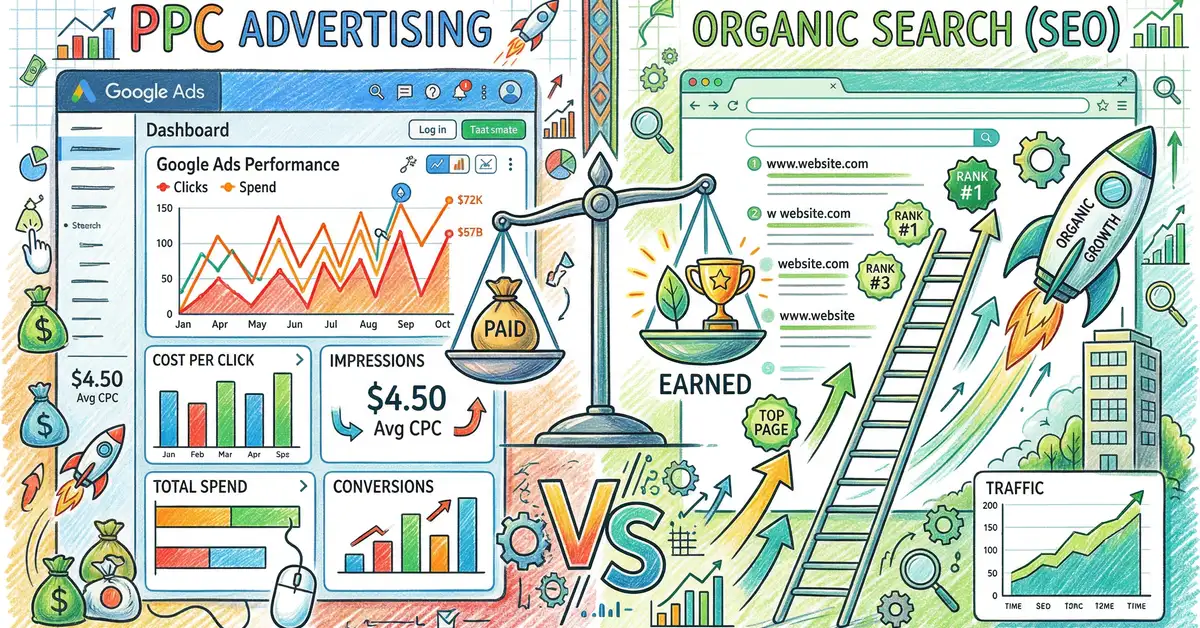
Table of Contents
- SEO vs PPC at a Glance
- What PPC and SEO Actually Cost in the UK
- ROI Comparison: Why SEO Compounds and PPC Plateaus
- When to Prioritise SEO, PPC, or Both
- Budget Allocation Framework by Company Stage
- Why the Best B2B Strategies Use Both Channels Together
- How AI Search Is Changing the PPC vs SEO Calculus in 2026
- Frequently Asked Questions
748%
Median SEO ROI (3yr, FirstPageSage 2026)
~200%
Average PPC ROI (Google Ads)
£1.72
UK average CPC (LocaliQ 2025)
SEO vs PPC at a Glance
SEO builds compounding organic visibility over months; PPC buys immediate visibility at a per-click cost. Here is how they compare across the metrics that matter most to UK B2B decision-makers.
| Factor | SEO | PPC |
|---|---|---|
| Time to results | 3–6 months | Hours |
| UK monthly cost (typical) | £1,000–£5,000 agency | £500–£10,000+ (spend + management) |
| Cost per click | Free once ranking | £0.66–£3.65 avg (up to £50+ B2B) |
| 3-year ROI | 748% median (compounds) | ~200% (fixed/diminishing) |
| UK cost per lead (B2B avg) | £165 (Sopro 2025) | £224 (Sopro 2025) |
| Traffic when you stop paying | Declines gradually over months | Stops immediately |
| B2B trust level | 81% trust organic over paid | Lower perceived trust |
| Best for B2B when… | Building authority, long sales cycles, thought leadership | Product launches, quick leads, ABM, remarketing |
What PPC and SEO Actually Cost in the UK
Most PPC vs SEO comparisons use US dollar figures. Here are real UK costs in GBP that you can use in budget proposals.
UK Google Ads CPC by B2B Industry
| Industry | Estimated UK CPC | Notes |
|---|---|---|
| Legal services | £5.53–£7.13+ | Among highest CPC sectors |
| Financial services | £4–£8+ | Insurance highest overall |
| B2B SaaS / technology | £4–£40 | Enterprise keywords £80+ |
| Professional services | £3–£7 | Competitive vertical |
| Healthcare / medical | £2–£5 | Moderate competition |
| Manufacturing | £1.50–£4 | Lower competition on niche terms |
Sources: Statista UK (Dec 2024), PPC Geeks, LocaliQ 2025 UK benchmarks. UK CPCs are generally 20–40% lower than US equivalents.
UK Agency Costs: SEO vs PPC Management
SEO Agency Retainers
Small business: £800–£1,500/mo
Mid-market: £1,500–£3,000/mo
Enterprise: £3,000–£10,000+/mo
Minimum viable B2B SEO: £1,500/mo. Budgets under £1,000 produce minimal B2B results.
PPC Management Fees
% of ad spend: 10–20% (SME), 5–10% (enterprise)
Fixed retainer: £300–£5,000+/mo
Setup fee: £500–£2,000 (one-time)
Plus ad spend on top. London agencies average £1,200/mo management vs £950 regional. Contact Whitehat for a bespoke pricing proposal.
ROI Comparison: Why SEO Compounds and PPC Plateaus
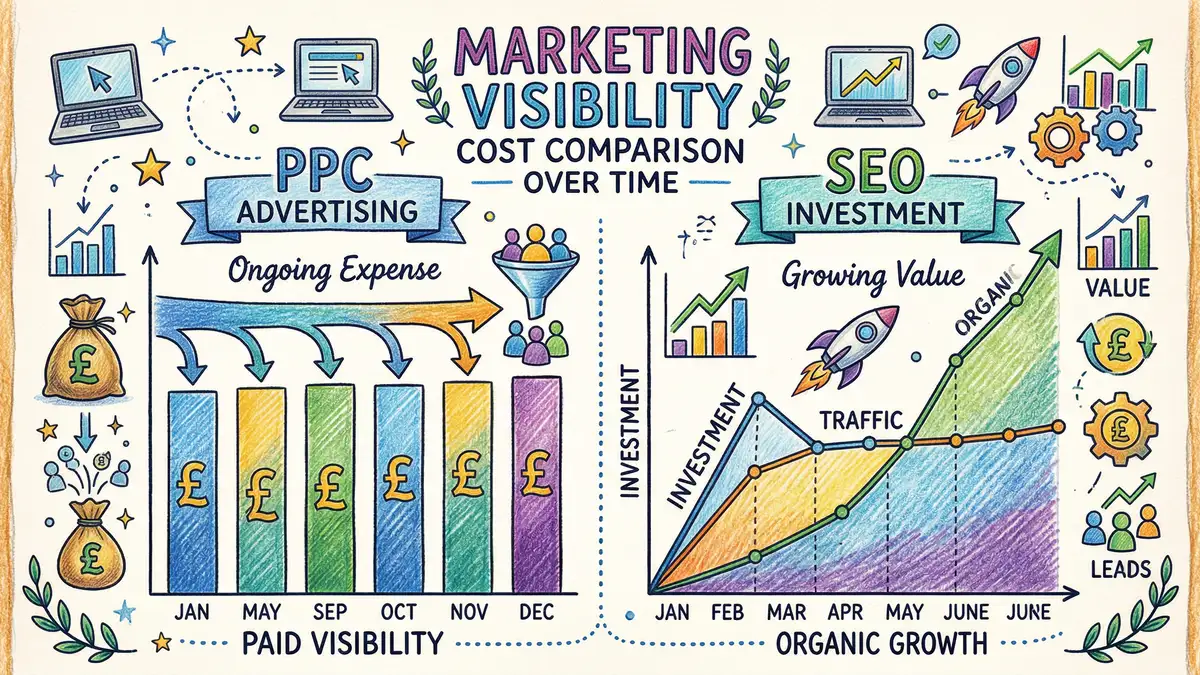
The fundamental difference between the two channels is their cost curve. PPC delivers a linear return — you spend, you get clicks, you stop, they stop. SEO builds an asset that compounds. According to FirstPageSage (2026), the median B2B SEO ROI reaches 748% over three years, meaning £7.48 returned for every £1 invested.
PPC averages approximately 155–200% ROI — roughly £2 for every £1 spent. That is still profitable, but the returns plateau and often diminish as CPCs increase. UK B2B CPCs rose 28% year-on-year according to LocaliQ's 2025 UK benchmark data, and 87% of industries saw CPC increases in 2024–2025.
The Crossover Point
SEO typically surpasses PPC ROI at the six-to-nine-month mark for well-executed campaigns. By month nine onward, SEO delivers five to ten times the return of PPC. The analogy holds: SEO is buying a house (building equity), PPC is renting (no long-term asset).
| Industry | SEO ROI (3yr avg) | SEO Break-Even | PPC ROI (avg) |
|---|---|---|---|
| Real estate | 1,389% | ~8 months | ~200% |
| Financial services | 1,031% | ~9 months | ~200% |
| B2B SaaS | 702% | ~7 months | ~155% |
| All industries median | 748% | 6–9 months | ~200% |
Source: FirstPageSage 2026 (thought-leadership campaigns). Note: represents well-executed campaigns, not average implementations.
Click-Through Rates: Organic vs Paid
Organic position one captures 39.8% of all clicks (FirstPageSage 2026), whilst the top paid ad averages just 2.1% (Sistrix). That is a 19:1 ratio. Overall, organic results receive 94% of all clicks versus 6% for paid — though for commercial queries, paid captures a larger share (roughly one-third of clicks in product categories, according to ALM Corp/Similarweb, January 2026).
When to Prioritise SEO, PPC, or Both
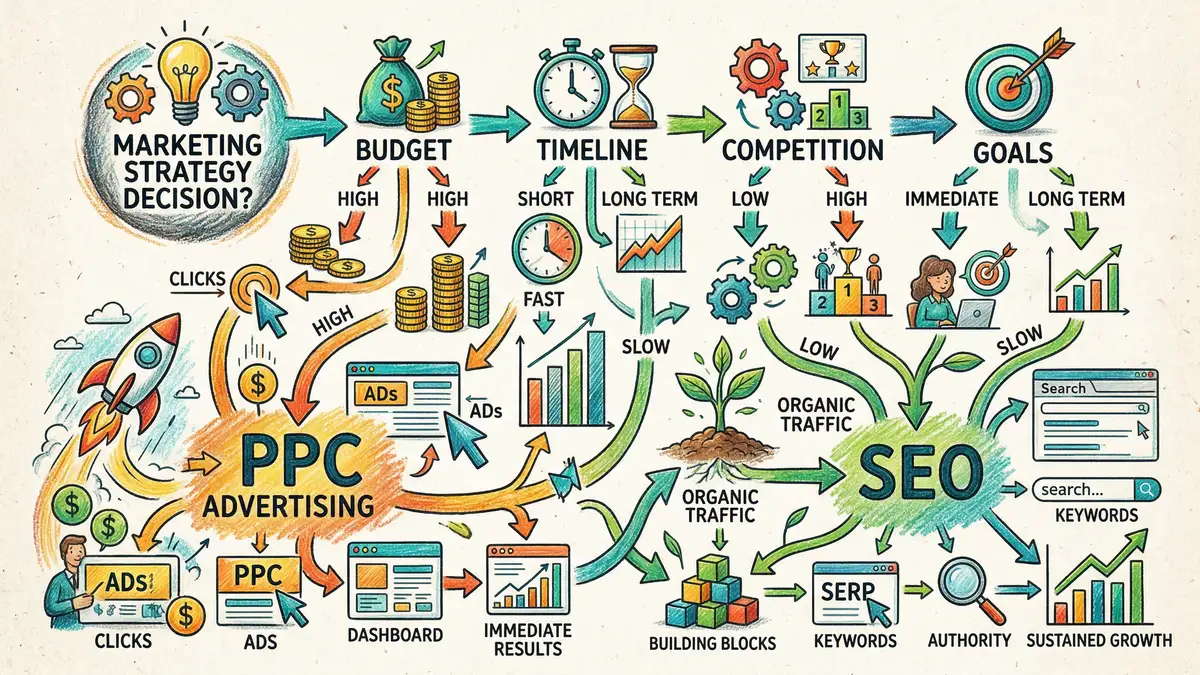
The right channel depends on your specific situation, not a blanket recommendation. B2B buyers have sales cycles spanning 5–18 months with up to 15 stakeholders involved in enterprise purchases. According to Gartner, B2B buyers spend only 17% of buying time in direct vendor contact — the rest is self-guided research where your content needs to be visible.
Prioritise SEO When…
- Your sales cycle is 6+ months and needs multiple touchpoints
- You are building thought leadership in your sector
- Contract values exceed £50K and even small conversion volumes are profitable
- CPCs in your sector are prohibitive (£10+ per click)
- Multiple stakeholders need different content — SEO serves persona-specific pages
- You want a durable competitive moat — domain authority takes years to replicate
Prioritise PPC When…
- You are launching a new product or service and need immediate visibility
- You have pipeline gaps and need leads within days, not months
- You are entering a new market against established competitors
- You are running ABM campaigns targeting specific companies or job titles
- You need brand defence — without brand ads, 40% of clicks leak to competitors
- You want to test keyword viability before committing months to SEO content
Budget Allocation Framework by Company Stage
For most established UK B2B companies with budgets above £3,000 per month, the right answer is both channels working together. The split depends on where you are in your growth journey.
| Company Stage | PPC | SEO | UK Monthly Spend | Rationale |
|---|---|---|---|---|
| Startup (0–2 yrs) | 60–70% | 30–40% | £3,000–£5,000 | Need an immediate pipeline. PPC data informs SEO content priorities. |
| Growth (2–5 yrs) | 40–50% | 50–60% | £5,000–£10,000 | Organic foundations maturing. Reduce PPC on terms where organic ranks. |
| Established (5+ yrs) | 20–30% | 70–80% | £8,000–£15,000+ | Strong organic base compounds. PPC for launches, defence, remarketing. |
Recommended Split by Industry
| Vertical | SEO : PPC | Why |
|---|---|---|
| Professional services | 70 : 30 | Extremely high CPCs (£8–£50+), trust and thought leadership critical |
| B2B SaaS | 65 : 35 | Complex buyer journeys, multiple stakeholders, high content consumption |
| Healthcare / medtech | 65 : 35 | YMYL requires E-E-A-T, trust paramount, regulatory requirements |
| Manufacturing | 60 : 40 | Niche keywords, long sales cycles, lower CPCs |
| Technology / IT | 50 : 50 | Competitive in both channels, need full-funnel coverage |
| Recruitment / staffing | 40 : 60 | Time-sensitive roles, seasonal hiring, immediate visibility needed |
Why the Best B2B Strategies Use Both Channels Together
Owning both the top paid and top organic position for a search term captures approximately 49% of all clicks. According to Google's own research, 89% of PPC traffic is incremental — it does not simply replace organic clicks. Even with a number one organic ranking, paid ads provide 50% additional clicks.
The practical integrations that drive results for UK B2B companies include using PPC search term reports to identify high-converting keywords worth targeting with SEO content, testing keyword viability via PPC before investing months in organic content, retargeting organic visitors who did not convert through PPC remarketing across Google Display and LinkedIn, and using high-CTR PPC ad copy to inform SEO title tags and meta descriptions.
The combined approach is particularly powerful for B2B because buyers spend 83% of their journey in self-guided research. SEO builds the content they discover during that research phase, whilst PPC remarketing keeps your brand visible as they move towards a decision. Explore our integrated marketing services to align both channels.
How AI Search Is Changing the PPC vs SEO Calculus in 2026
AI Overviews now appear on approximately 15–25% of Google searches, with commercial query triggers rising from 8% to nearly 19% throughout 2025. This affects both channels significantly.
Impact on SEO
Position one CTR drops 47–61% when an AI Overview is present (Ahrefs/Seer Interactive 2025–2026). Zero-click searches have reached 58–60% overall and 93% in Google's AI Mode. However, 92% of AI Overview citations come from domains ranking in the top 10 — strong SEO fundamentals remain the foundation for AI visibility.
Impact on PPC
Paid CTR dropped from 19.7% to 6.34% on AI Overview queries — a 68% decline (Seer Interactive). However, text ads gained 7–13 percentage points of previously organic traffic. Google is actively creating new paid inventory within AI features, and AI Max campaigns are delivering 14–18% more conversions at similar CPA.
The emerging consensus is that the question is no longer "SEO vs PPC" but "SEO vs PPC vs AI visibility." The winning strategy combines PPC for harvesting high-intent demand today, SEO and answer engine optimisation (AEO) for building the authority infrastructure AI engines cite, and monitoring your brand's presence across ChatGPT, Perplexity, and Google AI Overviews.
AI-referred traffic converts dramatically better — 14.2% versus Google's 2.8% according to Exposure Ninja — and AI-referred sessions surged 527% between January and May 2025. Companies investing in AEO alongside traditional SEO are positioning themselves for where search is heading. See our content marketing strategies to strengthen your authority.
Frequently Asked Questions
What is the difference between PPC and SEO?
SEO improves your website's visibility in organic (unpaid) search results through content creation, technical optimisation, and link building. PPC places paid advertisements at the top of search results, and you pay each time someone clicks. SEO compounds over time whilst PPC stops the moment you stop spending.
Is SEO or PPC better for B2B companies?
For most UK B2B companies, a combined approach works best. SEO delivers higher-quality leads at lower long-term cost — organic search converts at roughly 2.2 times the rate of paid. However, PPC is invaluable for product launches and generating leads whilst SEO builds momentum. Many B2B marketers start 60/40 PPC-to-SEO and shift towards SEO as organic rankings grow.
How much does PPC cost compared to SEO in the UK?
The average UK Google Ads cost-per-click ranges from £0.66 to £3.65, though competitive B2B keywords can reach £7–£50+ per click. SEO services from a UK agency typically cost £1,000–£5,000 per month. The key difference is that SEO costs decrease per lead over time as rankings compound, whilst PPC requires continuous spend. Contact us for a bespoke pricing proposal.
How long does SEO take to show results compared to PPC?
PPC can drive traffic within hours. SEO typically takes 3–6 months for meaningful ranking improvements, with peak results in years 2–3. For UK B2B companies with longer sales cycles, expect 6–12 months before SEO delivers measurable pipeline impact. Once established, SEO content generates leads for years without additional per-click costs.
Can PPC and SEO work together?
Yes — the most effective UK B2B strategies integrate both. Use PPC data to identify high-converting keywords for SEO content. Run PPC to drive traffic whilst building organic rankings. Retarget organic visitors with PPC to nurture leads through long B2B sales cycles. Studies show appearing in both paid and organic results captures approximately 49% of all clicks.
Does paying for Google Ads improve my organic rankings?
No. Google has confirmed that paying for PPC ads does not directly improve organic search rankings — they are separate systems. However, PPC can indirectly benefit SEO by increasing brand awareness, providing keyword conversion data to inform SEO strategy, and driving traffic to pages that may earn backlinks.
What is the ROI of SEO vs PPC for UK businesses?
SEO typically delivers 500–748% ROI over a 3-year period for well-executed campaigns, compounding over time. PPC averages approximately 155–200% ROI (roughly £2 return per £1 spent). The average UK B2B cost per lead via organic search is approximately £165, whilst PPC-generated leads cost £224 according to Sopro 2025 benchmarks.
How should I split my budget between SEO and PPC?
Start 60/40 or 70/30 favouring PPC when you need immediate leads, then shift towards 60–70% SEO as organic rankings mature. Startups typically allocate 60–70% to PPC; growth-stage companies move to 50/50; established businesses allocate 70–80% to SEO. Review quarterly based on channel performance data.
Should a small business invest in SEO or PPC first?
If you need leads immediately, start with PPC — even £500–£1,000 per month can generate enquiries within days. Simultaneously begin building SEO foundations. As organic traffic grows over 6–12 months, gradually reduce PPC spend on keywords where you rank organically. Local SEO and long-tail keywords are often more cost-effective than competing on expensive PPC terms.
Is SEO still worth investing in with AI search and Google AI Overviews?
Yes. Organic search still drives 53% of all website traffic, and 92% of AI Overview citations come from domains ranking in the top 10. For UK B2B companies, creating authoritative content that AI systems want to cite is essential. Companies optimising for both SEO and AEO are best positioned for 2026 and beyond. Explore our B2B lead generation strategies for authority-building approaches.
Ready to move from "SEO vs PPC" to "SEO and PPC"? Our free audit analyses your current organic performance, paid spend efficiency, and competitive landscape — then recommends a channel allocation based on your specific market position and growth goals.
About the Author
This guide is maintained by the Whitehat SEO research team. We combine proprietary B2B SEO data with publicly available benchmarks from FirstPageSage, LocaliQ, Sopro, and Seer Interactive to deliver practical, UK-focused guidance. Updated February 2026 to reflect 2025 market data and 2026 AI search developments.
Methodology: Cost and ROI data sourced from FirstPageSage (2026), LocaliQ UK Industry Benchmarks (2025), Sopro B2B CPL Study (2025), PPC Geeks, Statista UK, and Seer Interactive. All figures converted to GBP at ~£0.80/$1 where necessary. UK CPCs are generally 20–40% lower than US equivalents. SEO ROI figures from FirstPageSage represent well-executed thought-leadership campaigns, not average implementations. AI search data from Semrush (10M+ keywords) and Pew Research Center. This article was last updated February 2026.