
B2B Podcasting for UK Businesses: Strategy, ROI & Pipeline Growth Guide 2026
By Clwyd Probert | Published: 22 March 2026 | Last Updated: 22 March 2026
B2B decision-makers spend over 7 hours weekly listening to podcasts, with 93% completing entire episodes. The UK podcast advertising market reached £750 million in 2024 and is projected to hit £1.4 billion by 2030. Yet 75% of B2B podcasts fail to demonstrate ROI because they focus on vanity metrics instead of pipeline attribution. This guide shows UK business leaders how to build podcasts that drive measurable revenue growth.
Why B2B Podcasting Has Become Essential for UK Businesses
The global podcast audience reached 584 million listeners in 2025, with UK weekly podcast listeners now exceeding 16 million—a 54% increase since 2020. More crucially for B2B marketing: podcast listeners demonstrate exceptional engagement. 93% of podcast listeners complete most or all episodes, compared to just 12% for video content and 20% for blog posts.
Key B2B Podcast Statistics (2025-2026)
- 16 million UK weekly listeners (+54% since 2020)
- 50% of B2B marketers plan to increase podcast investment in 2025
- 93% episode completion rate (vs. 12% video, 20% blog)
- £750 million UK advertising market in 2024 (growing 9.8% annually)
- 42% of UK adults listen monthly; 30-34% listen weekly
- 3x higher brand recall vs. digital audio; 1.5x conversion rates
- Average B2B podcast CPM: £14-37 with 4.9x ROAS in UK
For UK B2B companies targeting decision-makers (ages 35-54), podcasts offer direct access to an engaged, high-value audience. Edison Research data shows 78% of business podcast listeners tune in weekly, and these listeners are 2.5x more likely to hold senior positions than non-listeners. The opportunity is clear: UK per-capita podcast ad spend sits at just £1.20 compared to £5.25 in the US—yet UK podcast advertising delivers 4.9x return on ad spend versus 3.7x media average. This gap means UK B2B companies entering podcasting now face less competition while reaching highly receptive audiences.
Podcast Demographics: Who's Actually Listening
| Age Group | Monthly Listeners | Weekly Listeners | Weekly Hours |
|---|---|---|---|
| 35-54 (Prime B2B Target) | ~50% | 34% | 7+ hours |
| 18-34 | Majority | 41% (highest) | 6+ hours |
| 55+ | 28% (+8% YoY) | 18% | 5+ hours |
| Women (UK) | 39% (+8% from 2023) | 26% | 5 hrs 27 min |
Building a B2B Podcast Strategy That Drives Pipeline
Successful B2B podcasts start with audience definition, not content ideas. Creating detailed buyer personas helps identify specific questions your target listeners need answered, the daily challenges they face, and their format preferences. A marketing director commuting into London has entirely different needs than a remote operations manager in Manchester.
Step-by-Step: Launch Your B2B Podcast
- Define Your Niche — Choose a topic narrow enough that listeners immediately understand your positioning yet broad enough to sustain 50+ episodes. Example: "B2B SaaS pipeline acceleration" rather than "general business advice."
- Create Buyer Personas — Document job titles, pain points, listening habits, and industry challenges. Use LinkedIn insights and CRM data to validate assumptions.
- Select Your Format — Interview shows leverage guest networks; solo episodes build stronger host relationships; hybrid formats combine both. Video can be added after audio-only workflows stabilise.
- Plan Content Pillars — Develop 8-10 broad topics that align with your ICPs' buying journey. This ensures 50+ episodes without repetition.
- Set Up Infrastructure — Select hosting (Transistor, Captivate, Riverside), recording tools (Riverside.fm, Squadcast), and editing software (Descript).
- Configure Attribution — Create dedicated landing pages per episode, add podcast source to HubSpot forms, implement UTM parameters on all links.
- Publish Consistently — Weekly publishing builds fastest, but fortnightly works for resource-constrained teams. Consistency trumps frequency.
- Measure Influenced Revenue — Track self-reported podcast attribution, landing page conversions, CRM touchpoints, and attributed pipeline. Ignore download counts.
Podcast Format Selection for UK B2B
Interview format remains popular because it leverages guest networks for promotion and provides expert perspectives. However, solo episodes and co-hosted formats often build stronger listener relationships because audiences connect with consistent hosts. Most successful B2B podcasts combine formats—perhaps weekly solo episodes with monthly guest interviews.
Video podcasts now represent 36% of all podcast content and grow 35% faster than audio-only shows. Yet 92% of podcast consumers still primarily listen rather than watch. For UK B2B companies, starting with audio-only minimises production complexity while allowing clips for social media. Video can be added once workflows stabilise.

Essential Podcast Equipment and Software Stack
Quality audio matters more than fancy equipment. Listeners tolerate imperfect video but abandon podcasts with poor sound within seconds. Fortunately, professional-quality business podcasts require modest investment—typically £300-£800 for a complete setup that will serve for years.
Equipment & Software Recommendations
Microphone Options by Budget
| Budget Tier | Recommended Microphone | UK Price | Key Benefit |
|---|---|---|---|
| Entry (Under £100) | Samson Q2U or Audio-Technica ATR2100x | £60-£80 | USB/XLR dual output, upgrade path |
| Mid-Range (£100-£250) | Shure MV7+ or RØDE PodMic USB | £100-£220 | Studio-quality sound, portable |
| Professional (£300+) | Shure SM7dB or Electro-Voice RE20 | £350-£450 | Broadcast quality, lasting investment |
Recommended setup: Pair any microphone with a boom arm (£25-£50), pop filter (£10-£20), and quality headphones (£50-£100) for a complete recording setup. The Samson Q2U offers exceptional value for UK business podcasters because its dual USB/XLR output allows simple setup now with an upgrade path later.
Recording & Editing Software Stack
Recording (Remote Guests)
- Riverside.fm or Squadcast — Local device recording prevents internet quality loss
- Free tier available; paid plans £12-£24/month
- Essential for multi-guest remote interviews
Editing (Post-Production)
- Descript — Text-based editing cuts 50-70% edit time
- Free tier: 3 hours transcription monthly; paid £12/month
- Auto-generates show notes and highlights
Podcast Distribution Strategy for UK Audiences
YouTube has emerged as the primary podcast discovery platform, with one-third of UK listeners finding new shows there. Among Gen Z, 84% discover podcasts via YouTube. For B2B podcasts, this means publishing full episodes on YouTube—even audio-only with a static image—captures significant discovery traffic that podcast-only distribution misses.
UK Platform Distribution: Where to Prioritise
| Platform | UK Market Share | Priority Level | Notes |
|---|---|---|---|
| Spotify | 33% | 1 (Top) | Largest dedicated platform; algorithm favours consistency |
| YouTube | 20% + discovery | 1 (Top) | Primary discovery channel; Gen Z dominant; must-have |
| BBC Sounds | 15-16% | 2 (Secondary) | Uniquely British; older demographic; quality seal |
| Apple Podcasts | 10-13% | 2 (Secondary) | Lower UK share than US; still important |
| Amazon Music | Variable | 3 (Optional) | Via RSS syndication; auto-uploaded |
Distribution tip: Submit your podcast to all major platforms through your hosting service (Transistor, Captivate, Riverside), but allocate marketing effort to Spotify and YouTube first. LinkedIn drives 3x more B2B podcast engagement than Apple Podcasts discovery.
LinkedIn Promotion Strategy for B2B Podcasts
Native video with 15-second hooks and captions generates 8x more engagement than simple podcast link posts. Rather than announcing "new episode is live," share compelling stories, guest quotes, or surprising insights from each episode. Tag guests to tap their networks and post links in comments to preserve algorithmic reach.
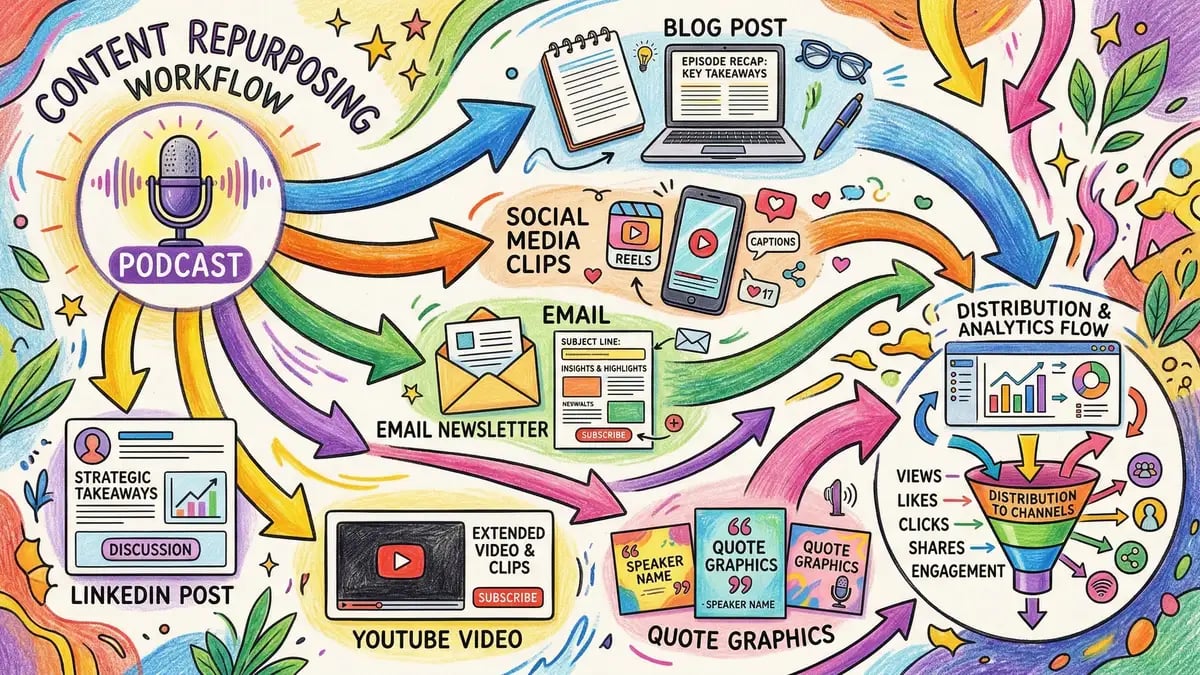
Content marketing strategy helps B2B companies repurpose each podcast episode into 10-15 pieces of content: blog posts, video clips, audiograms, quote graphics, and newsletter content. This multiplied presence reinforces the "Rule of 7"—prospects need approximately seven touchpoints before engaging with a brand. A single podcast episode can provide that entire touchpoint sequence.
Podcast Attribution and HubSpot Integration
HubSpot Content Hub provides native podcast management including episode hosting, automatic transcription, AI-powered show notes, and built-in analytics. More importantly, HubSpot enables closed-loop attribution connecting podcast listeners to pipeline—something standalone podcast platforms cannot achieve.
Building Podcast Attribution in HubSpot
- Create Custom Contact Properties — Add "Podcast Listener" property (true/false) and "Podcast Episodes Consumed" (list). This captures engagement history.
- Add Podcast Source to Forms — Include "How did you hear about us?" field with "Podcast" as an option. Make this the default for episode landing pages.
- Implement UTM Parameters — Use UTM parameters consistently across all podcast links: utm_medium=podcast, utm_source=episode-name, utm_campaign=q1-2026.
- Build Episode-Specific Landing Pages — Create one landing page per episode with episode title, transcript excerpt, and form. This enables per-episode performance tracking.
- Track in Multi-Touch Attribution — Configure HubSpot workflows to identify opportunities influenced by podcast touchpoints. Measure attributed pipeline, not downloads.
- Connect to Revenue — Build custom reports showing "Podcast-Influenced Opportunities," "Podcast-Influenced Revenue," and "Podcast Listener Conversion Rate."
The data justifies the effort. Fame's analysis of 100+ B2B podcasts found shows generating £500k+ in pipeline averaged just 2,500 downloads per episode—proving podcast ROI comes from listener quality, not quantity. Meeting bookings from podcast CTAs convert at 34% compared to 8% for cold outreach. One SaaS company attributed 47% of enterprise deals to podcast listener touchpoints.
Measuring B2B Podcast ROI Beyond Vanity Metrics
Download counts reveal almost nothing about business impact. 75% of B2B podcasts fail to demonstrate measurable ROI because they focus on vanity metrics. Fame's research found zero correlation between download counts and attributed revenue. Instead, track metrics that connect to pipeline: self-reported attribution mentions, landing page conversions, CRM touchpoint attribution, and brand search volume changes.
Key ROI Metrics to Track (Not Download Counts)
- Attributed Pipeline: Opportunities created with podcast as influence touchpoint
- Attributed Revenue: Closed-won deals influenced by podcast listening
- Conversion Rate: Percentage of podcast listeners who convert to leads/customers
- Average Deal Value: Revenue value of deals influenced by podcast vs. other channels
- Sales Cycle Length: Time from first podcast touchpoint to deal close
- Brand Search Lift: Increase in branded search volume correlated with new episode releases
- Meeting Booking Rate: % of podcast landing page visitors who book demos/calls
- Listener Retention: Percentage of listeners who subscribe after first episode
Realistic podcast benchmarks help set expectations. Top 50% of podcasts achieve 28+ downloads in the first seven days per episode. Top 20% reach 1,000+ downloads per episode. But a B2B podcast with 500 downloads per episode reaching exactly the right decision-makers can outperform a general business podcast with 50,000 downloads reaching irrelevant audiences.
AI Tools Transforming Podcast Production in 2026
The AI in podcasting market reached £1.7 billion in 2023 and is projected to hit £20 billion by 2033. Currently, 61% of podcasters plan to integrate AI tools into production, while 70% already use AI transcription. These tools dramatically reduce production time without requiring technical expertise.
Essential AI Tools for Podcast Production
Descript
- Remove filler words automatically
- Create highlight clips from transcript
- Generate show notes
- Time saved: 50-70% vs. manual editing
Riverside Magic Clips
- Identify potentially viral moments
- Auto-generate social-ready clips
- Multiple format templates
- Distribute across platforms
OpusClip
- Generate 10-15 short-form videos per episode
- Optimised for TikTok, Instagram Reels, YouTube Shorts
- Automatic captions and branding
- Multi-platform scheduling
Show Notes AI
- Auto-generate comprehensive show notes
- Extract key topics and timestamps
- Create transcripts with speaker labels
- Optimise for SEO
Impact on production time: For UK businesses concerned about resource requirements, AI tools reduce per-episode time investment from 8-10 hours to 2-3 hours. This makes fortnightly or weekly publishing sustainable for teams without dedicated podcast producers.
UK Advertising Regulations for Business Podcasts
The ASA/CAP Non-broadcast Code applies to podcast advertising in the UK. Sponsored content and advertisements must be "obviously identifiable" with disclosure before or as the ad starts—not during or after. The terms "paid-for advertisement" and "sponsored" are recognised most effectively by listeners. Both brands and podcast creators share legal responsibility for compliance.
For B2B podcasts featuring vendor mentions or partnership content, err toward over-disclosure. A simple "This episode is sponsored by..." at the beginning protects both host and sponsor. Guest interviews promoting specific products should acknowledge any commercial relationship. These requirements apply whether monetising through advertising or simply featuring business partners.
Frequently Asked Questions About B2B Podcasting
How much does it cost to start a B2B podcast in the UK?
A professional B2B podcast requires £300-£800 initial equipment investment plus £20-£50 monthly for hosting and tools. Total first-year costs typically range from £500-£1,500 for self-produced shows, or £2,000-£5,000 monthly for agency-produced podcasts with full production support.
How long should B2B podcast episodes be?
B2B podcast episodes perform best between 20-45 minutes. Shorter episodes (under 20 minutes) struggle to deliver substantive value, while episodes exceeding 60 minutes see significant drop-off. Interview episodes tend to run longer; solo episodes work well at 15-25 minutes. 93% completion rates occur at this duration range.
How often should a B2B company publish podcast episodes?
Weekly publishing builds audience fastest, but fortnightly works well for resource-constrained teams. Consistency matters more than frequency—listeners who expect Tuesday episodes disengage when publishing becomes erratic. Start with a sustainable cadence and increase later if capacity allows.
How long before a B2B podcast generates leads?
Most B2B podcasts require 6-12 months of consistent publishing before generating measurable pipeline. Early episodes build audience and authority; lead generation accelerates as listener base grows. Companies expecting immediate ROI often abandon podcasts before they reach effectiveness—patience and consistency matter.
Should B2B podcasts include video or audio only?
Start with audio-only to minimise production complexity, then add video once workflows stabilise. Audio-only podcasts achieve 150% higher completion rates than video. However, video provides valuable clips for social promotion—consider recording video specifically for clip creation even if the primary podcast remains audio.
How do I attribute podcast listeners to revenue in HubSpot?
Create custom contact properties for podcast attribution, add "podcast" as a source option in conversion forms, use UTM parameters on episode links, build dedicated landing pages per episode, and include podcast in multi-touch attribution reports. Our HubSpot onboarding includes podcast integration setup as part of comprehensive content workflows.
Ready to Launch Your B2B Podcast?
Transform Your Podcast into a Revenue-Generating Machine
Whitehat helps UK B2B companies develop podcast strategies that connect to pipeline through HubSpot attribution. From audience definition and content planning to distribution, AI production optimisation, and ROI measurement, our integrated approach ensures podcast investment delivers measurable business results.
Key References and Sources
- Grand View Research. UK Podcast Advertising Market Size & Outlook 2025-2030. Accessed March 2026. grandviewresearch.com
- Podnews. UK Audio Ad Growth Slows. April 2025. podnews.net
- LRB Media. Podcast Statistics in the UK 2025. July 2025. lrb-media.co.uk
- Captivate FM. Record Number of UK Podcast Listeners: Official 2024 Data. June 2024. captivate.fm
- Content Allies. Top 12 Emerging B2B Podcasting Trends in 2026. March 2026. contentallies.com
- Fame. 2025 B2B Podcasting Trends: Data, Insights, and What Actually Works. July 2025. fame.so
- CommandYourBrand. 2025 Podcast Advertising Data: Reach, ROI, and Listener Behavior. October 2025. commandyourbrand.com
About the Author
Clwyd Probert
CEO, Whitehat SEO Ltd
Clwyd is a London-based HubSpot Diamond Solutions Partner and founder of Whitehat SEO. He leads the world's largest HubSpot User Group (8,000+ members), lectures on digital marketing at UCL, and advises 40+ UK B2B companies on content-driven pipeline growth. His practical expertise in podcast attribution via HubSpot has helped clients attribute £2M+ in revenue to podcast listening. Connect on LinkedIn.