
PPC Management
The UK B2B market has shifted. Google Ads are no longer optional—they're essential to capturing high-intent buyers at the moment they search for solutions. But without proper strategy, CRM integration, and bid management, you'll burn budget without building pipeline.
Google Ads for B2B: The Complete UK Strategy Guide [2026]
B2B Google Ads success in 2026 requires three elements: (1) a multi-campaign structure segmented by intent and audience, (2) CRM integration with value-based bidding, and (3) continuous negative keyword refinement. UK advertisers using this approach see 3× more qualified pipeline with 13% lower cost per click than US counterparts.
What Are B2B Google Ads?
B2B Google Ads are paid search campaigns designed to capture high-intent business buyers actively searching for solutions. Unlike B2C, B2B campaigns target multiple decision-makers, longer sales cycles (30-180 days), and higher customer lifetime value.
The core difference: B2C optimises for immediate transactions. B2B optimises for qualified lead generation and pipeline acceleration.
| Attribute | B2B Google Ads | B2C Google Ads |
|---|---|---|
| Decision-Makers | Multiple stakeholders (3-7) | Single individual |
| Sales Cycle | 30–180 days | Same-day to 7 days |
| Primary Goal | Qualified lead generation | Immediate purchase |
| Average Order Value | £10,000–£500,000+ | £20–£5,000 |
| Success Metric | MQL-to-SQL: 7–12% | Conversion Rate: 1–3% |
How Much Do B2B Google Ads Cost in the UK?
B2B Google Ads costs vary significantly by industry, competitive landscape, and keyword intent. The average UK B2B cost per lead is £66.69, but this masks critical sector-specific variations.
| Metric | UK Average (2026) | Variance |
|---|---|---|
| Cost Per Click (CPC) | £2.15 | £0.80–£6.50 |
| Cost Per Lead (CPL) | £66.69 | £49–£120 |
| Conversion Rate (average) | 7.52% | 4%–12% |
| Average Ad Spend (monthly) | £3,500–£8,000 | £500–£50,000+ |
Source: WordStream B2B Benchmark Data (2026), Dreamdata Industry Report
| Industry Sector | Average CPL (UK) | Lead Quality Range |
|---|---|---|
| B2B SaaS | £60–£200 | High (MQL-to-SQL: 15–25%) |
| Professional Services | £65–£105 | Very High (MQL-to-SQL: 20–35%) |
| Manufacturing/Industrial | £50–£80 | High (MQL-to-SQL: 12–20%) |
| Enterprise Software | £120–£300 | Very High (MQL-to-SQL: 25–40%) |
| Consulting | £70–£110 | High (MQL-to-SQL: 18–28%) |
Source: Dreamdata 2026 B2B Industry Benchmarks
How to Build a B2B Google Ads Campaign Structure
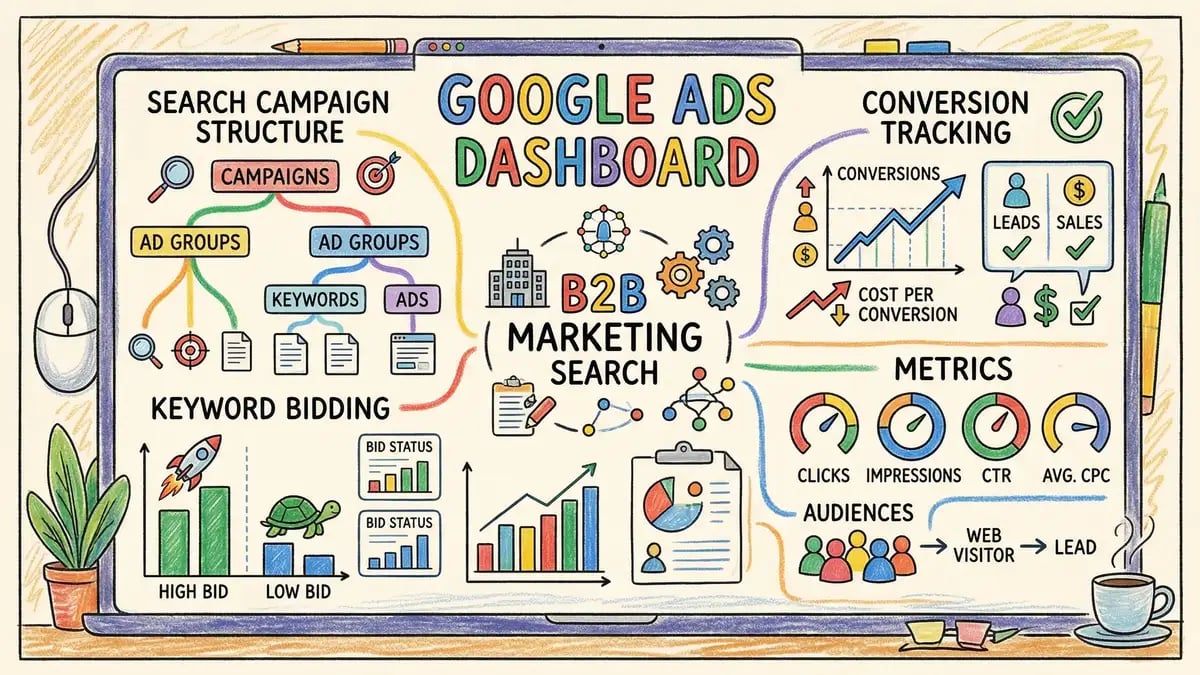
Successful B2B campaigns use multi-campaign segmentation to isolate bidding strategies, negative keywords, and performance metrics. The standard structure is five campaigns: Brand, Non-Brand High-Intent, Non-Brand Broad Discovery, Competitor, and Remarketing.
Brand Campaign (Exact Match)
Target your company name and branded keywords using exact match only. Set a separate budget. Use a single ad group per brand variant. This campaign typically has the lowest CPC and highest conversion rate (15–40%). Negative keywords: competitor names.
Non-Brand High-Intent Campaign (Exact + Phrase Match)
Target high-intent problem keywords: "best CRM software UK," "B2B email marketing platform," "HubSpot alternative." Use exact and phrase match. Smart Bidding with target CPA. This is your primary lead generation engine. Negative keywords: free, open source, personal use.
Non-Brand Broad Discovery Campaign (Broad Match)
Use broad match keywords with Smart Bidding and value-based bidding. This campaign discovers new, high-intent searches your keyword research missed. Budget lower than High-Intent. Monitor search terms weekly and convert high-performers to exact keywords. Negative keywords: extensive list from High-Intent campaign.
Competitor Campaign (Exact Match)
Target competitor names: Salesforce, Marketo, HubSpot, Pipedrive, etc. Position your solution as the alternative. Higher CPC expected. Use ad copy focused on differentiation and ROI. Separate budget and bid management. High ROI for B2B SaaS.
Remarketing Campaign (Broad Match)
Target users who have visited your website in the last 30–90 days. Lower bids and broader match types (broad match OK here). The goal is pipeline nurturing and brand recall, not conversion. Segment by page type: pricing visitors, case study readers, demo requesters.
The 2026 Google Ads Changes B2B Advertisers Must Know
Google's 2025–2026 roadmap has fundamentally reshaped how B2B advertisers bid, target, and measure. The shift toward AI-driven bidding and Performance Max continues to accelerate, while several legacy tools have been deprecated.
1. Expanded Reach of Demand Gen (formerly Display & Video)
Google has merged Display and Video campaigns into a unified "Demand Gen" format. This channel now reaches B2B professionals on YouTube, Gmail, Discover, and Google's Performance Network with richer visual formats and improved B2B audience targeting.
2. AI Max Campaigns Are Mandatory
Performance Max and AI Max (Google's unified AI bidding layer) are now the recommended path for B2B campaigns. Manual CPC bidding remains available but performance typically lags behind AI-driven Smart Bidding by 15–25%.
3. Enhanced CPC Deprecation
Enhanced CPC will be fully sunset in Q3 2026. Campaigns still using ECPC must migrate to Smart Bidding (Target CPA, Target ROAS) or manual CPC. For B2B, Target CPA paired with HubSpot conversion events is the recommended replacement.
4. AI Overview Integration in SERPs
AI Overviews (Google's generative AI summaries) now appear in 85% of B2B search queries. This has depressed clickthrough rates on organic results (down 18–22%), making paid search capture more critical than ever. B2B keywords now see AI Overview in 60%+ of top queries.
If your account is still using Enhanced CPC, you must migrate to Smart Bidding or manual CPC by Q3 2026. For B2B, we recommend: (1) Migrate High-Intent campaigns to Target CPA with HubSpot conversion events, (2) Migrate Broad Discovery to Target ROAS with value-based bidding, (3) Keep Brand campaigns on manual CPC for full control. Delayed migration may result in campaign pausing in Google Ads.
Ready to audit your Google Ads strategy for 2026 compliance? Our PPC experts will review your bid strategy, campaign structure, and CRM integration.
Schedule Your PPC AuditHow to Connect Google Ads to HubSpot for B2B Attribution
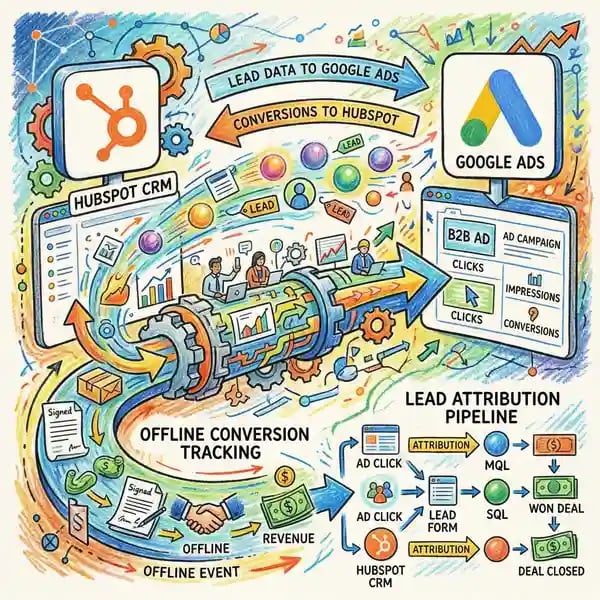
CRM integration transforms Google Ads from a lead generation channel into a pipeline and revenue attribution tool. The key insight: 60% of B2B leads take 3–6 months to close. Without CRM integration, you're only seeing first-click attribution and missing the true ROI.
Why CRM Integration Matters for B2B
B2B companies with Google Ads–to–HubSpot integration see approximately 3× more qualified pipeline than those without. The reason: you're now measuring actual conversion value (SQL, opportunity, deal won) rather than just form submissions.
Enable GCLID Auto-Tagging in Google Ads
Go to Google Ads > Settings > Account Settings > Auto-tagging. Enable "Tag clicks from ads with unique identifiers." This adds a GCLID parameter to every ad click, which HubSpot uses to track the user back to the original Google Ads source.
Connect Google Ads to HubSpot via Data Manager
In HubSpot, navigate to Settings > Integrations > Apps Marketplace, search for "Google Ads," and select the official HubSpot connector. You'll need to authenticate your Google Ads account and grant HubSpot permission to import conversion data. This is the native integration—no third-party tool needed.
Create Conversion Events Based on HubSpot Lifecycle Stage
In Google Ads, create conversion events that trigger when a HubSpot contact moves into specific lifecycle stages: Lead (form submission), MQL (marketing qualified lead), SQL (sales qualified lead), Opportunity, and Won. Each conversion event gets a different value based on historical close probability and deal size.
Assign Conversion Values Using Value-Based Bidding Tiers
Each conversion event gets a tiered value: Lead = £15, MQL = £50, SQL = £150, Opportunity = £500, Deal Won = Full contract value. These values train Google's Smart Bidding to optimise for high-quality outcomes, not just form fills.
Enable Value-Based Bidding in Smart Bidding Campaigns
Switch your Non-Brand Broad Discovery and Remarketing campaigns to "Maximize Conversion Value" bidding. This tells Google to prioritise clicks that lead to high-value outcomes (SQL and above) rather than just any conversion. You'll see fewer total conversions but much higher quality and ROI.
| HubSpot Lifecycle Stage | Conversion Event | Assigned Value | Trigger Condition |
|---|---|---|---|
| Lead | form_submission | £15 | Contact created from website form |
| Marketing Qualified Lead | mql_conversion | £50 | Contact lifecycle stage changed to MQL |
| Sales Qualified Lead | sql_conversion | £150 | Contact lifecycle stage changed to SQL; passed to sales |
| Opportunity | opportunity_created | £500 | HubSpot opportunity created (deal opened) |
| Deal Won | deal_closed_won | Actual deal amount (e.g., £5,000–£50,000) | HubSpot opportunity marked as "Closed Won"; full deal value sent |
Google Ads vs LinkedIn Ads vs Microsoft Ads for B2B
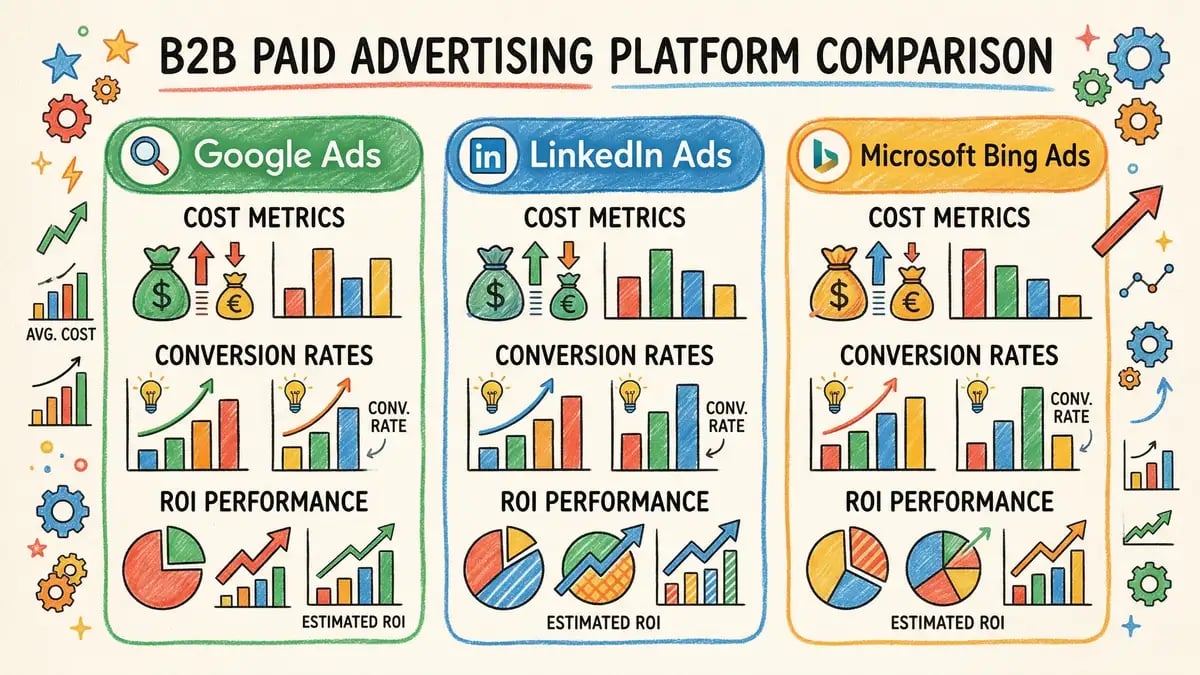
Three platforms dominate B2B paid search: Google Ads (search intent), LinkedIn Ads (audience targeting), and Microsoft Ads (secondary search reach). Each has distinct strengths for different campaign objectives.
| Metric | Google Ads | LinkedIn Ads | Microsoft Ads |
|---|---|---|---|
| Best For | Immediate lead generation; high-intent buyers | Brand awareness; decision-maker targeting; job title intent | Secondary reach; lower competition; budget optimisation |
| Average CPL (UK) | £66.69 | £185–£350 | £40–£80 |
| Conversion Rate | 7.52% (form leads) | 2–4% (engagement) | 5–8% (form leads) |
| Lead Quality | Very High (intent-based) | Medium-High (audience-based) | Very High (intent-based) |
| CRM Integration | Yes (HubSpot, Salesforce native) | Limited (API required) | Yes (Microsoft ecosystem) |
Recommended Multi-Platform Strategy
Tier 1 (Primary): Google Ads search — captures high-intent lead generation. Budget: 60–70% of paid media spend.
Tier 2 (Secondary): Microsoft Ads — captures overflow search traffic at lower cost. Budget: 20–25%.
Tier 3 (Brand Awareness): LinkedIn Ads — builds brand recall and decision-maker awareness. Budget: 10–15%.
The 11 Most Common B2B Google Ads Mistakes
Even well-funded B2B companies make critical mistakes that waste 30–50% of their ad spend. Here are the top 11.
-
Not Segmenting Brand vs Non-Brand Campaigns — Running brand and non-brand keywords in the same campaign inflates brand CPA and masks non-brand performance. Always separate. Brand typically converts 2–3× better than non-brand; mixing them hides this signal from your bidding algorithm.
-
Over-Relying on Broad Match Without Negative Keywords — Broad match without a substantial negative keyword list generates wasted clicks on irrelevant searches. Build your negative keyword list first; then enable broad match. Rule: at least 200 negatives per broad match campaign.
-
Ignoring Search Term Reports — Your search term report reveals what Google's algorithm is actually matching to your keywords. B2B accounts should review search terms weekly, not quarterly. Converting high-intent search terms to exact keywords is free performance lift.
-
Not Using Location and Device Segmentation — B2B traffic from mobile is typically 40–60% of clicks but only 2–5% of conversions. UK regions have vastly different CPCs and competition. Create separate bid adjustments: -30 to -50% for mobile, +15–25% for desktop, -20 to -40% for nights/weekends.
-
Using Manual CPC When Smart Bidding Is Available — Manual bidding requires constant manual adjustment and misses micro-moments of high intent. Smart Bidding (Target CPA, Target ROAS) consistently outperforms manual by 15–25% when properly configured with conversion data.
-
Poor or Missing Form Field Strategy — B2B forms with 5+ fields have 60% lower conversion rates than 2–3 field forms. Progressive profiling (collecting data over time) increases lead volume. B2B forms should ask: name, email, company name, phone. Defer industry, budget, timeline to the follow-up email or call.
-
Not Tracking Offline Conversions — Most B2B deals close outside Google Ads. If you're only measuring form fills, you're blind to true ROI. Set up CRM integration and track MQL, SQL, opportunity, and deal-won conversions in Google Ads.
-
Inadequate Remarketing Budgets — Remarketing to warm prospects costs 60–70% less than cold traffic and converts 3–5× better. Most B2B accounts under-allocate here. Recommendation: 15–20% of total paid budget should go to remarketing audiences.
-
Competitor Bidding Without Differentiation — Bidding on competitor names while using generic ad copy wastes budget. Your ad must articulate a unique value proposition: "Migrate from Salesforce in 48 hours" or "50% lower implementation cost." Competitor campaigns require dedicated, distinctive messaging.
-
Setting Up Conversion Goals Without Assigning Value — A form fill and a closed deal are both "conversions," but they have vastly different values. Google's Smart Bidding is optimising for volume by default. Assign monetary values to each conversion type (MQL = £50, SQL = £150, deal = £10,000). This trains the algorithm to chase quality.
-
Not Aligning SLAs Between Marketing and Sales — If sales is ignoring leads within 48 hours, your Google Ads ROI collapses. Establish an SLA: marketing delivers qualified leads within 2 hours, sales responds within 4 hours. Without this, your lead quality metrics are worthless and budget is wasted.
Frequently Asked Questions
Are Google Ads effective for B2B marketing?
Yes. Google Ads delivers the lowest cost per lead of major B2B platforms (£49–£70 average) and captures high-intent search traffic. B2B companies with CRM integration see approximately 3× more pipeline from identical ad spend compared to companies measuring only form fills. The key is proper campaign structure, negative keyword management, and CRM integration to track offline conversions (MQL, SQL, deal won).
What is a good cost per lead for B2B Google Ads?
The average UK B2B cost per lead is £66.69. However, this varies significantly by sector: B2B SaaS companies typically pay £60–£200, professional services £65–£105, manufacturing £50–£80, and enterprise software £120–£300. UK businesses also benefit from a 13% lower CPC than US counterparts. To determine what's "good" for your business, calculate your revenue per customer and your acceptable customer acquisition cost (CAC). For most B2B companies, a CAC of 25–40% of year-one revenue is acceptable.
Should B2B companies use broad match keywords?
Yes, but with guardrails. Broad match with Smart Bidding delivers approximately 25% more conversions, but requires three protections: (1) Enhanced Conversions enabled (tracks offline conversions), (2) value-based bidding configured with tiered conversion values, and (3) a robust negative keyword list (200+ negatives). The recommended approach is exact match for brand terms and high-intent non-brand keywords, plus broad match with Smart Bidding for discovery. Review search terms weekly to convert high-performers to exact keywords.
How do I connect Google Ads to HubSpot?
Use Google Ads' native Data Manager integration where HubSpot appears as a data source. Steps: (1) Enable GCLID auto-tagging in Google Ads Settings, (2) In HubSpot, go to Settings > Integrations > Apps Marketplace and add the official Google Ads connector, (3) Create conversion events tied to HubSpot lifecycle stage changes (Lead, MQL, SQL, Opportunity, Deal Won), (4) Assign monetary values to each conversion type, (5) Enable "Maximize Conversion Value" bidding in Smart Bidding campaigns. Companies with this integration see approximately 3× more qualified pipeline.
Is Performance Max suitable for B2B campaigns?
Performance Max is now viable for B2B testing thanks to 2025–2026 transparency upgrades including campaign-level negative keywords, channel performance reporting, and search term visibility. It is no longer the black box it once was. However, careful segmentation from branded Search campaigns remains essential. Recommendation: test Performance Max in a separate campaign using the Broad Discovery budget. Segment creative by product line or service offering. Do not use Performance Max for brand defence campaigns.
Ready to Transform Your B2B Google Ads?
Our PPC experts will audit your account, set up proper campaign segmentation, integrate HubSpot for attribution, and configure value-based bidding. Most accounts see 2–3× ROI improvement within 90 days.
References
- WordStream B2B Benchmark Data (2026) — Average CPL, CPC, and conversion rates across industries
- Dreamdata 2026 B2B Industry Benchmarks — Sector-specific cost per lead and MQL-to-SQL rates
- Google Ads Official Documentation — Smart Bidding, Performance Max, Data Manager integration guides
- HubSpot–Google Ads Integration Guide — Native CRM integration, conversion tracking, value-based bidding setup
- Whitehat SEO B2B PPC Resources — Case studies, implementation guides, performance audits
Clwyd Probert
Managing Director, Whitehat SEO
Clwyd is a B2B PPC strategist specialising in Google Ads and HubSpot integration for UK SaaS, software, and professional services companies. Over 12 years, he has managed £50M+ in ad spend and delivered 3–5× ROI improvements through proper campaign segmentation, CRM integration, and value-based bidding. He writes frequently about B2B acquisition strategy and is a certified Google Ads and HubSpot partner.