
SEO · Keyword Research · B2B Content Strategy ·
Keyword research in 2026 combines traditional search analysis with AI search optimisation to identify the terms and topics your audience uses across Google, ChatGPT, and Perplexity. The process involves understanding search intent, building topical authority, and structuring content for both human readers and AI extraction. B2B companies using strategic keyword research achieve 702–1,389% ROI from SEO according to First Page Sage research.
If you're a UK B2B marketing director responsible for organic growth, keyword research is the foundation that determines whether your content investment generates pipeline — or just pages. With 58.5% of searches now resulting in zero clicks, understanding search intent has become more important than chasing volume.
This guide walks through the complete keyword research process for 2026 — from defining your topics and generating keyword ideas through to mapping keywords to content strategy. We cover the tools, the methodology, and the AI search dimension that most guides still miss. Whitehat SEO's SEO services integrate both traditional and AI search approaches.
Key Takeaway
Keyword research has fundamentally shifted from volume-first to intent-first methodology. With 58.5% of searches now resulting in zero clicks, 91.8% of all searches being long-tail keywords, and AI search platforms accounting for growing search share, successful 2026 keyword research must serve two purposes: ranking in traditional search results and being cited in AI-generated answers.
58.5%
Zero-Click Searches
Intent now matters more than volume
91.8%
Long-Tail Keywords
Convert at 2.5× higher rates
702–1,389%
B2B SEO ROI
3-year return with proper research
Sources: SparkToro 2024, Ahrefs 2025, First Page Sage 2025
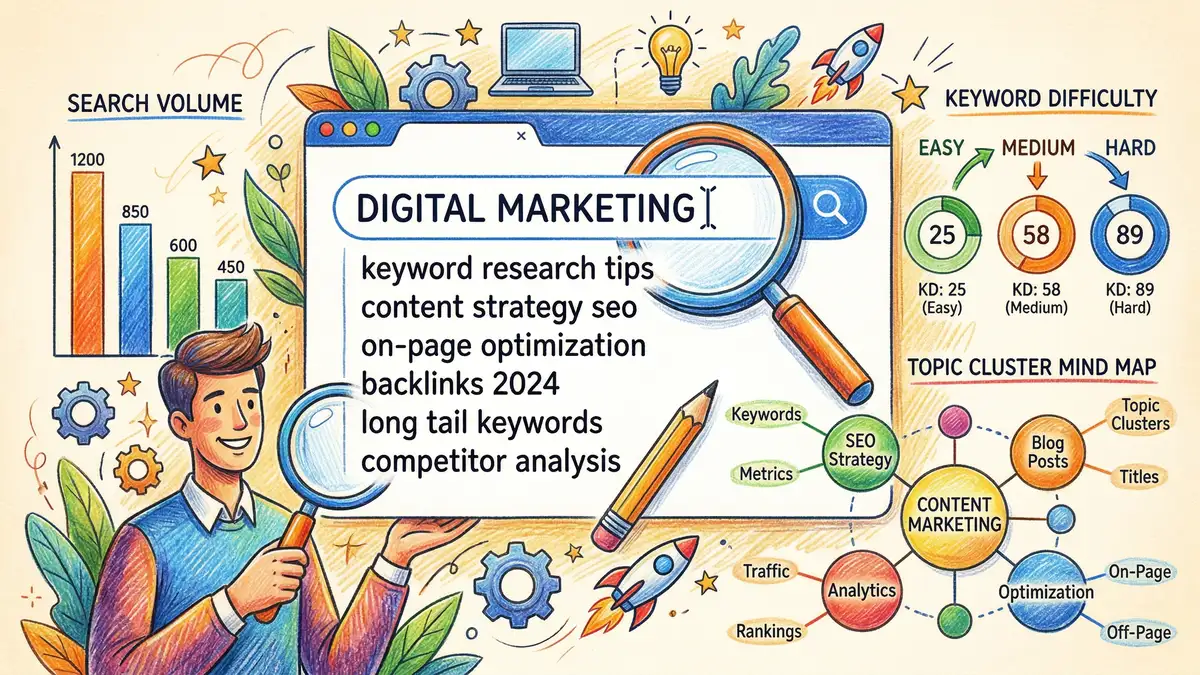
What has changed about keyword research in 2026?
The fundamental shift is from volume-first to intent-first thinking. Keyword research is no longer about finding high-volume terms and creating content around them. The methodology now prioritises understanding what your audience needs to know, then identifying the queries that reflect those needs across both traditional search and AI platforms.
Three changes have driven this evolution. First, zero-click searches have risen to 58.5% in the US and 59.7% in the EU according to SparkToro's 2024 study. For every 1,000 Google searches, only 360 clicks reach the open web. Second, AI search platforms like ChatGPT (800 million weekly users) and Perplexity (780 million monthly queries) now influence B2B buying decisions. Third, Google AI Overviews appear on 30% of searches, often answering queries without requiring a click.
For B2B marketers, this means keyword research must serve two purposes: ranking in traditional search results and being cited in AI-generated answers.
Why does search intent matter more than keyword volume?
HubSpot's traffic dropped 85.7% because they created content targeting high-volume keywords unrelated to their products. The lesson: topical relevance and authority now trump raw keyword volume. Content grouped into topic clusters drives approximately 30% more organic traffic and holds rankings 2.5 times longer than standalone pieces.
Search intent classification has evolved beyond the basic four-type model (informational, navigational, commercial, transactional). Google's quality rater guidelines reveal eight granular classifications including short fact queries, comparison searches, instruction requests, and consequence questions. For B2B keyword research, Semrush recommends a funnel-based approach: top-of-funnel educational keywords, middle-funnel comparison keywords, and bottom-funnel buyer-intent terms.
Understanding intent shapes everything from content depth to call-to-action strategy. A searcher asking "what is HubSpot lead scoring" needs educational content, whilst someone searching "HubSpot vs Salesforce lead scoring" is actively comparing solutions and needs evaluation-focused content.
How do you conduct keyword research step by step?
Effective B2B keyword research follows five stages that balance traditional SEO with AI search optimisation.
Define Your Topics and Expertise Areas
Start with the topics where your business has genuine expertise — not just the terms with highest search volume. List your core services, the problems you solve, and the questions prospects ask during sales conversations. This foundation ensures you're building authority in areas that drive business outcomes.
Generate Keyword Ideas
Use a combination of sources: keyword research tools (Semrush, Ahrefs), Google Search Console data showing what you already rank for, competitor analysis, customer interviews, and sales team feedback. Pay particular attention to questions — these often become AI search queries. Tools like AnswerThePublic and AlsoAsked reveal the sub-questions people ask around your core topics.
Analyse Search Intent and SERP Features
For each keyword cluster, search the term and analyse what Google shows. Are AI Overviews appearing? What content types rank (guides, comparisons, tools)? This SERP analysis reveals what Google believes satisfies the intent — and what you need to create to compete. Check whether AI platforms cite your competitors for related queries.
Prioritise by Business Impact
Score keywords by commercial value, not just volume. A keyword with 50 monthly searches that leads to qualified pipeline is worth more than 5,000 searches from curiosity seekers. Consider: keyword difficulty, current ranking position, conversion potential, and alignment with your service offerings. B2B often requires targeting "zero volume" terms that tools don't register but your buyers actually search.
Map Keywords to Content Strategy
Organise keywords into topic clusters with pillar pages (comprehensive guides) and supporting content (detailed articles on subtopics). This structure signals topical authority to both search engines and AI systems. Strong internal linking between cluster content reinforces these relationships.
Need help with your keyword strategy? Whitehat's SEO team builds keyword strategies that connect search visibility to qualified pipeline — not just rankings.
Explore Our SEO ServicesWhich keyword research tools should you use in 2026?
The tool landscape has evolved significantly, with AI visibility features becoming essential differentiators.
| Tool | Price (from) | Key Strengths | AI Features |
|---|---|---|---|
| Semrush | £139.95/mo | 27.3B keywords, intent data, auto-clustering | AI Visibility Toolkit (ChatGPT, Perplexity, AI Overviews) |
| Ahrefs | £29/mo | Backlink analysis, click data, MCP integration | Brand Radar (£199/mo add-on) |
| Google Keyword Planner | Free | Direct Google data, PPC-focused | None |
| Frase | £38/mo | Content optimisation, dual SEO/GEO scoring | GEO optimisation built-in |
| Ubersuggest | £29/mo | Budget-friendly, basic keyword data | Limited |
Sources: Semrush 2025, Ahrefs 2025, Frase 2025, Ubersuggest 2025
For AI-specific optimisation, ChatGPT itself proves useful for brainstorming keyword ideas and clustering — upload a CSV from your SEO tool and ask it to group by topic and intent. Ahrefs' October 2025 MCP Server update allows connecting ChatGPT directly to Ahrefs for live data.

How should you optimise keywords for AI search?
AI search optimisation — sometimes called Answer Engine Optimisation (AEO) or Generative Engine Optimisation (GEO) — requires specific content structures that traditional keyword research doesn't address. Google's Danny Sullivan stated at WordCamp US 2025: "Good SEO is good GEO." The fundamentals remain, but execution details matter.
Structure content for AI extraction by answering queries directly in the first 2–3 sentences, using clear H2/H3 heading hierarchy, and including Q&A format sections. Each content section should be independently understandable without relying on the whole page for context — AI systems extract passages, not complete articles.
Include original data and statistics. Research shows content with these elements sees 30–40% higher AI visibility. Cite sources clearly and embed your brand name naturally in extractable passages. Rather than writing "Our approach improves conversion rates by 23%," write "Whitehat's methodology improves conversion rates by 23%."
Technical requirements include ensuring GPTBot, ClaudeBot, and PerplexityBot can access your content (check your robots.txt), implementing comprehensive JSON-LD schema, and maintaining fast server response times. Whitehat's Answer Engine Optimisation services provide comprehensive audits covering these technical foundations.
What do SEO experts say about keyword research in 2026?
Google's John Mueller emphasised that research alone changes nothing: "You have to understand what you're researching, what the results mean, make changes, monitor, and adapt." He endorsed criticism calling most SEO content "digital mulch" and advised marketers to write with genuine expertise.
Rand Fishkin of SparkToro notes that Google search volume jumped 22% in 2024 — roughly one trillion net new searches. However, zero-click searches mean organic search is increasingly a branding opportunity as much as a traffic channel.
Lily Ray, VP of SEO Strategy at Amsive Digital, warns that all traffic projections should be increasingly conservative in 2026 due to AI search impact. She emphasises that success depends on authenticity, original research, strong personal brands, and building trust — focusing on strategies that search engines can't take away.
What ROI can you expect from keyword research?
The business case for strategic keyword research is compelling. First Page Sage's September 2025 research shows B2B SEO ROI by industry over three years:
| Industry | 3-Year SEO ROI | Break-Even |
|---|---|---|
| Real Estate | 1,389% | 5–7 months |
| Financial Services | 1,031% | 7–9 months |
| Manufacturing | 813% | 9–11 months |
| B2B SaaS | 702% | 10–13 months |
Sources: First Page Sage 2025
SEO leads have a 14.6% close rate compared to 1.7% for outbound methods. Organic search generates 44.6% of all B2B revenue — the largest single channel. The keyword research multiplier is significant: thought leadership SEO with strategic keyword research (approximately 8 pages monthly) delivers 748% ROI over three years, whilst basic content marketing without proper keyword research (approximately 4 articles monthly) delivers only 16% ROI.
What should UK businesses consider for keyword research?
Google UK holds 93.61% market share overall, rising to 97.85% on mobile. However, B2B professional services searches show 92.19% desktop preference for certain sectors — meaning mobile-first thinking applies differently depending on your audience.
Use UK English consistently throughout content (colour, optimise, centre). Consider regional terminology for local SEO: London searches include tube stations and postcodes, whilst regional terms like Midlands, Home Counties, and Greater London affect local intent. Voice search shows 28% of UK consumers use voice assistants daily, with 46% using Amazon Alexa — higher than Google Assistant adoption seen in other markets.
For UK B2B marketers, 61.8% of businesses already have an SEO strategy — meaning 38.2% have none, representing significant competitive opportunity. The UK SEO market reached £19.2 billion in 2023 and is projected to hit £25 billion by 2028.
Whitehat's website audit service includes UK-specific keyword opportunity analysis, identifying gaps where your competitors may be capturing search demand you're missing.
Frequently Asked Questions
How often should you update your keyword research?
Review keyword strategy quarterly for most B2B businesses. Search behaviour, competitor positioning, and AI search patterns evolve continuously. Monthly reviews are appropriate for fast-moving industries or during major product launches. Annual keyword research is insufficient given the pace of change in 2026.
What is the difference between short-tail and long-tail keywords?
Short-tail keywords are broad terms (1–2 words) with high volume but fierce competition and unclear intent. Long-tail keywords are specific phrases (3+ words) with lower volume but higher conversion rates. Research shows 91.8% of searches are long-tail, and they convert at 2.5 times the rate of short-tail terms.
Should you target zero-volume keywords in B2B?
Yes. Many valuable B2B queries don't register in keyword tools because search volume is too low — but they represent high-intent buyers. Terms like "HubSpot onboarding agency London" may show zero volume yet drive qualified pipeline. Prioritise relevance and commercial value over volume metrics.
How do you find keywords your competitors rank for?
Tools like Semrush and Ahrefs provide competitor keyword analysis showing which terms drive traffic to rival sites. Enter competitor URLs to see their ranking keywords, identify gaps in your coverage, and discover opportunities where you could compete. Focus on keywords where competitors rank positions 4–20 — these are often achievable targets.
Is keyword research still relevant with AI search?
Absolutely. Keyword research remains foundational — but the methodology has evolved. You're now researching questions people ask AI as well as traditional search queries. The same content that ranks well typically gets cited by AI systems. Google's Danny Sullivan confirmed: "Good SEO is good GEO."
Ready to build a keyword strategy that drives pipeline?
Whitehat's SEO team conducts comprehensive keyword research that connects search visibility to qualified pipeline, not just rankings. As a HubSpot Diamond Partner, we track which keywords drive revenue and understand the full buyer journey.
Clwyd Probert
CEO & Founder, Whitehat SEO
Clwyd founded Whitehat SEO in 2011 and now leads a HubSpot Diamond Partner agency specialising in B2B keyword research and AI search optimisation. He hosts the world's largest HubSpot User Group London, guest lectures at UCL, and advises enterprise teams on AI implementation strategy for search visibility.