
Marketing Attribution
This guide covers everything Whitehat SEO's team has learned implementing attribution solutions for B2B clients: what models work for long sales cycles, how to handle privacy-driven data loss, the AI search attribution blind spot most companies are ignoring, and a practical tool stack for companies spending £2,000–£5,000 per month on attribution.
B2B Marketing Attribution in 2026: What's Changed and What to Do About It
The practical framework for mid-market HubSpot teams navigating 211-day buyer journeys, cookieless tracking, and AI search blind spots.
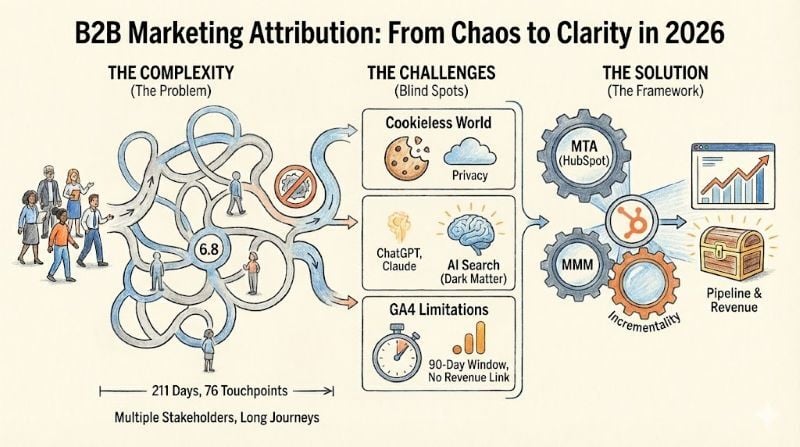
B2B marketing attribution in 2026 requires a fundamentally different approach than even two years ago. The average B2B buying journey now spans 211 days across 76 touchpoints involving nearly 7 stakeholders, according to Dreamdata's 2025 Benchmarks Report. Single-touch attribution is dead. The winning approach combines multi-touch attribution (MTA), marketing mix modelling (MMM), incrementality testing, and self-reported attribution into a unified measurement framework. For mid-market companies using HubSpot, this means rethinking not just your models but your entire measurement stack.
The B2B Buyer Journey Has Exploded in Complexity
The data on B2B buying behaviour is striking. Dreamdata's 2025 Benchmarks Report analysed actual B2B SaaS journeys and found the average path to a closed deal spans 211 days and 76 tracked touchpoints involving 6.8 stakeholders across 3.7 channels. HockeyStack Labs reports even higher numbers for larger deals: 2,879 impressions and 266 touchpoints to close an average B2B SaaS deal, rising to 5,500 impressions and 417 touchpoints for deals above $100K.
The buying committee itself has doubled. Research from Challenger Inc. shows the typical B2B buying team now includes approximately 12 individuals, up from 5.4 in 2020. Meanwhile, 6sense's 2025 Buyer Experience Report found that 95% of buyers purchase from their Day One shortlist of around four vendors. The battle is often won or lost before prospects enter your trackable funnel.
These numbers explain why single-touch attribution is losing credibility. While 75% of companies now use multi-touch attribution according to Ruler Analytics, adoption varies dramatically by company size: 73% of enterprises versus just 38–44% of mid-market firms. For companies using SEO services alongside paid campaigns, understanding how these channels work together across six-month sales cycles is essential.
2026 B2B Attribution Benchmarks
- 211 days — Average B2B customer journey length
- 76 touchpoints — Average interactions before purchase
- 6.8 stakeholders — Average buying committee size
- 7.7% — Marketing budgets as percentage of revenue (Gartner 2025)
- 37% — ROI improvement from comprehensive attribution (Gartner)
Which Attribution Models Work for Long B2B Sales Cycles
For B2B companies with 60–180 day sales cycles, Whitehat SEO's attribution implementations have crystallised around three tiers of sophistication.
Rules-Based Starting Points
W-shaped attribution remains the top recommendation for complex B2B pipelines with 6+ month cycles. This model assigns heavier credit to first touch, lead creation, and opportunity creation milestones—the moments that actually matter in long sales cycles.
U-shaped (position-based) attribution gives 40% credit each to first and last touch with 20% distributed across the middle. It's a strong starting point for companies beginning their attribution journey with 3–6 month cycles.
Time-decay models are gaining traction. Research shows interactions within the final 30 days before purchase have up to 3× the impact of earlier touchpoints. This model weights recent touches more heavily—sensible for companies where late-stage content heavily influences decisions.
Data-Driven Attribution: The Conversion Volume Problem
Data-driven attribution (DDA) is now Google's default for all conversion actions in Google Ads. Companies using AI-powered attribution see an average 27% improvement in campaign performance. However, there's a catch most mid-market B2B companies cannot overcome.
DDA requires 600+ monthly conversions to function reliably in Google Ads and 400+ within 28 days in GA4. Most mid-market B2B companies generating 50–200 leads per month cannot meet these thresholds. When volume falls short, GA4 silently falls back to last-click with no notification—a critical gotcha that means you're probably not getting the data-driven attribution you think you are.
The Triangulation Consensus
The 2026 best practice, endorsed by CaliberMind, RevSure, Gartner, and others, combines three methods:
- Multi-touch attribution (MTA) — For granular, touchpoint-level tactical optimisation
- Marketing mix modelling (MMM) — For strategic budget allocation capturing offline and brand effects
- Incrementality testing — For causal validation that campaigns actually drive conversions
CaliberMind's 2025 State of Attribution Report notes that for B2B specifically, MTA remains the only methodology providing daily optimisation granularity. MMM falls short because it requires large datasets and media budgets most mid-market companies lack.
Whitehat SEO's practical recommendation: Start with rules-based MTA in HubSpot (W-shaped for 6+ month cycles, U-shaped for 3–6 months), add self-reported attribution to high-intent forms immediately, then layer in a dedicated B2B attribution platform. MMM and incrementality testing come later as data volume and budget grow.
Google Killed Cookie Deprecation, But Privacy Still Reshapes Everything
The cookie saga reached its conclusion in three acts. In July 2024, Google reversed its deprecation plan in favour of a "user choice" model. In April 2025, Google announced it would not introduce a consent prompt for third-party cookies. Then in October 2025, Google formally retired the Privacy Sandbox APIs entirely, citing low adoption. Third-party cookies remain enabled by default in Chrome.
Yet this changes less than you'd think. Approximately 47% of the open internet is already cookieless due to Safari's Intelligent Tracking Prevention, Firefox's Enhanced Tracking Protection, and mobile app policies. Safari limits first-party cookies set via JavaScript to 7 days and known tracker cookies to just 24 hours. For B2B companies with long sales cycles, this means touchpoints beyond these windows receive zero attribution credit in Safari—roughly 15% of desktop traffic and over 20% in the UK.
Consent Management Creates Larger Data Gaps Than Cookies
Under compliant EU/UK consent implementation with a proper "Reject All" button, studies consistently show 40–70% fewer tracking data points collected. Only 25.4% of users accept all cookies. The ICO's own website saw a 90.8% drop in tracked users after implementing compliant consent.
For UK B2B marketers using PPC management services alongside organic campaigns, expect 30–60% of web visitor behaviour to be invisible to traditional analytics.
Server-Side Tracking Is the Primary Countermeasure
Server-side tracking adoption among B2B companies has reached 67%, with average data quality improvements of 41%. Server-side tracking achieves 80–95% data coverage versus 40–60% for client-side. Implementation through managed solutions like Stape or Addingwell costs as little as £20–200 per month.
GA4's Consent Mode v2 Advanced implementation, now mandatory for EEA/UK traffic since July 2025, can recover up to 70% of lost attribution data through behavioural modelling—but requires minimum thresholds of 1,000 daily consenting users. Companies under this threshold need supplementary tools.
GA4's B2B Limitations You Must Know
- 90-day maximum lookback window — Far shorter than most B2B sales cycles
- 400 conversion threshold — Required within 28 days for data-driven attribution
- No offline conversions — Cannot track CRM pipeline or phone calls natively
- No revenue connection — Cannot link to actual deal outcomes
- 34% dark social — "Direct" traffic that may originate from untrackable channels
AI Search Is Creating Attribution Dark Matter
This is perhaps the most significant new challenge for B2B marketers—and the one most competitors are ignoring. ChatGPT now processes over 1 billion searches per week with 800M+ weekly active users. Nearly 90% of B2B buyers use generative AI during their purchase journey, according to Forrester.
AI-generated traffic to B2B sites grew 527% between January and May 2025, with AI search now accounting for 34% of qualified B2B leads according to 10Fold Communications—the second-largest lead source after social media.
The attribution problem is acute: when a buyer researches via ChatGPT, evaluates vendors through Claude, and arrives at your website ready to book a demo, analytics shows a direct visit or branded search. The entire top and middle funnel becomes invisible.
Yet these visitors are extraordinarily valuable. ChatGPT referral traffic converts at 15.9% versus 1.76% for Google organic, and Claude users show the highest session value at £3.60 per visit. Companies investing in Answer Engine Optimisation (AEO) are capturing this high-converting traffic while competitors remain blind to its existence.
Practical Approaches to AI Search Attribution
- Add self-reported attribution to all conversion forms — "How did you first hear about us?" as an open-text field captures AI discovery that analytics cannot track
- Set up GA4 custom channel groups — Match chatgpt.com, perplexity.ai, claude.ai, and similar AI domains to track what referrals you can capture
- Monitor AI citation visibility — Tools like Otterly.AI, ZipTie.dev, or Profound (which raised $35M Series B from Sequoia) track when AI mentions your brand
- Track branded search volume — Rising branded search with no corresponding campaign activity often indicates AI-driven awareness
Only 16% of brands currently track AI search performance systematically. This creates an early-mover advantage for companies that start now.
What HubSpot Can and Cannot Do for Attribution in 2026
HubSpot's attribution capabilities are solid but come with clear boundaries that mid-market teams must understand. As a HubSpot Diamond Partner, Whitehat SEO has implemented attribution for dozens of B2B companies and learned where HubSpot shines—and where it falls short.
The Tier Divide
Marketing Hub Professional (£740/month) includes only contact create attribution—tracking which marketing efforts generate new contacts across four multi-touch models. This is top-of-funnel only, with no revenue or deal attribution.
Marketing Hub Enterprise (£2,990/month) unlocks all three attribution report types: contact create, deal create, and revenue attribution across six multi-touch models including W-shaped, full-path, and time-decay.
Critical Limitations
- No custom attribution models — You cannot create custom weighting schemes, algorithmic models, or ML-based attribution within native HubSpot
- No account-level rollups — Attribution tracks at individual contact level only, a significant gap for ABM-focused companies with buying committees
- Breeze AI excludes attribution — Despite HubSpot's heavy AI investment, attribution reports cannot be generated by AI
Recent 2025–2026 Updates
HubSpot has made genuine improvements. Pathfinder in Customer Journey Analytics (August 2025 public beta) reveals actual customer paths without pre-defined journeys. Data Hub (announced at INBOUND 2025) replaces Operations Hub with AI-powered data transformation and warehouse connections to Snowflake and BigQuery. Free data enrichment is now included for all paid tiers, and interaction type customisation allows Enterprise users to toggle specific interaction types in attribution settings.
For companies running attribution reporting within HubSpot, these updates improve data quality but don't solve the fundamental limitations around custom models and account-level attribution.
The B2B Attribution Tool Stack for Mid-Market Companies
The B2B attribution market in 2026 has stratified into distinct tiers. For mid-market HubSpot users (50–500 employees), three platforms consistently lead:
Dreamdata
From £625/month, free tier available. Excels at account-level B2B journey mapping from first anonymous touch to closed deal. Dreamdata offers the strongest LinkedIn integration through the Conversions API partnership, with 75% of customers implementing CAPI. Limitations include slow data syncs, limited ABM analytics, and a steep onboarding curve.
HockeyStack
From approximately £790–£1,160/month. Has evolved from an attribution tool into a full GTM intelligence platform with AI assistants, cookieless tracking, and account intelligence. Promises two-week implementation but carries a steep learning curve, and some users report data trust issues at scale.
Ruler Analytics
From £165/month. Offers the strongest offline conversion tracking alongside digital attribution, with call tracking, form tracking, and live chat attribution feeding revenue data back to marketing sources. Integrates with HubSpot, Salesforce, and Google Analytics but is more lead-level than account-level.
| Tool | Starting Price | Best For |
|---|---|---|
| Dreamdata | £625/month | Account-level B2B, LinkedIn integration |
| HockeyStack | £790–£1,160/month | Full GTM intelligence, cookieless tracking |
| Ruler Analytics | £165/month | Call tracking, offline conversions |
| Fibbler | £75/month | LinkedIn-to-pipeline visibility |
Measuring the Dark Funnel: Events, Podcasts, and Community
Up to 70% of the B2B buyer journey happens in the dark funnel—private Slack communities, LinkedIn DMs, podcast listening, peer conversations, and WhatsApp groups. With 83% of the buyer's journey occurring before a prospect contacts sales, and 95% purchasing from their Day One shortlist, the unmeasured portion of the journey is often where decisions are actually made.
Self-Reported Attribution Has Resurged
Self-reported attribution is now the primary dark funnel measurement tool. HockeyStack Labs analysed 8,500+ self-reported responses from 36 B2B SaaS companies and found a 90% measurement gap between what software credits and what buyers self-report.
Best practices include using open text fields rather than dropdowns, placing the question on high-intent forms only (demo requests, pricing pages), and overlaying responses with software attribution data. The critical limitation: self-reported attribution captures only one person's memory, typically the person who booked the demo rather than the decision-maker.
Event and Podcast Attribution
Event attribution has strengthened, with 86% of companies now able to directly attribute events to revenue and 47% of marketers identifying in-person events as delivering the largest ROI. However, only 7.6% use AI-powered attribution to connect events to pipeline. Tools like Bizzabo and Splash provide CRM-integrated event ROI measurement that integrates with HubSpot.
Notably, Fame.so found zero correlation between podcast download counts and attributed revenue—shows generating £400K+ pipeline averaged just 2,500 downloads per episode. Self-reported attribution and CRM integration matter far more than download metrics.
A Practical Attribution Framework for Mid-Market HubSpot Teams
The 2026 attribution landscape rewards pragmatism over perfection. Three insights from Whitehat SEO's implementation experience stand out as genuinely actionable.
1. The Triangulation Approach Has Won—But Implement in Stages
Start with rules-based multi-touch attribution in HubSpot (W-shaped for 6+ month cycles, U-shaped for 3–6 months). Add self-reported attribution to high-intent forms immediately. Then layer in a dedicated B2B attribution platform like Dreamdata or Ruler Analytics. MMM and incrementality testing come later as data volume and budget allow.
2. AI Search Is the Fastest-Growing Attribution Blind Spot
The 527% growth in AI-referred traffic, combined with 15.9% conversion rates from ChatGPT referrals, means this channel likely already influences a meaningful share of your pipeline—even if your analytics shows nothing. Setting up AI search tracking in GA4 and monitoring AI citation visibility is a low-effort, high-signal move that competitors are ignoring.
3. HubSpot's Native Attribution Is Necessary But Insufficient
The 90-day GA4 lookback window, HubSpot's Enterprise-only revenue attribution, the absence of account-level rollups, and the inability to create custom models mean supplementary tools are not optional for most mid-market B2B companies.
Whitehat SEO's Recommended Stack for 50–500 Employee Companies
Budget: £1,600–£4,000/month
- HubSpot Marketing Hub Professional or Enterprise — CRM and campaign layer
- Dreamdata or Ruler Analytics — B2B-specific attribution with account-level tracking
- Server-side GTM with Consent Mode v2 Advanced — Privacy-compliant tracking that recovers lost data
- Self-reported attribution on all high-intent forms — Dark funnel visibility
- GA4 custom channel group for AI search traffic — ChatGPT, Perplexity, Claude referral tracking
This combination addresses the three structural challenges—privacy-driven data loss, dark funnel invisibility, and the multi-stakeholder account journey—that no single tool can solve alone.
Frequently Asked Questions
Which attribution model is best for B2B companies with long sales cycles?
W-shaped attribution is the recommended model for B2B companies with sales cycles of 6 months or longer. This model assigns heavier credit to first touch, lead creation, and opportunity creation milestones—the moments that actually matter in complex buying journeys. For shorter 3–6 month cycles, U-shaped (position-based) attribution provides a strong starting point by weighting first and last touches equally at 40% each.
How much does B2B marketing attribution cost to implement properly?
A comprehensive B2B attribution stack for mid-market companies typically costs £1,600–£4,000 per month. This includes HubSpot Marketing Hub (£740–£2,990/month), a dedicated attribution platform like Dreamdata or Ruler Analytics (£165–£625/month), and server-side tracking implementation (£20–£200/month). Implementation is a 3–6 month effort requiring ongoing maintenance, with the average martech environment spanning 17–20 platforms making integration the primary time investment.
Why isn't HubSpot's native attribution enough for most B2B companies?
HubSpot provides solid attribution foundations but has critical limitations for B2B. Revenue attribution requires Enterprise tier (£2,990/month). The platform cannot create custom attribution models or provide account-level rollups for buying committees. GA4 integration brings a 90-day lookback window—far shorter than most B2B sales cycles. These gaps mean supplementary tools like Dreamdata, HockeyStack, or Ruler Analytics are necessary for comprehensive measurement.
How do I track marketing attribution from AI search like ChatGPT?
Most AI search referrals appear as direct traffic or branded search in analytics, making them invisible. To track AI search attribution, implement three approaches: add "How did you first hear about us?" open-text fields to all high-intent forms, create GA4 custom channel groups matching chatgpt.com, perplexity.ai, and claude.ai domains, and monitor AI citation visibility using tools like Otterly.AI or ZipTie.dev. Only 16% of brands currently track AI search performance, creating an early-mover advantage.
What ROI can companies expect from implementing proper attribution?
Organisations implementing comprehensive marketing attribution models see 37% higher marketing ROI according to Gartner. Companies without proper attribution commonly misallocate up to 30% of their marketing budget. Multi-channel attribution provides efficiency gains of 15–30%, and companies using advanced models report 15–30% lower customer acquisition costs. With marketing budgets flat at 7.7% of revenue, attribution is essential for proving and improving ROI.
Need Help Implementing Attribution for Your HubSpot Environment?
As a HubSpot Diamond Partner, Whitehat SEO helps B2B companies build attribution frameworks that connect marketing activity to pipeline and revenue. Get a free audit to identify gaps in your current measurement stack.
Get Your Free Attribution AuditReferences and Further Reading
- Dreamdata (2025). B2B Customer Journey Benchmarks. dreamdata.io/b2b-customer-journey
- Gartner (2025). 2025 CMO Spend Survey. gartner.com/en/marketing/research/annual-cmo-spend-data-snapshots
- Dreamdata (2025). B2B Attribution Guide. dreamdata.io/b2b-attribution
- The Wise Marketer (2025). Dreamdata Report Reveals Complexity of B2B Buying Journeys. thewisemarketer.com
- Ruler Analytics (2025). Marketing Attribution Benchmark Report. ruleranalytics.com
- HubSpot (2025). Marketing Attribution Reporting. knowledge.hubspot.com
- CaliberMind (2025). State of B2B Attribution Report. calibermind.com
- MarTech (2025). CMOs Brace for Cuts as Marketing Budgets Stay Flat. martech.org