
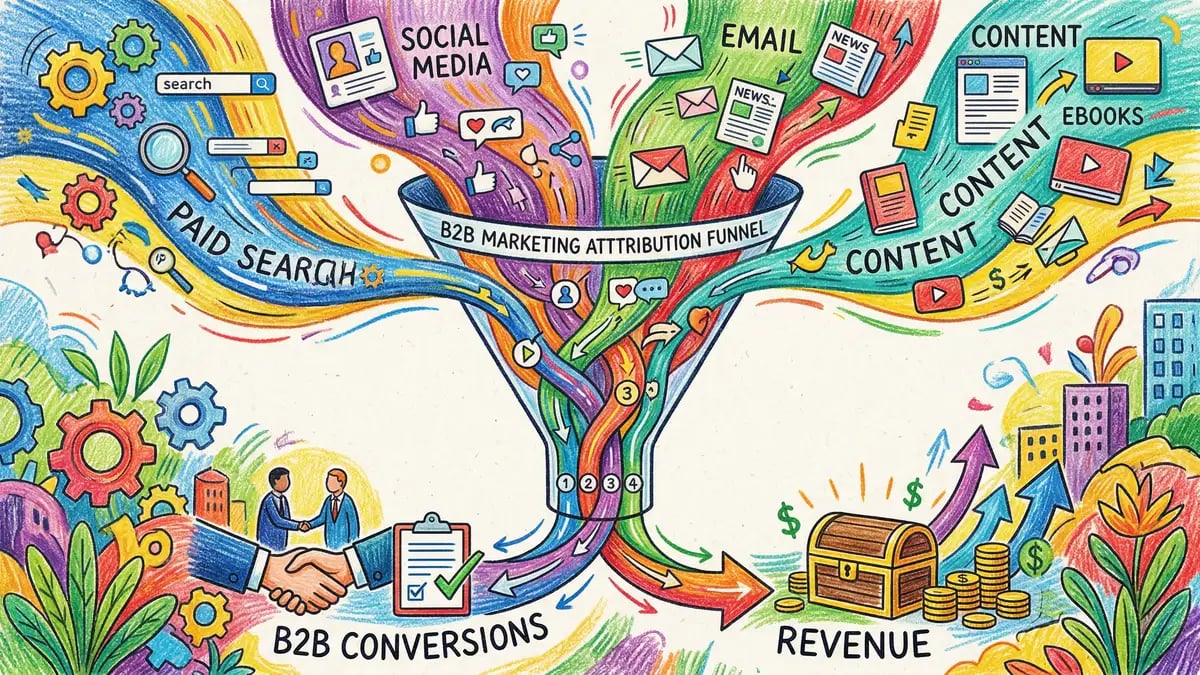
Marketing attribution is the practice of assigning credit to the touchpoints that drive customer conversions. In B2B environments, buyers engage with 8–15 different channels before making a purchase decision, yet most companies track only 1–2 of those interactions. The gap between what attribution models predict and what companies actually measure creates a 90% discrepancy in reported performance—leading to misallocated budgets, undervalued channels, and missed growth opportunities.
90%
Attribution Gap
Discrepancy in self-reported vs modelled performance
266
Avg B2B Touchpoints
Per customer journey (click-tracking captures <0.5%)
4x
View-Through Lift
vs click-through attribution
77.97%
AI Search Volume
ChatGPT traffic unattributed (11x higher conversion)
Sources: Harvard Business Review 2025, B2B Institute 2026, Cometly Analytics Report 2026, OpenAI Traffic Analysis 2026
The Attribution Problem
Most attribution models fall into two camps: single-touch and multi-touch. Single-touch models (first-click, last-click) oversimplify the journey. Last-click attribution credits the final touchpoint with 100% of the conversion, ignoring the awareness and consideration phases where most brand influence occurs. This approach systematically underfunds awareness channels like content marketing, organic search, and display advertising.
Multi-touch models attempt to distribute credit across multiple touchpoints, but the rules that govern credit distribution are often arbitrary. A 40-20-40 model (40% to first-touch, 20% to middle, 40% to last-touch) looks scientific, but it's just a guess. Time-decay models assume that recent touches matter more, but this ignores the compounding effect of earlier awareness-stage touchpoints. And none of these rules account for the fact that 75% of B2B buyers never click a single link—they read, watch, and engage without leaving an attribution signal.
The real problem is that traditional attribution was designed for single-channel journeys with clear conversion paths. In the modern multi-channel environment, where customers see your brand on LinkedIn, visit your website, download a whitepaper, attend a webinar, and engage with retargeting ads before finally clicking a sales email—the model needs to reflect that reality, not oversimplify it.
The Bottom Line
Single-touch attribution credits 90% of conversions to the final touchpoint, undervaluing awareness and consideration. Multi-touch rule-based models are better, but still guesswork. Data-driven and incrementality-based approaches reveal the true influence of each channel—and often contradict existing budget allocations.
Three Attribution Models That Work
If you're choosing an attribution approach for your B2B business, three models dominate enterprise deployments: Marketing Mix Modelling (MMM), Multi-Touch Attribution (MTA), and Incrementality Testing. Each has different data requirements, accuracy profiles, and pricing tiers. Here's how they compare:
| Model | Data Requirement | Accuracy | Timeframe | Best For |
|---|---|---|---|---|
| MMM | Spend data + conversions (macro) | ±15–20% | 12–24 months of history | Budget reallocation, channel ROI |
| MTA | Event-level tracking (GA4, CDP) | ±8–12% | 3–6 months minimum | Tactical adjustments, bid optimization |
| Incrementality Testing | Holdout groups + control audience | ±5–8% (highest) | 4–12 weeks per test | Channel validation, true causal impact |
Sources: Google Analytics Blog 2026, Nielsen MMM Standards 2025, Cometly Incrementality Framework 2026
Marketing Mix Modelling (MMM)
MMM uses statistical regression to correlate spend across all channels against aggregate outcomes (revenue, leads, conversions). It works best when you have 12–24 months of historical spend data and can link channel investment to business outcomes at the macro level. The advantage: MMM doesn't rely on cookies, pixels, or event-level tracking. It works even when third-party data is unavailable. The disadvantage: it's probabilistic, not causal, and accuracy ranges from ±15–20% depending on data quality and external factors (seasonality, competitor activity, market conditions).
Multi-Touch Attribution (MTA)
MTA (also called data-driven attribution or DDA in GA4) tracks individual user journeys across touchpoints and assigns credit algorithmically based on observed behavior. Google's DDA model—the default in GA4 since September 2023—analyzes thousands of conversion paths to determine which touchpoints most often precede conversion. As of February 2026, GA4's new Conversion Attribution Analysis Report includes assisted conversions data, giving you both direct and indirect contribution metrics. MTA requires robust event tracking and a customer data platform (CDP) or analytics system that can stitch journeys together. Accuracy is ±8–12%, and it works well for tactical optimization within 3–6 months of data collection.
Incrementality Testing
Incrementality testing is the gold standard for causal attribution. You run a controlled experiment: expose one group to a marketing campaign (treatment), hold back another identical group (control), and measure the difference in conversion rates. The delta is the true incremental impact of that campaign. Real-time attribution platforms like Cometly enable incrementality testing across channels in weeks instead of months. Accuracy is ±5–8%—the highest possible—because you're measuring real behavior, not inferring it. The trade-off: you need sufficient volume in both treatment and control groups, and you're testing one channel or campaign at a time.
HubSpot's Attribution Stack
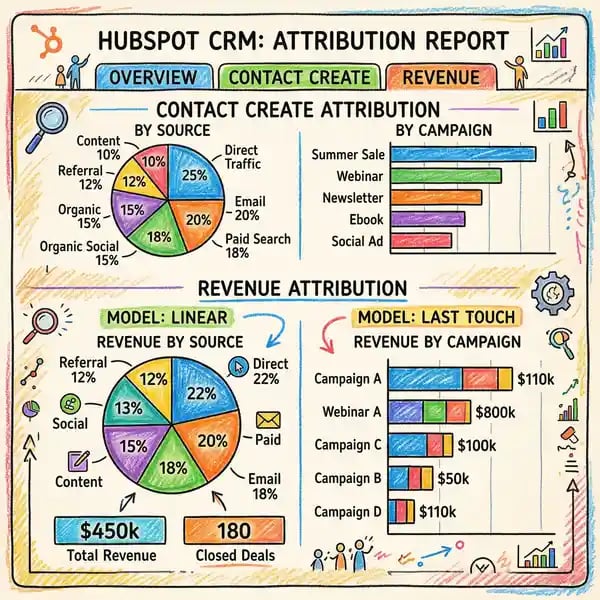
HubSpot's native attribution system includes nine different models out of the box: first-touch, last-touch, linear, time-decay, 40-20-40, U-shaped, W-shaped, custom, and data-driven. Each model can be applied independently to the same dataset, so you can compare outputs and see where they diverge—often revealing hidden insights about your customer journey.
The three most powerful are Contact Attribution (credit by individual contact), Deal Attribution (credit by sales deal), and Revenue Attribution (credit by actual closed revenue). Revenue attribution is crucial for B2B companies because it connects marketing touches to final deal value, not just lead count. Combined with HubSpot's February 2026 enhancements to targeting, automation, and data capabilities, the platform now supports more sophisticated customer journey mapping than ever before.
HubSpot also integrates directly with GA4 via the GA4 Data Manager (available in HubSpot February 2026+), allowing you to sync GA4 events and revenue data into HubSpot's attribution system. This creates a closed-loop attribution model where web analytics data feeds directly into your CRM, eliminating manual spreadsheet work and reducing data latency from weeks to hours.
| Model Type | Touch | Credit Logic | Use Case |
|---|---|---|---|
| First-Touch | Single | 100% to first interaction | Awareness channel ROI |
| Last-Touch | Single | 100% to final interaction | Direct response optimization |
| Linear | Multi | Equal credit to all touches | Full-funnel analysis |
| Time-Decay | Multi | More credit to recent touches | Consideration phase evaluation |
| Data-Driven | Multi | Algorithm learns from conversion paths | Holistic budget allocation |
Sources: HubSpot Attribution Models Documentation 2026, GA4 Data Manager Integration Guide 2026
Privacy & Cookie Status: What Changed in 2026
Third-party cookies persist in Chrome through 2026, but the broader ecosystem has shifted significantly. Google's Privacy Sandbox initiative—touted as the "cookieless future"—was officially retired in October 2025 without a viable replacement. This means the industry is in an awkward middle ground: third-party cookies still work in Chrome, but tracking degradation has accelerated through alternative mechanisms.
Consent Mode v2 (Google's consent management protocol) has become the de facto standard for tracking compliance, but it introduces measurement challenges. When users withhold consent for analytics, you lose visibility into their behavior entirely. This creates a blind spot: you see conversions from consented users, but the unconverted visits and behavior of non-consented users disappears. Over time, this biases your attribution models toward high-intent, compliant audiences and away from the broader journey that precedes purchase intent.
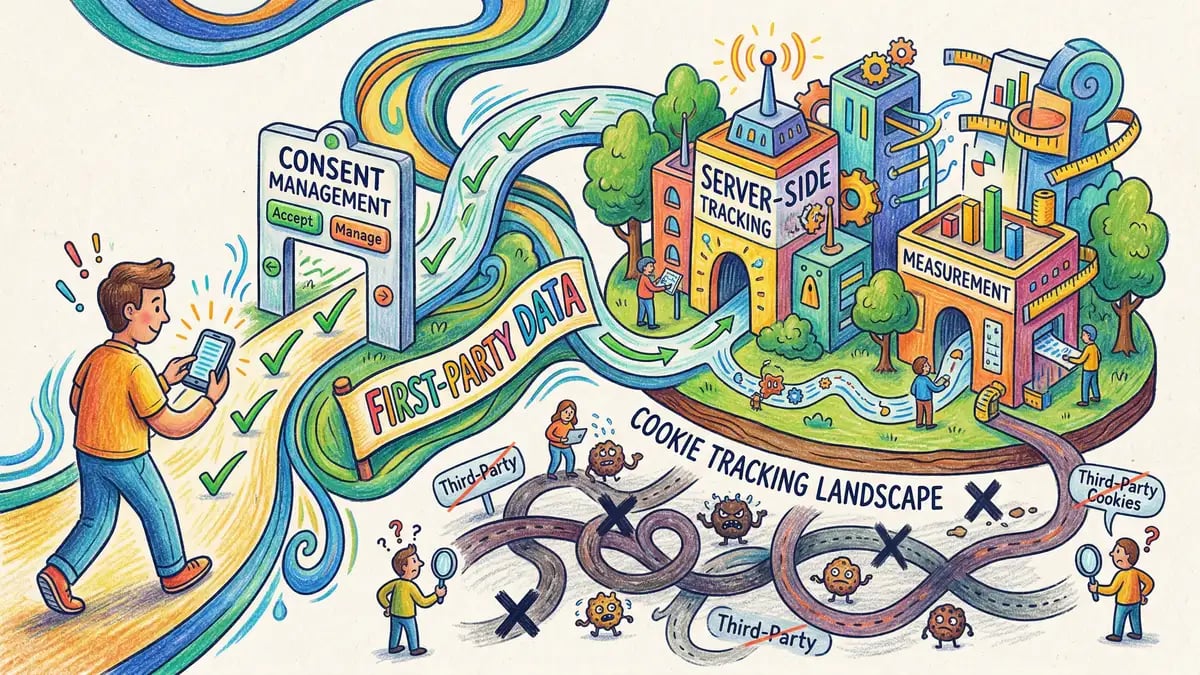
Privacy Paradox: Compliance Costs Attribution
Common mistake: Assuming Consent Mode v2 maintains data quality. When users deny analytics consent, you lose their entire journey, not just their identity.
The reality: Your attribution model becomes increasingly biased toward compliant users. To mitigate, combine first-party data (email, CRM engagement) with anonymized cohort analysis and server-side conversion tracking.
The AI Search Attribution Blind Spot
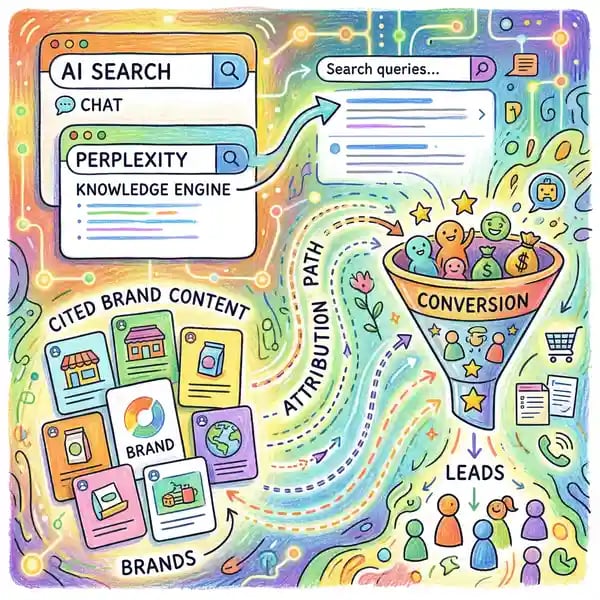
As of March 2026, 77.97% of all AI-powered search traffic routes through ChatGPT. Yet almost no traditional attribution systems—GA4, HubSpot, or otherwise—can track these visits. Users enter queries into ChatGPT, Claude, Perplexity, or other large language model (LLM) interfaces, and when they click through to your website, the traffic appears as direct or referral, not as the organic search that it actually is.
The compounding issue: AI search traffic converts 11x higher than traditional organic search. Users asking detailed questions in a conversational interface are typically further along the buying journey than users typing generic keywords into Google. If your attribution model doesn't recognize these AI search visits, you're systematically undervaluing your content strategy and overvaluing paid search that appears in last-click metrics.
To capture AI search attribution, implement UTM parameters on content links that are shared in model contexts, set up server-side conversion tracking that logs the referrer and user behavior independently of client-side pixels, and monitor direct traffic spikes that correlate with high-intent pages. The Model Context Protocol (MCP) is emerging as a standard for campaign monitoring across AI assistants, but adoption is still early.
5-Step Implementation System
Implementing attribution reporting doesn't require a complete platform overhaul. Start with the foundations, then layer in sophistication. Here's a proven five-step system that works for B2B companies at any scale:
Audit Current Tracking
Identify all customer touchpoints across email, web, social, advertising, and offline channels. Document which are tracked (GA4, HubSpot events) and which are dark (phone calls, direct mail, third-party data feeds). This gap analysis reveals where data is being lost.
Implement Event-Level Tracking
Set up GA4 event tracking on all key actions (page views, form submissions, video plays, file downloads, email opens). Sync GA4 with HubSpot using the GA4 Data Manager to create a single source of truth for customer interactions. Test event implementation to ensure data flows correctly end-to-end.
Choose Your Attribution Model
Start with data-driven attribution (default in GA4) for holistic budget allocation. Run data-driven and last-touch models in parallel for 3–6 months to see where they diverge. Once you have baseline confidence, layer in incrementality testing for high-spend channels.
Build Your Attribution Dashboard
In HubSpot, create custom reports showing revenue attribution by channel, campaign, and contact source. Include filters for pipeline stage, deal size, and sales cycle length. Update dashboards monthly and review with both marketing and sales leadership to surface blind spots.
Test, Iterate, and Refine
Incrementality testing is not a one-time exercise. Run monthly tests on new channels, offers, and messaging. Use attribution insights to reallocate budget from underperforming channels and double down on those showing strong influence across the funnel. Compare results quarter-over-quarter.
Need help implementing attribution in HubSpot? Our team specializes in CRM implementation and data strategy to unlock insights from your customer data.
Explore HubSpot ServicesCommon Attribution Questions
Which attribution model should we choose?
Start with data-driven attribution (DDA) in GA4 or HubSpot for 3–6 months to establish a baseline. Run DDA alongside last-touch to see where they diverge—big gaps usually indicate undervalued awareness and consideration channels. Once you have confidence in DDA, layer in incrementality testing on high-ROI channels to validate causal impact. Most mature B2B companies end up using DDA for quarterly budget planning and incrementality tests for tactical channel decisions.
How do we account for dark funnel traffic?
Dark funnel—traffic from AI search, direct visits, phone calls, and third-party data—is real but often invisible to pixel-based tracking. First step: implement server-side conversion tracking to log behavior independent of client-side pixels. Second: set up UTM parameters on all content that might be shared in LLM contexts or conversations. Third: import offline touchpoints (CRM notes, sales calls) as custom events in HubSpot. Fourth: use cohort analysis to segment converters who showed no previous web activity—these are often dark funnel users whose journeys finally became visible at conversion.
Does Consent Mode v2 break attribution?
Partially. Consent Mode v2 doesn't break attribution—it shifts attribution toward compliant users. When someone denies analytics consent, you lose visibility into their full journey, which biases your models. Solution: pair Consent Mode v2 compliance with first-party data (email interactions, form submissions) and server-side tracking. Build separate attribution models for consented vs. non-consented users to see the differences. Over time, prioritize first-party data collection (email, account-based CRM records) over pixel-based tracking.
How do we track AI search traffic in our attribution model?
AI search traffic arrives as direct or referral traffic, making it invisible to organic search attribution. To capture it: (1) Add UTM parameters to content shared in AI assistant contexts (whitepapers, case studies, guides). (2) Monitor your GA4 "direct" traffic for spikes that correlate with content topics—AI users often bypass search and go straight to your site from LLM results. (3) Implement server-side conversion tracking to log the referrer header and user behavior independently. (4) Create a custom dimension in GA4 for "AI-assisted discovery" based on specific landing pages and referrer patterns. By Q3 2026, platforms may offer native AI search attribution, but for now, these workarounds are essential.
What's the difference between assisted and influenced revenue?
Assisted revenue is the credit assigned to a non-final touchpoint in a conversion path (e.g., 20% credit for a middle-funnel webinar in a linear model). Influenced revenue is total revenue from any conversion where a specific channel appeared in the journey, regardless of credit allocation. GA4's February 2026 Conversion Attribution Analysis Report now surfaces assisted conversions explicitly. HubSpot's multi-touch models do the same. For budget allocation, focus on assisted revenue—it shows which channels contribute to conversions without taking credit away from others. For strategic prioritization, look at influenced revenue—it answers "how much revenue would we lose if we eliminated this channel entirely?"
Ready to unify your data and optimize your marketing performance?
Whitehat has implemented attribution systems for dozens of B2B companies, from SaaS startups to global manufacturers. We integrate HubSpot, GA4, and custom data pipelines to build attribution models that actually reflect your customer journey.
Clwyd Probert
Founder, Whitehat
Clwyd founded Whitehat in 2011 to help B2B companies unlock growth through data-driven marketing. He's led HubSpot implementations and attribution projects for SaaS, manufacturing, and professional services companies since Whitehat became a HubSpot Platinum Partner in 2016. When he's not optimising CRM workflows, Clwyd writes about AEO, technical SEO, and the future of AI in marketing.
Article published 27 March 2026 | Last updated 27 March 2026 | Estimated read time: 8 minutes