
Published: January 2026 | Last Updated: January 2026
What Does a Successful Inbound Marketing Campaign Look Like in 2026?
By Clwyd Probert, CEO & Founder, Whitehat SEO
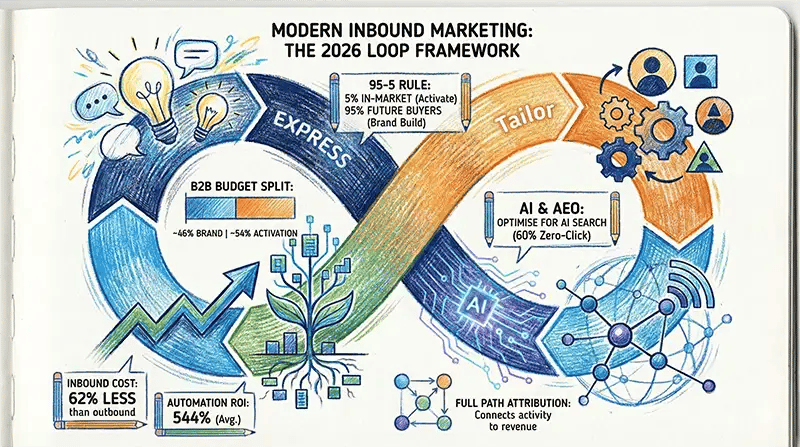
A successful inbound marketing campaign in 2026 follows HubSpot's Loop Marketing framework: Express your brand identity, Tailor messaging to audience segments, Amplify across channels including AI platforms, and Evolve through continuous testing. Modern campaigns cost 62% less per lead than outbound whilst delivering 10x higher conversion rates—Whitehat helps B2B companies implement this approach through integrated inbound marketing services.
The theoretical benefits of inbound marketing are well-documented. But knowing that inbound works and understanding exactly how to build a campaign that delivers results are entirely different challenges.
This guide walks you through the complete anatomy of a modern inbound marketing campaign—from initial audience research through to measurement and optimisation. You'll see real statistics, practical frameworks, and the exact methodology that HubSpot Diamond Partners use to generate predictable pipeline for B2B companies.
Why Inbound Marketing Campaigns Still Work in 2026
Despite the rise of AI and shifting digital behaviours, inbound marketing remains the most cost-effective approach for B2B lead generation. The numbers are compelling: inbound leads cost 62% less than outbound leads, according to research from Invesp. More importantly, HubSpot's 2025 State of Marketing report confirms that website, blog, and SEO collectively ranked as the number one ROI-driving channel for B2B brands in 2024.
The economics have actually improved. Marketing automation now delivers 544% ROI—£4.35 return for every £1 invested—according to AISofto's 2025 analysis. Companies using inbound marketing see 92.34% traffic increases, with 83.9% achieving results within seven months. These aren't vanity metrics; they translate directly to pipeline and revenue.
For UK businesses specifically, the opportunity is significant. The IPA Bellwether Report Q4 2024 shows 25.6% of UK companies expect marketing budget increases in 2025/26, whilst LOCALiQ reports that 53% of UK businesses now use AI in their marketing—creating a competitive advantage for early adopters who integrate AI tools into their campaign planning.
Pre-Campaign: Understanding Your Audience
Every successful inbound campaign starts with audience research. This isn't optional groundwork—it's the foundation that determines whether your content resonates or falls flat. Research from Delve AI shows that 71% of companies exceeding their lead generation goals have documented buyer personas, compared to just 37% of those who merely meet targets.
The persona development process should answer five essential questions about your ideal buyers: What are their primary job responsibilities and success metrics? What challenges keep them awake at night? Where do they seek information and advice? What objections might prevent them from engaging with your solution? What does their buying process look like, and who else is involved?
Understanding timing matters enormously in B2B. The Ehrenberg-Bass Institute's 95-5 rule reveals that only 5% of B2B buyers are actively in-market at any given time. Professor John Dawes explains: "To grow a brand, you need to advertise to people who aren't in the market now, so that when they do enter the market your brand is one they are familiar with." This insight fundamentally shapes how successful campaigns balance immediate lead generation with long-term brand building.
The Loop Marketing Framework: Modern Campaign Planning
HubSpot introduced the Loop Marketing framework in September 2025, representing the most significant evolution in campaign methodology since the Flywheel model. The Loop addresses a critical reality: 60% of Google searches now end without a click to any website, according to SparkToro research. Traditional funnel-based campaigns optimised for website conversions miss the majority of buyer interactions.
The Loop consists of four interconnected stages that compound over time. Unlike linear campaign models, each loop iteration makes subsequent campaigns more effective—your brand intelligence grows, your content library expands, and your optimisation data becomes richer.
Stage 1: Express — Define Your Brand Position
The Express stage establishes your campaign's strategic foundation. This involves creating or refining your ideal customer profile (ICP) using AI to analyse customer reviews, sales calls, community discussions, and existing data. You'll develop style guides covering mission, tone, and non-negotiables, then generate campaign concepts that claim specific market positions.
HubSpot's Breeze AI tools now accelerate this process significantly. Breeze Copilot functions as a context-aware assistant that can summarise customer interactions, research prospects, and complete CRM tasks. Breeze Intelligence provides real-time data enrichment from over 200 million profiles—giving you deeper audience insights without manual research. HubSpot onboarding and implementation from a Diamond Partner ensures these AI capabilities are configured correctly from day one.
Stage 2: Tailor — Personalise at Scale
The Tailor stage transforms generic campaigns into personalised experiences. Using behavioural signals, intent data, and contextual enrichment, you segment audiences and adjust content by industry, role, buying stage, and timing. AI-powered segmentation builds dynamic audience groups that update automatically as prospect behaviour changes.
The impact of personalisation is substantial. Segmented email campaigns achieve 30% higher open rates and 50% higher click-through rates than generic broadcasts, according to HubSpot's 2024 research. Automated emails generate 320% more revenue than manual campaigns. Email marketing overall returns £36 for every £1 spent—but only when properly segmented and personalised.
Stage 3: Amplify — Optimise for AI and Multi-Channel Distribution
The Amplify stage diversifies your channel strategy beyond traditional search to include AI answer engines like ChatGPT and Claude, YouTube, Reddit, LinkedIn, and community platforms. This is where Answer Engine Optimisation (AEO) becomes critical—optimising content structure so AI systems can extract, cite, and recommend your brand.
Content remixing maximises campaign ROI. Top-performing blog posts become AEO-optimised articles, video scripts, LinkedIn carousels, podcast discussion points, and email sequences. Whitehat's AI consulting services help B2B companies implement AEO strategies that ensure their content appears in AI-generated search responses—a capability becoming essential as AI search adoption accelerates.
Stage 4: Evolve — Measure and Iterate
The Evolve stage enables continuous optimisation through AI-powered predictive analytics and rapid A/B testing. Rather than waiting until campaign completion to assess performance, Loop campaigns use real-time monitoring to identify what's working and adjust accordingly. AI can now predict content performance before publishing, allowing you to optimise headlines, formats, and distribution strategies proactively.
Each completed loop compounds your competitive advantage. Your brand intelligence grows richer, your content library expands with proven performers, and your optimisation data becomes increasingly predictive. This is why companies using HubSpot report 505% ROI over three years—the platform enables systematic improvement that accelerates over time.
Budget Allocation and Timeline Planning
The Gartner CMO Survey 2024 reports that marketing budgets have stabilised at 7.7% of company revenue—down from 9.1% in 2023. This means campaign planning must deliver maximum impact from constrained resources. Evidence-based budget allocation significantly outperforms intuition.
Les Binet and Peter Field's research for the IPA establishes the 60:40 principle as the optimal default: 60% of budget toward brand building (broad reach, emotional messaging) and 40% toward sales activation (targeted, rational content). For B2B specifically, the ratio adjusts to approximately 46% brand and 54% activation. New businesses should weight more heavily toward performance initially (65/35), whilst established market leaders can invest up to 72% in brand building.
Timeline expectations must be realistic. SEO and content marketing typically require six to twelve months to show significant organic traffic improvements, with compound returns over subsequent years. However, the average cost per lead drops 80% after five months of consistent inbound activity, according to Impact research. HubSpot implementations take six to eight weeks for standard deployments with a Diamond Partner—considerably faster than the typical 90-day self-implementation timeline.
Real Campaign Example: The HubSpot Agency Partner Campaign
HubSpot's internal agency partner acquisition campaign demonstrates these principles in practice. The Partner Acquisition Marketing team surveyed 1,400 existing partners to identify unmet needs, discovering that original research addressing sales challenges resonated most strongly with their target audience.
The campaign structure included three lead magnets: a comprehensive research report, an interactive assessment tool, and a video series featuring partner success stories. The execution phase began with limited A/B testing to optimise email subject lines and landing page copy before full deployment. Results included over 7,000 form submissions and almost 1,000 new marketing-qualified contacts—demonstrating how research-driven content consistently outperforms promotional messaging.
The key insight: campaigns built on genuine audience research and documented needs outperform assumption-based approaches by significant margins. This is why the persona research phase cannot be shortcut—it determines everything that follows.
Measuring Campaign Success: Attribution That Works
Only 52% of marketing leaders successfully demonstrate marketing's contribution to business outcomes, according to Gartner research. This attribution gap undermines budget conversations and strategic credibility. Modern inbound campaigns require measurement frameworks that connect marketing activity to revenue—not just traffic and engagement metrics.
Multi-touch attribution has become essential, with 75% of companies now using these models according to Mordor Intelligence. HubSpot's Full Path attribution model distributes credit most accurately for B2B: 22.5% each to first touch, lead creation, deal creation, and closed-won, with 10% to middle interactions. This approach answers the critical question of what actually drove revenue rather than obscuring it with single-touch simplifications.
Campaign measurement should track both immediate performance and long-term brand building. For activation: cost per lead, conversion rates by stage, sales-accepted lead volume, and pipeline contribution. For brand building: share of search, unaided awareness, and AI citation frequency. Full-funnel strategies that balance both deliver 45% ROI uplift compared to activation-only approaches, according to Amazon Ads research.
Frequently Asked Questions
How long does an inbound marketing campaign take to show results?
Most B2B companies see measurable traffic improvements within three to four months, with significant lead growth by month six. Research shows 83.9% of companies using inbound achieve results within seven months. SEO compounds over time—top-ranking pages are typically over two years old.
What's a realistic budget for B2B inbound marketing in the UK?
UK agency retainers typically range from £2,000 to £10,000 monthly for ongoing programmes, with project work from £5,000 to £75,000. The Gartner CMO Survey shows average marketing budgets at 7.7% of revenue. B2B cost per lead ranges from £32 to £160 for most industries.
How do I measure inbound marketing ROI?
Use multi-touch attribution to connect marketing touchpoints to closed revenue. Track cost per lead, conversion rates by funnel stage, marketing-sourced pipeline percentage, and customer acquisition cost. HubSpot's attribution reports show which content and channels actually drive deals, not just engagement.
What tools do I need for modern campaign planning?
A CRM with marketing automation forms the foundation—HubSpot is the market leader for B2B. Add analytics platforms, SEO tools for keyword research and tracking, email marketing capabilities, and increasingly, AI tools for content creation and optimisation. Integration between systems is essential.
How has AI changed inbound marketing campaigns?
AI now influences every campaign stage. 88% of marketers use AI tools daily, saving five or more hours weekly. AI accelerates persona research, content creation, personalisation, and optimisation. Critically, 60% of searches now occur in AI platforms—requiring new AEO strategies alongside traditional SEO.
Should I use HubSpot for inbound marketing?
HubSpot delivers 505% ROI over three years according to IDC research. Users generate 3x more leads and close 94% more deals after six months of proper implementation. Working with a Diamond Partner accelerates results—partner-led implementations complete in 45-60 days versus 90+ for self-implementation.
What's the difference between inbound and content marketing?
Content marketing is a component of inbound marketing. Inbound is the complete methodology encompassing content creation, SEO, social media, email nurturing, lead scoring, and CRM integration—all working together to attract, convert, close, and delight customers through the full buyer journey.
How do I optimise campaigns for AI search engines?
Answer Engine Optimisation (AEO) structures content for AI citation. Lead with direct answers in the first paragraph, use descriptive headings, create standalone sections AI can extract, include expert credentials and source citations, and implement comprehensive schema markup. Whitehat's inbound marketing strategy resources provide detailed guidance.
Building Your Inbound Marketing Campaign
Successful inbound marketing campaigns in 2026 combine proven fundamentals with emerging capabilities. The core principles remain unchanged: understand your audience deeply, create genuinely valuable content, nurture relationships systematically, and measure results rigorously. What's evolved is the sophistication of tools available and the imperative to optimise for AI alongside traditional search.
The 95-5 rule reminds us that most marketing impact comes from building memory structures with future buyers—not obsessing over immediate conversions. Balance your campaign investment accordingly, and measure both brand building and activation outcomes.
Whether you're launching your first inbound campaign or optimising an existing programme, the methodology outlined here provides a structured path from strategy to execution. For B2B companies serious about implementing B2B inbound marketing best practices, working with an experienced HubSpot Diamond Partner accelerates time-to-value whilst avoiding common implementation mistakes.
Ready to Build Your Inbound Marketing Campaign?
Whitehat SEO is a HubSpot Diamond Partner helping B2B companies generate qualified leads through integrated inbound marketing, SEO, and HubSpot implementation. We run the world's largest HubSpot User Group and have delivered 100+ successful implementations since 2011.
Explore Our Marketing ServicesReferences and Sources
- HubSpot State of Marketing Report 2025 — Marketing statistics and trends
- HubSpot Loop Marketing — Campaign methodology framework
- Content Marketing Institute B2B Research 2025 — Content marketing effectiveness data
- Gartner CMO Survey 2024 — Marketing budget benchmarks
- IPA Bellwether Report Q4 2024 — UK marketing investment trends
- LOCALiQ UK Digital Marketing Report 2025 — UK-specific marketing statistics
- Ehrenberg-Bass Institute — 95-5 rule research on B2B buyer timing
- Binet & Field / IPA — 60:40 brand vs activation research
About the Author
Clwyd Probert is CEO and Founder of Whitehat SEO, a HubSpot Diamond Solutions Partner based in London. He leads the world's largest HubSpot User Group and is a guest lecturer at UCL on digital marketing and entrepreneurship. Since founding Whitehat in 2011, Clwyd has helped over 100 B2B companies implement inbound marketing strategies that connect activity to revenue. SEO services view our pricing