
Published: 11 January 2026 | Last Updated: 11 January 2026
How Many Blog Posts Should a B2B Company Publish Per Month?
B2B companies should publish 8-12 high-quality blog posts per month, with at least 50% of content effort dedicated to updating existing articles rather than creating new ones. HubSpot's dramatic 81% traffic collapse in late 2024—despite publishing 150+ posts monthly—proves that volume without focus destroys results. At Whitehat, as HubSpot Diamond Partners, we've helped B2B companies build sustainable content operations that generate pipeline, not just pageviews.
This guide breaks down what the data actually shows about publishing frequency, why the biggest content marketing operation in B2B failed, and how to build a content strategy that compounds over time.
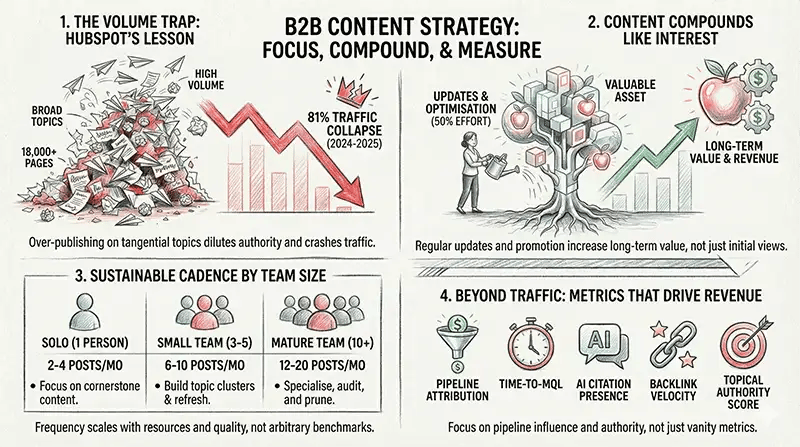
What Happened to HubSpot's Content Empire
HubSpot built the most influential content marketing operation in B2B, publishing approximately 200 blog posts per month at its peak between 2015-2018. By mid-2024, their blog had grown to over 18,000 indexed pages—an archive representing nearly two decades of compounding content investment.
Then came the collapse. Between November 2024 and January 2025, HubSpot's organic traffic plummeted from 13.5 million monthly visits to 2.8 million—an 81% decline confirmed across Ahrefs, Semrush, and Sistrix data. Google's algorithm updates effectively punished them for strategic overreach.
The root cause wasn't technical SEO failures. HubSpot had expanded into increasingly tangential topics—famous quotes guides, shrug emoji explanations, resignation letter templates—content that diluted their topical authority in marketing automation and CRM. Their blog linked to over 28,000 external domains, fragmenting authority signals further.
HubSpot's organic growth team confirmed the strategic pivot: the range of topics is now much narrower, with aggressive content pruning removing off-topic material. For B2B companies considering their own content strategy, this case study delivers a clear message: topical focus beats volume every time. Whitehat's HubSpot onboarding process specifically addresses content architecture to prevent this kind of authority dilution.
The Publishing Frequency Myth
HubSpot's own research, based on data from 13,500 customers, found that companies publishing 16+ blog posts monthly generate 4.5 times more leads than those publishing 0-4 posts. This statistic has driven countless B2B content strategies toward volume maximisation.
The problem? This benchmark misleads smaller teams in three critical ways:
- Resource assumption: HubSpot employed 23 experienced writers, editors, and strategists on their blog operation before recent layoffs—a team size impossible for most B2B companies
- Quality degradation: Scaling to 16+ posts monthly typically forces quality compromises that hurt ranking potential and reader trust
- UK market dynamics: Search volumes and competition levels differ significantly from US markets where this research originated
The correlation between publishing frequency and leads exists, but causation runs through quality and relevance, not raw volume. A UK B2B company publishing 8 focused, expert-level articles monthly will outperform one pushing 20 surface-level posts on tangential topics.
What Actually Drives B2B Content ROI
HubSpot's content operation revealed a counterintuitive truth: their writers dedicated 50-80% of their time updating existing posts rather than creating new content. This "historical optimisation" model stems from their discovery that 76% of monthly blog views came from posts published more than a month prior.
Content compounds like interest. A single authoritative article, continuously updated and promoted, generates more long-term value than multiple thin pieces abandoned after publication. Whitehat's approach to optimising existing content follows this same principle.
The practical framework for B2B content allocation:
| Activity | Time Allocation | Expected Impact |
|---|---|---|
| Updating existing high-performers | 40-50% | Maintain and grow existing traffic |
| Creating new strategic content | 30-40% | Expand topical authority |
| Content distribution and promotion | 15-20% | Amplify reach and backlinks |
This allocation ensures your content investment appreciates over time rather than depreciating as posts age and become outdated.
The Right Publishing Cadence for Your Team Size
Publishing frequency should scale with available resources and quality thresholds, not arbitrary benchmarks. Here's what sustainable content operations look like at different scales:
Solo marketer or founder-led content (1 person)
Sustainable output: 2-4 posts per month
Focus on cornerstone content that establishes expertise. Every piece should be comprehensive enough to rank for primary keywords. Update one existing post for every new post published. Quality at this scale beats quantity—a single authoritative guide outperforms four mediocre articles.
Small marketing team (3-5 people)
Sustainable output: 6-10 posts per month
Build topic clusters around core service areas. Dedicate one team member's time primarily to content refresh and optimisation. Implement a content calendar that balances new production with systematic updates of the back catalogue.
Mature marketing function (10+ people)
Sustainable output: 12-20 posts per month
Specialise writers by topic area to build deep expertise. Maintain strict topical boundaries—the HubSpot trap was expanding beyond their authority zone. Implement formal content audits quarterly to prune or consolidate underperforming pages.
Whitehat's content marketing services help B2B companies determine the right cadence for their resources and competitive landscape.
Measuring Content Success Beyond Traffic
HubSpot's traffic collapse revealed an interesting paradox: despite losing 81% of organic visitors, they maintain a 35.3% share of voice in AI-generated answers for CRM and marketing automation queries. As search fragments across AI assistants like ChatGPT and Perplexity, traditional traffic metrics may matter less than being the cited authority.
The metrics that actually matter for B2B content:
- Pipeline attribution: Which content pieces appear in the journey of closed deals?
- Time-to-MQL: Does content accelerate or delay qualification?
- AI citation presence: Are you being recommended by ChatGPT, Claude, and Perplexity?
- Backlink velocity: Is your content attracting organic authority?
- Topical authority scores: Are you ranking consistently for your core topic cluster?
HubSpot's closed-loop reporting enables tracking content influence across the entire buyer journey, connecting blog visits to revenue outcomes. This attribution clarity is why proving ROI from content investment becomes possible—and why Whitehat's content marketing strategy approach centres on measurable pipeline impact.
Building a Sustainable Content Operation
The HubSpot case study proves that even massive content investments can collapse without strategic discipline. Building a sustainable operation requires systematic approaches rather than volume targets.
Content audit framework
Review your existing content quarterly. For each piece, decide: update, consolidate, or prune. HubSpot's 2023 audit of 4,000 older URLs recommended deleting 72% outright and optimising only 24%. Most B2B blogs benefit from similar aggressive pruning—ten excellent articles outperform one hundred mediocre ones.
Topical authority mapping
Define 3-5 core topics where you want to be the definitive authority. Every piece of content should support these pillars directly. If you can't explain how a proposed article strengthens your topical position, don't publish it. This discipline prevents the authority dilution that devastated HubSpot's rankings.
90-day implementation plan
Days 1-30: Audit existing content. Identify top 20 performers and bottom 20 candidates for removal. Map current topical coverage gaps.
Days 31-60: Update top performers with fresh data and expanded sections. Consolidate or remove underperformers. Establish content calendar within defined topic boundaries.
Days 61-90: Launch systematic new content production. Implement quarterly review cadence. Set up attribution tracking in HubSpot to connect content to pipeline.
Ready to build a content strategy that generates pipeline?
Whitehat helps B2B companies create sustainable content operations with measurable ROI. As HubSpot Diamond Partners, we bring deep platform expertise to content strategy, ensuring your investment compounds over time rather than collapsing like HubSpot's high-volume model. Book a content strategy conversation to discuss your specific situation.
Frequently Asked Questions
Should I publish more content if I'm not getting results?
Usually not. Poor results typically indicate quality, targeting, or distribution problems rather than volume issues. Before increasing output, audit existing content performance, verify you're targeting queries your audience actually searches, and ensure content reaches prospects through email and social distribution.
How do I know if my content is too broad or off-topic?
Apply the topical authority test: can you rank on page one of Google for your core service terms? If you're creating content on topics where you wouldn't credibly rank against specialists, you're diluting authority. Every article should strengthen your position on core topics, not chase tangential traffic.
What's the minimum viable publishing frequency for B2B?
Four quality posts per month represents a sustainable minimum for building organic momentum, combined with systematic updates to existing content. Below this threshold, search engines may not recognise your site as an active, authoritative source on your topics.
Is AI search changing how much content I need?
AI search engines prioritise quality and authority over volume. They extract answers from sources they trust, not sources that publish frequently. HubSpot maintaining 35% AI share of voice despite losing 81% of traffic demonstrates that brand authority and content depth matter more than publishing cadence.
How do I measure content ROI for B2B with long sales cycles?
Use HubSpot's attribution reporting to track content touchpoints across the entire buyer journey, from first visit through closed deal. Multi-touch attribution models reveal which content influences pipeline, even when conversion happens months after initial engagement. This closed-loop reporting connects content investment directly to revenue outcomes.
References and Sources
- HubSpot Blog Benchmarks Research — HubSpot analysis of 13,500 customer blogs
- Ahrefs HubSpot Traffic Analysis — May 2024 data showing 148 posts published
- Semrush and Sistrix Traffic Verification — Nov 2024-Jan 2025 traffic decline data
- HubSpot Organic Growth Team — Strategic pivot confirmation and content pruning approach
- HubSpot Historical Optimisation Model — Internal discovery that 76% of views from older posts