
Optimising Old Content
Historical optimisation is the process of updating, expanding, and technically refining existing content so it ranks again, earns AI citations, and generates more leads. Instead of publishing “more”, you fix content decay (outdated facts, broken links, thin coverage, weak structure) and re-ship pages with stronger answers, clearer entities, and better tracking—so your archive compounds into pipeline.
Freshness is the new currency in 2026 (because trust beats “rankings”)
In 2026, “freshness” isn’t a gimmick—it’s a trust signal. AI-powered interfaces summarise answers, and they’re more likely to cite sources that look current, accurate, and well-structured. That’s why old content fails quietly: not because it’s “bad”, but because it looks risky.
There’s also a very practical problem: the web decays. Ahrefs’ large link-rot study (updated Feb 2024) found 66.5% of links pointing to sampled sites had rotted since 2013. That’s not just annoying—it leaks authority and makes your page feel unreliable.
Google’s own guidance is blunt: ranking systems are designed to prioritise helpful, reliable, people-first content. “People-first” doesn’t mean fluffy. It means accurate, transparent, and genuinely useful—especially when the query has commercial or compliance stakes.
Practical takeaway: if your post is dated 2021 and your stats are from 2018, you’re basically asking an AI summary box to trust a fossil.
Updating old posts usually beats creating new ones (speed-to-value wins)
If you’re under pressure to prove ROI, historical optimisation is the most CFO-friendly SEO work you can do. The reason is simple: existing pages already have age, links, and behavioural data. You’re not starting from zero—you’re upgrading an asset that’s already indexed and understood.
HubSpot’s “Optimising the Past” project is the canonical example. They reported a 106% average lift in monthly organic views for optimised old posts, and an even more uncomfortable stat: 92% of their monthly blog leads came from older posts (not the new stuff).
This is why we’re opinionated about content strategy: you don’t need a bigger blog. You need a higher-performing archive. New content still matters—but updates are where you often get the fastest compounding returns.
- Need pipeline this quarter? Start with updates on pages already ranking in positions 4–20.
- Need defensible reporting? Track before/after with HubSpot attribution dashboards.
- Need fewer “random acts of marketing”? Ship a repeatable update protocol (below).
Content decay has predictable symptoms (and you can catch them early)
Content decay isn’t mysterious. It usually shows up as a slow drop in impressions, a flattening of clicks, or rankings sliding from page one to “basically invisible.” The fix isn’t always “rewrite everything.” Often it’s accuracy, structure, and internal link context.
Here are the common signals we look for first: (1) stats or screenshots older than 18–24 months, (2) broken internal/external links, (3) the page answers the query late (or never), (4) headings are vague (“Tips”, “Conclusion”), and (5) the intent has shifted—AI Overviews now satisfy broad queries without clicks.
You can validate decay with simple checks: compare Search Console performance year-on-year, review the SERP for AI summaries/featured snippets, and inspect whether competitors are using tables, FAQ schema, and clearer entity language. If they are—and you aren’t—you’re giving away citations.
The “Keep, Kill, or Consolidate” matrix stops you wasting crawl budget
Not all old content deserves a refresh. Some pages are worth polishing, some should be merged, and some should be removed (or redirected) to protect crawl budget and topical clarity. The goal is brutal simplicity: every URL should earn its place in your site architecture.
Use the matrix below to make fast, defensible decisions. If you’d rather not do this yourself (fair), a site audit will identify decay patterns, cannibalisation, and technical blockers across the whole domain.
| Page performance status | Diagnosis | Recommended action (2026 protocol) |
|---|---|---|
| High traffic / low conversion | Intent mismatch (learning, not buying) | Update (CRO refresh): stronger CTAs, clearer next step, better offer alignment |
| High traffic / declining rank | Content decay (stale facts, weaker structure) | Update (full refresh): new stats, new examples, AEO formatting, reindex signals |
| Low traffic / high impressions | CTR failure (snippet doesn’t win) | Meta refresh: rewrite title + description, match intent, test hooks |
| Low traffic / thin content | Zombie URL wasting crawl | Prune: delete + 410, or 301 to a stronger relevant page |
| Duplicate topic / cannibalisation | Entity confusion (Google/AI doesn’t know “the” page) | Consolidate: merge into one master guide, 301 the rest |
The 5-step protocol turns “update a post” into a repeatable system
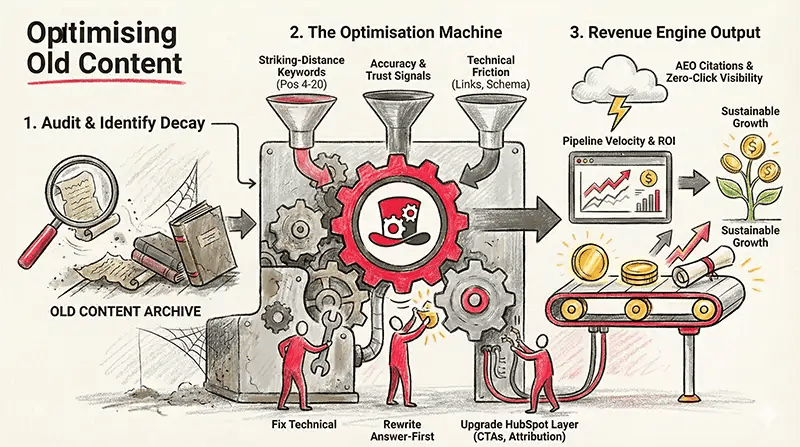
A proper refresh isn’t “sprinkle keywords and republish.” It’s a system designed for both humans and machines: clearer answers, stronger entities, repaired link equity, and tracking that proves impact. Use the five steps below as a checklist you can run every quarter.
- Audit for striking-distance wins (positions 4–20, decaying pages, cannibalisation)
- Update accuracy and trust signals (stats, dates, examples, compliance)
- Rewrite for answer-first + entities (chunking, definitions, knowledge graph clarity)
- Fix technical friction (broken links, CWV, schema, indexation)
- Upgrade the HubSpot layer (CTAs, attribution, reporting dashboards)
Whitehat opinion: if your update doesn’t change the structure and the facts, don’t touch the date. “Fake freshness” is the quickest way to lose trust.
Step 1: Audit for striking-distance keywords and intent mismatch
The fastest wins usually come from pages already “almost” performing. Start by pulling Search Console data for the last 3–6 months and filter queries where you rank in positions 4–20. These are the terms where an update can push you into consistent visibility without waiting for new pages to earn authority.
Next, sanity-check search intent. If AI Overviews or featured snippets answer the query fully, your page needs to become the cited source (fact-dense, structured, trustworthy), not just “another result.” That means clearer definitions, better tables, and tighter topical coverage—especially for long-tail questions.
Finally, run a cannibalisation check: do you have multiple posts competing for “optimising old content”, “content pruning”, or “historical optimisation”? If yes, pick a winner, consolidate into a single authoritative page, and 301 the rest. One topic. One primary URL. No confusion.
Step 2: Refresh accuracy, citations, and compliance-friendly wording
Your first job is accuracy. Replace outdated statistics, update screenshots, and remove claims you can’t defend. If you operate in regulated industries (think biotech/medtech), outdated guidance isn’t just an SEO issue—it’s a reputational risk.
Use authoritative sources where they add trust without turning your post into a bibliography. For example: HubSpot’s data is perfect for showing ROI logic, Ahrefs’ study makes link rot tangible, and Google’s people-first guidance keeps you aligned with the direction of travel. Your citations should make readers think: “OK, this is grown-up SEO.”
This is also where expert perspective matters. Lily Ray’s point is simple: the future is authenticity, original research, strong personal brands, and trust. Translation: don’t auto-regurgitate your old post with AI and call it an “update.” Add real value, or don’t bother.
Step 3: Rewrite in answer-first chunks and clarify entities (not just keywords)
AEO-friendly writing is simple: say the answer first, then expand. Each section should stand alone if lifted into an AI result. That means no throat-clearing intros and no vague headings. Your H2 should state what the section delivers, and the first 1–2 sentences should define the concept.
Then build entity clarity. Keywords are strings; entities are concepts with relationships. When you mention “SEO audit,” connect it explicitly to “crawl budget,” “broken links,” “Core Web Vitals,” and “revenue attribution.” Those relationships help search engines (and LLMs) understand why you’re the right document to cite.
| Approach | What it looks like | Outcome |
|---|---|---|
| Legacy SEO | Long intro, vague headings, “tips” lists, weak definitions | Hard to extract, low citation probability |
| 2026 AEO | Answer-first sections, tables, FAQs, explicit entities + relationships | Higher chance of snippets, AI citations, and branded visibility |
Step 4: Fix technical friction (links, CWV basics, and schema)
Technical tidy-up is where “good content” becomes “rankable content.” Start with broken links (internal and external). Link rot is real, and it erodes user trust fast. Then check the page for basic performance issues: bloated images, render-blocking scripts, and anything that makes the page feel sluggish.
Next, implement structured data. At minimum, this page includes Article + FAQPage + HowTo schema and a lastReviewed signal—because freshness without metadata is just a wish. Schema doesn’t magically rank you, but it makes your content easier to interpret and re-use in rich results and AI summaries.
Finally, tighten internal linking. This post should reinforce the SEO cluster by linking to your broader search engine optimisation guide, and it should pass commercial intent to service pages (because education without a path to action is charity).
Step 5: Upgrade the HubSpot layer (CTAs + attribution + dashboards)
In HubSpot, the update isn’t finished until it’s measurable. Replace stale CTAs (old ebooks, dead campaigns) with offers that match today’s buyer stage: audit, calculator, diagnostic, benchmark. Then make sure the page is wired into reporting so you can answer the only question that matters: did this create revenue?
HubSpot’s attribution logic is exactly why historical optimisation works: you can identify high-traffic/low-converting posts, improve conversion paths, and prove impact without guessing. If your reporting is a mess, fix that first—because “more traffic” without revenue visibility is just a dopamine habit.
If you want help implementing clean tracking and board-ready dashboards, connect your updates to HubSpot reporting dashboards so your SEO work ties to pipeline velocity, CAC, and attribution. That’s how you protect budget.
Zero-click search is normal now, so optimise for being cited (not just clicked)
A painful reality: many searches end without a website visit. Rand Fishkin’s 2024 study found that in the US, only 360 clicks per 1,000 Google searches go to the open web. That’s why AEO matters—your brand can “win” without the click if you become the source AI uses.
This changes what “success” looks like. You still care about rankings and traffic, but you also care about visibility inside summaries. The content that gets cited tends to be: dense with verifiable facts, clear definitions, simple tables, and unambiguous entity language.
Aleyda Solis’ recommendation is sharp: focus on answering long-tail queries because broad head terms are increasingly satisfied directly in AI results. That’s why we include a tight FAQ and build sections that can stand alone when extracted.
AEO mindset shift: “Even if they don’t click, you must be the cited answer.” (That’s the new brand impression.)
Combining SEO and PPC protects pipeline while updates take effect
Historical optimisation is fast compared to net-new content, but it’s not instant. If you need immediate demand capture while updates climb, an integrated search strategy matters: use PPC to cover high-intent queries while SEO builds durable, compounding visibility.
The practical approach is simple: prioritise SEO updates for MOFU/TOFU pages that influence journeys, and run PPC for BOFU terms where intent is explicit. You’re not “choosing a channel.” You’re engineering a predictable flow from visibility to conversion.
If you want a coordinated plan, combining SEO and PPC is often the cleanest way to protect revenue while your content upgrades do their job.
Measurement that actually proves impact (not vanity charts)
Track three layers: (1) visibility (impressions, average position, AI features in SERPs), (2) engagement (scroll depth, time on page, CTA clicks), and (3) outcomes (leads, MQLs, revenue attribution). If you stop at “traffic”, you’ll never win the budget argument.
Set a baseline before you update: export Search Console queries, record current conversions, and snapshot backlinks/internal links. Then measure at 2, 4, and 8 weeks. Updates often move faster than brand-new posts because they already have equity, but you still need a consistent cadence for proof.
Bonus: track assisted conversions. Old content is often the “first touch” that starts a buyer journey. If you only look at last-click, you’ll undervalue the pages doing the heavy lifting.
The three mistakes that quietly kill an “update”
Most updates fail for predictable reasons. Mistake one: changing URLs unnecessarily and nuking link equity. Mistake two: updating the date without making meaningful changes (trust killer). Mistake three: “refreshing” with generic AI content that adds no experience, no proof, and no opinion.
Keep URLs stable wherever possible. If you absolutely must move a URL, use a clean 301 redirect and update internal links to point directly to the final destination. If you’re consolidating multiple pages, pick one canonical “winner” and redirect the rest.
And please: don’t pad your post with fluff. Kevin Indig’s framing is useful here—clicks alone aren’t the goal. Trust, visibility, and influence are. Your update should make the page more defensible, more citeable, and more useful than any AI summary can be.
Ready to stop content decay?
If you want a team to run the audit, fix the technical debt, and tie every update to reporting, we can do the boring bits (properly) so your archive starts compounding again.
Prefer DIY? Run the matrix + protocol above quarterly and track results in HubSpot attribution.
Frequently asked questions about updating old content
How often should I update my blog content?
Update high-value pages quarterly and review the rest of your library at least twice a year. Prioritise posts that already rank in positions 4–20, pages with declining impressions, and content that supports conversion paths or revenue attribution.
Should I change the URL when updating an old post?
Usually no. Keeping the same URL preserves link equity and historical relevance. Only change the URL if it’s genuinely wrong or you’re consolidating multiple pages, and then use a 301 redirect and update internal links to point to the final canonical page.
Does updating the publish date help SEO rankings?
It can, but only when the content meaningfully changes. If you update facts, sections, and structure (roughly 5–10%+ of the page), date updates reinforce freshness signals. If you only tweak wording or swap a few sentences, changing the date can backfire by signalling manipulation.
References
Sources used to support the statistics, platform guidance, and expert perspectives referenced in this article.
- “The Blogging Tactic No One Is Talking About: Optimizing the Past”, HubSpot Blog (accessed Jan 2026).
https://blog.hubspot.com/marketing/historical-blog-seo-conversion-optimization - “2024 Zero-Click Search Study”, SparkToro, 1 July 2024.
https://sparktoro.com/blog/2024-zero-click-search-study-for-every-1000-us-google-searches-only-374-clicks-go-to-the-open-web-in-the-eu-its-360/ - “At Least 66.5% of Links to Sites in the Last 9 Years Are Dead (Ahrefs Study on Link Rot)”, Ahrefs, updated 2 Feb 2024.
https://ahrefs.com/blog/link-rot-study/ - “Creating Helpful, Reliable, People-First Content”, Google Search Central Documentation (Google for Developers).
https://developers.google.com/search/docs/fundamentals/creating-helpful-content - “The 2025 State of Marketing Report”, HubSpot, 2025.
https://www.hubspot.com/state-of-marketing - “Clicks are empty calories. SEO needs a new diet.”, Kevin Indig (resource page), 7 Aug 2025.
https://www.urllo.com/resources/learn/seo-in-2025-visibility-trust-and-the-end-of-the-click-economy-with-kevin-indig - “The Vicious Cycle of SEO: How We Got Here & Where We’re Going”, iPullRank recap (SEO Week 2025), 2025.
https://ipullrank.com/seo-week-2025-lily-ray - “Focus on the long tail”, Majestic “SEO in 2025” interview with Aleyda Solis, 2025.
https://majestic.com/seo-in-2025/aleyda-solis
Note: Where you cite additional stats internally (e.g., platform benchmarks, client data), add date + source in-line to preserve trust and machine readability.