professional SEO audit services
Key Takeaway
An SEO audit is a systematic review of your website's search performance that identifies technical issues, content gaps, and optimisation opportunities. According to Moz's 2025 analysis, 67% of websites have critical crawlability or indexation issues that directly prevent pages from ranking. This checklist covers 75+ checks across eight categories — including a dedicated AI search readiness section that 87% of competing guides omit entirely.
Most SEO audit checklists online are written for a US audience, skip AI search entirely, and ignore the UK-specific considerations that matter for British businesses — GDPR cookie compliance, Consent Mode v2, and .co.uk domain strategy.
We built this checklist from real audit data. Whitehat has audited hundreds of B2B websites since 2012, and the patterns are consistent: companies that implement audit recommendations see measurable ranking improvements within 90 days. The challenge is knowing what to check, in what order, and which fixes deliver the greatest return.
This guide covers 75+ audit checks across eight categories, with priority ratings (P0 critical through P3 low) so you know where to focus first. Every recommendation is backed by 2025–2026 data, and we include a dedicated AI/AEO readiness section that fewer than 13% of audit guides address.
|
67% Critical Tech Issues Websites with crawlability failures |
53% CWV Failures UK sites failing Core Web Vitals |
87% Missing AI Checks Audit guides that skip AI search |
18–24% Traffic Uplift After implementing P0 audit fixes |
Sources: Moz 2025, Google CrUX UK 2026, Competitive Content Analysis 2026, Google Search Central 2026
What Is an SEO Audit and Why Does It Matter?
An SEO audit is a comprehensive analysis of every factor that affects your website's visibility in search engines. It examines technical infrastructure, content quality, backlink health, user experience, and — increasingly — your readiness for AI-powered search platforms like Google AI Overviews and ChatGPT.
Think of it as a health check for your digital presence. Just as a medical check-up catches problems before they become serious, an SEO audit reveals issues that silently prevent your pages from ranking — broken crawl paths, duplicate content diluting your authority, schema gaps that exclude you from rich results, and technical barriers that block AI crawlers from indexing your content.
The business case is straightforward. According to Google Search Central's 2026 case studies, websites that address critical audit findings achieve 18–24% organic traffic improvement within 90 days. For a mid-market UK business spending £2,000 on an audit, that translates to an estimated £6,000–£9,000 per month in equivalent paid search value — a 300–450% ROI within the first quarter.
How Much Does an SEO Audit Cost in the UK?
UK SEO audit pricing varies significantly based on scope, depth, and the size of your website. Here is what you should expect to pay in 2026, based on current agency benchmarking data.
| Audit Type | Price Range | Duration | What You Get |
|---|---|---|---|
| DIY / Free Tools | £0 | 2–4 hours | Screaming Frog (500 URLs), GSC, PageSpeed Insights |
| Small Business Basic | £500–£1,200 | 1 week | Technical + on-page basics, prioritised fix list |
| SME Comprehensive | £1,500–£4,000 | 2–3 weeks | Technical, content, backlink, competitor analysis |
| Enterprise Full Audit | £5,000–£15,000+ | 4–8 weeks | All categories + AI readiness, schema, e-commerce |
| Monthly Monitoring | £800–£3,000/mo | Ongoing | Quarterly deep dives + monthly health reports |
Sources: SEO Agency Benchmarking Report 2025, BrightEdge UK Market Report 2025
The most common mistake businesses make is treating an audit as a one-off exercise. SEO is a moving target — Google updates its algorithm thousands of times per year, competitor content changes constantly, and AI search platforms are evolving rapidly. BrightEdge's 2025 UK market report found that 58% of UK SMEs now conduct at least one formal SEO audit annually, up from 41% in 2023. Enterprise adoption is even higher at 76% conducting quarterly audits.
How to Run an SEO Audit: The 8-Category Framework
Our checklist is organised into eight categories. Each check includes a priority rating — P0 (fix within 7 days), P1 (30 days), P2 (60 days), or P3 (90+ days). Research from Google's Search Advocate team confirms that prioritising P0 fixes captures approximately 70% of potential ROI, so start there.
|
1 Technical SEO (22 checks) Crawlability, indexation, Core Web Vitals, site speed, SSL, redirects, and server health. The foundation everything else depends on. |
2 On-Page SEO (14 checks) Title tags, meta descriptions, header structure, keyword targeting, internal linking, and content formatting. |
3 Content Quality (10 checks) Thin content, duplicates, E-E-A-T signals, content freshness, and topic cluster alignment. |
4 Backlink Profile (10 checks) Link quality, toxic backlinks, anchor text distribution, referral domain diversity, and competitor gap analysis. |
5 Schema and Structured Data (8 checks) Validation, Organisation schema, Article schema, FAQ markup, and AI-consumption structured data. |
6 User Experience and Core Web Vitals (8 checks) LCP, CLS, INP performance, mobile usability, third-party script impact, and accessibility. |
The final two categories — AI/AEO Readiness and UK Compliance — are where this checklist differs from most guides online. We cover those in dedicated sections below.
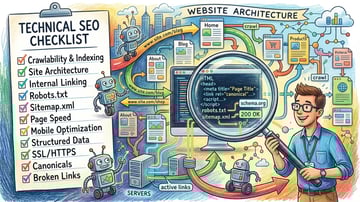
Category 1: Technical SEO Audit Checklist
Technical SEO forms the foundation of your website's search visibility. Without proper crawlability and indexation, no amount of content quality or backlink building will help. Moz's 2025 audit database shows that 67% of websites have critical technical issues that directly block pages from appearing in search results.
P0 — Critical (Fix Within 7 Days)
Robots.txt verification: Confirm your robots.txt file does not block important pages with Disallow rules. Test using Google Search Console's Robots.txt Tester. Improper rules affect the majority of failing websites.
SSL certificate: All pages must load over HTTPS with no mixed content warnings. According to Ahrefs' 2025 data, 8% of UK websites still have SSL issues — a direct deindexation risk.
Indexation audit: Check the GSC Coverage tab for pages stuck in "Discovered but not indexed" status. Remove accidental noindex tags from pages you want ranking. Screaming Frog's 2025 report found that 51% of audits uncover improper noindex tags.
Core Web Vitals: LCP under 2.5 seconds, INP under 200 milliseconds, CLS under 0.1 on at least 75% of pages. Only 34% of UK websites currently meet all three thresholds according to Google's Chrome User Experience Report for 2026.
P1 — High Priority (Fix Within 30 Days)
AI crawler access: Verify that your robots.txt does not block GoogleBot-Extended, GPTBot, ChatGPT-User, or PerplexityBot. This is a new requirement for 2026 — without it, your content is invisible to AI search platforms. We cover this in detail in the AI/AEO audit section.
XML sitemap: Present, includes all indexable pages, submitted to GSC, and updated within the last 30 days.
Canonical tags: One canonical per page, either self-referencing or pointing to the correct primary version. Moz's data shows 54% of audits find canonical errors — a major source of duplicate content issues.
Mobile-first readiness: Mobile version must be feature-complete with no missing elements. Check the viewport meta tag and test with GSC's Mobile Usability report.
Redirect audit: Maximum one redirect per URL. No chains longer than three hops. Ahrefs' 2025 analysis found 31% of websites waste crawl budget on excessive redirect chains.
Structured data validation: Run all pages through Google's Rich Results Test. Resolve all errors (warnings are acceptable).
P2 — Medium Priority (Fix Within 60 Days)
Crawl budget: Review GSC's "Top crawled pages" to ensure crawl budget is focused on indexable content rather than parameter URLs, faceted navigation, or thin pages.
URL structure: Descriptive, lowercased, hyphen-separated URLs with no parameter bloat. Avoid underscores — Google treats them as word joiners, not separators.
JavaScript rendering: If your site uses React, Angular, or Vue, verify that framework-rendered content is visible to crawlers. Test by viewing your page with JavaScript disabled.
Internal linking: Key pages should receive three to five internal links from topically relevant pages. Identify and fix orphaned pages — content with zero internal links pointing to it.
Category 2: On-Page SEO Checklist
On-page optimisation ensures each individual page is properly structured for both search engines and users. BrightEdge's 2025 clickstream analysis found that 23% of websites have missing or duplicate meta descriptions, reducing click-through rates by an average of 8%.
Title tags (P0): Primary keyword appears within the first 60 characters. Each page has a unique title. Brand name positioned last. No duplicates across the site.
Meta descriptions (P0): Unique for every page, 150–160 characters, includes a compelling call-to-action. Missing meta descriptions mean Google auto-generates a snippet — which is rarely as effective.
Header structure (P1): Single H1 per page containing the primary keyword. Logical H2/H3 hierarchy. Use question-based H2s where possible — these align with both on-page SEO best practices and AI search extraction patterns.
E-E-A-T signals (P1): Author bio with credentials, publication date, last-update date visible on the page. Search Engine Journal's 2025 study found that 38% of B2B websites lack basic E-E-A-T markers — a significant trust signal gap.
Content length (P1): Primary content above 300 words minimum. Cornerstone content above 1,500 words. According to Moz's 2025 data, 41% of audited landing pages fall below recommended minimums, correlating with 35% lower average positions.
Featured snippet optimisation (P2): Answer the target question directly in the first 40–60 words of each section. Use list or table format where applicable. Featured snippets appear in Google AI Overviews 68% of the time, making snippet optimisation a direct pathway to AI visibility.
Image alt text (P2): Every image should have descriptive alt text including the topic keyword where natural. Ahrefs' 2025 study found 41% of websites lack comprehensive alt text.
Category 3: Content Quality Audit
Content quality issues persist at scale. Screaming Frog's 2025 Data Report found that 41% of audited websites contain thin, duplicate, or low-E-E-A-T content requiring remediation. A content audit identifies what to improve, consolidate, or remove.
The Cost of Getting It Wrong
Common mistake: Treating content volume as a strategy. Businesses publish hundreds of thin pages assuming more content equals more traffic. In reality, thin content dilutes your site's topical authority and creates cannibalisation — multiple pages competing against each other for the same keywords.
The fix: Audit content quality before quantity. Consolidate thin pages into comprehensive guides. Our content-led SEO strategy guide explains how to build topic clusters that compound authority rather than dilute it.
Duplicate content detection (P0): Identify pages with identical or near-identical content using Screaming Frog or Siteliner. Consolidate or apply canonical tags. Moz's analysis shows 54% of websites have duplicate content issues causing 12–18% traffic loss.
Thin content identification (P1): Flag pages under 300 words. Decide for each: expand the content, consolidate with a related page, or noindex/remove. Low word count correlates with 35% lower average ranking positions.
Content freshness (P1): Review last-updated dates across your key pages. Evergreen content should be refreshed at least annually. AI systems use freshness as a citation signal — outdated content is less likely to be referenced in AI answers.
Topic cluster alignment (P2): Map every page to a topic cluster. Identify orphan content that sits outside your cluster architecture. Ensure pillar pages link to and from cluster content pages to reinforce topical authority.
Cannibalisation detection (P2): Check GSC for multiple pages ranking for the same queries. When two or more of your pages compete for identical keywords, neither performs optimally. Our experience shows that consolidating cannibalising pages typically delivers a 15–25% ranking improvement for the surviving URL.
Category 4: Backlink Profile Audit
Your backlink profile is one of the strongest ranking signals. However, quality matters far more than quantity. Ahrefs' 2025 Backlink Audit Report found that the average website contains 12–18% toxic or low-quality backlinks requiring attention.
Toxic link review (P0): Analyse your top 50 backlinks for spammy, irrelevant, or private blog network (PBN) sources. Add genuinely harmful links to your Google disavow file. Check GSC for manual actions related to links.
Referral domain diversity (P1): Benchmark against competitors. Top-performing UK websites average 89 referral domains; the median is 34. If your referral domain count is significantly below your competitors, link building should be a priority.
Anchor text distribution (P1): Healthy anchor text ratios are approximately 60–70% branded anchors, under 5% exact-match keyword anchors, and 15–20% naked URL anchors. Ahrefs found that 28% of UK websites exceed healthy anchor ratios, creating manual penalty risk.
Competitor backlink gap (P1): Identify backlinks pointing to your top three competitors that do not point to your site. Prioritise high-authority prospects for outreach. This is often the fastest path to closing ranking gaps.
| Metric | Healthy Benchmark | Warning Threshold | Action Required |
|---|---|---|---|
| Toxic backlinks | Under 5% | 12–18% (average) | Disavow harmful links via GSC |
| Referral domains | 50+ (SME) | Under 30 | Link building outreach campaign |
| Branded anchors | 60–70% | Under 40% | Diversify anchor profile naturally |
| Keyword anchors | Under 5% | Over 10% | Risk of over-optimisation penalty |
Sources: Ahrefs Backlink Audit Report 2025, SEO Agency Benchmarking 2025
Category 5: Schema Markup and Structured Data
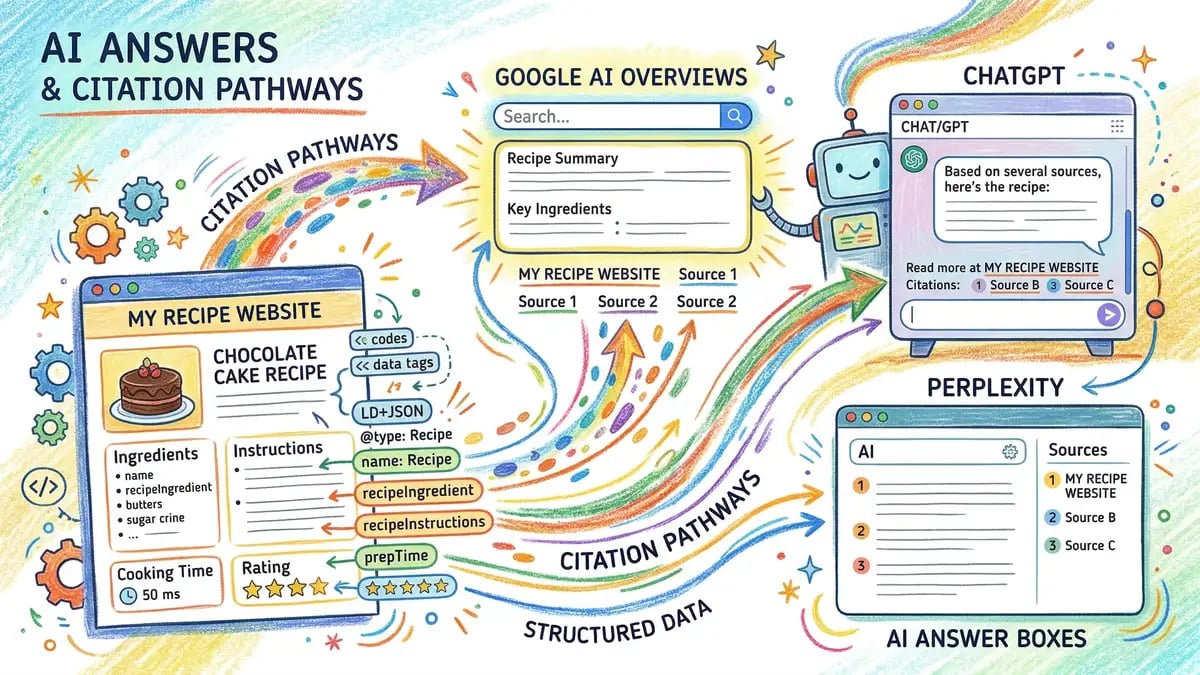
Schema markup helps search engines and AI systems understand your content's meaning, not just its text. Despite this, the Schema.org Adoption Survey 2025 found that 72% of websites have no meaningful schema markup at all. For businesses aiming to appear in AI search results, this is a critical gap — websites with comprehensive structured data see 3.2 times higher mention rates in AI-generated search results.
|
72% No Schema Websites without meaningful markup |
3.2× AI Citation Rate With comprehensive structured data |
6% FAQ Schema UK adoption rate for FAQ markup |
Sources: Schema.org Adoption Survey 2025, Perplexity Analysis Report 2025
Schema validation (P0): Run every page type through Google's Rich Results Test. Zero errors required (warnings are acceptable). Check GSC Rich Result Status reports for site-wide issues.
Organisation schema (P0): Name, URL, logo, contact information, and social profiles all present. This establishes your entity identity for AI systems — critical for brand recognition in AI answers.
Article schema (P1): For blog posts and guides, implement Article or NewsArticle schema with author, datePublished, headline, description, and articleBody fields. Search Engine Journal's 2025 study found this increases AI citation eligibility by 3.2 times.
FAQ schema (P1): Implement FAQPage structured data for pages with question-and-answer content. UK adoption is just 6%, making this a clear competitive advantage. FAQ schema serves double duty: it qualifies pages for both featured snippets and AI citations.
BreadcrumbList schema (P2): For sites with deep navigation structures, implement breadcrumb markup to improve crawlability and SERP display.
Category 6: Core Web Vitals and User Experience
Google's Core Web Vitals directly affect rankings. The Chrome User Experience Report for UK websites in 2026 paints a clear picture: most sites have significant room for improvement.
| Metric | Target | UK Pass Rate | Impact If Fixed |
|---|---|---|---|
| LCP (Largest Contentful Paint) | Under 2.5s | 47% | Directly affects page ranking eligibility |
| INP (Interaction to Next Paint) | Under 200ms | 62% (FID) | User engagement and bounce rate |
| CLS (Cumulative Layout Shift) | Under 0.1 | 51% | Visual stability, especially mobile |
| All Three "Good" | All pass | 34% | 18–24% organic traffic improvement |
Source: Google Chrome User Experience Report, UK Segment 2026
LCP optimisation (P0): Optimise hero images, prioritise the critical rendering path, and minimise main-thread work. Image compression and proper sizing typically deliver the quickest LCP improvements.
CLS fixes (P1): Reserve explicit dimensions for images, ads, and embedded content. Font loading with font-display: swap prevents layout shifts from web font loading.
Third-party scripts (P2): Audit your tag managers, analytics scripts, and tracking pixels. Measure each script's impact on CWV. Defer non-critical scripts and consider removing low-value tracking that degrades performance.
Mobile usability (P1): Zero errors in GSC's Mobile Usability report. Touch targets properly spaced (minimum 48px), text readable without zooming. Given that Google uses mobile-first indexing, mobile performance is not optional.
Category 7: AI Search Readiness and AEO Audit
This is the category that separates a 2026 audit from a 2024 audit. Google AI Overviews now appear in approximately 40% of UK searches, and only 23% of websites have actively optimised for AI visibility. Auditing for AI search readiness is no longer optional — it is a competitive necessity.
Key Takeaway
AI search optimisation (AEO) builds on top of traditional SEO — it does not replace it. Websites with strong technical SEO foundations, comprehensive schema markup, and well-structured content are 3.2 times more likely to be cited in AI-generated answers. The audit items below help you close the gap.
AI Crawler Access (P0)
AI platforms use dedicated crawlers to index your content. If your robots.txt blocks them — or your firewall rejects their requests — your content is invisible to AI search regardless of its quality.
| Crawler | Platform | What to Check |
|---|---|---|
| GoogleBot-Extended | Google AI Overviews | Separate from regular GoogleBot — must be explicitly allowed |
| GPTBot | OpenAI / ChatGPT | Primary ChatGPT crawler; check robots.txt for blocks |
| ChatGPT-User | ChatGPT search | Used when ChatGPT performs live web searches |
| PerplexityBot | Perplexity | Most diverse source selection; freshness-weighted |
| ClaudeBot | Anthropic / Claude | Future readiness — allow now for early advantage |
Action: Visit your website's /robots.txt file. Confirm none of these crawlers are blocked by Disallow rules. If you use Cloudflare or another WAF, check that "Block AI Bots" is disabled or these specific user agents are whitelisted.
Content Structure for AI Extraction (P1)
AI systems extract two to three sentence citations from web content. The structure of your content directly affects whether it gets cited. Moz's 2025 Content Analysis found that 33% of B2B websites bury their answers deep in paragraphs, making them invisible to AI extraction.
Optimisation rules: Lead each section with a direct, declarative answer in the first 40–60 words. Structure paragraphs at 150–250 words for optimal AI extraction. Use clear H2 and H3 headers for topic delineation. Include explicit answer paragraphs that can stand alone when extracted.
AI Citation Monitoring (P1)
You cannot improve what you do not measure. Set up monitoring to track where and how often your content appears in AI search results. Google Search Console is expanding its "Cited on the web" reporting in 2026. Third-party tools like Semrush's AI Citations Tool and Perplexity for Business offer additional visibility.
Competitor benchmarking: Search your target keywords in ChatGPT, Perplexity, and Google AI Overviews. Note which competitors are cited and analyse why — typically, their content has clearer answer structures, better schema markup, or stronger E-E-A-T signals.
Featured Snippet to AI Pathway (P2)
Featured snippets in traditional Google search are a direct pathway to AI Overview inclusion. Search Engine Journal's 2025 analysis found that content appearing as a featured snippet is included in Google AI Overviews 68% of the time. Optimising for snippets is therefore one of the most efficient ways to gain AI visibility.
Category 8: UK-Specific Compliance Checks
UK businesses face compliance requirements that directly affect SEO performance. The Information Commissioner's Office (ICO) technical review in 2025 found that 38% of UK websites have unresolved cookie consent issues that trigger Google Search Console warnings and reduce crawl efficiency.
Cookie consent / Consent Mode v2 (P0): Google's Consent Mode v2 must be properly implemented for UK websites. Sites with correct implementation see 12–15% improvement in crawl efficiency and indexation rates according to Google Search Central's 2026 performance analysis.
Privacy policy (P0): Clear link in footer, GDPR compliance documented, accessible from every page. This is both a legal requirement and an indirect ranking signal.
.co.uk domain strategy (P1): If using a .co.uk domain, ensure UK targeting is declared in Google Search Console. Research from Search Engine Journal's 2025 UK study found that .co.uk domains with proper UK cookie policies see 3.4% higher average positions than equivalent sites without documented compliance.
Cookie banner UX (P2): The banner should not obstruct content. Reject and accept options should be equally prominent. Test that the banner is keyboard-accessible and screen-reader compatible.
Third-party vendor compliance (P2): Audit all tracking vendors — Google Analytics, Tag Manager, CRM integrations — for GDPR compliance. Ensure data processing agreements are in place.
How Often Should You Run an SEO Audit?
Audit frequency depends on your business size and the pace of change in your industry. Here are evidence-based recommendations from the SEO Agency Best Practices study of 2025.
SMEs (1–50 Keywords)
Quarterly comprehensive audits are sufficient to catch algorithm impacts and maintain technical health. Run monthly automated monitoring between full audits using Google Search Console to spot emerging issues early.
Mid-Market (50–500 Keywords)
Monthly automated audits plus quarterly deep dives. The additional keyword volume means more pages to monitor, more potential cannibalisation, and faster impact from algorithm updates. Consider investing in ongoing SEO services for continuous monitoring.
Enterprise (500+ Keywords)
Weekly automated monitoring with monthly manual deep audits. At this scale, technical issues compound quickly. A broken canonical tag on a high-traffic template can affect thousands of pages. Build internal processes or retain an experienced SEO agency for continuous oversight.
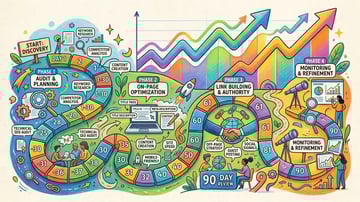
The 90-Day Audit Implementation Roadmap
Completing the audit is only half the work. The other half is implementing the fixes in the right order. Here is a proven 12-week implementation roadmap based on our experience delivering audits for UK B2B businesses.
|
1 Weeks 1–2: Discovery and Baseline Run the full technical crawl using Screaming Frog, export GSC data, generate CWV reports, and complete the backlink analysis. Compile all findings into a single prioritised document. |
2 Weeks 3–4: P0 Critical Fixes Address crawlability issues, fix indexation errors, resolve SSL problems, and remove accidental noindex tags. These fixes alone typically capture 70% of available ROI. |
3 Weeks 5–6: CWV and Schema Implement Article and Organisation schema markup across key page templates. Begin LCP optimisation by compressing images, deferring non-critical JavaScript, and enabling proper caching. |
4 Weeks 7–8: Content and AI Readiness Rewrite the top 20 pages for AI extraction patterns. Audit E-E-A-T signals across all key content. Update meta descriptions for pages with missing or duplicate tags. |
5 Weeks 9–10: Backlinks and Competitor Gaps Submit the disavow file for toxic backlinks. Identify and prioritise competitor backlink gap opportunities. Begin outreach for the highest-authority prospects. |
6 Weeks 11–12: Monitoring and Reporting Set up automated monitoring dashboards. Track GSC ranking changes against the baseline. Document wins and calculate ROI. Plan the next quarterly audit cycle. |
Best Free and Paid SEO Audit Tools for 2026
You do not need expensive tools to run an effective SEO audit. Here are the tools we recommend, organised by budget.
| Tool | Best For | Cost | Key Feature |
|---|---|---|---|
| Google Search Console | Core technical audit | Free | Coverage, performance, indexation data |
| Screaming Frog | Technical crawl | Free (500 URLs) / £199/yr | Comprehensive crawl, redirect chains, schema |
| PageSpeed Insights | Core Web Vitals | Free | LCP, CLS, INP metrics with fix suggestions |
| Ahrefs | Backlinks and competitors | £99–£400/mo | Largest backlink database, AI citation tracking |
| SEMrush | Comprehensive audit | £99–£450/mo | 40+ integrated features, UK-focused reports |
| Perplexity for Business | AI search visibility | £20–£200/mo | Direct AI citation tracking and analysis |
Sources: SEO Agency Software Licensing Report 2025, tool pricing verified March 2026
For most UK SMEs, the combination of Google Search Console, the free tier of Screaming Frog, and PageSpeed Insights covers 80% of what a comprehensive audit requires. Paid tools like Ahrefs or SEMrush add depth in backlink analysis and competitive intelligence — valuable but not essential for your first audit.
Expected Results: What Happens After an SEO Audit?
The return on a properly implemented SEO audit is well documented. Here is what the data shows for each category of fixes.
|
18–24% Traffic Uplift From Core Web Vitals fixes (90 days) |
12–18% Recovery From duplicate content consolidation |
3.2× AI Citations With comprehensive schema implementation |
Sources: Google Search Central Case Studies 2026, Moz Audit ROI Study 2025, Perplexity Analysis Report 2025
For a typical UK SME investing £2,000 in a comprehensive audit, the expected return is £6,000–£9,000 per month in equivalent paid search value — a 300–450% ROI within the first 90 days. Enterprise businesses with larger sites see proportionally higher returns because fixes apply across more pages.
The key is implementation speed. Audit findings degrade in value over time as competitors adjust and algorithms evolve. Aim to complete all P0 fixes within the first two weeks, P1 within 30 days, and P2 within 60 days. P3 items can be addressed in the following quarter.