
SEO for accountants is the process of optimising a UK accounting firm's website and online presence to rank higher in Google, dominate the local map pack, earn citations from AI search engines, and generate qualified leads from business owners searching for accounting services. With a £39.8 billion UK accountancy market, over 408,000 professional members across chartered bodies, and 42% of clients now finding their accountant online, the firms that invest in search visibility capture clients worth £5,000–£240,000 in lifetime value.
This guide covers every aspect of accountancy SEO: a direct answer for ICAEW-regulated firms, how UK accountancy SEO differs from generalist SEO, local SEO, content strategy around MTD and self-assessment deadlines, website optimisation, pricing and ROI, AI search readiness, ICAEW/ACCA regulatory compliance, and a 90-day implementation roadmap.
Accountancy SEO: what works for UK practices in 2026
Accountancy SEO is the structured practice of making a UK accounting firm rank in Google and AI Overviews for the high-intent client queries that drive new instructions — within ICAEW, ACCA, and AAT advertising standards. The work covers technical SEO (Core Web Vitals, structured data, site architecture tuned for service-area depth), local visibility (Google Business Profile optimisation, citation-building on accountancy directories), commercially-aligned content (service-line landing pages, sector-specialism content, regulatory-aware tax and compliance pieces), and AEO (answer engine optimisation — citation-ready content for ChatGPT, Perplexity, and Google AI Overviews). According to ICAEW's marketing standards, UK accountancy firms must balance discoverability with professional-conduct obligations — Whitehat's specialist SEO approach combines technical depth with ICAEW/ACCA-compliant content to win new instructions without breaching regulator expectations. UK firms working with HubSpot Diamond Partners typically see 25–60% increases in qualified enquiry pipeline within 6–9 months.
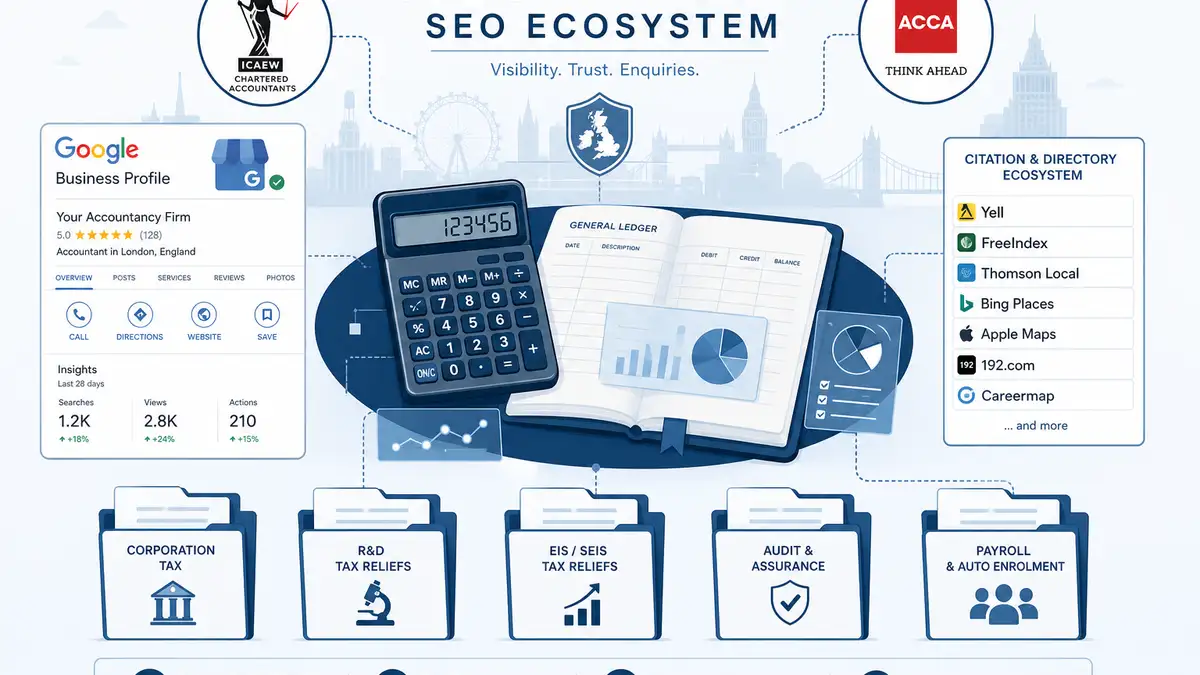
SEO for UK accountants: how it differs from generalist SEO

SEO for UK accountants is not a vertical lift of generic professional-services SEO. The regulatory environment, sector vocabulary, software-integration questions, and buying cycle all behave differently — and the techniques that win for a marketing agency or e-commerce site routinely breach professional-conduct expectations for an ICAEW or ACCA firm. Five factors make accountancy SEO a specialist discipline.
1. Regulatory framework. Generalist SEO writers do not work to ICAEW Codes of Ethics or ACCA Rules of Engagement. Both regulators restrict comparative fee advertising, disparaging competitor copy, and unsolicited approaches to clients. The Financial Reporting Council (FRC) adds a further layer of integrity expectations on audit firms. Specialist accountancy SEO is engineered to survive that compliance review.
2. Sector-specialism keyword research. Accountants serve owner-managed businesses, contractors and IR35-affected workers, property landlords, e-commerce sellers, life-sciences founders, charities, and dental and medical practices — and each sector searches differently. Generic keyword tools collapse this nuance.
3. Service-line content depth. Corporation tax, R&D claims, EIS/SEIS, cloud accounting migration, payroll, statutory audit, MTD readiness — each is a distinct content territory with its own intent and competitor landscape. Generalist SEO treats them as one "services" page.
4. Client-acquisition cycle. Accountancy clients have long retention (5–15 years), but the instruction decision often happens after Google and AI Overview research, not after a referral. Whitehat builds the search and AEO architecture around that hybrid discovery journey.
5. Software-integration content. UK clients ask "Xero accountant near me", "QuickBooks bookkeeper", "Sage payroll specialist", "Companies House filing" — technical software queries that generalist SEO copywriters cannot resolve without sector knowledge.

Every business owner searching for "accountant near me" or "bookkeeping services UK" is a potential client worth £5,000–£240,000 in lifetime value. Dominating local Google results, earning citations in AI search engines, and ranking for intent-driven keywords can add £50,000–£500,000 in annual revenue to your practice. Unlike PPC advertising, organic rankings are a compounding asset — articles you publish today will generate leads for 2–3 years with minimal maintenance.
Local SEO for Accountants: Dominating the Google Map Pack
Local SEO is the fastest way for accountants to win new business. When a business owner searches "accountant Manchester" or "tax advisor London," Google displays a local map pack with three businesses. Being in that top three drives phone calls, enquiries, and qualified leads directly to your practice.
According to BrightLocal's 2024 Local Consumer Review Survey, 87% of consumers read online reviews for local businesses, and accountancy is one of the most review-influenced professional services categories.
Google Business Profile Optimisation
Your Google Business Profile (formerly Google My Business) is the foundation of local visibility. Google ranks local businesses using proximity, relevance, and prominence signals — all of which can be optimised.
Profile completeness matters: Fill every field including business name, address, phone, website, hours, categories (Accountant, Tax Advisor, Bookkeeper), photos, description, and service areas. Select "Accountant," "Tax Advisor," and "Bookkeeper" as primary and secondary categories — Google uses these to match search intent.
Reviews drive rankings: Actively request reviews from clients after delivering tax returns or completing audits. Respond to all reviews (positive and negative) within 48 hours. Higher review count plus higher average rating equals higher local ranking. Google Business Profile Help confirms that review quantity and quality are ranking factors.
Post regularly: Publish 2–3 Google Business Profile posts per month about tax deadlines, seasonal tips, and new services. These posts appear in your knowledge panel and signal freshness to Google's algorithm.
Local Citations and Directories
A local citation is any mention of your business name, address, and phone number (NAP) on a third-party website. Google uses citations to verify your business and rank you locally. Consistency is critical — even small differences between "Smith & Associates" and "Smith and Associates" across directories can confuse Google's algorithm.
High-impact directories for UK accountants include the ICAEW Find a Chartered Accountant directory, the ACCA Find an Accountant tool, Freeindex, Yell.com, and local Chambers of Commerce listings. Prioritise high-authority, industry-specific directories first.
Local Backlinks and Authority
Backlinks from local websites — chambers of commerce, local news outlets, partner businesses — tell Google you're a trusted local entity. Build relationships with local business coaches, financial advisors, and HR consultants who can provide contextual links. Sponsor local events, charities, or sports teams, as sponsorship websites typically include backlinks to sponsors.
Local SEO (Google Business Profile + citations + reviews) typically drives 20–40% of new enquiries for UK accountancy practices within 3–6 months. For a detailed implementation guide, see our article on local SEO for accountants.
Content Strategy: Ranking for High-Intent Accountant Keywords
While local SEO wins "near me" searches, content strategy targets high-intent keywords that signal buying readiness: "tax planning for contractors," "corporation tax deadline," "MTD software for accountants." These keywords convert at 5–15%, compared to generic "accountant" which converts at just 0.5–2%.

Seasonal Content Calendar for UK Accountants
UK accountants face statutory deadlines throughout the year. Publishing content 4–6 weeks ahead of each deadline captures intent-driven traffic at peak search volume. The self-assessment filing deadline (31 January) and corporation tax deadline (19 April) drive the highest organic search volumes, but every quarter presents content opportunities.
| Season | Key Deadlines | Content Topics | Search Volume |
|---|---|---|---|
| Jan–Feb | Self-assessment filing (31 Jan) | Self-assessment deadline, tax return checklist, MTD-ready software, filing fees | High |
| Mar–Apr | Corporation tax (19 Apr), VAT quarter end (31 Mar) | Corporation tax rate, VAT threshold, R&D tax relief, quarterly VAT returns | High |
| May–Jun | PAYE year-end (5 Apr), CIS monthly returns | PAYE year-end checklist, CIS returns, contractor tax planning, dividend tax | Medium |
| Jul–Aug | Half-year reviews, business planning | Business accounting software, management accounts, tax planning tips | Medium |
| Sep–Oct | VAT returns, quarterly review planning | Quarterly accounts, VAT deadlines, tax planning for Q4 | Med-High |
| Nov–Dec | Year-end tax planning, corporation tax planning | Year-end tax planning, salary vs. dividend, trading allowance | High |
Content by User Intent
Educational content (informational intent): Articles like "What is Making Tax Digital?" or "How to Choose an Accountant" rank for broad keywords and establish authority. Target 1,500–2,500 words. These build trust with prospects who aren't ready to buy yet but will remember your firm when they are.
Action-oriented content (commercial intent): Guides such as "Contractor Tax Planning: 5 Strategies to Save £10,000+" or "Self-Assessment Checklist 2026" target keywords showing buying intent. These convert at 5–15% and should be 2,000–3,500 words with clear calls to action. For a deeper dive into content approaches, read our guide to content marketing for accountants.
Local + intent content: Pages targeting "Accountants in Manchester" or "Contractor Accountant Leeds" combine geographic and commercial intent. Target 1,000–2,000 words per location page, each with unique content (not templated copies).
On-Page SEO Best Practices
Every piece of content should follow on-page fundamentals: descriptive title tags (50–60 characters with primary keyword), meta descriptions including keyword plus benefit plus CTA (150–160 characters), proper heading hierarchy (H2 for sections, H3 for subsections), and 3–5 internal links per 1,500 words. Use descriptive anchor text — "read our guide to contractor tax relief" rather than "click here."
Images should include keyword-rich alt text: "Contractor tax planning timeline showing January self-assessment through April corporation tax deadlines" rather than "image1.png." For comprehensive guidance on accountant website structure, see our article on accountant website design and SEO.
Want to see how your practice's online visibility compares?
Website Optimisation for Accountants
Core Web Vitals and Site Speed
Google's Core Web Vitals are confirmed ranking factors. Many accountancy websites run on legacy platforms with poor performance scores. The three metrics that matter are Largest Contentful Paint (LCP, target under 2.5 seconds), Cumulative Layout Shift (CLS, target under 0.1), and Interaction to Next Paint (INP, target under 200 milliseconds).
Quick wins include enabling Gzip compression, using a CDN for static assets, minifying CSS and JavaScript, lazy-loading below-fold images, and removing unused fonts. Check your scores using Google PageSpeed Insights and the Core Web Vitals report in Google Search Console.
Mobile-First Indexing
Google indexes and ranks based on the mobile version of your site. If your desktop site is better than your mobile experience, your rankings will suffer. Ensure responsive layouts, touch-friendly buttons (minimum 44×44px), readable text (minimum 16px), clear mobile navigation with click-to-call CTAs, and mobile page loads within 3 seconds.

Technical SEO Essentials
Canonical URLs: Prevent duplicate content by adding <link rel="canonical"> tags to every page. XML Sitemap: Submit your sitemap to Google Search Console and ensure robots.txt allows all important pages. Schema markup: Add JSON-LD structured data for Organisation, LocalBusiness, and FAQPage types — properly marked-up pages may earn rich snippets in search results.
Backlink Strategy for Accountants
Quality backlinks from high-authority sites improve domain authority and rankings. Accountant backlinks are earned through resource page outreach (finding industry "best practice" pages and suggesting your content), broken link building (finding and replacing dead links on relevant sites), co-authoring content with peers and industry bodies, winning industry awards through Accountancy Age or similar publications, and building local partnerships with solicitors, financial advisors, and business coaches.
Never buy links or participate in link schemes — Google can issue manual actions that tank rankings permanently. Also avoid excessive internal linking to commercial pages (looks unnatural) and linking to unrelated high-authority sites (not topically relevant).
SEO Costs and ROI for Accountants
Investment Ranges by Service Model
SEO investment for UK accountancy firms varies significantly based on your growth goals, competitive landscape, and whether you build capacity in-house or partner with specialists. Here's what to expect across the main service models:
| Service Model | Monthly Cost | What's Included | Best For |
|---|---|---|---|
| DIY / Tools | £0–£300/mo | SEO tools (Ahrefs, Semrush), content calendar, your time to implement | Solo practitioners; time-rich, budget-limited |
| Freelancer | £500–£1,500/mo | 1–4 content pieces/month, local SEO, backlink outreach (~10–20 hrs/week) | Small practices (1–3 partners) |
| In-House | £2,000–£4,000/mo | Full-time SEO specialist: content, technical SEO, link building, analytics | Growing practices (5+ staff) |
| Agency | £3,000–£8,000/mo | Strategy, 4–8 content pieces/month, technical SEO, link building, reporting | Mid-to-large firms (10+ staff), multi-location |
For a detailed breakdown of accountant marketing budgets across all channels, see our dedicated guide to accountant marketing costs and ROI.
ROI Calculation Example
Consider a 15-partner accountancy firm in Manchester investing £2,500/month in SEO (in-house specialist). Starting from 200 organic visits per month with a 1% conversion rate (2 leads/month), the goal is 1,000 visits per month at 5% conversion (50 leads/month) after 6 months.
With an average new client contract worth £12,000/year in accounting and tax planning fees, and a 20% close rate: 50 leads × 20% = 10 new clients per month = £120,000/month in new revenue. Against a £30,000 annual SEO investment, that's a 47× ROI in Year 1.
Conservative estimates suggest accountants typically see 2–3× ROI within 6 months and 5–10× ROI within 12 months. The compounding nature of organic content means Year 2 costs less (maintenance vs. building) while traffic continues growing.
AI Search and AEO (Answer Engine Optimisation) for Accountants
Google's AI Overviews, ChatGPT, Perplexity, and Claude are fundamentally changing how people find professional services. AI summaries now appear above organic results for many accounting queries, and being cited in these summaries is becoming as important as traditional page-one rankings.
What is Answer Engine Optimisation (AEO)?
AEO is the practice of optimising content to be cited in AI-generated summaries and answers. When a business owner asks ChatGPT "What's the best way to set up a limited company for tax purposes?", your content will be cited if it's well-structured, factually accurate, and ranks for that query.
AEO Tactics for Accountants
Structure content for AI extraction: Use clear headings and numbered lists. AI models extract from well-structured content more reliably than from dense paragraphs. Start sections with direct answers, then elaborate — this "inverted pyramid" approach mirrors how AI models select citation sources.
Include data and citations: AI engines prefer factual, well-sourced content. Reference data from HMRC, the Financial Reporting Council (FRC), and industry research. For example: "According to HMRC, 12.1 million individuals filed self-assessment returns for the 2023/24 tax year."
Target question-based keywords: AI queries are predominantly questions. Create comprehensive FAQ sections answering queries like "How do I set up a limited company?", "What is the corporation tax rate in the UK?", and "Can I claim home office expenses as a contractor?" Answer each in 200–400 words with cited sources.
Monitor AI citations: Use tools like Dataforseo or manual searches in ChatGPT, Perplexity, and Google AI Overviews to track whether your content is being cited. Aim for consistent citations across multiple AI platforms.
ICAEW and ACCA Compliance: SEO Without Violating Professional Standards
UK accountants must comply with ethical standards set by ICAEW, ACCA, or ICAS. These bodies regulate marketing practices, and SEO content must align with professional standards.
Educational content: Guides explaining tax relief, deadlines, regulation — education, not personalised advice.
Testimonials: Real client results (anonymised, with consent) — "Saved contractor £8K via pension planning."
Credentials: ACA, ACCA, CTA qualifications; years in practice. Factual statements only.
Service descriptions: Clear descriptions of what you provide — corporation tax planning, quarterly management accounts.
Misleading claims: "We guarantee you'll save £50,000 in tax" without situational context = unethical.
Disparaging competitors: "Our competitors overcharge" without evidence violates ethical codes.
Unsubstantiated guarantees: Avoid absolute promises — tax outcomes vary by client.
Unsolicited advice: Blog content must be general education with disclaimers, not personalised advice.
Compliance best practice: Include disclaimers on all articles ("For tax advice specific to your situation, contact a qualified accountant"), back up claims with cited data, obtain client consent before using testimonials, and review content within 30 days of any relevant tax law changes. The ACCA Rules of Engagement apply in parallel and are worth cross-checking before publication.
Action Plan: 90-Day SEO Roadmap for Accountants
Here's a practical 90-day implementation plan to get your practice's SEO programme off the ground. Each phase builds on the previous, creating a solid foundation for long-term organic growth.
Audit your website for speed, mobile responsiveness, and indexing issues via Google Search Console. Set up or claim your Google Business Profile and complete all fields. Install Google Analytics 4. Identify your top 20 target keywords using Semrush, Ahrefs, or Google Keyword Planner.
Launch a client review request campaign via email (target: 10+ new Google reviews). Submit your business to 5–10 high-authority directories (ICAEW, ACCA, Freeindex, Yell, local Chambers of Commerce). Add LocalBusiness and Organisation schema markup to your homepage.
Write 4 pillar articles (2,500–3,500 words each) targeting your highest-value keywords: limited company tax planning, self-assessment guide, contractor accountant in [city], and VAT compliance. Each article needs internal links, optimised images with alt text, and FAQPage schema markup.
Reach out to 20–30 relevant websites for backlinks (resource pages, guest posts, broken link replacement). Optimise your top 3 pages for Core Web Vitals. Monitor Google Search Console weekly and fix issues promptly. Establish a monthly publishing cadence of 2–3 articles targeting seasonal keywords.
Organic traffic increase of 20–50%. Top-10 rankings for 3–5 priority keywords. 20–50 qualified leads per month from organic search. Google Map Pack visibility for your primary location. For practices wanting to accelerate these timelines, combining SEO with broader digital marketing and PPC campaigns can drive results while organic rankings build.
SEO as a Long-Term Investment for Your Practice
SEO for accountants is not a quick fix — it typically takes 6–12 months to see meaningful, compounding results. However, the payoff is substantial: consistent, low-cost lead generation that compounds over time.
Unlike PPC advertising (which stops the day you stop paying), organic rankings are an appreciating asset. A well-optimised article ranking for "contractor tax planning" will generate qualified leads for 2–3 years with minimal ongoing maintenance. Each new article you publish strengthens the entire domain, lifting rankings for existing pages.
The firms investing in SEO today will dominate their local markets by 2027. Those who wait will face steeper competition and higher costs to catch up. Whether you start with local SEO fundamentals, invest in content marketing, or pursue a comprehensive digital marketing strategy, the time to begin is now.
Ready for professional support? Explore Whitehat's specialist SEO services for accountants — tailored strategies for UK accounting firms at every stage of growth.
Frequently asked questions: SEO for UK accountants
Ready to Grow Your Practice with Specialist Accountancy SEO?
Whitehat builds SEO strategies specifically for UK accounting firms — local visibility, ICAEW/ACCA-compliant content that converts, technical foundations, and AI search readiness. Book a free audit to see where your practice stands.
Book Your Free SEO AuditMore Accountant Marketing Guides
Whitehat is a HubSpot Diamond Partner and specialist SEO agency for UK professional services firms. With particular expertise in regulated industries including accountancy, legal, and healthcare, the team combines technical SEO, ICAEW/ACCA-compliant content strategy, and AI search optimisation to deliver measurable growth. Learn more about Whitehat's SEO services for accountants →
Disclaimer: This article is for general information purposes only and does not constitute professional tax or accounting advice. For advice specific to your situation, consult a qualified accountant or tax advisor.