
Customer Experience Strategy
Gartner research confirms that organisations using customer journey maps are twice as likely to outperform their competitors. Yet nearly a third of companies struggle to use their journey maps effectively—often because they treat mapping as a one-off exercise rather than an ongoing strategic discipline.
Customer Journey Mapping: The Complete B2B Guide for 2026
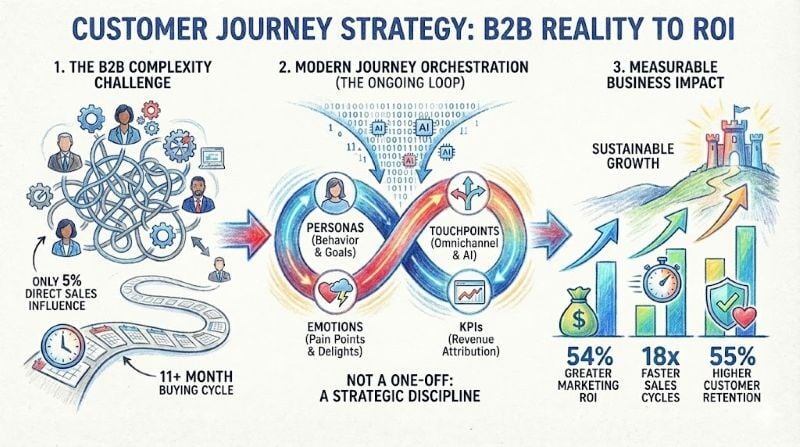
A customer journey map is a visual representation of every interaction a customer has with your brand, from initial awareness through purchase and beyond. Companies using customer journey mapping achieve 54% greater marketing ROI and 55% higher customer retention rates, according to Aberdeen Group research. For B2B organisations managing complex buying committees and lengthy sales cycles, journey mapping has evolved from static diagrams into dynamic, AI-powered orchestration tools that drive measurable revenue growth.
At Whitehat SEO, we've helped dozens of B2B companies implement customer journey mapping within their HubSpot CRM systems. This guide shares our methodology and the latest 2025 best practices for creating journey maps that actually drive business outcomes—not just beautiful diagrams that gather dust.
What Is Customer Journey Mapping?
Customer journey mapping documents the complete experience a customer has with your organisation—every touchpoint, emotion, pain point, and decision along their path from stranger to advocate. Unlike traditional sales funnels that view the process from your company's perspective, journey maps adopt the customer's viewpoint to reveal what they actually experience, think, and feel.
Modern customer journey mapping in 2026 has evolved significantly. As Amy Hage, Co-founder at Strategy Maven, explains: "Instead of broad stages like 'awareness' and 'consideration,' we're mapping actual customer behaviours: Did they browse but not add to cart? Did they subscribe to SMS but never open an email? Each of these micro-behaviours triggers a different journey."
Core Elements of Modern Journey Maps
- Personas: Demographics, psychographics, and behavioural traits
- Actions: What the customer does at each touchpoint
- Timeline: Process through touchpoints and phases
- Channels: Which brand channels are used
- Emotions: Feelings, expectations, and questions at each stage
- KPIs: Metrics linked to each journey stage
Why B2B Customer Journey Mapping Is Different
B2B customer journeys are fundamentally more complex than their B2C counterparts. Research from 6sense reveals that B2B buyers spend up to 11 months in their buying journey, with 8 months conducting research before engaging sales. Gartner's data shows that only 17% of the purchase journey is spent talking to sales representatives—meaning your individual company's direct influence is typically less than 5%.
This complexity is compounded by the number of stakeholders involved. According to Forrester, B2B deals typically involve 13 stakeholders across multiple departments. More concerning, 86% of B2B purchases stall because stakeholder voices don't align. When Whitehat SEO works with clients on their B2B website strategy, we build journey maps that account for this buying committee complexity.
| Factor | B2B Journey | B2C Journey |
|---|---|---|
| Decision makers | 6-13 stakeholders (up to 20 enterprise) | Usually individual consumer |
| Decision cycle | Months to years | Minutes to days |
| Primary drivers | ROI, implementation, compliance | Emotional, impulse-driven |
| Touchpoint volume | High (awareness/consideration heavy) | Lower, shorter chains |
| Post-purchase importance | Critical (implementation, adoption) | Less focus typically |
These differences have significant implications. Nearly 77% of B2B buyers report finding the buying process too complicated. Your journey map must account for multiple personas with different priorities, information needs, and decision criteria—all navigating the same purchase together.
Five Types of Customer Journey Maps
Not all journey maps serve the same purpose. Choosing the right type depends on what you're trying to achieve and what decisions the map needs to inform.
1. Current State Map
Purpose: Documents the existing customer experience as it happens today.
Best for: Diagnosing inefficiencies, identifying pain points, and establishing a baseline for improvement.
2. Future State Map
Purpose: Outlines the ideal customer experience you want to create.
Best for: Redesigning processes, planning improvements, and aligning teams around a shared vision.
3. Day-in-the-Life Map
Purpose: Provides a broader view of the customer's daily life and context.
Best for: Developing deeper empathy, discovering unmet needs, and identifying new opportunities.
4. Service Blueprint
Purpose: Includes backstage business processes that support the customer journey.
Best for: Internal process improvement, identifying operational bottlenecks, and cross-functional alignment.
5. Buyer's Journey Map
Purpose: Focuses specifically on the decision-making process before purchase.
Best for: Sales and marketing alignment, content planning, and conversion optimisation.
For most B2B organisations, Whitehat SEO recommends starting with a Current State Map for your primary buyer persona, then developing a Future State Map to guide improvements. Service Blueprints become valuable once you've identified specific process issues that need internal attention.
How to Create a Customer Journey Map: Step-by-Step
Creating an effective customer journey map requires both quantitative data and qualitative insights. Here's Whitehat SEO's proven methodology for B2B journey mapping, developed through our work with dozens of HubSpot CRM implementations.
Define Your Objectives and Scope
Set SMART goals for what you want to achieve. Are you trying to reduce customer churn? Shorten sales cycles? Improve onboarding? Research shows that approximately 70% of organisations fail because they don't define clear objectives before mapping. Decide which persona and which journey (acquisition, onboarding, renewal) you'll focus on first.
Gather Cross-Functional Stakeholders
Assemble a team of 10-15 people who influence or interact with the customer journey. Include representatives from Sales, Marketing, Customer Success, Product, and Support. According to Gartner, customer journey mapping is more successful when it's a collaborative process across departments—not a siloed marketing exercise.
Research and Build Detailed Personas
Go beyond basic demographics to include behavioural traits, goals, challenges, and decision-making criteria. Conduct customer interviews, analyse CRM data, review support tickets, and study website analytics. Poorly developed personas based on assumptions rather than research is one of the most common reasons journey maps fail to drive meaningful action.
Identify All Touchpoints and Channels
Document every interaction point across the journey. In 2025, B2B marketing teams manage an average of 10.2 channels. Include both digital touchpoints (website, email, social, ads, chatbots) and human touchpoints (sales calls, demos, support). Don't forget the touchpoints before they find you and after the sale—many journey maps fail because they start too late and end too early.
Map Emotions, Pain Points, and Opportunities
At each stage and touchpoint, document what the customer is thinking, feeling, and experiencing. Use HubSpot's 5-question framework: What is the customer trying to achieve? What questions do they have? What pain points exist? What content or resources do they need? What triggers move them to the next stage?
Validate, Prioritise, and Take Action
Share the map with stakeholders and validate findings against data. Prioritise improvements based on impact and feasibility. According to industry research, 67% of customer journey maps fail to drive change—usually because they remain beautiful documents rather than catalysts for action. Connect each insight to a specific improvement initiative with owners and deadlines.
Mapping Digital Touchpoints in 2026
The modern B2B customer journey spans more channels than ever before. Omnisend research shows that omnichannel marketing can drive 6x the sales versus single-channel approaches, with omnichannel customers proving 30% more valuable over their lifetime. Your journey map must capture this complexity.
Pre-Purchase Touchpoints
- Organic search and AI answer engines
- Paid advertising (search, social, display)
- Social media content and engagement
- Website and landing pages
- Blog and educational content
- Webinars and virtual events
- Review sites (G2, Capterra, TrustRadius)
- Email marketing and newsletters
Engagement Touchpoints
- Live chat and AI chatbots
- Form submissions and content downloads
- Product demos and free trials
- Meeting scheduling
- Sales calls and consultations
- WhatsApp and SMS communications
Post-Purchase Touchpoints
- Onboarding emails and sequences
- In-app messaging and product tours
- Customer support tickets
- NPS and CSAT surveys
- Loyalty and advocacy programmes
- Renewal and expansion communications
According to Nielsen Norman Group, omnichannel UX excellence requires five components: consistency across channels, individual channel optimisation, seamless transitions, strategic orchestration, and internal team collaboration. Your journey map should evaluate each touchpoint against these criteria to identify gaps and opportunities.
How AI Is Transforming Customer Journey Mapping
The customer journey analytics and orchestration market is projected to reach £10.2 billion by 2025, growing at 24% annually according to MarketsandMarkets. AI is fundamentally changing how organisations understand, map, and optimise customer journeys—moving from static diagrams to dynamic, real-time orchestration systems.
Key AI Capabilities for Journey Mapping
- Real-time data processing: Millisecond-by-millisecond journey updates
- Cross-channel identity resolution: Connecting interactions across devices and platforms
- Automated pattern recognition: Processing data from websites, apps, email, and social simultaneously
- Natural language processing: Analysing sentiment from reviews, support tickets, and social interactions
- Predictive analytics: Anticipating customer needs before they're expressed
The results speak for themselves. Companies using AI-powered customer journey mapping report 25% higher customer satisfaction, 15% increase in revenue, and up to 25% improvement in customer retention, according to Gartner research. Walmart, for example, reduced customer service calls by 38% using AI-powered analysis of customer journey data.
Within HubSpot's ecosystem, AI capabilities have expanded significantly. Enterprise-tier users now have access to Journey Analytics with Sankey diagram visualisations, supporting up to 15 stages with AI-assisted Pathfinder tools. The platform's Journey Orchestration features (currently in beta) enable multi-channel automation and end-to-end journey creation with revenue attribution. If you're not yet taking advantage of these capabilities, speak with a HubSpot consultant about what's possible.
The Business Impact of Customer Journey Mapping
Journey mapping isn't just a strategic exercise—it delivers measurable business outcomes. Aberdeen Group's research on companies investing in customer journey mapping reveals significant performance improvements across multiple metrics.
| Metric | Improvement | Source |
|---|---|---|
| Marketing ROI | 54% greater | Aberdeen Group |
| Customer retention rate | 55% vs 21% | Growth Molecules |
| Revenue from referrals | 3.5x greater | Aberdeen Group |
| Cross-sell and upsell revenue | 56% more | Aberdeen Group |
| Sales cycle speed | 18x faster | Aberdeen Group |
| Customer service costs | 10x improvement | Aberdeen Group |
McKinsey's research reinforces these findings: customer-centric companies achieve 2x revenue growth compared to less focused peers. For every 10-percentage-point increase in customer satisfaction scores, organisations see 2-3% revenue growth. B2B companies specifically report 8-10% higher revenue per bid through journey-influenced efforts.
Perhaps most compelling is Hanover Research's finding that 76% of companies report customer journey mapping increased the ROI of their business investments overall. The discipline forces organisations to think systematically about customer experience—and that systematic thinking pays dividends across the business.
Ten Customer Journey Mapping Mistakes to Avoid
Despite the proven benefits, only 29% of senior marketers say they're very effective at journey mapping, even though 86% consider it important. Through Whitehat SEO's work with B2B organisations, we've identified the most common pitfalls that prevent journey maps from driving real change.
- No clear goals or objectives: Set SMART goals before starting. What specific business outcome should the map enable?
- Weak or no customer research: Conduct interviews, surveys, and analyse support tickets. Assumptions aren't insights.
- Mapping from the company's perspective: Build the map from the customer's viewpoint, not your internal processes.
- Poorly developed personas: Include behavioural traits, not just demographics. Understand motivations and decision criteria.
- Starting too late, ending too early: Include stages before the customer finds you and after the purchase.
- One journey for all personas: Create separate maps for different segments—their experiences differ substantially.
- Prioritising aesthetics over action: Beautiful maps that don't drive change are worthless. Focus on actionability.
- Treating it as a one-off project: Establish regular reviews and feedback loops. Customer journeys evolve constantly.
- Lacking cross-functional involvement: Include Product, Sales, and Support stakeholders—not just Marketing.
- Ignoring pre-funnel activity: Track what creates demand, not just what converts it. The journey starts before awareness.
Best practice from Whitehat SEO's experience: review and update your journey maps at minimum every six months, combining quantitative data from your CRM and analytics with qualitative insights from customer conversations and frontline staff feedback.
Customer Journey Mapping with HubSpot
As a HubSpot Diamond Partner, Whitehat SEO has extensive experience implementing journey mapping within the HubSpot ecosystem. The platform offers robust capabilities for operationalising your journey maps—turning insights into automated workflows, personalised experiences, and measurable outcomes.
| HubSpot Feature | Tier | Journey Mapping Application |
|---|---|---|
| Journey Analytics | Enterprise | Sankey visualisation, up to 15 stages, AI Pathfinder |
| Journey Orchestration | Beta (2024-25) | Multi-channel automation, revenue attribution |
| Customer Feedback | Professional+ | NPS, CES, CSAT surveys at journey milestones |
| Attribution Reporting | Professional+ | Multi-touch revenue attribution across touchpoints |
| Free CJM Templates | All tiers | 7 downloadable journey mapping templates |
Key HubSpot Integration Points for Journey Mapping
- Contact and company properties: Map customer attributes to journey stages for segmentation and personalisation
- Lifecycle stages: Track progression through the journey funnel automatically
- Behavioural data: Capture page visits, email opens, form submissions, and content engagement
- Deal pipeline: Connect marketing touchpoints to revenue outcomes
- Workflows: Automate actions triggered by journey stage transitions
- Custom behavioural events: Track industry-specific journey milestones (Enterprise)
For organisations using both HubSpot and Salesforce, proper integration ensures your journey maps reflect the complete customer experience across both platforms. Learn more about creating customer journey maps that work seamlessly with your CRM infrastructure.
Frequently Asked Questions
What is the purpose of a customer journey map?
A customer journey map helps organisations understand every interaction a customer has with their brand, identify pain points and opportunities, and align teams around improving the customer experience. Companies using journey maps are twice as likely to outperform competitors according to Gartner research.
How is B2B customer journey mapping different from B2C?
B2B journeys involve multiple stakeholders (typically 13 per deal), longer decision cycles (up to 11 months), and greater emphasis on rational factors like ROI and implementation. B2B maps must account for buying committees with different priorities and information needs navigating the same purchase together.
How often should I update my customer journey map?
Best practice is to review and update journey maps at minimum every six months. Customer behaviours, channel preferences, and competitive landscapes evolve constantly. Combine quantitative CRM data with qualitative insights from customer interviews and frontline staff feedback during each review.
Can HubSpot track customer journey touchpoints automatically?
Yes, HubSpot captures behavioural data including page visits, email engagement, form submissions, and content downloads automatically. Enterprise-tier users access Journey Analytics with Sankey diagram visualisation and AI-powered Pathfinder tools for deeper journey analysis and optimisation.
What's the difference between a customer journey map and a sales funnel?
A sales funnel views the purchase process from the company's perspective, focusing on conversion stages. A customer journey map adopts the customer's viewpoint, documenting their emotions, pain points, and experiences across the entire relationship—including post-purchase stages like onboarding, retention, and advocacy.
Getting Started with Customer Journey Mapping
Customer journey mapping remains one of the highest-impact strategic exercises a B2B organisation can undertake. The evidence is clear: companies that map, understand, and optimise their customer journeys achieve dramatically better business outcomes—54% better marketing ROI, 18x faster sales cycles, and retention rates nearly three times higher than competitors.
The key is moving beyond static diagrams to dynamic, data-driven journey management. Start with a single persona and journey, gather real customer data, involve cross-functional stakeholders, and most importantly, connect every insight to specific actions. Beautiful maps that don't drive change aren't worth the paper they're printed on.
Need Help with Your Customer Journey Strategy?
Whitehat SEO helps B2B organisations implement customer journey mapping within HubSpot—connecting marketing, sales, and service touchpoints into a unified customer experience. As a HubSpot Diamond Partner running the world's largest HubSpot User Group, we've seen what works across hundreds of implementations.
References and Further Reading
- HubSpot (2025). Customer Journey Map: Definition and Templates. HubSpot Blog.
- Gartner (2024). Customer Journey Mapping: The Key to CX Excellence. Gartner Research.
- Gartner (2023). 3 Steps to Creating Customer Journey Maps People Will Use. Gartner for Marketers.
- McKinsey & Company (2024). Customer Experience Insights. McKinsey Growth, Marketing & Sales.
- Harvard Business Review (2013). The Truth About Customer Experience. Rawson, Duncan, Jones.
- Forrester (2024). 2024 US Customer Experience Index. Forrester Research.
- InMoment (2024). Customer Journey Mapping: A Complete Guide. InMoment Blog.
- Aberdeen Group Research. The Business Value of Customer Journey Mapping. Various reports 2022-2024.