
Customer Success & Retention
Customer success is a proactive, company-wide strategy focused on helping customers achieve their desired business outcomes—which in turn increases their likelihood of staying, buying more, and becoming advocates. Unlike customer support (which reacts to problems), customer success anticipates needs and intervenes before issues arise.
Customer Success in 2026: The Complete Guide to Turning Retention into Revenue
Increasing customer retention by just 5% can boost profits by 25-95%. That single statistic, proven by Bain & Company research spanning two decades, explains why customer success has transformed from a support function into the primary revenue driver for growth-focused B2B companies. Here, Whitehat explains how to build a customer success programme that delivers measurable ROI—with practical frameworks, current benchmarks, and the AI tools reshaping the discipline in 2026.
What Is Customer Success (And Why Does It Matter Now)?
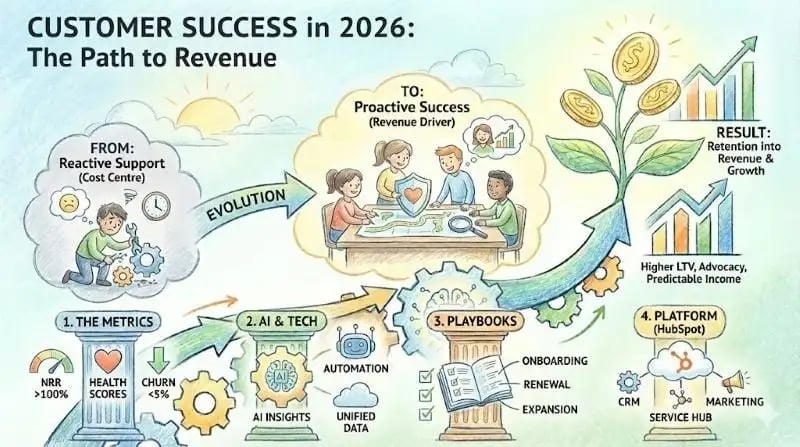
The distinction matters because the economics of modern B2B have shifted dramatically. According to Whitehat's analysis of current market data, acquiring a new customer now costs 5-25 times more than retaining an existing one. Customer acquisition costs have increased 60% over the past five years. Meanwhile, existing customers generate 65% of a typical company's revenue.
This is why 60% of US enterprise software companies now have dedicated customer success teams—up from 40% just four years ago, according to Bain & Company's 2024 research. The function has moved from nice-to-have to essential.
Customer Success vs Customer Support: The Key Differences
| Aspect | Customer Success | Customer Support |
|---|---|---|
| Approach | Proactive—anticipates needs | Reactive—responds to issues |
| Focus | Long-term customer goals | Immediate issue resolution |
| Key Metrics | NRR, retention, expansion | Response time, CSAT, tickets |
| Business Impact | Revenue driver (growth) | Cost centre (service) |
The ROI of Customer Success: What the Data Shows
Forrester's 2024 Total Economic Impact study found that comprehensive customer success programmes deliver 91-107% ROI within three years. Their research into digital-first customer success investments showed returns reaching 220% over the same period.
These returns come from multiple sources. Companies have a 60-70% success rate selling to existing customers, compared with just 5-20% for new prospects. According to Custify's 2025 analysis, the probability of selling to a happy existing customer is 14 times higher than converting a new lead.
The compound effect is significant: for every 1% increase in revenue retention, a SaaS company's value increases by 12% after five years, according to SaaS Capital's research. This explains why Whitehat recommends customer success as a priority investment for any B2B company using HubSpot or similar platforms.
Key Statistics Every B2B Leader Should Know
- 5-25x: Cost of acquiring new customers versus retaining existing ones
- 25-95%: Profit increase from 5% improvement in retention
- 65%: Revenue generated by existing customers
- 74%: Companies reporting most revenue comes from existing customers
- 50%: Higher likelihood of existing customers trying new products
Net Revenue Retention: The Metric That Matters Most
Net Revenue Retention (NRR) measures the percentage of recurring revenue retained from existing customers over a given period, including expansion revenue and accounting for churn. It's become the single most important metric for understanding customer success effectiveness.
According to ChurnZero's benchmark research, median NRR across all SaaS companies sits at 102%. However, performance varies significantly by segment and company maturity. Here's what Whitehat considers healthy targets based on current industry data:
NRR Benchmarks for 2025
| Performance Level | NRR Range | Context |
|---|---|---|
| World-class | 130%+ | Enterprise SaaS leaders |
| Top Quartile | 120%+ | 63% valuation premium |
| Good | 110-120% | Growth-stage target |
| Healthy | 100-110% | SMB-focused businesses |
| Concerning | Below 100% | Revenue shrinking |
Enterprise software companies typically achieve 120-150% NRR, whilst SMB-focused tools average 100-115%. The difference comes down to expansion opportunities and contract structures—longer agreements correlate with lower churn (8% for two-year contracts versus 18% for monthly).
Customer Health Scoring: A Practical Framework
A customer health score is a predictive metric—typically measured on a 0-100 scale—that combines product usage, sentiment data, support activity, and relationship signals to indicate retention likelihood. Effective health scoring transforms customer success from gut-feel to data-driven decision making.
Based on Whitehat's experience implementing HubSpot for B2B clients, we recommend a four-metric model that balances leading and lagging indicators:
The 4-Metric Health Score Model
- Product Setup (25% weighting): Configuration completion, feature activation, integration status
- Product Usage (40% weighting): Active engagement, feature adoption, login frequency
- NPS Score (20% weighting): Customer sentiment from surveys
- CSM Pulse (15% weighting): Qualitative assessment from relationship manager
Score thresholds should trigger specific actions. Customers scoring 71-100 (Healthy/Green) receive standard engagement. Those at 31-70 (At Risk/Yellow) need proactive intervention. Anyone scoring 0-30 (Critical/Red) requires immediate escalation and a retention playbook.
HubSpot's Service Hub now includes native health scoring capabilities, with customisable 0-100 scales, trend tracking up to two years (Enterprise tier), and automated alerts when status changes. This integrates directly with your CRM data for a unified view.
How AI Is Transforming Customer Success in 2026
Artificial intelligence has moved from experimental to essential in customer success operations. According to the Gainsight CS Index 2024, 52% of customer success teams now incorporate AI into their workflows. More significantly, 91% state that AI will have moderate to significant impact on their strategy going forward.
The practical applications are already delivering measurable results. Whitehat has identified four areas where AI creates the most value for customer success teams:
Early Warning Systems: AI-powered churn prediction has reached 85-96% accuracy with leading platforms like Salesforce Einstein and Gainsight. These systems analyse patterns across CRM, product usage, and support data to identify at-risk accounts weeks before traditional indicators would surface a problem. According to Gainsight's research, 73% of CS professionals see identifying at-risk customers as the highest-value AI application.
Automated Analysis: AI now handles the time-consuming work of aggregating customer data, summarising conversations, and identifying trends. CS teams report saving more than 10 hours per week through AI automation—time redirected to high-value customer interactions.
Intelligent Communications: AI-generated email recommendations, conversation summaries, and next-step suggestions help CSMs maintain personalised engagement at scale. HubSpot's Breeze AI includes these capabilities natively within Service Hub.
24/7 Customer Support: AI chatbots handle routine queries, freeing human agents for complex issues. Gartner predicts 80% of customer service organisations will use generative AI by 2025, with 70% of customer interactions handled by AI.
The AI Adoption Reality Check
Despite the hype, TSIA's 2024 research found nearly 60% of companies had not yet invested in AI for customer success. The early movers are seeing 10-15% churn reduction from AI-powered interventions. Companies using platforms like HubSpot with integrated AI are better positioned to capture these gains.
Building Your Customer Success Team: Structure and Ratios
Team structure depends on your customer segments and engagement model. The key question is how to balance high-touch personal service with scalable tech-touch approaches. Gainsight's benchmark data provides useful ratios:
CSM-to-Customer Ratios by Segment
| Segment | Touch Model | Accounts per CSM | ARR per CSM |
|---|---|---|---|
| Enterprise | High-touch | 10-50 | £2M-£5M |
| Mid-Market | Mid-touch | 50-100 | £2M-£5M |
| SMB | Tech-touch | 100-500+ | £1M-£2M |
When to hire your first Customer Success Manager: SaaStr founder Jason Lemkin advises hiring "as early as you can afford to"—typically around 50-100 customers or £1M-£3M ARR. Budget approximately 10% of existing revenue on customer success and support combined.
For SMBs implementing customer success for the first time, Whitehat recommends starting with a tech-touch foundation (automated onboarding, self-serve knowledge base), using a pooled CSM model for faster response, keeping health scoring simple (four metrics maximum), focusing high-touch effort on your top 20% by revenue, and limiting yourself to three essential playbooks: onboarding, churn risk, and renewal.
Essential Customer Success Playbooks
Playbooks codify your response to common customer scenarios, ensuring consistency and enabling scale. Whitehat recommends five core playbooks based on the inbound methodology:
Onboarding Playbook: Target under 30 days to first value. Define clear milestones, automate check-ins, and escalate if customers stall at any stage. Time-to-value is the strongest predictor of long-term retention.
At-Risk/Churn Mitigation: Triggered automatically when health scores drop below threshold. Include executive sponsor engagement, value realisation review, and renewal terms discussion.
Renewal Playbook: Begin 90 days before renewal date. Review usage, confirm value delivered, address any open issues, and present expansion opportunities where appropriate.
Expansion Playbook: Identify upsell opportunities from high usage patterns and positive NPS. Coordinate with sales on timing and positioning.
NPS Response Playbook: Different response tracks for Promoters (referral requests, case study opportunities), Passives (improvement conversations), and Detractors (immediate intervention, root cause analysis).
HubSpot Service Hub for Customer Success
HubSpot's Service Hub has evolved significantly for customer success use cases. The platform now includes a dedicated Customer Success Workspace (Professional and Enterprise tiers) that serves as a central hub for managing your book of business, complete with health scores, daily tasks, and revenue tracking.
Key capabilities relevant to customer success teams include:
- Customer Health Scoring: Customisable 0-100 scale with at-risk, neutral, and healthy status categories
- Score Trend Tracking: Up to 2 years of historical data on Enterprise tier
- Customer Portal: Self-service access to knowledge base, tickets, and communications
- Integrated Surveys: NPS, CSAT, and CES tools connected directly to contact records
- Breeze AI: Chatbots, reply recommendations, and call analytics powered by AI
- 1,900+ Integrations: Connect with Gainsight, ChurnZero, and other specialist tools
Professional tier starts at approximately £100/user/month with basic health scoring. Enterprise (approximately £150/user/month) adds custom scoring algorithms, predictive analytics, and up to five dedicated workspaces. For most growing B2B companies, Whitehat finds the Professional tier provides sufficient capability, with Enterprise making sense once you're managing multiple customer segments with distinct requirements.
The key advantage of using HubSpot for customer success is unified data. HubSpot's 2024 State of Service report found that CX teams with unified data are 225% more likely to deliver personalised experiences. When your marketing, sales, and service data live in one platform, customer success teams get complete context without manual data aggregation. Learn more about getting started in our HubSpot onboarding guide.
Customer Success Technology: Choosing the Right Platform
The customer success management market is valued at £2.2 billion in 2025 and projected to reach £6 billion by 2030. Platform selection depends on company size, existing tech stack, and maturity level.
Enterprise-Grade Platforms: Gainsight CS became the first-ever Gartner Magic Quadrant Leader for customer success management in October 2024. Salesforce Service Cloud offers 85% churn prediction accuracy through Einstein Analytics. Totango (merged with Catalyst) ranks #1 on G2's enterprise implementation index.
Mid-Market Options: ChurnZero provides ML-powered Success Insights for churn prediction. Vitally earned G2's #1 CS Platform for Best Results (Winter 2024) and offers the fastest implementation. Planhat provides highly customisable revenue management.
SMB-Friendly Solutions: ClientSuccess focuses on mid-market with strong ease-of-use. Custify offers simple, affordable tools with built-in usage analytics. ZapScale starts at approximately £500/month for early-stage SaaS. For companies already using HubSpot, Service Hub often makes sense as the first customer success platform, avoiding integration complexity.
The Metrics That Matter: Your Customer Success Dashboard
Beyond NRR, effective customer success requires tracking a balanced scorecard of leading and lagging indicators. Whitehat recommends monitoring these metrics as part of your marketing and revenue operations:
Essential CS Metrics and Targets
- Net Revenue Retention: Target 110%+ (120%+ for top performers)
- Gross Revenue Retention: Target 90%+ (95%+ for top performers)
- Annual Churn Rate: Below 5% is solid; enterprise typically 1-2%
- Time-to-Value: Target under 30 days for SaaS products
- NPS Score: Average SaaS is 31-36; 50+ is excellent; 80+ is world-class
- Customer Health Score: Leading indicator of retention likelihood
- Customer Effort Score: Lower effort correlates with higher retention
Frequently Asked Questions
What is the ROI of customer success programmes?
Forrester research shows comprehensive customer success programmes deliver 91-107% ROI within three years. Digital-first CS investments can achieve 220% returns over the same period. Benefits include 5 percentage point improvement in retention and 6% increase in account revenue.
How much does it cost to acquire a new customer compared to keeping an existing one?
Acquiring new customers costs 5-25 times more than retaining existing ones, according to Harvard Business Review and Bain & Company research. Companies also have a 60-70% success rate selling to existing customers versus only 5-20% for new prospects.
What is a good net revenue retention rate for SaaS companies?
NRR above 100% indicates healthy revenue growth from existing customers. Top-performing SaaS companies achieve 120%+ NRR. Enterprise software typically sees 120-150% NRR, whilst SMB-focused tools average 100-115%. Median across all SaaS is 102%.
When should a company hire its first customer success manager?
Hire your first CSM as early as you can afford to—typically around 50-100 customers or £1M-£3M ARR. Budget approximately 10% of existing revenue on customer success and support combined. Start with a tech-touch foundation before scaling high-touch resources.
How is AI changing customer success in 2025?
52% of CS teams now use AI, saving 10+ hours per week. Key applications include early warning systems for churn prediction (85-96% accuracy), automated data analysis, AI-generated communications, and 24/7 chatbot support. 73% of CS professionals see identifying at-risk customers as the top AI opportunity.
How many customers should a customer success manager handle?
CSM ratios vary by segment: high-touch enterprise accounts typically have 10-50 per CSM, mid-market 50-100 accounts, and SMB/tech-touch 100-500+ accounts. Each CSM typically manages £1M-£5M in ARR depending on segment complexity.
Getting Started: Your Next Steps
Customer success isn't a department—it's a company-wide commitment to helping customers achieve their goals. The organisations that treat it as a strategic priority are the ones seeing 25-95% profit improvements from retention alone.
Whether you're building customer success from scratch or optimising existing operations, the fundamentals remain the same: measure what matters (starting with NRR), build playbooks for consistent execution, invest in the right technology, and never lose sight of the fact that your customers' success is your success.
Ready to build customer success into your HubSpot setup?
Whitehat helps B2B companies get more from HubSpot—including Service Hub implementation for customer success teams. We're a HubSpot Diamond Partner with deep experience in retention-focused CRM configuration.
References and Further Reading
- Harvard Business Review: The Value of Keeping the Right Customers
- Bain & Company: Why Software Companies' Customer Success Is Failing (2024)
- Gainsight: The 2024 Customer Success Index
- Gainsight: The State of AI in Customer Success 2024
- ChurnZero: Customer Success Leadership Study 2024
- HubSpot: State of Service Report 2024
- Forrester: Investing in Customer Success Delivers 107% ROI
- ChurnZero: SaaS Customer Retention Benchmarks
- TSIA: The State of Customer Success 2024
- CustomerGauge: NPS Benchmarks for SaaS