
Customer Development vs Buyer Personas: What B2B Marketers Get Wrong in 2025
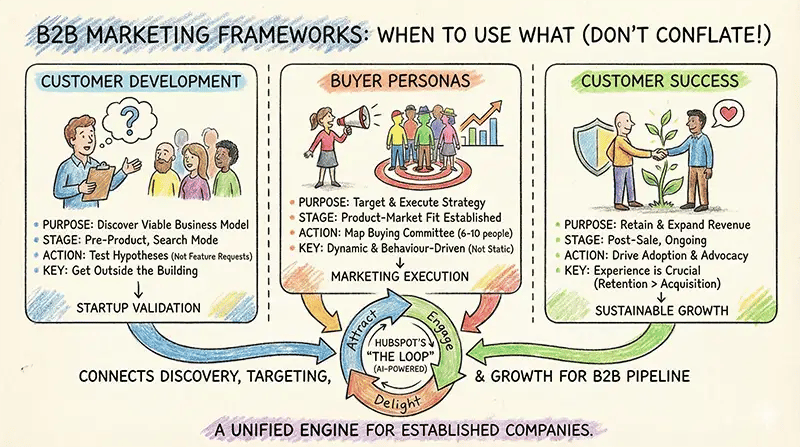
Customer development, buyer personas, and customer success serve fundamentally different purposes at different business stages—and conflating them causes strategic confusion that costs B2B companies pipeline and revenue. Customer development is a startup search methodology for discovering viable business models. Buyer personas are marketing execution tools used after product-market fit is established. Customer success is a post-sale retention function. This guide clarifies when to use each methodology, provides current 2025 statistics, and shows how HubSpot's flywheel philosophy connects them for established B2B companies seeking sustainable growth.
If you're a marketing director or demand generation leader struggling to align customer insights with your HubSpot implementation, understanding these distinctions isn't academic—it's the difference between building campaigns on solid strategic foundations and wasting budget on misapplied frameworks.
Why most B2B content gets this wrong
Search "customer development" and you'll find content that muddles three distinct disciplines into one generic "know your customer" message. This conflation creates real problems for B2B marketing teams. A marketing director tasked with building buyer personas doesn't need startup validation techniques—they need a framework for understanding buying committees. A product team launching into a new market doesn't need static persona documents—they need hypothesis-testing methodology.
The distinction matters because each methodology answers different questions at different stages. Applying the wrong framework wastes resources and leads to flawed strategic decisions. Here's what each methodology actually does and when established B2B companies should use it.
| Aspect | Customer Development | Buyer Personas | Customer Success |
|---|---|---|---|
| Purpose | Discover if viable business exists | Target known customer segments | Retain and expand customers |
| Stage | Pre-product, searching | Post-validation, executing | Post-sale, ongoing |
| Primary Users | Founders, product teams | Marketing, sales teams | CS managers, account teams |
| Key Question | "Will customers pay for this?" | "How do we reach and persuade?" | "How do we help customers succeed?" |
Customer development: the startup search framework
Steve Blank's customer development methodology remains the gold standard for startup validation. The foundational principle is deceptively simple: "There are no facts inside your building, so get outside to test them." Blank received the Strategic Management Society's "Strategy Leadership Impact" Award in October 2025, being recognised as the "Father of Modern Entrepreneurship" for this framework.
Customer development operates as a four-step iterative loop. Customer Discovery captures the founder's vision and converts it into testable hypotheses—the goal is understanding customer needs, not collecting feature requests. Customer Validation tests whether the business model is repeatable and scalable through MVP testing. If validation fails, teams return to Discovery—this iteration is crucial. Customer Creation builds end-user demand, and Company Building transitions from startup to executing company.
The methodology has achieved significant institutional adoption. Over 9,500 scientists and engineers have trained through the NSF I-Corps programme, with alumni startups raising over £3.2 billion in venture capital. At Stanford's Spring 2025 Lean LaunchPad cohort, 8 teams conducted 935 customer interviews using AI to help create business model canvases and analyse interview data.
When established companies should use customer development thinking
Customer development isn't just for startups. Established B2B companies benefit from this hypothesis-testing mindset during new product launches, market expansion into unfamiliar segments, innovation initiatives, and major pivots. The core principle—test assumptions with real customers before committing resources—applies whenever you're entering uncertain territory.
As Blank noted in his October 2025 speech: "AI is already having a major impact on customer discovery and validation... collapsing the distance between exploration and exploitation." For B2B marketing teams using HubSpot CRM, this means your customer data can accelerate hypothesis testing—but only if you recognise when you're in "search mode" versus "execution mode."
Buyer personas: the modern execution tool
Buyer personas are semi-fictional profiles of ideal customers used after product-market fit is established. They guide content strategy, messaging, campaign targeting, and sales enablement. But the methodology has evolved dramatically since 2019, and most B2B companies are using outdated approaches.
The single-decision-maker persona is obsolete. Gartner 2024 research identifies that average B2B purchases now involve 6-10 decision-makers, each entering with 4-5 pieces of independent research. Forrester 2024 data shows buying groups can include up to 13 people, with 89% of purchases involving 2 or more departments. This means your persona work must map the entire buying committee, not just the primary contact.
Five ways persona methodology has transformed
- From individual to buying committee: Best practice now requires mapping five core buying roles—Champion (internal advocate), Economic Buyer (budget holder), Technical Validator, User/Operator, and Procurement.
- From static to dynamic: 83% of highest-performing B2B teams update personas semi-annually or more frequently (Forrester 2024). Annual "set and forget" documents are outdated.
- From demographic-heavy to behaviour-driven: Modern personas incorporate digital behavioural patterns, channel preferences, and contextual signals. McKinsey 2025 identifies "Digital Confidence" as a key differentiating factor.
- From assumptions to data-driven: Effective personas are built from 12-24 closed-won deals and buyer interviews, validated through CRM data and win/loss analysis—not internal brainstorming sessions.
- Integration with Jobs-to-be-Done: Gartner 2025 reports that JTBD-based marketing strategies achieve 34% higher conversion rates in B2B sales.
The statistics on persona effectiveness are compelling. Companies using validated personas see 73% higher conversion rates from marketing-qualified leads and 79% shorter sales cycles. Yet only 37% of developed personas are consistently used in daily operations—highlighting an activation gap that HubSpot's tools can help close.
If your persona documents are gathering dust, Whitehat's guide to creating buyer personas in HubSpot shows how to build actionable profiles that integrate directly with your marketing automation. The goal isn't beautiful documents—it's operational personas that shape every campaign.
The retention economics: what the data actually shows
You've likely heard that acquiring a new customer costs 5-25 times more than retaining an existing one. This statistic originates from Frederick Reichheld's research at Bain & Company, cited in Harvard Business Review 2014. The wide range reflects significant variation by industry—it's directionally correct but shouldn't be treated as universal law.
What's more significant: customer acquisition costs have increased 60% over the past five years and risen 222% since 2013 (SimplicityDX 2024). This suggests the acquisition-retention cost gap has widened, making customer-centric growth strategies more valuable than ever.
The classic claim that "5% retention improvement equals 25-95% profit increase" comes from Reichheld and Sasser's Harvard Business Review article from September 1990—over 34 years old, examining one bank's branch system before the internet era. While no comprehensive study has contradicted it, current data provides stronger foundations for customer-centric strategies.
Current retention and customer-centric statistics (2024-2025)
- 41% faster revenue growth and 49% faster profit growth for customer-obsessed organisations (Forrester 2024 CX Index, 98,000+ respondents)
- 84% of B2B decision-makers start buying processes with a referral (Influitive)
- 70% higher conversion rates for B2B companies with referral programmes (Review42)
- 60-70% probability of selling to existing customers versus 5-20% for new prospects (Marketing Metrics)
- 80% of customers say experience is as important as products (Salesforce State of Connected Customer, 6th Edition)
- Companies treating customer service as a value centre grew revenue 3.5x faster (Accenture)
For B2B marketing leaders, this data makes the business case for customer success investment clear. Explore customer success as a growth driver for tactical implementation guidance.
The HubSpot flywheel: from philosophy to "The Loop"
The flywheel model, introduced by Brian Halligan at INBOUND 2018, positioned customers at the centre of growth rather than treating them as an output. Its three phases—Attract, Engage, Delight—replaced the linear funnel with a model where customer satisfaction drives referrals and repeat sales. This philosophy connects customer development thinking, persona-driven marketing, and customer success into a unified growth engine.
In September 2025 at INBOUND San Francisco, CEO Yamini Rangan introduced "The Loop"—a four-stage AI-powered framework designed for the era of AI-driven search. The Loop doesn't replace the flywheel; it operationalises it. Think of the flywheel as the "why" and The Loop as the "how."
The Loop's four stages
- Express: Define brand identity, tone, and point of view—building sharp Ideal Customer Profiles and AI style guides
- Tailor: Personalise messaging using unified customer data and behavioural signals, going beyond "Dear {First Name}"
- Amplify: Diversify across channels optimised for both humans and AI bots—including Answer Engine Optimisation for ChatGPT and Perplexity
- Evolve: Enable real-time iteration using AI insights, predicting before publishing and running rapid experiments
The shift reflects market reality. SparkToro 2024 data shows nearly 60% of Google searches now end without a click, and LLM traffic share more than doubled for enterprise sites from late 2024 to mid 2025. For inbound marketing strategies to remain effective, they must account for AI-mediated discovery.
Key HubSpot statistics supporting the flywheel philosophy: 81% of consumers trust friends and family over business advice (reinforcing the "Delight" phase), 57% of B2B sales processes complete before customers contact vendors (emphasising "Attract"), and companies using HubSpot's AI-driven features report 30% increases in conversion rates and 40% reductions in manual tasks.
Connecting the methodologies: a practical framework
For UK B2B marketing directors and demand generation leaders, the practical value lies in understanding when to apply each methodology. Customer development helps you discover and validate. Buyer personas help you target and execute. Customer success helps you retain and expand. The flywheel—operationalised through The Loop—provides the unifying philosophy that connects them.
At Whitehat, we help B2B companies implement this integrated approach through HubSpot onboarding and integration. As a HubSpot Diamond Partner, we've seen how proper methodology application—knowing when you're searching versus executing—transforms marketing ROI. The companies achieving 73% higher conversion rates aren't using better tools; they're applying the right framework at the right stage.
When to use each methodology
Use customer development thinking when:
- Launching new products or services
- Expanding into unfamiliar market segments
- Testing assumptions about customer problems
- Innovation initiatives with uncertain outcomes
Use buyer personas when:
- Product-market fit is established
- Planning content strategy and campaigns
- Aligning sales and marketing messaging
- Segmenting for personalisation
Use customer success methodology when:
- Onboarding and activating new customers
- Reducing churn and improving retention
- Identifying expansion and upsell opportunities
- Building referral and advocacy programmes
Moving forward: from understanding to action
The competitive advantage isn't knowing these methodologies exist—it's operationalising them correctly. With 70% of companies missing goals because they don't account for the full buying committee (Forrester 2024), and customer acquisition costs rising 60% in five years, the stakes for getting this right have never been higher.
Start by auditing your current approach. Are your personas static documents or operational tools integrated with your CRM? When launching new initiatives, are you testing hypotheses or assuming you know the answer? Is your customer success function generating the referral pipeline that 84% of B2B buying journeys begin with?
For B2B companies ready to implement these frameworks properly, Whitehat's marketing services combine strategic methodology with HubSpot expertise. We help you build the operational infrastructure that turns customer insights into pipeline—whether you're validating new markets, targeting buying committees, or maximising customer lifetime value.
Frequently Asked Questions
What is the difference between customer development and buyer personas?
Customer development is a startup search process for discovering if a viable business model exists, while buyer personas are marketing execution tools used after product-market fit is established to target known customer segments. Customer development asks "Will customers pay for this?" while buyer personas ask "How do we reach and persuade?" The methodologies serve different purposes at different business stages and shouldn't be conflated.
How many decision-makers are involved in B2B purchases?
According to Gartner 2024 research, the average B2B purchase now involves 6-10 decision-makers, each entering with 4-5 pieces of independent research. Forrester 2024 data shows buying groups can include up to 13 people, with 89% of purchases involving 2 or more departments. This makes buying committee personas essential for modern B2B marketing.
Does retaining customers really cost less than acquiring new ones?
Yes, though the commonly cited "5x" statistic originates from Bain & Company research from the 1990s-2000s. More recent data from SimplicityDX 2024 shows customer acquisition costs have increased 60% over the past five years and 222% since 2013, suggesting the acquisition-retention cost gap has actually widened. Current Forrester data shows customer-obsessed organisations achieve 41% faster revenue growth.
What is HubSpot's Loop methodology?
The Loop is HubSpot's 2025 evolution of the flywheel, introduced at INBOUND San Francisco by CEO Yamini Rangan. The Loop comprises four AI-powered stages: Express (define brand identity and ICPs), Tailor (personalise using unified customer data), Amplify (diversify across human and AI-optimised channels), and Evolve (real-time iteration using AI insights). It operationalises the flywheel philosophy for the AI search era.
How often should buyer personas be updated?
According to Forrester 2024 research, 83% of highest-performing B2B teams update personas semi-annually or more frequently. Annual "set and forget" persona documents are now considered outdated. Modern personas should be living documents that incorporate digital behavioural patterns, channel preferences, and contextual signals, validated against CRM data and win/loss analysis.
When should established companies use customer development methodology?
Established B2B companies should apply customer development thinking during new product launches, market expansion initiatives, innovation projects, or when entering unfamiliar customer segments. The core principle remains valuable: test assumptions with real customers before committing significant resources. AI tools now accelerate this process by helping analyse interview data and identify patterns across customer conversations. view our pricing
References
- Steve Blank - Customer Development Methodology and Strategic Management Society Award 2025
- Gartner - B2B Buying Research 2024
- Forrester - CX Index 2024 and Buyer Persona Research
- HubSpot - INBOUND 2025 and The Loop Methodology
- Bain & Company - Frederick Reichheld's Customer Retention Research
- McKinsey & Company - B2B Marketing Research 2025
- SimplicityDX - Customer Acquisition Cost Research 2024
- SparkToro - Search Behaviour Data 2024
- Salesforce - State of the Connected Customer, 6th Edition
- Influitive - B2B Referral Research