
B2B Marketing Strategy
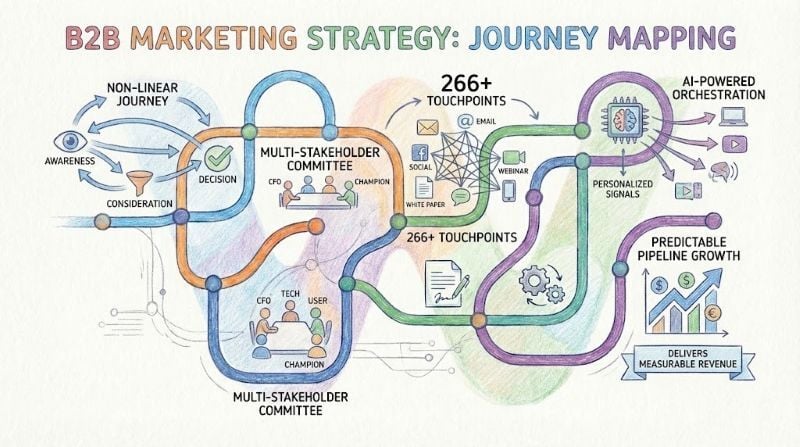
This gap between awareness and execution represents the opportunity. For B2B marketing leaders navigating increasingly complex buying committees and non-linear purchase journeys, effective journey mapping has become the critical differentiator between predictable pipeline growth and random acts of marketing.
Customer Journey Mapping in 2026: The Complete B2B Guide
Why 71% of organisations are stuck—and how to move from static visualisation exercises to AI-powered orchestration that delivers measurable revenue growth.
Key Takeaways
- Organisations with journey mapping programmes achieve 55% retention rates versus 21% without them
- Average B2B deals now require 266 touchpoints to close—a 20% increase from 2023
- Companies using AI for journey analytics report 25% improvement in retention and 30% faster resolution times
- Only 2% of organisations have achieved full CX maturity—representing a significant competitive opportunity
Customer journey mapping delivers measurable business impact that separates market leaders from laggards. According to Gartner's CX Management research, organisations that actively use customer journey maps are twice as likely to outperform competitors. The financial case is equally compelling: companies with journey mapping programmes achieve 55% customer retention rates compared to just 21% for those without—a 2.6x improvement that compounds year after year.
Yet despite proven ROI, adoption remains surprisingly low. The Qualtrics XM Institute's 2024 State of Customer Experience Management report found that 71% of organisations remain stuck in the first two stages of CX maturity. Only 2% have achieved full maturity where customer experience is deeply embedded in all processes.
The Business Case: ROI That Gets CFO Attention
Journey mapping isn't a nice-to-have visualisation exercise—it's a revenue driver with quantifiable returns. McKinsey's research on customer experience transformation shows that successful journey optimisation projects typically achieve 5-10% revenue growth and 15-25% cost reductions within two to three years.
The financial impact extends across the entire customer lifecycle:
| Metric | Impact | Source |
|---|---|---|
| Cross-sell revenue increase | 56% | Salesforce 2023 |
| Average sales increase (B2B) | 5-10% | McKinsey |
| Faster sales cycles | 18x | McorpCX Research |
| Service cost reduction | 15-20% | Gartner |
| Retention rate improvement | 2.6x (55% vs 21%) | Industry research |
Customer satisfaction scores typically increase 10-20% with effective journey mapping, whilst McKinsey reports that maximising journey satisfaction can lift revenue by 15% while simultaneously reducing service costs by 20%. This isn't incremental improvement—it's the kind of transformation that reshapes competitive position.
B2B Journey Complexity Has Intensified Dramatically
B2B customer journeys have become substantially more complex than even two years ago. HockeyStack Labs' 2024 research reveals that the average B2B deal now requires 266 touchpoints to close—a 19.8% increase from 2023. For enterprise deals with £100K+ annual contract value, this rises to 417 touchpoints and approximately 5,500 impressions.
Several factors drive this complexity increase. Buying committees have nearly doubled over the past decade, from an average of 6.8 stakeholders in 2017 to 13 stakeholders per purchase according to Forrester's 2024 State of Business Buying report. These committees span multiple departments: IT, finance, operations, compliance, legal, procurement, and executive leadership—each with distinct information needs and evaluation criteria.
The Self-Directed Buyer Reality
Gartner research shows B2B buyers complete 69-75% of their journey before ever contacting sales. They spend only 17% of their total purchasing time meeting with potential suppliers. Each stakeholder enters discussions with 4-5 pieces of independent research—and 86% of B2B purchases stall during the process due to stakeholder alignment issues.
For marketing teams at B2B SaaS companies, professional services firms, or complex solution providers, this means journey mapping isn't optional—it's the only way to understand where deals stall, which content influences which stakeholders, and how to orchestrate the 266+ touchpoints that precede a closed deal.
Modern Frameworks for Non-Linear Journeys
Traditional linear funnel models have given way to more sophisticated frameworks that acknowledge journey complexity. The standard five-stage model—Awareness, Consideration, Decision, Retention, Advocacy—remains common but proves insufficient for B2B contexts where buying jobs happen concurrently rather than sequentially.
Gartner's research reveals that B2B buying isn't linear but rather consists of concurrent "buying jobs": problem identification, solution exploration, requirements building, and supplier selection. These jobs are completed simultaneously, with buyers looping back repeatedly as stakeholder alignment shifts and new information emerges.
What Effective B2B Journey Maps Must Include
- Persona-specific swimlanes tracking each buying committee role separately—the CFO's journey differs fundamentally from the end user's
- Jobs-to-be-done alignment organised around buying tasks rather than arbitrary stages
- Behavioural specificity documenting exactly what customers do at each touchpoint, not just what you hope they do
- Emotional journey tracking capturing the emotional ups and downs that influence decisions—B2B buyers are nearly three times more likely to have high brand commitment when they perceive personal benefits
- Moment of truth identification highlighting make-or-break decision points where deals advance or stall
Boston Consulting Group's "Influence Maps" framework for 2025 maps influence according to four behaviour types: streaming (content consumption), scrolling (social browsing), searching (active research), and shopping (purchase behaviour). This approach better captures modern journey unpredictability than linear stage models.
How AI Transforms Journey Mapping from Static to Dynamic
Artificial intelligence has fundamentally changed journey mapping capabilities. According to SuperAGI research, 70% of companies are already using AI to improve their customer journey, with usage expected to increase by 25% over the next two years.
Predictive journey mapping uses several key technologies that transform reactive analysis into proactive orchestration:
- Time series forecasting analyses historical behaviour patterns to predict future actions
- Markov chain models predict next-best actions by analysing transition probabilities between journey states
- Propensity modelling calculates likelihood of specific actions—not just whether a customer will buy, but which product, when, and through which channel
- Deep learning with LSTM networks captures complex sequential patterns indicating customer intent
Companies leveraging AI for customer journey analytics report up to 25% improvement in retention and 30% faster resolution times. McKinsey reports that AI-powered "next best experience" capabilities can enhance satisfaction by 15-20%, increase revenue by 5-8%, and reduce service costs by 20-30%.
Looking ahead: Gartner predicts that by 2029, agentic AI will autonomously resolve 80% of common customer service issues without human intervention, leading to 30% reduction in operational costs. Currently, 85% of customer service leaders plan to explore or pilot customer-facing conversational GenAI in 2025.
Real-time journey orchestration has emerged as a critical capability. Leading platforms now execute personalisation in under 200 milliseconds, enabling instant cross-channel experiences. Multi-channel personalisation generates 126x higher user sessions and 6.5x more purchases when combining four or more channels.
CRM Integration: From Visualisation to Operational Reality
Journey maps that live in PowerPoint decks deliver zero operational value. For journey mapping to drive business results, it must integrate directly with your CRM system—creating a live connection between strategic insight and day-to-day execution.
HubSpot's Journey Capabilities
HubSpot's customer journey features include Customer Journey Reports that track contact and deal progress through stages, supporting up to 15 stages and 15 unique steps per report. The Pathfinder AI feature automatically defines journey stages and identifies top paths before and after key stages. Journey orchestration tools enable end-to-end customer journey creation across email, social, web, and messaging apps with real-time personalisation based on customer behaviours.
For organisations using both HubSpot and Salesforce, bi-directional sync capabilities ensure journey data flows seamlessly between systems. Whitehat SEO's HubSpot CRM implementation work consistently shows that organisations with properly integrated journey tracking achieve CFO-trusted attribution within 90 days of implementation.
Integration Best Practices
- Combine CRM behavioural data with direct customer feedback—quantitative data shows what happens, qualitative data explains why
- Use Customer Data Platforms to unify zero-party and first-party data across all touchpoints
- Ensure journey maps connect directly to measurable conversion metrics rather than vanity metrics—pipeline influence, not just pageviews
- Build attribution models that account for the full 266+ touchpoint reality of modern B2B buying
B2B Mapping Requires Buying Committee Orchestration
B2B journey mapping differs fundamentally from B2C in several dimensions. Decision-making involves 6-13+ stakeholders versus typically one individual. Sales cycles span months to years rather than minutes to weeks. Decisions are based on logic, ROI, and business value rather than emotional triggers alone. And relationships focus on long-term partnership rather than transactions.
Mapping buying committees effectively requires identifying all relevant roles:
- End users focused on features and usability
- Champions who build internal consensus and advocate for your solution
- Economic buyers with budget authority—CFOs hold final decision-making power in 79% of purchases according to G2 research
- Technical buyers evaluating integration, security, and compliance requirements
- Gatekeepers controlling information flow to decision makers
- Potential blockers who can veto purchases based on risk concerns
Effective Multi-Stakeholder Strategies
Stakeholder mapping before pipeline creation: Ask champions "Who else needs to approve this?" and map organisational charts early. Don't wait until the deal stalls to discover the CFO hasn't been briefed.
Role-based content clusters: Map stakeholders' roles to their points of common interest through each buying stage. Your content marketing strategy should include technical documentation for IT, ROI calculators for finance, and implementation guides for operations.
Multi-threading: Building relationships with multiple stakeholders simultaneously—research shows that sales outreach to 11+ people increases conversions by 3.4-4.4x compared to single-threaded engagement.
Buyer enablement materials: Create ROI calculators, comparison charts, and compliance summaries that help champions build consensus internally. Your job isn't just to convince your contact—it's to arm them to convince everyone else.
Common Mistakes That Undermine Journey Mapping Investments
Research from Nielsen Norman Group, UXPressia, and industry consultants reveals consistent patterns of journey mapping failure. Understanding these pitfalls helps you avoid expensive mistakes.
Strategic Mistakes
- Building maps without clear objectives. If you don't know what decisions the map should inform, you'll produce a pretty visualisation that gathers dust.
- Creating from internal perspective rather than customer viewpoint. Your internal process isn't the customer's experience—they don't care about your departmental structure.
- Treating mapping as a one-time exercise. One documented case involved a company spending £2 million on mapping without achieving ROI—nine months of work with 12 full-time employees yielding outdated insights never used operationally.
Research Failures
Creating personas through internal workshops without actual customer data produces maps reflecting assumptions rather than reality. Over-reliance on CRM systems misses key customer contexts and emotional elements that influence decisions. You need actual customer interviews, not just database records.
Scope and Coverage Gaps
Organisations often focus only on owned touchpoints, missing experiences on social media, peer recommendations, third-party review sites, and community discussions. For B2B buyers conducting 69-75% of their journey before sales contact, these "dark funnel" touchpoints often prove most influential.
Execution Breakdowns
Maps that remain within small groups rather than driving cross-functional alignment deliver no value. The most damaging mistake is gathering data without applying it—no plan for implementation means no business impact. Your journey map should live in your CRM dashboards, not a forgotten slide deck.
Update Frequency Determines Ongoing Value
Journey maps require regular updates to remain valuable. Expert consensus recommends quarterly reviews as minimum baseline, with updates triggered by experience improvements, new customer feedback, product changes, competitive shifts, or completion of improvement initiatives.
As Annette Franz of CX Journey advises: "Your journey maps should always reflect the most current state of the customer experience. Ultimately, when to update depends on your customers, your business, your industry; as each of these evolves, so will the experience."
Anastasia Schebrova, Chief Experience Officer at UXPressia, recommends: "Do it quarterly and you won't go wrong with that. Make sure there's a dedicated person or group responsible for keeping maps up-to-date."
Best Practices for Living Journey Maps
- Assign clear ownership to specific individuals or teams—not a committee
- Create triggers for automatic review post-project or post-feedback collection
- Use digital tools enabling easy updates versus static documents that require specialist access
- Differentiate strategic big-picture maps from tactical specific-journey maps requiring more frequent updates
Leading Tools: From Visualisation to Orchestration
The customer journey mapping software market is projected to reach £76 billion by 2035 at a 16.3% CAGR according to Future Market Insights. Tools fall into two categories with distinct purposes.
Journey Orchestration Platforms
These platforms evaluated in the Forrester Wave Q2 2024 move beyond visualisation to real-time automation:
- Medallia: AI-infused orchestration with real-time decisioning
- Genesys Cloud: AI-powered journey management with contact centre integration
- Qualtrics XM: Behavioural, sentiment, and emotion analysis with GenAI capabilities
- Alterian: Real-time CX platform analysing 100B+ journey events
- CSG Xponent: Journey analytics, data fusion, and real-time orchestration
Visualisation and Collaboration Tools
For teams starting their journey mapping practice or needing collaborative workshop tools:
- Miro: AI pattern identification with 100+ integrations
- Lucidchart: Journey maps with built-in collaboration
- UXPressia: User experience focus with persona creation
- Smaply: Stakeholder mapping toolkit
- Contentsquare: Journey analysis from session replays
From Static Maps to Revenue Engine
Customer journey mapping in 2025 has evolved from static visualisation exercises to dynamic, AI-powered orchestration systems driving measurable business outcomes. The evidence is clear: organisations with mature journey mapping programmes achieve 2x competitive advantage, 55% versus 21% retention rates, and significant improvements across revenue, satisfaction, and cost metrics.
For B2B organisations, success requires acknowledging the unique complexity of 13-stakeholder buying committees, 266+ touchpoint journeys, and non-linear buying processes. This means adopting frameworks that map concurrent buying jobs rather than linear funnels, integrating journey maps directly with CRM platforms like HubSpot, and leveraging AI for predictive insights and real-time personalisation.
The 71% of organisations stuck in early CX maturity represent both the challenge and the opportunity. Companies that move beyond one-time mapping exercises to continuous, research-driven, cross-functionally embedded journey practices will capture disproportionate value as customer experience increasingly becomes the primary competitive battleground.
Ready to Map Your Customer Journey?
Whitehat SEO helps B2B organisations implement HubSpot with journey mapping that connects to real pipeline impact—not just pretty visualisations.
Book a Discovery CallFrequently Asked Questions
How many touchpoints does a typical B2B sale require?
According to HockeyStack Labs' 2024 research, the average B2B deal now requires 266 touchpoints to close—up 19.8% from 2023. Enterprise deals exceeding £100K annual contract value require approximately 417 touchpoints and 5,500 impressions. This complexity makes journey mapping essential for understanding which touchpoints actually influence buying decisions.
How often should journey maps be updated?
Expert consensus recommends quarterly reviews as a minimum baseline. Updates should also be triggered by product changes, new customer feedback, competitive shifts, or completion of improvement initiatives. Journey maps that aren't regularly updated become expensive wall art rather than operational tools.
What's the difference between journey mapping and journey orchestration?
Journey mapping is the process of visualising and understanding customer experiences across touchpoints. Journey orchestration takes this further by using technology to automatically deliver personalised experiences based on where customers are in their journey. Mapping is the strategy; orchestration is the real-time execution.
Can HubSpot handle customer journey mapping and orchestration?
Yes. HubSpot's Customer Journey Reports track contact and deal progress through up to 15 stages and 15 unique steps per report. The Pathfinder AI feature automatically identifies top paths through your funnel, and journey orchestration tools enable automated, personalised experiences across email, social, web, and messaging apps. Whitehat SEO's HubSpot onboarding services include journey mapping configuration.
What ROI can organisations expect from journey mapping?
McKinsey research shows successful journey optimisation projects typically achieve 5-10% revenue growth and 15-25% cost reductions within two to three years. Companies with journey mapping programmes achieve 55% customer retention rates compared to 21% for those without—a 2.6x improvement that compounds significantly over time.
References & Further Reading
The research and statistics in this guide are drawn from the following verified sources:
- Gartner — The B2B Buying Journey: Key Stages and How to Optimize Them
- Forrester — The State of Business Buying 2024
- McKinsey & Company — Customer Experience: Creating Value Through Transforming Customer Journeys
- HockeyStack Labs — B2B Customer Journey Touchpoints: The Impact of Deal and Company Size
- Qualtrics XM Institute — State of CX Management 2024
- HubSpot — Customer Journey Map Guide
- Nielsen Norman Group — Journey Mapping 101
- UXPressia — How Often Should You Update a Customer Journey Map