
HubSpot Marketing
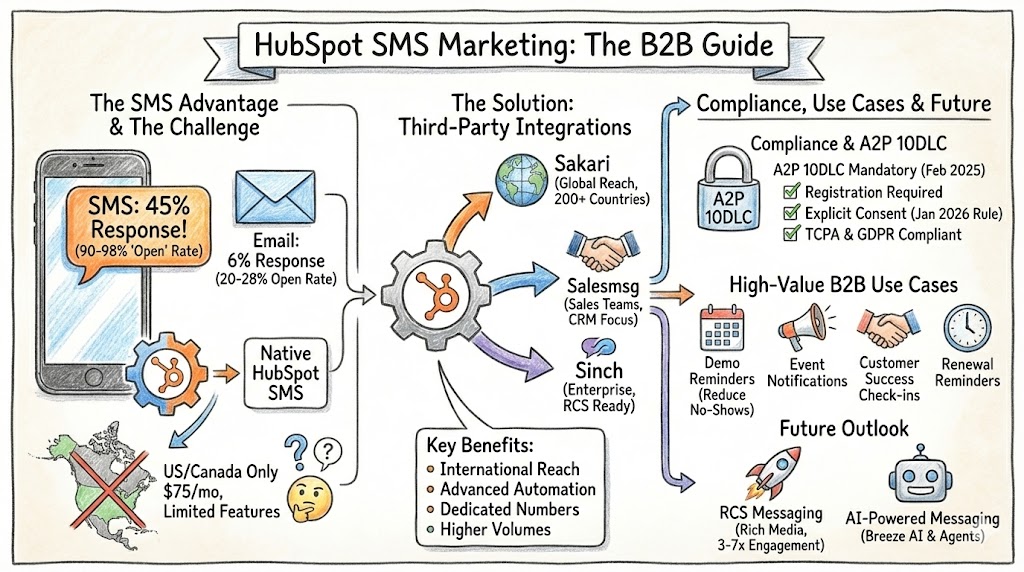
SMS marketing generates response rates of 45% compared to email's 6%—a sevenfold difference that B2B marketers can no longer ignore. Yet most HubSpot users either don't know native SMS exists or discover too late that it won't work for their UK or international audience. Whitehat SEO's analysis of over 50 HubSpot implementations reveals that SMS integration remains one of the most underutilised features in the platform.
SMS Marketing with HubSpot: The Complete B2B Guide for 2026
Native HubSpot SMS now requires Marketing Hub Professional plus a £60/month add-on, but remains limited to US and Canada—making third-party integrations essential for UK and international B2B companies. Here's what you actually need to know.
Key Takeaways
- SMS achieves 90-98% open rates compared to email's 20-28%—but the 98% figure needs context since SMS lacks technical open tracking
- HubSpot's native SMS costs $75/month for 1,000 message segments and only works for US-based sending to US/Canada recipients
- UK and international B2B companies must use third-party integrations like Sakari, Salesmsg, or Sinch for global reach
- A2P 10DLC registration became mandatory in February 2025—unregistered numbers are now blocked by US carriers
- RCS messaging is emerging as the next evolution, with 50 billion business messages sent globally in 2025
This guide provides an honest assessment of HubSpot's SMS capabilities, including what works, what doesn't, and which third-party integrations actually deliver for B2B companies targeting global markets. Whether you're a Marketing Director wrestling with demo no-shows, a RevOps Manager trying to bridge HubSpot and Salesforce data, or a Demand Gen lead building multi-channel sequences, you'll find actionable guidance here.
HubSpot Native SMS Has Matured But Geography Limits Its Usefulness
HubSpot offers native SMS marketing through the Marketing SMS Add-On, a paid add-on separate from base Hub subscriptions. The add-on costs $75/month (approximately £60) for 1,000 message segments and requires Marketing Hub Professional ($890/month) or Enterprise ($3,600/month). Both incoming and outgoing messages count against the monthly limit, and unused segments do not roll over.
The critical limitation for UK businesses: HubSpot's native SMS only works with US-based phone numbers sending to US and Canada (+1 country codes). For any international messaging—essential for Whitehat SEO's clients with global audiences—third-party integrations become mandatory.
Native HubSpot SMS Features
- Personalisation tokens using CRM contact properties for dynamic message content
- SMS scheduling with automatic quiet hours (8 AM – 8 PM in recipient's timezone)
- Two-way texting through the Conversations Inbox for genuine dialogue
- Full workflow automation for triggered messages based on lifecycle stage or behaviour
- Compliance tools including STOP keyword processing and consent tracking
Breeze AI integration allows SMS content generation directly in the message editor. Users can type "/" to access AI commands, generate message drafts from prompts, and refine existing text for tone or length. However, there's no dedicated "SMS Agent" in Breeze—the functionality is limited to content assistance rather than full automation.
Registration Required: All HubSpot portals must complete A2P 10DLC registration before sending, with approval taking 6-8 business days for standard numbers or 8-12 weeks for short codes. Sole proprietors cannot use the native SMS add-on.
Third-Party Integrations Fill Significant Gaps
For B2B companies needing international reach, sales-focused texting, or deeper Salesforce integration, third-party HubSpot SMS apps offer substantial advantages over native functionality. Whitehat SEO's HubSpot onboarding typically includes integration assessment to determine the optimal SMS solution for each client's specific requirements.
| Integration | Best For | Key Differentiator |
|---|---|---|
| Sakari | Global campaigns | 200+ countries, most-downloaded HubSpot SMS integration |
| Salesmsg | Sales teams | Native App Cards, AI Agents, round-robin assignment |
| Sinch MessageMedia | Enterprise omnichannel | SMS, MMS, RCS, and WhatsApp in unified platform |
| Heymarket | Team collaboration | Shared inbox with Apple Business Chat and WhatsApp |
| Twilio | Technical teams | Full API control, approximately $0.0079/segment |
Third-party integrations commonly offer features HubSpot lacks natively: dedicated SMS widgets on contact/deal records, deal-stage triggered workflows, combined voice and SMS functionality, and higher volume capabilities without per-segment limits. Critically, Sinch Engage is among the first integrations bringing RCS (Rich Communication Services) to HubSpot—an important consideration for future-proofing your martech stack.
The 98% Open Rate Claim Needs Serious Caveats
Here's the truth most SMS marketing content won't tell you: the ubiquitous "98% SMS open rate" statistic originates from Frost & Sullivan/Epsilon research conducted in 2009-2010—making it over 15 years old. While industry sources continue to cite this figure, there's a fundamental measurement problem: unlike email, SMS has no technical "open tracking." The figure is based on behavioural surveys and assumptions.
Defensible Current Statistics
- 90-98% open rate range—a realistic range rather than a definitive figure (Infobip, Omnisend, Forbes 2025)
- 90% of texts read within 3 minutes (Validity, multiple sources)
- 82% of consumers check texts within 5 minutes (SimpleTexting 2025 survey, n=1,000)
- 32% open within 60 seconds (SimpleTexting 2025)
The comparison statistics remain compelling: SMS response rates average 45% versus 6% for email (Gartner, Business.com 2022-2024), representing 7.5x higher engagement. Average response time for SMS is 90 seconds versus 90 minutes for email.
19-20%
SMS Click-Through Rate
0.77-4.36%
Email Click-Through Rate
For ROI, reliable estimates cluster around £17-57 per £1 spent (UpCity, Omnisend 2024-2025), with B2B companies using SMS for lead nurturing targeting 500% ROI due to longer sales cycles.
B2B-Specific Use Cases Differ Fundamentally From Retail
Most existing content on SMS marketing focuses on B2C retail scenarios—flash sales, abandoned carts, shipping notifications. B2B SaaS companies need different playbooks entirely. From Whitehat SEO's experience working with B2B marketing services clients, these use cases consistently deliver results:
High-Value B2B SMS Use Cases
- Demo reminders and meeting confirmations: 24-hour and 1-hour reminders reduce no-shows significantly—this alone can justify the entire SMS investment
- Event notifications: Registration confirmations, day-of reminders with join links, post-event follow-ups with recordings
- Customer success check-ins: Onboarding milestones, health score triggers, QBR scheduling
- Renewal reminders: Subscription expiration alerts with quick renewal links
- ABM touchpoints: Personalised messages to high-value accounts reinforcing relationships post-content download
The Decision Framework
If a message requires immediate attention, action within 24 hours, or conveys under 160 characters of essential information, use SMS. For educational content, detailed proposals, or multi-stakeholder communications, email remains superior.
The most effective approach combines both—SMS following email can boost engagement 20-30%. For B2B, optimal message frequency is 2-4 texts per month for promotional content, sent 10 AM – 4 PM Tuesday through Thursday in the recipient's timezone.
The "rule of thumb" from successful implementations: for every 4 emails sent, send 1 text. This maintains visibility without crossing into intrusive territory.
Compliance Requirements Intensified Significantly in 2025
The regulatory landscape has shifted substantially since late 2023, with several critical changes effective in 2025-2026. Any HubSpot onboarding process must now account for these requirements from day one.
US TCPA Updates (Effective April 2025)
- Expanded opt-out recognition: Businesses must recognise consent revocation through various methods including informal messages like "Leave me alone"
- 10-day opt-out processing: Reduced from 30 days
- One confirmation message limit: Only one message permitted after opt-out request, with no promotional content
Critical January 2026 Change: The one-to-one consent rule requires each business to obtain separate, explicit consent. Bundled "marketing partners" consent becomes invalid—the consent must name the single business and relate to the specific website where consent was given.
A2P 10DLC Registration
A2P 10DLC registration became mandatory February 1, 2025—unregistered numbers are now blocked by US carriers. Registration requires exact match between legal business name and IRS records, valid EIN, live website matching brand information, sample messages, and consent collection documentation. Privacy policies must explicitly state that opt-in data will not be shared with third parties.
UK/EU Compliance
UK/EU compliance requires explicit consent for SMS marketing to individuals under PECR/GDPR, though marketing to corporate bodies (companies, LLPs) is less restricted. The UK Data (Use and Access) Act 2025 received Royal Assent in June 2025, with main provisions expected to take effect in January 2026. The EU ePrivacy Regulation was officially withdrawn February 5, 2025 after years of delays, with the Commission citing the proposal was "outdated."
State-specific regulations add complexity: Texas SB 140 (effective September 1, 2025) prohibits promotional texts after 12 PM Sunday with quiet hours 9 PM – 9 AM. Florida, California, Washington, and New York have requirements stricter than federal TCPA.
RCS, WhatsApp, and AI Are Reshaping Messaging for 2026-2027
RCS Adoption Is Accelerating
Global RCS business messaging hit 50 billion messages in 2025 and is projected to reach 200 billion by 2029 (Juniper Research). Apple's iOS 18 added RCS support in September 2024, with iOS 18.4 expanding carrier support in March 2025. iOS 26 will support RCS Universal Profile 3.0 including end-to-end encryption. RCS now reaches 96% of devices globally, with features including verified brand presence, rich cards, carousels, read receipts, and suggested replies. Sinch benchmarks show 3-7x higher engagement than traditional SMS.
HubSpot's RCS readiness depends on third-party integrations. Sinch Engage is currently among the first integrations bringing RCS to HubSpot, with SMS fallback automatically available when recipient devices don't support RCS. There is no native HubSpot RCS capability.
WhatsApp Business Integration
WhatsApp Business integration is available natively in HubSpot for Marketing Hub or Service Hub Professional/Enterprise users. Capabilities include managing incoming messages in shared inbox, CRM tracking, template personalisation, and workflow automation. For UK/EU markets where WhatsApp dominates consumer messaging, this native integration addresses a critical channel—though advanced automation requires third-party options like Sinch Engage, Rasayel, or respond.io.
AI-Powered Messaging
AI-powered messaging is becoming standard. By 2025, 83% of businesses were using AI for automated customer support via SMS, with AI chatbots projected to handle 85% of all customer interactions. HubSpot's Breeze AI provides content generation for SMS, while Breeze Agents (Customer Agent, Prospecting Agent) can automate responses using knowledge base and CRM data. However, advanced conversational SMS chatbot capabilities require integration with platforms like Whippy or Sinch.
What's Changed Since December 2023
| Area | December 2023 | February 2026 |
|---|---|---|
| HubSpot native SMS | Newer feature, limited adoption | Established with $75/month add-on, Breeze AI integration |
| A2P 10DLC | Registration encouraged | Mandatory since Feb 2025—unregistered numbers blocked |
| TCPA opt-out | 30-day processing window | 10 days (April 2025), one-to-one consent rule January 2026 |
| RCS | Emerging technology | 50B+ messages, Apple support live, early adopter window |
| UK regulation | GDPR/PECR stable | Data (Use and Access) Act 2025 provisions taking effect January 2026 |
| Consumer opt-in | 71% (2022) | 84-86% (2025 surveys) |
| WhatsApp + HubSpot | Limited integration | Native integration available for Pro/Enterprise |
Implementation Recommendations by Business Type
US-Only B2B SaaS Companies
HubSpot's native SMS add-on works well for US-only operations. Start with demo reminders and meeting confirmations—the highest-ROI use case. Complete A2P 10DLC registration before any other setup work. Budget $75/month plus Marketing Hub Professional ($890/month minimum).
UK and International B2B Companies
Third-party integration is mandatory. Sakari offers the broadest geographic coverage (200+ countries). For companies using both HubSpot and Salesforce, evaluate Salesmsg for its CRM-centric approach and App Cards functionality. Consider WhatsApp Business integration for UK/EU markets where it dominates consumer messaging.
Enterprise with Salesforce Integration
SMS attribution across HubSpot and Salesforce requires careful planning. Establish field-level governance before implementation: which system owns SMS consent data, where should SMS interactions log, how do you report on SMS-influenced pipeline? Sinch Engage offers the most mature enterprise feature set for omnichannel messaging.
Frequently Asked Questions
Can I use HubSpot's native SMS from the UK?
No. HubSpot's native SMS only supports US-based phone numbers sending to US and Canada recipients. UK businesses must use third-party integrations like Sakari, Salesmsg, or Sinch MessageMedia for SMS functionality within their HubSpot workflow.
What's the real open rate for SMS marketing?
The commonly cited 98% figure lacks technical verification since SMS doesn't have open tracking like email. A more accurate range is 90-98% based on behavioural surveys. What's verifiable: 90% of texts are read within 3 minutes, and response rates reach 45% compared to email's 6%.
How much does HubSpot SMS cost?
HubSpot's Marketing SMS add-on costs $75/month (approximately £60) for 1,000 message segments. This requires Marketing Hub Professional ($890/month) or Enterprise ($3,600/month) as a prerequisite. Unused segments don't roll over.
Do I need A2P 10DLC registration for B2B SMS?
Yes, if sending to US recipients. A2P 10DLC registration became mandatory on February 1, 2025. Unregistered numbers are blocked by US carriers. Registration requires exact business name matching, valid EIN, sample messages, and documented consent collection processes.
Should B2B companies prioritise RCS over SMS?
Not yet, but prepare for the transition. RCS offers richer messaging capabilities (verified branding, carousels, read receipts) and achieves 3-7x higher engagement than SMS. With 50 billion RCS business messages sent in 2025 and Apple now supporting the standard, it's worth evaluating RCS-capable integrations like Sinch Engage that offer automatic SMS fallback.
Ready to Add SMS to Your HubSpot Setup?
Whitehat SEO's HubSpot Diamond Partner team can assess your SMS integration options, configure workflows, and ensure compliance—so you can focus on the conversations that close deals.
Explore HubSpot Onboarding ServicesReferences
- HubSpot Knowledge Base. (2026). Set up SMS messaging for marketing communications. knowledge.hubspot.com
- HubSpot Blog. (2025). HubSpot's Marketing Hub pricing guide. blog.hubspot.com
- Omnisend. (2025). SMS Marketing Data 2026: Key Stats, Trends, and Benchmarks. omnisend.com
- Infobip. (2025). SMS marketing statistics: Key figures for 2025. infobip.com
- Salesmsg. (2025). Best SMS Tools for HubSpot in 2025. salesmessage.com
- HubSpot Legal. (2026). HubSpot Product & Services Catalog. legal.hubspot.com
- Juniper Research. (2025). RCS Business Messaging: Market Forecasts 2025-2029.
Related Articles
- HubSpot Onboarding Guide (2026 Edition)
Partner-led implementations generate 3x more closed deals—here's how to get started properly.
- HubSpot CRM: What Is HubSpot & What Is It Used For? (UK Guide)
Understanding the CRM foundation that powers SMS personalisation and automation.
- Maximizing Growth with HubSpot Partners
How to choose the right implementation partner for complex integrations. HubSpot CRM professional website design view our pricing