
Legal Marketing Strategy
The legal marketing landscape has fundamentally shifted. UK law firms that adapt to Answer Engine Optimisation (AEO), comply with tightened SRA rules, and implement proper lead nurturing will capture market share—while those relying on outdated tactics risk becoming invisible to their ideal clients.
Law Firm Marketing in 2026: The Complete UK Guide for Solicitors
79% of legal professionals now use AI. Zero-click searches have reached 69%. High-growth firms spend 16.5% of revenue on marketing versus 5% for no-growth firms. Here's what UK solicitors need to know to stay competitive.
Key Statistics for 2025-2026
79%
of legal professionals now use AI
69%
of searches end in zero clicks
526%
three-year ROI from SEO
£22
return per £1 spent on SEO
This guide compiles verified statistics, regulatory requirements, and actionable strategies specifically for UK solicitors, drawing on research from Clio's 2025 Legal Trends Report, the Law Firm Marketing Club Professional Services Survey, and Whitehat SEO's own experience helping law firms build sustainable marketing engines.
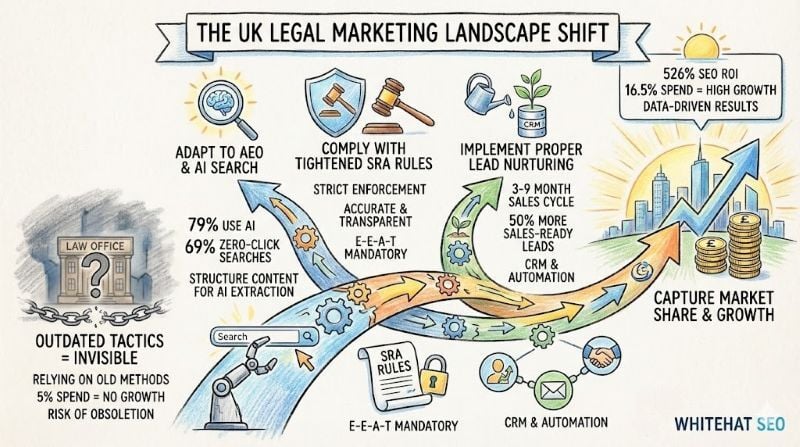
The evidence is clear: strategic investment drives results. High-growth law firms spend 16.5% of revenue on marketing compared to just 5% for no-growth firms. The question isn't whether to invest in marketing—it's how to invest intelligently.
UK Law Firm Marketing Budgets and ROI Benchmarks
Marketing investment among UK law firms is rising but remains modest compared to high-performing firms globally. The Law Firm Marketing Club Professional Services Survey 2024 found average marketing budgets at 3.1% of turnover, up from 2.7% previously. A firm with £10 million turnover typically spends around £300,000 annually on marketing, while personal injury, clinical negligence, and conveyancing firms report budgets of £84,000-£159,000.
Budget allocation is shifting decisively toward digital channels. 65% of law firms now spend the majority of their budget online, with the typical breakdown being 28% on internet marketing, 45% on SEO specifically, and 30% on PPC. Among Chief Marketing Officers surveyed, 54% saw budget increases in 2024, while 34% remained unchanged and only 14% decreased.
Channel ROI Comparison
The ROI comparison between channels reveals significant differences. SEO delivers a three-year return of 526% with an average of £22 return for every £1 spent, compared to PPC which generates approximately £2 return per £1 spent. However, 82% of firms using PPC believe the ROI isn't worth the investment when poorly managed. Email marketing remains the efficiency champion with an average 4,400% ROI.
| Channel | ROI | Conversion Rate |
|---|---|---|
| SEO | £22 per £1 (526% over 3 years) | 4.2% |
| Email Marketing | £42 per £1 (4,400%) | 4.5% |
| PPC (Optimised) | £2-£30 per £1 | 1.8% |
| Networking/Referrals | Perceived best by 43% | Highest quality |
The Lead Response Problem
Client acquisition patterns heavily favour organic search and referrals. 96% of people seeking legal advice use search engines first, with over 70% of UK clients beginning their solicitor search online. Critically, firms using client intake technology see 51% more leads and 52% higher revenues.
Lead response time dramatically impacts conversion. Firms responding within five minutes see 400% higher conversion rates, yet 27% of law firms don't respond to online leads at all and 48% are essentially unreachable by phone. The median response time has improved to 13 minutes (down from 21 minutes in 2023), but only 28% of firms achieve the five-minute benchmark that maximises conversions.
SEO for Solicitors: Local Optimisation, E-E-A-T, and Technical Excellence
Local SEO represents the foundation of legal search visibility. 36% of UK consumers now use the internet to find a solicitor (up from just 7% in 2005), and 46% of all Google searches are local business or service related. Complete Google Business Profiles are seven times more likely to receive clicks than incomplete profiles, and listings with photos generate 42% more direction requests.
Google Business Profile Optimisation for UK Solicitors
For UK solicitors, Google Business Profile optimisation must prioritise specific category selection (e.g., "Personal Injury Solicitor" or "Conveyancing Solicitor" rather than generic "Lawyer"), complete every available field including the 750-character business description, and post weekly updates featuring office photos and team content.
Critically, UK firms must display SRA price transparency information within their profiles—this regulatory requirement also serves as a trust signal. Businesses with four or more secondary categories achieve the highest average map rankings, and NAP (Name, Address, Phone) consistency across all listings is non-negotiable.
Priority UK Legal Directories for Citation Building
- The Law Society Find a Solicitor register
- SRA regulatory listings
- Legal 500 and Chambers and Partners
- Free Index, Yell.com, and Thomson Local
- Industry-specific directories for practice areas
E-E-A-T for Legal YMYL Content
Legal content carries YMYL (Your Money or Your Life) classification under Google's quality guidelines, making E-E-A-T (Experience, Expertise, Authoritativeness, Trustworthiness) compliance mandatory rather than optional. Inaccurate legal information can impact financial stability, personal rights, physical safety, and health—Google explicitly states it applies the strictest standards of trustworthiness for such content.
Experience (added December 2022) requires demonstrating tangible connection to subject matter through case results, practical experience handling specific legal issues, and client testimonials showing real outcomes.
Expertise demands detailed attorney bios including SRA registration numbers, educational background, professional qualifications, years of experience, practice area specialisations, and awards or recognitions.
Authoritativeness comes from clear author bylines linking to detailed bio pages, citation of actual statutes and case law, "Last Reviewed" dates on content, and backlinks from trusted legal publications.
Trustworthiness requires SSL certificates (HTTPS), clear privacy policies, GDPR compliance, transparent pricing per SRA requirements, and appropriate disclaimers distinguishing general information from specific legal advice.
Technical SEO Requirements
Technical SEO for law firms centres on Core Web Vitals: Largest Contentful Paint under 2.5 seconds, First Input Delay under 100ms, and Cumulative Layout Shift under 0.1. 53% of mobile users abandon sites taking longer than three seconds to load, and a five-second delay increases bounce rates by 38%.
With 60%+ of legal searches happening on mobile devices, Google's mobile-first indexing means the mobile version determines desktop rankings. Schema markup implementation should include LegalService schema, LocalBusiness schema for NAP consistency, Person schema for attorney profiles, and FAQPage schema for rich results eligibility.
AI Search and Answer Engine Optimisation Are Reshaping Client Acquisition
The emergence of AI-powered search represents the most significant change in legal marketing since SEO began. 28% of consumers now use ChatGPT to find lawyers—triple the 9% recorded in May 2023—though 94% of ChatGPT users also use Google, indicating complementary rather than replacement behaviour.
AI search referrals have grown over 500% year-over-year for some organisations. While AI assistants currently drive approximately 1% of legal website traffic, their conversion rates are 185-2,300% higher than traditional Google searches—meaning visitors from AI recommendations are pre-qualified and ready to act.
The Zero-Click Reality
Zero-click searches have become the dominant outcome for informational queries. 58.5% of US searches result in zero clicks (59.7% in EU), and this percentage grew from 56% to 69% after Google's AI Overview rollout. Searches triggering AI Overviews show an 83% zero-click rate versus 60% for traditional queries.
The traffic impact is measurable: law firms report 15-25% declines in organic traffic from previously effective SEO strategies. Gartner forecasts a 25% decrease in traditional search traffic by 2026. However, one agency reported a counterintuitive finding: website traffic dropped from 1,000 to 300 visitors but consultations tripled from 5 to 15—indicating higher-quality leads despite lower volume.
Critical Finding
Research from Seer Interactive (10,000 queries) found a 0.65 correlation between Google first-page rankings and ChatGPT brand mentions, while 76% of AI Overview citations pull from top 10 organic results. Investing in traditional SEO simultaneously builds AI visibility.
What Is Answer Engine Optimisation?
Answer Engine Optimisation (AEO) focuses on getting your firm selected as THE answer AI delivers, rather than merely ranking in search results. Whitehat SEO's Answer Engine Optimisation services help law firms implement this methodology effectively.
Question-based content architecture: Identify 10-15 common questions clients ask in consultations, use actual questions as H2 headings (e.g., "How long do I have to file a personal injury claim in England?"), and provide direct answers in 1-2 sentences followed by supporting details.
Content structure for AI extraction: Keep direct answers concise at 100-300 words per answer, use bullet points and numbered lists for easy parsing, include jurisdiction-specific information, and implement comprehensive schema markup.
Third-party authority building: AI models rely heavily on external validation from legal directories (Legal 500, Chambers and Partners), bar association profiles, legal publications, and peer reviews. Getting cited across these platforms improves AI citation likelihood.
Voice Search Optimisation
Voice search matters increasingly as over 40% of adults use voice search daily and 30% of web browsing sessions are initiated via voice. Voice queries average 4.2 words longer than typed searches and contain 73% more emotional language. A typed search might be "personal injury lawyer Manchester" while the voice equivalent is "Who's the best personal injury lawyer in Manchester?" Featured snippet targeting is essential since voice assistants pull from Google's position zero.
Content Marketing and Digital Channel Strategies
Content marketing drives legal lead generation when properly executed. Firms report 2-4x consultation volume increases from consistent helpful content publishing, while websites with video are 53 times more likely to reach Google's first page and achieve 80% higher conversion rates on landing pages. Yet only 24% of law firms currently utilise video in marketing efforts, representing significant competitive opportunity.
High-Performing Content Types for Legal Services
- Educational guides and FAQs: High conversion as they address common questions at the research stage
- Blog posts: Core strategy with 2-4x consultation potential when published consistently (2-4 posts per month minimum)
- Case studies: Particularly powerful in video format
- Client testimonials: Show real results while maintaining SRA compliance
- Video content: 1-3 minute FAQ/explainer videos, attorney profiles, legal news commentary
Recommended content budget allocation: 40% for content creation (blogs, videos, graphics), 35% for distribution (paid promotions, social sharing), 15% for tools and resources (SEO software, writing tools), and 10% for performance tracking.
Channel Performance Data
LinkedIn dominates B2B legal marketing. 87% of law firms use LinkedIn (up from 76% in 2020), 96% of individual attorneys have profiles, and 80% of B2B social media leads come from LinkedIn. 71% of lawyers say social media brings in new business (up from 38% in 2020).
Email marketing for legal services leads all industries with a 4.90% click-through rate—the highest of any sector. Legal click-to-open rates are 14.72% (second highest globally), and open rates have increased from 39.7% to 54.5% year-over-year. Fridays achieve the highest average open rate at 36.7%.
Google Ads for legal services commands premium pricing. The legal industry average CPC is £6.58-£9.21, compared to the cross-industry average of £4.22. UK-specific data shows legal clicks can cost north of £800 for competitive keywords. However, properly optimised campaigns can achieve 3:1 to 30:1 ROI—one UK firm achieved a 5.8% CTR and 16.5% conversion rate versus industry averages of 3% CTR and 6.9% conversion.
SRA Compliance and GDPR Requirements Create Clear Boundaries
The Solicitors Regulation Authority's December 2024 warning notice significantly tightened marketing enforcement. Titled "Marketing your services to members of the public," it targets high-volume consumer claims firms, lead generators and claims management companies, and 'no win, no fee' advertising practices.
Prohibited Marketing Practices
Cold calling, door knocking, and directly targeted online messaging to members of the public are prohibited under SRA rules. Firms must verify that third-party introducers are not using these tactics.
Key SRA Code of Conduct Requirements
Rule 8.8 requires all publicity to be "accurate and not misleading," including information about charges and interest circumstances.
Rule 8.9 prohibits "unsolicited approaches to members of the public" except to current or former clients.
Rule 8.7 mandates providing "best possible information" about pricing—the price transparency requirement.
What Marketing Remains Permitted
- General advertising (billboards, Google Ads, social media ads, TV, radio, print)
- Marketing to current or former clients
- B2B marketing (direct approaches to business clients are not prohibited)
- Website and content marketing
- SEO and PPC advertising
- Email marketing to opted-in subscribers (subject to GDPR/PECR)
GDPR and PECR Compliance
For B2C individual subscribers: Consent is required under PECR before sending marketing emails or texts. This must be separate, freely given, unambiguous, and affirmative. Silence, pre-ticked boxes, or inactivity do not constitute consent.
For B2B corporate subscribers: Marketing to generic business emails (info@company.com) does not require consent under PECR, though UK GDPR applies if using personal data. Legitimate interests may serve as lawful basis for B2B marketing.
The "soft opt-in" exception allows emailing existing customers without consent if you obtained details through a sale or negotiation, you're marketing similar products/services, and you gave them a clear opt-out at collection and in every subsequent message. SRA enforcement has intensified with over £1.5 million in fines issued since enhanced powers took effect.
CRM and Marketing Automation Enable Long-Cycle Lead Nurturing
78% of law firms use CRM systems, and 84% saw increased work efficiency through legal technology adoption. Yet many firms rate CRM effectiveness only 5 out of 10, indicating frustrations with data quality, user adoption, and ROI measurement. Among Top 100 UK firms, approximately 50% have implemented CRM, and 100% of Top 10 firms plan CRM-focused projects in the next 1-2 years.
Why Lead Nurturing Matters for Law Firms
Lead nurturing is essential given legal B2B sales cycles averaging 3-9 months (complex enterprise legal can reach 12-18 months) with typically 6-10 decision-makers involved. Nurtured leads produce 20% more sales opportunities, while 79% of marketing leads never convert due to lack of proper nurturing. Companies excelling at nurturing generate 50% more sales-ready leads at 33% lower cost.
HubSpot for Law Firms
HubSpot offers compelling legal sector capabilities including centralised client communications and case progress tracking, content marketing integration with SEO and lead nurturing, automated intake processes with case routing, and comprehensive attribution reporting from lead to case closure. Most firms become operational within 2-4 weeks.
Whitehat SEO's HubSpot onboarding methodology includes workflow configuration in the first 30 days, not as an afterthought. For firms using HubSpot, closed-loop reporting connects marketing activities directly to new client revenue.
Case Study Results
Legartis (HubSpot implementation) reduced cost per lead by 75%, increased Marketing Qualified Leads by 20x, and improved MQL to SQL conversion rate by 200%. Another firm went from 1 enquiry per quarter to 550+ enquiries total with email open rates 3x industry average.
Strategic Priorities for Law Firm Marketing Success
The research reveals several clear strategic imperatives for UK law firms serious about marketing effectiveness.
1. AI-Readiness Is Now Mandatory
With 79% of legal professionals using AI and zero-click searches at 69%, firms must implement AEO strategies—structuring content for AI extraction, building third-party authority signals, and maintaining strong traditional SEO (which correlates 0.65 with AI citations).
2. Investment Levels Must Increase
High-growth firms spend 16.5% of revenue on marketing versus 5% for stagnant firms, yet UK average budgets sit at just 3.1% of turnover. The ROI data supports increased spend—SEO returns £22 per £1 invested, email marketing delivers 4.90% CTR (highest of any industry), and properly optimised PPC achieves 3:1 to 30:1 returns.
3. Compliance Creates Competitive Moats
The December 2024 SRA warning notice and intensified enforcement mean compliant marketing is a differentiator. Firms must thoroughly understand SRA Rules 8.7-8.9, GDPR/PECR requirements for B2C versus B2B marketing, and E-E-A-T requirements for YMYL content.
4. Lead Nurturing Bridges Long Sales Cycles
With B2B legal sales averaging 3-9 months and 79% of marketing leads never converting due to poor nurturing, firms implementing proper CRM and marketing automation see 50% more sales-ready leads at 33% lower cost.
5. Video and Content Differentiation Remain Underleveraged
Only 24% of law firms use video despite 80% higher landing page conversion rates, and consistent blogging delivers 2-4x consultation volume increases. The competitive gap in these channels offers first-mover advantage for firms willing to invest.
Frequently Asked Questions
How much should a UK law firm spend on marketing?
The UK average is 3.1% of turnover, but high-growth law firms spend 16.5% of revenue on marketing compared to 5% for no-growth firms. For a firm with £10 million turnover, this translates to approximately £300,000-£1.65 million annually, depending on growth ambitions and market position.
What marketing activities are prohibited for UK solicitors under SRA rules?
Cold calling, door knocking, and directly targeted online messaging to members of the public are prohibited under SRA Code of Conduct Rule 8.9. Firms must also ensure third-party lead generators and introducers do not use these tactics. General advertising, content marketing, SEO, and PPC remain permitted.
What is Answer Engine Optimisation (AEO) and why does it matter for law firms?
AEO is the practice of optimising content so AI tools like ChatGPT, Google AI Overviews, and Perplexity cite and recommend your firm when answering legal questions. With 28% of consumers now using ChatGPT to find lawyers and zero-click searches at 69%, AEO complements traditional SEO to ensure visibility across both traditional and AI search channels.
How long does it take to see results from law firm SEO?
Most law firms see measurable ranking improvements within 3-4 months, with significant traffic and lead growth by month 6. SEO is a compounding investment—early gains build momentum for larger results over time. The three-year ROI from legal SEO averages 526%, with returns of £22 for every £1 invested.
Should law firms use HubSpot or a legal-specific CRM?
HubSpot offers strong marketing automation, attribution reporting, and integration capabilities that benefit law firms focused on lead generation and nurturing. Legal-specific CRMs like Clio Grow or Lawmatics excel at client intake and case management. Many firms use both—HubSpot for marketing and a legal CRM for practice management—with proper integration between systems.
References and Sources
- Clio (2025). Legal Trends Report 2025. https://www.clio.com/uk/resources/legal-trends/
- Solicitors Regulation Authority (2024). Marketing your services to members of the public - Warning notice. https://www.sra.org.uk/solicitors/guidance/marketing-public/
- SRA (2024). Transparency Rules. https://www.sra.org.uk/solicitors/standards-regulations/transparency-rules/
- Hinge Research Institute (2024). High Growth Study. https://hingemarketing.com/library/article/2024-high-growth-study-full-report
- Legal Futures (2024). Clio Legal Trends Report UK Findings. https://www.legalfutures.co.uk
- SparkToro/Datos (2024). Zero-Click Search Study. https://sparktoro.com
- Google (2024). Search Quality Evaluator Guidelines: E-E-A-T for YMYL Content. https://developers.google.com/search
Ready to Build a Marketing Engine That Delivers Results?
Whitehat SEO helps UK law firms implement compliant, effective marketing strategies that connect rankings directly to revenue. As a HubSpot Diamond Partner with deep legal sector experience, we understand the unique challenges solicitors face.
Explore Our ServicesRelated Reading view our pricing local SEO strategies for UK solicitors lead generation for architects