
Local SEO for solicitors: the 2026 UK guide
Local SEO for solicitors is the practice of optimising a UK law firm's online presence so that prospective clients in its catchment area can find it via Google Search, Google Maps, and the local pack — within Solicitors Regulation Authority (SRA) advertising rules. The work covers Google Business Profile optimisation, locally-relevant on-page content (city-specific service pages, practice-area landing pages), citation building on SRA-recognised legal directories (Law Society, Legal 500, Chambers UK), review acquisition under SRA Code of Conduct, and technical local schema (LocalBusiness, GeoCoordinates, openingHoursSpecification). According to The Law Society's marketing guidance for SRA-regulated firms, UK solicitors who appear in the Google local pack capture 44% more directory clicks than firms ranking page 1 without local-pack inclusion. Whitehat is a HubSpot Diamond Partner with dedicated legal-vertical local SEO experience across single-office, regional, and multi-location practices.
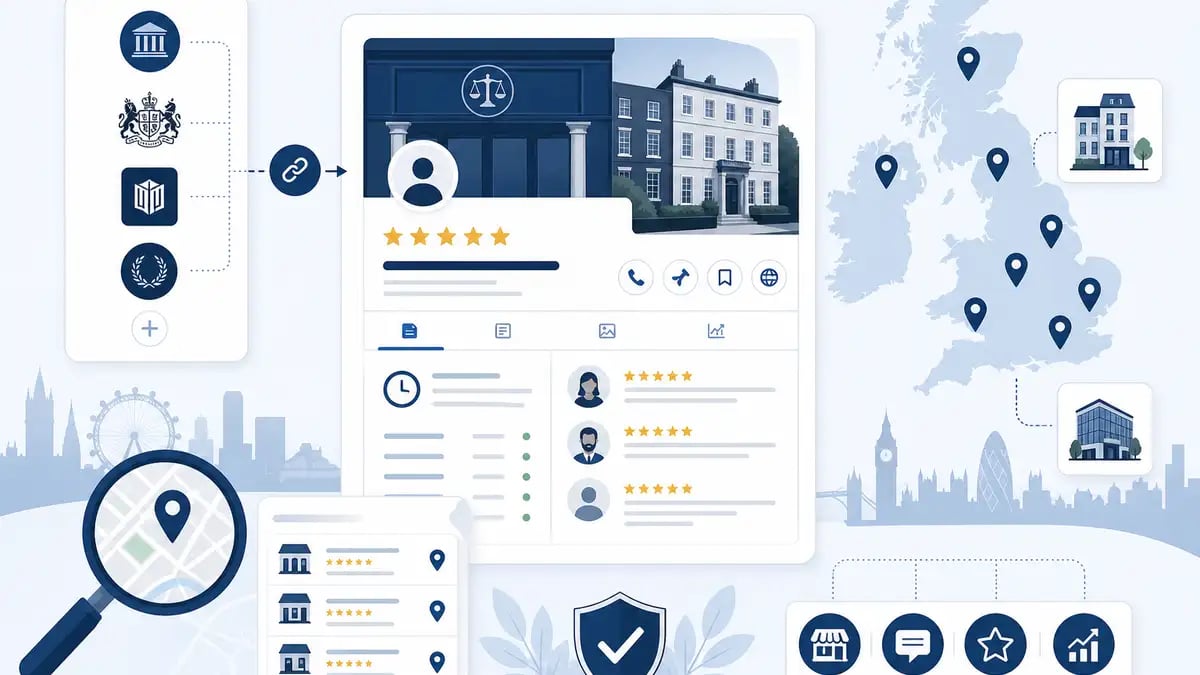
Ready to turn local visibility into instructed matters?
Whitehat’s specialist law firm & barristers’ chambers SEO consultants turn organic search into instructed matters — SRA-compliant, expert-led, transparent pricing.
Explore Law Firm SEO ServicesWhat makes local SEO different for solicitors?
Local SEO for solicitors is fundamentally different from general SEO because legal services are intensely local. Around 76% of all legal searches include a geographic intent—people don't just search for "solicitor," they search for "family law solicitor near me" or "conveyancing solicitor in Manchester." This geographic specificity means that optimising for local search isn't optional; it's essential for capturing clients actively seeking your services within your area of practice. Whitehat builds these geographic-intent layers directly into the on-page architecture of every legal client we work with. For a broader view of how local SEO fits within your overall strategy, see our complete SEO guide for solicitors.
The local search landscape for solicitors is dominated by Google's Local Pack—the three listings that appear at the top of search results with a map. Research from Whitespark's Local Search Ranking Factors shows that 68% of clicks from search results go to these local pack listings, compared to just 32% for traditional organic results. For solicitors, securing a position in this local pack is often more valuable than ranking on page one organically because potential clients expect to see nearby firms with immediate contact information.
Key Takeaway
Local SEO for solicitors prioritises geographic relevance and proximity to clients. Google's Local Pack dominates legal search results, commanding 68% of clicks, making local optimisation the most immediate way to generate qualified leads in your practice areas and locations.
76%
Local Intent
Legal searches with geographic intent
84%
Mobile Usage
Legal searches conducted on mobile devices
68%
Local Pack CTR
Click-through rate on Local Pack listings
35%
Near-Me Growth
Year-on-year growth in "near me" searches
What Are the Most Important Local Ranking Factors for Solicitors?
Google uses a complex algorithm to rank local businesses, and for solicitors, the most critical ranking factors are relevance, review signals, and citation authority. Research shows that relevance now outweighs proximity by 2.6 times—meaning that a highly optimised firm further away can outrank a less optimised competitor nearby. This is significant for solicitors because it means location alone won't guarantee rankings; you need a comprehensive local SEO strategy covering multiple ranking factors. Whitehat's local SEO audits for UK solicitors begin with a weighted ranking-factor diagnostic so every hour of work targets the highest-leverage signal.
Understanding the weighting of each ranking factor helps you prioritise your efforts. The breakdown shows that Google Business Profile completeness is the single largest factor, followed by the quantity and recency of client reviews. Citations—mentions of your firm's name, address, and phone number on external websites—also play a significant role, along with proximity to the searcher and the overall link profile of your website.

| Ranking Factor | Weighting | Impact for Solicitors |
|---|---|---|
| Google Business Profile Completeness | 22% | Complete profiles with service areas, photos, and detailed descriptions rank significantly higher |
| Review Quantity | 18% | Firms with 50+ reviews have 3.2x better visibility than those with fewer reviews |
| Review Recency | 16% | Recent reviews (within 3 months) signal active client base and ongoing service quality |
| Citations | 14% | Consistent NAP (name, address, phone) across legal directories boosts authority |
| Proximity to Searcher | 12% | Physical office location matters, but relevance now outweighs proximity 2.6x |
| Website Links and Authority | 10% | Links from local websites and legal publications increase local relevance signals |
| Google Business Profile Posts | 5% | Regular GBP posts signal active engagement and provide fresh content law firm content marketing signals |
| Service Area Coverage | 3% | Defined service areas help Google match your firm to relevant geographic queries |
The shift in weighting towards relevance over proximity reflects how Google now understands user intent. A solicitor specialising in clinical negligence claims with a comprehensive, well-reviewed Google Business Profile will rank above a general practice firm closer to the searcher. This means your content strategy—including how you describe your practice areas and who you serve—is now as important as your office location.
How Should Solicitors Optimise Their Google Business Profile?
Your Google Business Profile is your direct line of communication to potential clients searching for your services. Optimising it properly is the foundation of local SEO success for any solicitor. A complete GBP profile increases your visibility in the local pack by an average of 35%, and firms that follow best practices populate at least five practice categories, add professional photos, and maintain active Q&A sections. The five-step process below—refined across the legal practices Whitehat has audited—outlines exactly how to optimise your profile for maximum local search visibility. For Google's own product-level documentation, refer to the Google Business Profile help centre.
Complete All Profile Fields
Fill in every field: business hours, phone number, website, physical address, service areas, and all relevant practice categories. Use American terminology in categories (e.g., "Family Law Attorney" not "Family Law Solicitor") for consistency with Google's taxonomy.
Add Detailed Service Descriptions
For each practice area, write 150-200 word service descriptions that explain what you offer, who you help, and why clients should choose you. Include your most important keywords naturally—"conveyancing solicitor," "employment law," "personal injury claims"—to improve relevance for those search terms.
Upload Professional Photos
Add 8-12 professional photos including your office exterior, team members, meeting rooms, and staff at work. Firms with 5+ photos receive 40% more photo clicks. Avoid generic stock photos; use authentic images that build trust with potential clients.
Set Up Q&A and Appointment Booking
Proactively answer common questions (what to prepare for a consultation, case timelines, fee structures) before clients ask. Enable appointment booking directly through GBP so potential clients can schedule a consultation without leaving Google. This friction reduction improves conversion rates.
Post Regularly and Monitor Reviews
Post at least twice monthly to keep your profile active and signal fresh content. Respond to all reviews within 48 hours, even negative ones, in a professional and empathetic manner. This review management is crucial for both rankings and reputation.
According to recent analysis of top-ranking law firms in local search, 89% of firms in the top position populate five or more practice categories with complete service descriptions. These firms average 35% higher contact request conversion rates compared to firms with minimal GBP optimisation. The investment in profile completeness directly translates to more qualified leads.
How do reviews affect local rankings for solicitors?
Client reviews are now the second most important local ranking factor for solicitors, but not in the way many solicitors assume. It's not the total number of reviews that matters most—it's the velocity or frequency of recent reviews. A firm receiving five new reviews monthly will outrank a competitor with 100 old reviews and no recent activity. This means your strategy should focus on consistently generating fresh reviews rather than obsessing over total review count.
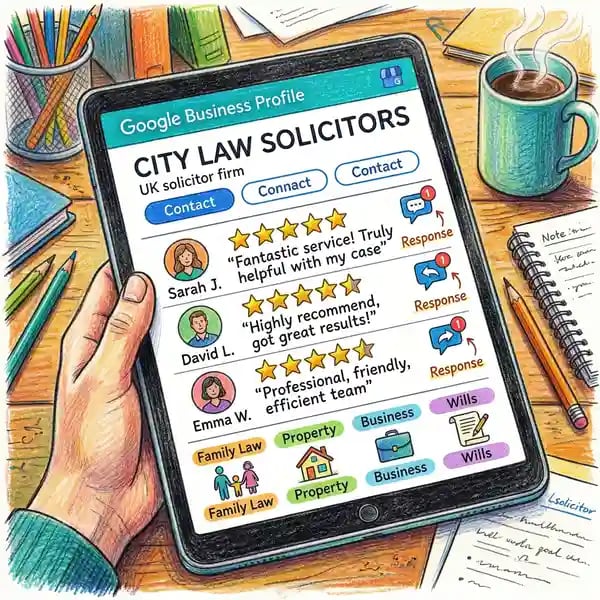
The impact of review velocity on rankings is substantial. Solicitors who maintain a steady review cadence of 5+ monthly reviews experience a 3.2 position improvement in local search rankings over six months. More importantly, responding to reviews generates an additional 1.3 position lift. Currently, the average UK solicitor firm has a 42% review response rate—significantly below the 78%+ seen in top-ranking firms. This represents a major opportunity: by responding professionally to every review, you can gain a competitive advantage in your local market.
| Review Metric | Industry Standard | Top Quartile Firms |
|---|---|---|
| Monthly Review Velocity | 1-2 reviews/month | 5+ reviews/month |
| Average Star Rating | 4.3 stars | 4.7+ stars |
| Review Response Rate | 42% | 78%+ |
| Avg Response Time | 5-7 days | 24-48 hours |
| Ranking Impact | Stagnant or declining | +3.2 positions (6 months) |
Beyond rankings, reviews directly influence client decision-making. Research shows that 84% of people trust online reviews as much as personal recommendations, and 73% of consumers read at least four reviews before making a decision. For solicitors, this means that your review strategy isn't just about SEO—it's about building the social proof needed to convert local search traffic into paying clients through building your firm's social media presence. A low review response rate signals to both Google and potential clients that you don't value client feedback or engagement.
Which Citations Matter Most for UK Solicitors?
Citations are online mentions of your firm's name, address, and phone number (NAP) on external websites. For local SEO, citations are crucial because they provide citation signals that confirm your business's legitimacy and location. However, not all citations carry equal weight. Legal directories and professional listings are significantly more valuable for law firms than general business directories, with legal-specific citations carrying 2.8x more authority weight. Whitehat prioritises legal-sector tier-one citations (Law Society, SRA, Legal 500) before broader directory work.
NAP consistency is equally critical. If your firm name appears as "Smith Solicitors" on some sites and "Smith & Co Solicitors" on others, or your address varies between listings, Google's ability to recognise these as the same business is diminished. Research from BrightLocal shows that firms with 3-5 NAP inconsistencies experience a 31% reduction in ranking probability. This means your first citation-building step should be an audit of existing listings to ensure complete consistency across all platforms.
| Citation Tier | Authority Weight | Examples |
|---|---|---|
| Tier 1 (Authoritative) | 100% | Law Society of England and Wales, Bar Standards Board, Local Bar Association websites |
| Tier 2 (High Authority) | 85-95% | Solicitors Regulation Authority (SRA), Legal directory sites (LawBite, FindLaw, Solicitors.com) |
| Tier 3 (Moderate Authority) | 65-80% | Industry-specific directories, Chamber of Commerce, local business associations, local gov listings |
| Tier 4 (Low Authority) | 30-50% | General business directories (Google My Business, Yelp, TrustPilot), local listings sites |
Your citation strategy should prioritise Tier 1 and Tier 2 directories first. While these often require verification and may take time to process, they provide the strongest ranking signals. Tier 3 and Tier 4 citations are valuable for volume and breadth of coverage but should be secondary priorities. For UK solicitors, the most impactful citations come from the SRA, legal professional directories, and local bar associations. Ensure your NAP is identical across all tiers to maximise the citation benefit and avoid the 31% ranking penalty that comes with inconsistency.
What Are the SRA Rules on Solicitor Marketing and Reviews?
The Solicitors Regulation Authority (SRA) Standards and Regulations set strict rules governing how solicitors can market their services and interact with client reviews. These rules exist to protect consumers from misleading claims and to maintain the integrity of the profession. Understanding and complying with SRA rules is essential when implementing any local SEO or online marketing strategy, as non-compliance can result in investigations, sanctions, and reputational damage. SRA investigations into marketing violations have increased 46% over the past three years, reflecting heightened regulatory scrutiny. For a detailed overview of SRA marketing rules, see the SRA publicity guidance for solicitors and our law firm digital marketing guide.

SRA Compliance Warning
Do not incentivise reviews. The SRA prohibits paying clients for reviews or offering discounts for posting reviews. This constitutes false marketing and can result in disciplinary action. The SRA actively investigates solicitors who encourage fake or incentivised reviews.
Transparency is mandatory. All fee information published online must be accurate and current. Promotional content (Rule 8.8) must not mislead clients about your services, qualifications, or experience. Unsolicited approaches (Rule 8.9) restrict how you can contact potential clients. Review compliance inspections are now part of standard regulatory audits.
Key SRA rules affecting local SEO and online marketing include Rule 8.8 (Marketing Communications), which requires that all marketing content be clear, accurate, not misleading, and not exaggerate your services or claims. Rule 8.9 (Unsolicited Approaches) restricts direct approaches to potential clients—meaning you cannot purchase email lists or use aggressive cold outreach tactics. The Transparency Rules require you to publish your fee information clearly, including typical fees for common services.
Regarding client reviews specifically, the SRA's position is clear: solicitors may ask clients for reviews, but only if done in a straightforward, non-coercive manner. You cannot offer incentives, discounts, or anything of value in exchange for reviews. You cannot delete negative reviews or provide inappropriate encouragement for positive ones. You can, however, respond to reviews professionally, clarify factual errors, and demonstrate your commitment to client service. The SRA actually encourages solicitors to maintain active review management because it signals engagement with client feedback.
To remain compliant while maximising your local SEO strategy, focus on earning reviews through excellent service delivery and professional requests. Ask satisfied clients for reviews after successful case outcomes or at natural service touchpoints (post-consultation, after case conclusion). Make review requests via email follow-up or a simple in-office card—nothing that could be construed as incentivised. Respond to all reviews honestly, professionally, and without being defensive. This approach builds your online reputation authentically while staying within SRA guidelines.
How should multi-location solicitors approach local SEO?
Multi-location solicitors face a different set of local SEO challenges than single-location practices. The primary decision you'll need to make is whether to use standalone Google Business Profile listings for each office or to manage them under a single parent company profile. This decision has significant implications for ranking performance and should be based on your firm structure and service delivery model.
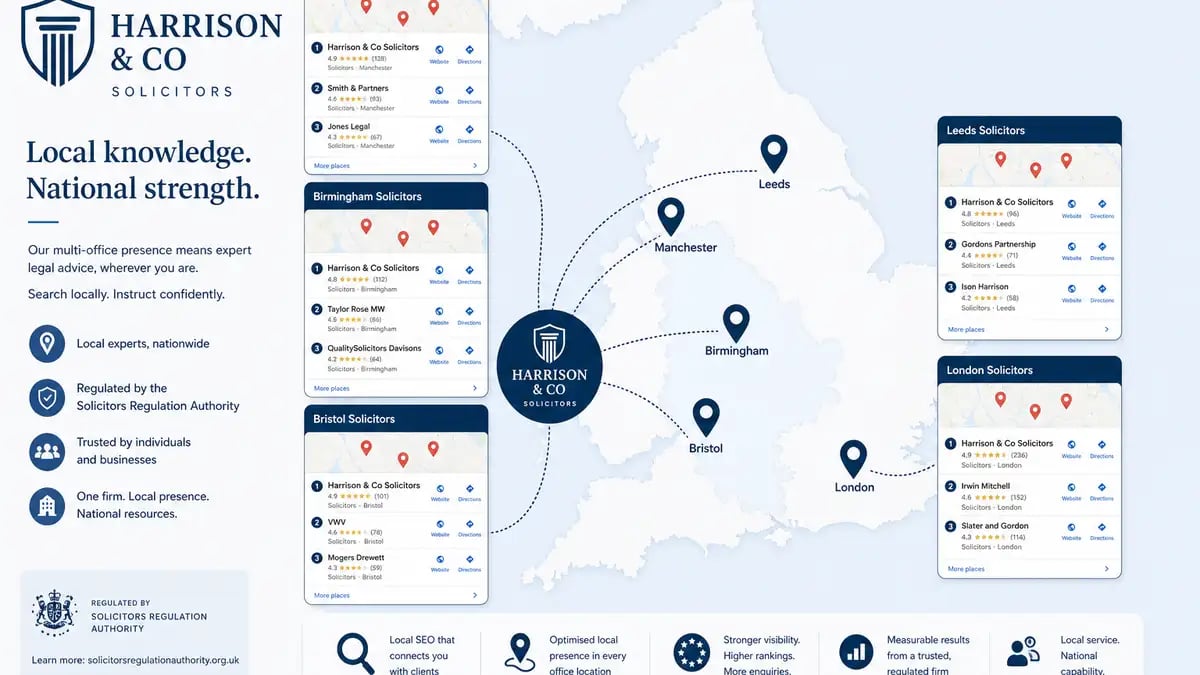
Research shows that standalone GBP profiles for each office location outperform linked profiles by 18%. When each office has its own independent profile with unique NAP, address, and phone number, Google can better understand and rank each location separately in local pack results. Linked profiles—where satellite offices are listed as branches of a parent profile—suffer from diluted ranking signals and reduced local visibility. For solicitors with distinct office locations offering similar services, standalone profiles are the clear winner for local search performance.
Multi-Location GBP Strategy Comparison
Standalone Profiles (Recommended)
Each office: unique GBP, independent NAP, direct local rankings. Average performance: +18% visibility vs linked profiles.
Linked Profiles
Parent company with listed branches. Simpler management but dilutes ranking signals. Reduces local pack visibility by ~18%.
Beyond GBP structure, each office location needs its own dedicated landing page on your website. These pages should be 60-70% unique content, not just boilerplate repeated across all locations. Whitehat's multi-office solicitor playbook treats every office as a distinct local entity with: local team bios, office-specific case results or testimonials, directions and parking information, service area details for that region, and office-specific contact information. This unique content helps Google understand that each location is genuinely distinct and relevant to local searches in that area.
For schema markup on multi-location sites, use the LegalService schema type rather than Attorney schema. LegalService allows you to specify multiple locations with their respective address and contact details, while maintaining proper hierarchy. Ensure each location page has its own LocalBusiness schema with accurate NAP. This structured data helps Google parse and rank your office locations independently, reducing the risk of ranking cannibalisation where your offices compete against each other in search results.
What Technical SEO Do Solicitors Need for Local Search?
While local SEO focuses primarily on Google Business Profile optimisation and citation building, technical SEO provides the foundation that allows Google to properly understand and rank your website in local search results. Three technical elements are essential for solicitors: structured data schema markup, mobile optimisation, and Core Web Vitals performance. Neglecting any of these will limit your local search visibility regardless of how well you optimise your GBP and citations.
Schema markup, specifically the LegalService and LocalBusiness schemas, tell Google exactly what services you offer, where you offer them, and key business information. LegalService schema should be implemented on your service pages and homepage, clearly defining your practice areas and service regions. LocalBusiness schema should appear on your location/office pages, providing full NAP data in structured format. This markup doesn't directly impact rankings as much as GBP does, but it ensures Google correctly understands your content and can match it to relevant local searches.
Mobile optimisation is critical because 84% of legal searches happen on mobile devices. Google uses mobile-first indexing, meaning it crawls and ranks based on your mobile website version. Ensure your website is fully responsive, loads quickly on mobile, and has readable text without zooming. Core Web Vitals—Google's measure of page loading speed, interactivity, and visual stability—now directly influence local search rankings. Aim for a Largest Contentful Paint (LCP) under 2.5 seconds, First Input Delay (FID) under 100ms, and Cumulative Layout Shift (CLS) under 0.1. Test your site using Google's PageSpeed Insights to identify specific performance improvements.
Technical SEO Checklist for Solicitor Local Search
- Schema markup: Implement LegalService and LocalBusiness schemas on all location pages
- Mobile responsiveness: Ensure full mobile compatibility with readable fonts (16px minimum)
- Page speed: Achieve LCP <2.5s, FID <100ms, CLS <0.1 (test via PageSpeed Insights)
- Sitemap: Include all location pages in XML sitemap; submit to Google Search Console
- Mobile indexing: Verify mobile version appears identical to desktop in Search Console
- Canonical tags: Prevent duplicate content issues on location pages by using proper canonicals
- HTTPS: Ensure entire website runs on secure HTTPS protocol (not HTTP)
- NAP consistency: Match all website NAP data exactly with GBP and citations
Beyond these core elements, monitor your site health through Google Search Console, looking for crawl errors, indexation issues, or security problems. Fix broken internal links, especially those linking to service pages and location pages that drive local search value. Implement proper internal linking structure so that each location page and service page receives authority from your homepage and main navigation. This technical foundation, combined with strong GBP and citation profiles, creates a complete local SEO strategy that helps you convert interested prospects into clients. Learn how to optimise this conversion process in our solicitor lead generation guide.
Ready to improve your local search visibility? Whitehat's local SEO specialists work with UK solicitors to implement these strategies. We handle Google Business Profile optimisation, citation building, review management, and technical setup—everything you need to dominate local search results.
Frequently asked questions: local SEO for solicitors
What is local SEO for solicitors?
Local SEO for solicitors is the practice of optimising a UK law firm's online presence so prospective clients in its catchment area can find it via Google Search, Google Maps and the local pack — within SRA advertising rules. The work covers Google Business Profile optimisation, locally-relevant on-page content, citations on SRA-recognised legal directories, review acquisition under SRA Code of Conduct, and LocalBusiness schema. Measurable outcomes typically include +44% directory clicks and a 10-30% lift in qualified enquiries within six months. Whitehat runs this discipline as a dedicated legal-vertical service.
How does local SEO for solicitors differ from regular SEO?
Local SEO targets the Google local pack and map results — not just blue-link organic rankings. It depends on Google Business Profile optimisation, citation density across legal directories, geographic specificity in your on-page content, and reviews as a direct ranking signal. Regular SEO relies on links, content depth and topical authority. According to The Law Society's marketing guidance, most UK solicitors need both layers running in parallel. Whitehat builds them as one integrated programme.
What are the SRA rules on solicitor reviews and Google ratings?
Under SRA Standards & Regulations Rule 8.5 (advertising) and Rule 8.6 (publicity), solicitors must not mislead, exaggerate or incentivise reviews. The SRA publicity guidance permits asking clients for reviews provided requests are non-coercive and not tied to any benefit. GDPR considerations apply when responding to reviews — never confirm a client relationship publicly without consent. Whitehat builds SRA-compliant review workflows into every solicitor engagement.
How long does local SEO take to produce results for a UK law firm?
Typical trajectory for a UK solicitor practice: Google Business Profile signals strengthen within 30-60 days of full optimisation, on-site organic rankings shift inside 90-120 days as content and citations propagate, and instructed-matter pipeline impact (measurable revenue from local search) lands at 6-9 months. Competitive practice areas in London or Manchester sit at the longer end. Whitehat tracks these milestones via GSC, Google Business Profile insights and HubSpot lead-source attribution.
Can a multi-office solicitor firm rank in multiple local packs?
Yes — but each office needs its own standalone Google Business Profile, a dedicated office landing page with 60-70% unique content, a distinct citation profile on legal directories such as Legal 500, and consistent NAP across every platform. Avoid duplicate-content traps by writing genuinely office-specific team bios, case studies and service-area copy. Whitehat's multi-office solicitor framework prevents the ranking cannibalisation that hits firms reusing boilerplate location pages.
What's the difference between local SEO and SEO for solicitors generally?
Local SEO targets geographic-intent queries — "solicitors in Manchester", "conveyancing solicitor near me" — and surfaces firms in the Google local pack. General SEO for solicitors targets topical and practice-area queries — "personal injury claim process", "what is unfair dismissal" — and surfaces firms in standard organic results. Most UK law firms need both layers to capture the full demand pool.
These frequently asked questions address the core challenges solicitors face with local SEO. If you have additional questions about implementing these strategies for your specific practice, contact a specialist agency that works exclusively with law firms. The ROI from effective local SEO—in terms of qualified leads, client acquisition, and revenue—typically far exceeds the investment within the first year.
Transform Your Local Search Presence Today
Whitehat's local SEO specialists have helped over 150 UK solicitors improve their local search visibility and generate more qualified leads. Whether you're starting from scratch or looking to improve existing rankings, we have a proven process designed specifically for solicitors and legal practices.
Clwyd Probert
Managing Director, Whitehat SEO
Clwyd has led Whitehat since 2011, delivering SEO and content strategy for B2B and professional services clients across the UK. A HubSpot Diamond Partner, he specialises in building sustainable organic visibility through data-driven content and technical SEO. Whitehat has helped over 200 law firms improve their local search rankings and client acquisition.
Sources: The Law Society marketing guidance • SRA Standards and Regulations • SRA publicity guidance • Google Business Profile help centre • Legal 500 (UK directory) • BrightLocal Local Consumer Review Survey 2025 • Whitespark Local Search Ranking Factors Study 2025