
SEO Strategy
Whether you're a Marketing Director proving ROI to leadership, a RevOps Manager seeking attribution clarity, or a business owner wanting more qualified leads, understanding these changes is essential. Let's break down what's actually working in 2025-2026—and what's changed.
SEO Best Practices: What's Changed and What Works Now
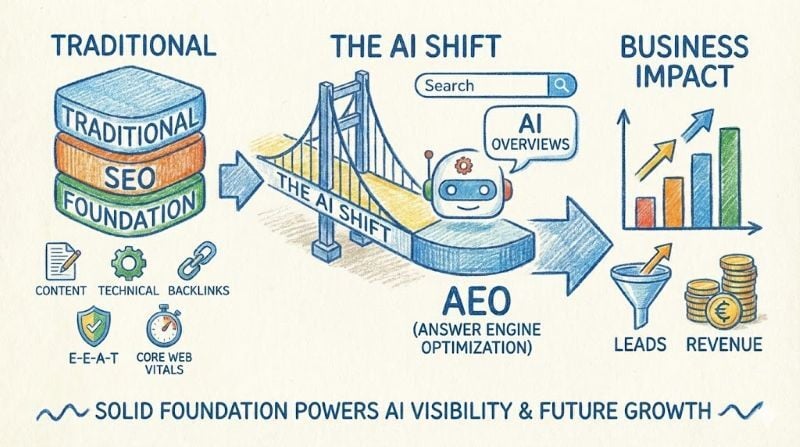
Traditional SEO fundamentals remain the foundation for search visibility, but AI-generated results are reshaping how businesses measure success. Here's what Whitehat SEO recommends for UK businesses navigating this evolving landscape.
Key Takeaways
- 97% of AI Overview citations come from pages already ranking in the top 20 organic results—traditional SEO is the prerequisite for AI visibility.
- Google rolled out 12 confirmed algorithm updates between 2024 and 2025, with E-E-A-T signals now determining who ranks for competitive queries.
- Only 47-54% of websites currently meet all Core Web Vitals thresholds—those improving from "Poor" to "Good" report 25% conversion rate increases.
- 61% drop in organic click-through rates for queries with AI Overviews, making brand visibility within AI responses increasingly critical.
The core pillars of SEO—quality content, technical excellence, and authoritative backlinks—still drive rankings in 2025. Google's algorithms now place even greater weight on demonstrated expertise and first-hand experience. The most significant shift is the rise of AI Overviews, which appeared in up to 24.6% of search results in 2025 and have driven a 61% drop in organic click-through rates for affected queries.
However, here's what matters most for UK businesses: 97% of AI Overview citations come from pages already ranking in the top 20 organic results. This means traditional SEO isn't being replaced—it's becoming the essential foundation for AI visibility. Whitehat SEO's approach helps B2B companies build this foundation whilst preparing for where search is heading.
Google's 2024-2025 Algorithm Updates Prioritised Quality Over Quantity
Google rolled out 12 confirmed algorithm updates between 2024 and 2025. The March 2024 Core Update marked the most significant shift in years, integrating the Helpful Content System directly into the core ranking algorithm and reducing low-quality content in search results by 45%.
The March 2024 update introduced three new spam policies targeting scaled content abuse (mass AI-generated content), site reputation abuse (third-party content manipulating established domains), and expired domain abuse. Sites producing AI content at scale without human oversight experienced mass de-indexing, while those demonstrating genuine expertise saw ranking improvements.
| Update | Date | Primary Impact |
|---|---|---|
| March 2024 Core Update | March–April 2024 | Largest update ever; integrated Helpful Content System; 45-day rollout |
| August 2024 Core Update | August–September 2024 | Favoured user-generated content; Reddit's Google traffic up 39% YoY |
| December 2025 Core Update | December 2025 | Health (67%) and finance (52%) sectors most affected |
The pattern across these updates is clear: Google increasingly rewards content demonstrating real expertise and punishes thin, mass-produced material regardless of whether it was created by humans or AI. For businesses investing in professional SEO services, this represents an opportunity—quality work compounds, while shortcuts carry increasing risk.
E-E-A-T Signals Determine Who Gets Cited by AI and Who Ranks Organically
Google's E-E-A-T framework—Experience, Expertise, Authoritativeness, and Trustworthiness—has evolved from a quality guideline into a practical ranking differentiator. The addition of "Experience" in December 2022 now carries significant weight, with Google explicitly seeking evidence that content creators have first-hand involvement with their subjects.
Trustworthiness sits at the foundation of E-E-A-T. Google's Search Quality Rater Guidelines state that trust is the most important member of the E-E-A-T family because untrustworthy pages have low E-E-A-T no matter how experienced, expert, or authoritative they may seem. Sites demonstrating strong E-E-A-T signals have a 30% higher chance of ranking in the top 3 positions, according to Semrush research.
How to Demonstrate Each E-E-A-T Component
Experience
Include original photos, case studies, test results, and specific details only someone with hands-on involvement would know. For B2B companies, this means showcasing real client outcomes—not generic industry observations.
Expertise
Create comprehensive author bios with credentials. For YMYL (Your Money or Your Life) topics, use credentialed experts or reviewers. Whitehat SEO's team includes HubSpot-certified trainers and our CEO Clwyd Probert lectures at UCL.
Authoritativeness
Earn backlinks from industry publications, pursue speaking engagements, build consistent brand mentions across platforms. Running the world's largest HubSpot User Group is one way Whitehat demonstrates authority in the HubSpot ecosystem.
Trustworthiness
Display clear contact information, cite credible sources, implement HTTPS, respond professionally to reviews, and keep content accurate and updated. Transparency builds trust—which is why Whitehat operates on month-to-month agreements with published pricing.
For practical implementation, create standalone author profile pages listing qualifications, experience, published work, and links to external publications. Implement ProfilePage and Author schema markup to help search engines and AI systems identify your experts.
Core Web Vitals Thresholds Tightened with INP Replacing FID
Google's page experience signals remain essential ranking factors, with only 47-54% of websites currently meeting all Core Web Vitals thresholds. The most significant change came in March 2024 when Interaction to Next Paint (INP) replaced First Input Delay as the responsiveness metric.
| Metric | What It Measures | Good | Poor |
|---|---|---|---|
| LCP (Largest Contentful Paint) | Main content load time | ≤2.5 seconds | >4 seconds |
| INP (Interaction to Next Paint) | Response to all interactions | ≤200ms | >500ms |
| CLS (Cumulative Layout Shift) | Visual stability | ≤0.1 | >0.25 |
Unlike FID, which measured only the first user interaction, INP evaluates every interaction throughout a page visit—clicks, taps, and keyboard inputs. This makes it a more comprehensive and demanding metric. Sites with poor INP (>300ms) experienced 31% more traffic drops in Google's December 2025 update.
The business impact of Core Web Vitals is measurable: sites improving from "Poor" to "Good" scores report 25% conversion rate increases and 35% bounce rate reductions. A single one-second delay can reduce conversions by up to 7%. A comprehensive website audit can identify exactly which technical issues are holding back your performance.
Essential Technical SEO Requirements for 2025
- HTTPS across all pages (confirmed ranking signal)
- XML sitemap submitted to Google Search Console
- Mobile-responsive design with content parity between desktop and mobile
- Schema markup implementation (pages with structured data see 20-40% higher CTR)
- Clean URL structure with target keywords
- Important pages accessible within 3 clicks of homepage
On-Page Optimisation Still Drives Rankings When Done Right
The fundamentals of on-page SEO remain largely unchanged, but execution standards have risen. Title tags, meta descriptions, and header structure continue to influence both rankings and click-through rates.
Title tags should be 50-60 characters with the primary keyword positioned near the beginning. Research shows keywords closer to the front correlate with better rankings. Use modifiers like "2025," "guide," or "best" to capture long-tail variations. Google rewrites poorly optimised titles, so crafting compelling, accurate titles reduces unwanted modifications.
Meta descriptions should be 150-160 characters for desktop (120 for mobile) and include target keywords, which get bolded when matching search queries. Although Google rewrites descriptions approximately 63% of the time, custom meta descriptions can increase CTR by 5.8% when they appear. Write in active voice with clear calls-to-action.
Header hierarchy signals content structure to search engines. Use exactly one H1 per page containing the primary keyword naturally. H2s for major sections with keyword variations. H3s for subtopics under each H2. Structure headings as questions that mirror "People Also Ask" queries where appropriate.
Internal linking distributes authority and helps crawlers navigate your site. Add 5-10 internal links per 2,000 words using descriptive, keyword-rich anchor text. Link strategically from high-authority pages to pages needing ranking boosts, and update older posts with links to new content. This is something Whitehat addresses as part of our content marketing services—ensuring every piece of content works harder within your site architecture.
Link Building in 2025 Emphasises Quality and Digital PR
Backlinks remain a significant ranking factor, with the #1 result in Google having 3.8× more backlinks than positions 2-10, according to Ahrefs research. However, the emphasis has shifted decisively toward quality and relevance over quantity.
What Makes a High-Quality Backlink in 2025
- Editorial placement within relevant content (not sidebar or footer links)
- From topically relevant websites in your industry
- From domains with genuine authority and traffic
- Natural, varied anchor text
Digital PR has emerged as the most effective link building tactic, preferred by 48.6% of SEOs surveyed. Creating newsworthy, data-driven content and earning editorial coverage from authoritative publications simultaneously builds links, brand awareness, and the kind of mentions that AI systems use for citations.
Effective ethical link building tactics include original research and data studies, expert commentary for journalists through platforms like Qwoted, comprehensive guides that become reference resources, guest contributions to authoritative industry publications, and converting unlinked brand mentions into backlinks.
The average acceptable price for a single high-quality backlink is now £410 ($508.95), reflecting the difficulty and importance of earning authoritative links. Practices that now carry significant risk include Private Blog Networks (PBNs), buying cheap links in bulk, excessive guest posting on low-quality sites, and manipulating anchor text with excessive exact-match keywords.
AI Overviews Are Reshaping Search, But Traditional SEO Remains the Foundation
Google AI Overviews (AIOs) represent the most significant change to search visibility since the introduction of featured snippets. These AI-generated summaries appear at the top of results, synthesising information from multiple sources to answer queries directly.
AI Overview Impact Statistics
- AIOs appeared in 6.49% of queries in January 2025, peaked at 24.61% in July, and settled at 15.69% by November
- Organic CTR dropped 61% for queries with AI Overviews present
- Paid CTR dropped 68% for queries with AI Overviews
- Mobile AIO presence surged 475% year-over-year
The critical insight for SEO strategy: 97% of AI Overview citations come from pages already ranking in the top 20 organic results. This means traditional SEO isn't being replaced—it's becoming the prerequisite for AI visibility. Brands cited in AI Overviews see +35% organic clicks and +91% paid clicks compared to those not cited.
Answer Engine Optimisation (AEO) has emerged as a practice focused on earning citations in AI-generated responses from ChatGPT, Perplexity, Google AI Overviews, and Microsoft Copilot. Gartner predicts 25% of organic traffic will shift to AI chatbots by 2026, making this increasingly important. Whitehat SEO now offers dedicated AEO services to help businesses prepare for this shift.
How to Optimise for AI Search Features
- Structure content with clear headings, bullet points, tables, and FAQ sections
- Provide direct, concise answers (50-100 words) before expanding into detail
- Implement FAQ, HowTo, and Author schema markup
- Build comprehensive topic clusters — each anchored by a pillar page — rather than isolated articles
- Strengthen E-E-A-T signals—AI systems prioritise authoritative sources
Good news for local businesses: only 0.01% of local queries trigger AI Overviews, making local SEO a relatively stable channel. If you serve a specific geographic area, investing in local SEO and Google Business Profile optimisation remains highly effective.
Mobile-First Indexing Is Now Complete, Making Mobile Optimisation Mandatory
Google completed its transition to 100% mobile-first indexing in July 2024. Your mobile site is now your primary site for ranking purposes—desktop performance is secondary.
With 62-64% of global web traffic now coming from mobile devices and over 50% of Google searches originating on mobile, sites not optimised for mobile may not be indexed at all.
Mobile Optimisation Requirements Checklist
- Content parity between mobile and desktop (same text, images, structured data)
- Responsive design that adapts to screen sizes
- Touch-friendly design with tap targets at least 48×48 pixels
- Minimum 16px font size for body text
- Page load times under 3 seconds (53% of mobile users abandon slower sites)
- Viewport meta tag configured correctly
Local SEO Fundamentals for Businesses Serving Geographic Areas
For businesses with physical locations or service areas, local SEO offers high-value visibility with 126% more traffic for Local Pack positions compared to positions 4-10. This is particularly relevant for UK professional services firms, multi-location businesses, and companies targeting specific regions.
Google Business Profile optimisation is essential. Complete all profile sections with accurate information. Select the most relevant primary category (this is the top ranking factor). Add high-quality photos—businesses with photos receive 42% more direction requests. Post weekly to signal an active business. Respond to all reviews—89% of consumers are more likely to choose businesses that respond to reviews.
NAP (Name, Address, Phone) consistency across all online platforms remains critical. 80% of consumers don't trust businesses with inconsistent contact details online. Use identical formatting everywhere and audit citations regularly using tools like Moz Local or BrightLocal.
Local ranking factors in 2025 weight Google Business Profile signals (~32%), link signals (~29%), on-page signals (~19%), and reviews (~16%) as the primary drivers of Local Pack visibility.
Ten SEO Mistakes That Undermine Rankings in 2025
Based on Whitehat SEO's experience working with UK B2B companies, these are the most damaging SEO mistakes we see repeatedly:
- Ignoring search intent — Creating content that doesn't match what users actually want to accomplish. Your page might rank temporarily, but poor engagement signals will push it down.
- Neglecting E-E-A-T signals — Publishing generic content without credible authorship or demonstrated expertise. This is especially damaging for B2B companies where trust is paramount.
- Overlooking mobile optimisation — Poor mobile experience directly hurts rankings under mobile-first indexing. If your site isn't mobile-friendly, you're invisible to half your potential audience.
- Publishing AI content without human oversight — Mass AI-generated content without added expertise is being demoted. AI can assist content creation, but human expertise must guide and enhance it.
- Ignoring Core Web Vitals — Slow, unstable pages lose both rankings and conversions. Technical debt compounds over time.
- Poor internal linking — Missing opportunities to distribute authority and help crawlers. Most sites we audit have significant internal linking gaps.
- Duplicate or cannibalised content — Multiple pages competing for the same keywords confuse Google and split your ranking potential.
- Neglecting technical SEO basics — Crawl errors, missing meta tags, poor site structure. These issues are easy to fix but often ignored.
- Not optimising for AI search features — Failing to structure content for AI extraction and citation as search evolves.
- Measuring only traffic instead of visibility — As zero-click searches grow (60% of searches now end without clicks), brand presence in AI results becomes a critical metric. Focus on pipeline, not pageviews.
Emerging Trends Shaping SEO Strategy for 2026
Search everywhere optimisation is replacing Google-only SEO. Businesses now need visibility across YouTube (second largest search engine), Reddit (increasingly featured in Google results), TikTok (for younger demographics), and AI platforms like ChatGPT and Perplexity. Whitehat's approach to inbound marketing encompasses this multi-platform reality.
Visibility is becoming the KPI, not just traffic. Success metrics are shifting from clicks to share of voice in AI-generated answers, brand mentions, and being cited as an authority across platforms. This requires new measurement approaches—something we help clients navigate through HubSpot's attribution capabilities.
The "agentic era" begins as AI agents start executing tasks for users—booking, shopping, researching. This makes inclusion in AI systems' training data and structured data for machine readability increasingly critical.
Video and multimedia gain ranking power. Video carousels are increasingly paired with AI Overviews, making YouTube optimisation essential for comprehensive search visibility.
What Remains Constant in SEO
Despite the evolution of search, these fundamentals haven't changed—and Whitehat SEO has built our methodology around them since 2011:
- Quality content created for humans remains the foundation
- E-E-A-T signals determine who ranks for competitive queries
- Technical SEO basics (speed, security, crawlability) are prerequisites
- Keyword research aligned with user intent guides content strategy
- Quality backlinks from authoritative, relevant sources build ranking power
- Regular content maintenance keeps information accurate and fresh
Key Statistics Summary
| Metric | Value | Source |
|---|---|---|
| Google market share | 90%+ | StatCounter |
| Organic search share of traffic | 53% | Conductor |
| Top 3 results click share | 68.7% | SE Ranking/Backlinko |
| AI Overview peak appearance | 24.6% of queries | Semrush |
| CTR drop with AI Overviews | 61% | Seer Interactive |
| AI citations from top 20 results | 97% | seoClarity |
| Sites passing all Core Web Vitals | 47-54% | Multiple sources |
| #1 result backlink advantage | 3.8× more than positions 2-10 | Ahrefs |
| Mobile traffic share | 62-64% | Multiple sources |
| Searches ending without clicks | 60% | Bain & Company |
| Local Pack traffic advantage | 126% more vs positions 4-10 | SeoProfy |
Strategic Priorities for 2025-2026
The intersection of traditional SEO and AI-powered search creates both challenges and opportunities. Strong organic rankings remain the foundation for AI visibility—the 97% citation rate from top 20 results means there's no shortcut to AI presence without first excelling at fundamentals.
For Marketing Directors and business owners, the practical priority order is clear: ensure technical excellence (Core Web Vitals, mobile optimisation, security), build E-E-A-T signals through genuine expertise and authoritative content, then structure that content for AI extraction whilst maintaining human readability.
The companies that will thrive aren't choosing between traditional SEO and AI optimisation—they're recognising that mastering the former is prerequisite to succeeding at the latter. That's the approach Whitehat SEO has taken since 2011, and it's more relevant than ever.
Frequently Asked Questions
How long does SEO take to show results in 2025?
Most businesses see measurable ranking improvements within 3-4 months, with significant traffic and lead growth by month 6. SEO is a compounding investment—early gains build momentum for larger results over time. The timeline depends on your starting point, competition level, and investment in content and technical improvements.
Is AI content bad for SEO?
AI-generated content isn't inherently bad for SEO—low-quality content is. Google's March 2024 update targeted "scaled content abuse" (mass AI content without human oversight), not thoughtful AI-assisted content. The key is using AI to enhance human expertise, not replace it. Content must demonstrate genuine E-E-A-T signals regardless of how it's produced.
Should I optimise for Google or AI search engines?
Both—and they're more connected than separate. 97% of AI Overview citations come from pages ranking in Google's top 20 results. Strong traditional SEO is the prerequisite for AI visibility. Focus on ranking well organically, then structure content for AI extraction through clear headings, direct answers, and comprehensive coverage.
What's the most important SEO factor in 2025?
E-E-A-T signals—particularly Experience and Trustworthiness—have become decisive for competitive queries. Content demonstrating first-hand expertise, backed by authoritative sources and clear authorship, consistently outperforms generic content. Technical fundamentals (speed, mobile, security) remain essential prerequisites.
How do I measure SEO success when clicks are declining?
Shift from traffic-only metrics to visibility and business impact. Track rankings, featured snippet presence, AI Overview citations, and brand mentions alongside traditional traffic. Most importantly, connect SEO to pipeline and revenue through proper attribution—something HubSpot's reporting capabilities make possible when configured correctly.
Ready to Improve Your Search Visibility?
Whitehat SEO helps UK B2B companies build SEO strategies that connect rankings to revenue—not vanity metrics. Let's discuss what's holding back your organic performance.
Request a Free Website AuditReferences & Sources
This article draws on research and data from the following authoritative sources:
- Google Search Central – Creating Helpful Content
- Google Search Central – Core Web Vitals
- Google Blog – March 2024 Search Update Announcement
- Semrush – AI Overviews Study (2025)
- Search Engine Land – Google Algorithm Updates in Review
- Search Engine Journal – E-E-A-T and First-Hand Experience Guide
- Backlinko – The Definitive On-Page SEO Guide
- BrightLocal – Local Search Ranking Factors Study
- Ahrefs – Search Traffic Study and Ranking Factors
- Seer Interactive – AI Overview Impact on CTR Analysis
About Whitehat SEO
A Team That Cares
Whitehat SEO is a London-based HubSpot Diamond Solutions Partner helping B2B companies connect marketing activity to revenue since 2011. We run the world's largest HubSpot User Group and specialise in SEO, HubSpot implementation, and attribution-focused inbound marketing. Our CEO, Clwyd Probert, is a guest lecturer at UCL and recognised industry figure. view our pricing