
SEO Strategy
This guide covers the essential metrics, tool configurations, and reporting frameworks B2B marketers need to prove SEO value in an AI-transformed search landscape. Whether you're a Marketing Director needing attribution clarity, a RevOps Manager building CFO-trusted dashboards, or a Demand Generation lead seeking predictable pipeline metrics, these practices will help you connect SEO activity directly to revenue.
SEO Reporting Best Practices for 2026: The Complete Guide to Metrics That Matter
SEO reporting in 2026 requires measuring visibility across both traditional search and AI answer engines, not just rankings and traffic. With AI Overviews now appearing in up to 50% of Google searches and organic click-through rates dropping by 32% for top positions, Whitehat SEO's approach combines three metric tiers—business impact, visibility, and technical health—to demonstrate real marketing ROI to leadership teams.
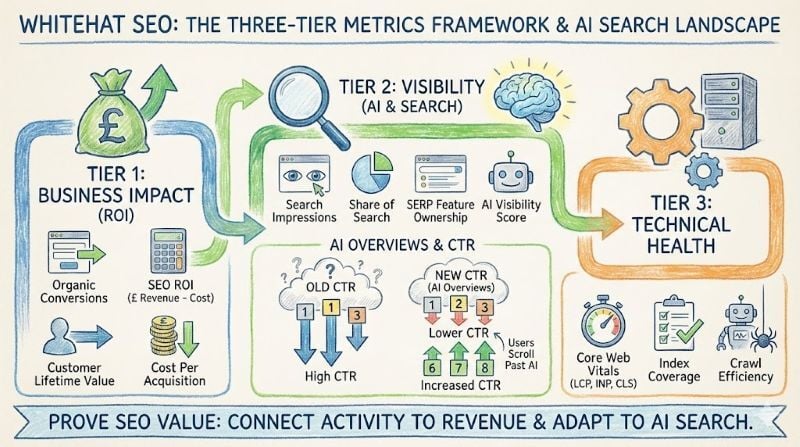
The Three-Tier SEO Metrics Framework
The most significant shift in SEO reporting for 2026 is moving from traffic-centric to visibility-centric measurement. With 60% of Google searches now ending without a click to any website, focusing solely on organic sessions misses the complete picture of how search drives business results.
Whitehat SEO's reporting framework organises metrics into three tiers that connect search activity to revenue:
Tier 1: Business Impact Metrics
- Organic conversions — form submissions, demo requests, and purchases from search traffic
- SEO ROI — revenue attributed to organic search minus investment costs
- Customer lifetime value from organic — long-term revenue from search-acquired customers
- Cost per acquisition — total SEO investment divided by conversions
Tier 2: Visibility Metrics
- Search impressions — how often your pages appear in results
- Share of search — your brand's proportion of category search queries versus competitors
- SERP feature ownership — featured snippets, knowledge panels, and image results captured
- AI visibility score — presence in ChatGPT, Perplexity, and Google AI Overviews
Tier 3: Technical Health Metrics
- Core Web Vitals — LCP under 2.5 seconds, INP under 200ms, CLS under 0.1
- Index coverage — percentage of pages successfully indexed by Google
- Crawl efficiency — server response times and crawl budget utilisation
Share of search has emerged as a particularly powerful predictive KPI. Research by Les Binet demonstrates that brands with growing share of search typically see market share increases within 6–24 months. This makes it a leading indicator that surfaces before revenue data shows movement.
Key benchmark: Organic search drives 53.3% of all website traffic, and SEO leads close at 14.6% compared to just 1.7% for outbound leads.
How AI Search Has Changed Click-Through Rates
Google's AI Overviews rollout has fundamentally disrupted the CTR benchmarks that SEO professionals have relied upon for years. Understanding these changes is essential for setting realistic expectations and identifying new opportunities in your reporting.
According to GrowthSRC's study of 200,000 keywords across e-commerce, SaaS, B2B, and EdTech industries, organic CTR for position one dropped from 28% to 19%—a 32% decline—after AI Overviews expanded. Position two experienced an even steeper 39% decline.
Updated CTR Benchmarks by Position
| Position | Average CTR | Notes |
|---|---|---|
| #1 | 27.6% (19% with AI Overviews) | Still captures most clicks |
| #2 | 15.8% | Significant drop from #1 |
| #3 | 11.0% | Top 3 receive 54.4% combined |
| #4–5 | 6.3–8.4% | Emerging mid-position opportunity |
| #6–10 | Increased 30.63% YoY | Users scroll past AI results |
| Page 2 | 0.63% | Almost zero click value |
Here's where the data gets interesting: positions 6–10 actually saw CTRs increase by over 30% year-on-year. As users scroll past AI Overviews seeking deeper, more nuanced content, pages ranking outside the top five are capturing attention they previously missed.
AI Overviews now appear in approximately 30% of all search results and 74% of problem-solving queries. For B2B marketers targeting informational keywords, this means the traditional "rank higher, get more traffic" equation no longer holds with the same predictability. Your SEO reports must account for visibility within AI-generated answers, not just traditional organic positions.
Learn more about optimising for this new landscape in our Answer Engine Optimisation service guide.
GA4 Configuration for SEO Success
Google Analytics 4's event-based model requires specific configuration to capture SEO performance accurately. The most critical setup step is connecting Google Search Console to GA4, then publishing the Search Console reports collection from the Library.
Essential GA4 Configurations for SEO Reporting
1. Enable Google Signals
Navigate to Admin → Data Settings → Data Collection. Google's data-driven attribution model—previously a £150,000 per year enterprise feature—is now available free for all GA4 users when signals are enabled.
2. Create Custom Organic Explorations
Set filter "Session default channel group = Organic Search" and add dimensions for landing page and source/medium. This isolates search performance from other traffic sources for cleaner reporting.
3. Configure Scroll Depth Tracking
Use Google Tag Manager to set up scroll depth tracking at 25%, 50%, 75%, and 100% thresholds. This measures content engagement beyond simple pageviews—critical for demonstrating content quality.
4. Set Up Enhanced Conversions
Mark B2B actions like form submissions and demo requests as Key Events. This enables attribution tracking that connects organic traffic to pipeline contribution.
The GA4–GSC integration provides two critical reports: Google Organic Search Queries (search queries with impressions, clicks, CTR, and average position) and Google Organic Search Traffic (landing pages with combined metrics).
Important limitation: Search Console data in GA4 has a maximum 16-month retention period. For historical preservation, export to BigQuery or use Looker Studio with direct GSC connection.
For HubSpot users, connecting GA4 data through native integration provides unified reporting across marketing channels. Our HubSpot onboarding service includes analytics configuration as part of the standard implementation.
Google Search Console's New Features for 2026
Google Search Console has evolved from a basic reporting tool to an intelligent workspace with several AI-powered features launched in late 2025. Understanding these capabilities helps you extract more actionable insights from your data.
Major New Features
Branded Queries Filter (November 2025)
AI-powered automatic recognition of brand names, variations, product names, and common misspellings. This separates brand traffic from discovery traffic without requiring manual regex configuration—essential for understanding true SEO-driven growth.
AI-Powered Configuration (December 2025)
Natural language interface where you describe analysis in plain English. For example: "compare blog traffic this quarter versus last year" and GSC automatically applies the relevant filters. This dramatically speeds up exploratory analysis.
Social Channels Integration (December 2025)
See linked social profile performance alongside website reporting. This provides a more complete picture of your digital visibility across platforms.
Weekly and Monthly View Options
Aggregate views that smooth out daily anomalies and help identify broader performance trends without noise from day-to-day fluctuations.
Critical Note on AI Overviews Tracking
Despite fake screenshots circulating on social media, Google Search Console does not have a dedicated AI Overviews filter. AI Overviews are counted within the standard "Web" search type. To estimate AI Overview impact, monitor the pattern of "impressions up, CTR down" and use third-party tools like Semrush or SISTRIX.
For actionable analysis, use the Performance report to identify high-impression, low-click queries (CTR optimisation opportunities), detect keyword cannibalisation (flag when secondary pages capture 30% or more impressions compared to the primary page), and track performance before and after major site changes.
Our website audit service includes comprehensive Search Console analysis to identify quick wins and technical issues affecting your visibility.
Measuring Visibility in AI Search
Answer Engine Optimisation (AEO) and Generative Engine Optimisation (GEO) have emerged as essential practices for forward-thinking marketers. With over 400 million people now using ChatGPT weekly and Gartner predicting 25% of organic search traffic will shift to AI chatbots by 2026, visibility in AI-generated answers increasingly drives business outcomes.
The Critical Metric: AI Share of Voice
AI SoV (%) = (Your Brand Mentions ÷ Total Brand Mentions for Relevant Queries) × 100
Measuring AI Share of Voice requires building a library of 50 or more prompts your audience typically searches, running queries systematically across ChatGPT, Perplexity, Google AI Overviews, and Claude, then logging mentions, citations, and recommendations weighted by position within each response.
Key finding: AI-referred traffic converts at 4.4× higher rates than traditional organic visitors. ChatGPT visitors spend 15 minutes on site compared to 8 minutes from Google.
Traditional vs AI Metrics Comparison
| Traditional Metric | AI Search Equivalent |
|---|---|
| Rankings | AI Visibility Score |
| Impressions | AI Mention Frequency |
| Click-through rate | Citation Rate |
| Organic traffic | AI Referral Traffic |
| Share of search | AI Share of Voice |
| Featured snippets | AI Overview Citations |
Tools for Monitoring AI Visibility
Free options: HubSpot AI Search Grader provides visibility snapshots across major AI platforms. Semrush offers an AI Overviews Visibility Checker within their platform.
Mid-market solutions: Otterly AI (from £29/month) and SE Ranking (from £119/month) offer more systematic tracking.
Enterprise platforms: Profound (from £499/month) and Goodie AI (from £495/month) provide comprehensive monitoring and competitive benchmarking.
Learn how to optimise your content for AI citation in our comprehensive guide to ranking in ChatGPT.
What Executives Want from SEO Reports
C-suite executives and board members approach SEO reports differently than marketing teams. Where practitioners focus on rankings and technical metrics, leadership needs to see business outcomes expressed in financial terms they can trust and act upon.
The core challenge: only 52% of CMOs report being able to prove marketing's value to their organisations. SEO reporting that fails to connect search activity to revenue contribution becomes noise rather than signal.
Five Metrics Every Executive SEO Report Should Include
- Revenue attributed to organic search — the single most important number, showing how much closed business originated from search traffic
- Pipeline contribution — total value of opportunities in sales stages that came through organic channels
- Cost per acquisition versus other channels — how SEO efficiency compares to paid advertising, events, and outbound
- Year-on-year growth trends — showing trajectory, not just point-in-time snapshots
- Market share of search — competitive position in your category's search landscape
Calculating SEO ROI
SEO ROI = [(Revenue from SEO − SEO Costs) ÷ SEO Costs] × 100
Industry benchmarks show impressive returns when SEO is executed properly. According to First Page Sage data, B2B SaaS businesses see average ROI of 702% over three years, financial services companies achieve 1,031%, and professional services firms can reach even higher returns.
Whitehat SEO builds dashboards in HubSpot that show pipeline contribution, cost per lead, and marketing-sourced revenue. Monthly reports include clear metrics tied to business goals plus strategic recommendations—not just data dumps. The goal is reporting your CFO will trust. See our marketing services for more on our reporting approach.
SEO Reporting Tools Compared
Each major platform has introduced AI capabilities whilst maintaining distinct strengths for different use cases. Choosing the right tool depends on your reporting needs, budget, and how SEO integrates with your broader marketing stack.
Semrush (£139.95/month Pro)
The most comprehensive reporting suite with My Reports 2.0 featuring drag-and-drop PDF building, an AI Summary Widget powered by GPT-4, and the new Semrush One platform combining traditional SEO with AI visibility tracking across ChatGPT, Perplexity, and Gemini.
Ahrefs (£99/month Lite)
Introduced Report Builder in September 2024 and maintains the largest backlink index. Their upcoming "Chatbot Explorer" will track brand visibility in major LLMs, with "Always-on Audit" providing real-time continuous crawling.
Screaming Frog (£199/year)
Remains the technical SEO standard, now with GA4 and GSC integration plus Looker Studio automated crawl reports. The paid licence enables unlimited crawls and scheduled audits—essential for larger sites.
HubSpot (£800/month Professional)
Excels when SEO ties into broader marketing automation and CRM integration. Their free AI Search Grader provides visibility snapshots across ChatGPT, Perplexity, and Gemini. Attribution reporting that connects first touch to closed revenue makes a compelling case for organisations already using HubSpot.
Agency-Specific Tools
AgencyAnalytics (£159/month for 10 clients) offers 80+ integrations with white-label capabilities, whilst DashThis (£45/month for 3 dashboards) provides the simplest setup for quick client-ready reports.
Whitehat SEO uses a combination of these tools to deliver comprehensive reporting for clients. Our SEO services include full analytics setup and monthly reporting as standard.
Frequently Asked Questions
What metrics should be included in a 2025 SEO report?
A complete 2025 SEO report should include three tiers: business impact metrics (organic conversions, SEO ROI, customer lifetime value), visibility metrics (impressions, share of search, AI visibility score), and technical health metrics (Core Web Vitals, index coverage, crawl efficiency). The exact mix depends on your audience—executives need revenue focus, whilst practitioners need technical detail.
How do I track AI Overview visibility in Google Search Console?
Google Search Console does not currently offer a dedicated AI Overviews filter—AI Overviews are counted within the standard "Web" search type. To estimate impact, monitor the pattern of rising impressions combined with declining CTR. Third-party tools like Semrush and SISTRIX provide more direct AI visibility tracking.
What is a good SEO ROI benchmark for B2B companies?
B2B SaaS businesses typically see average ROI of 702% over three years when SEO is properly executed. Financial services companies achieve even higher returns at 1,031%. The key is accurate attribution—connecting organic traffic to pipeline and closed revenue, not just measuring traffic volume.
How often should I report on SEO performance?
Monthly reporting works well for most organisations, with quarterly deep-dives for strategic review. Technical monitoring should happen weekly to catch issues quickly. For executive audiences, quarterly reports that show trends and business impact are often more valuable than monthly data dumps.
Should I track AI search traffic separately from traditional organic traffic?
Yes. AI-referred traffic converts at 4.4× higher rates than traditional organic visitors and shows different engagement patterns—visitors from ChatGPT spend 15 minutes on site compared to 8 minutes from Google. In GA4, you can segment by referrer to separate AI chatbot traffic and measure its distinct performance characteristics.
Ready to Build SEO Reporting Your CFO Will Trust?
Whitehat SEO is a HubSpot Diamond Partner helping B2B companies connect marketing activity to revenue. We run the world's largest HubSpot User Group and see what works across hundreds of businesses—not just our clients.
References & Further Reading
- Semrush — SEO KPIs: 12 KPIs for SEO to Track & Measure (January 2025)
- Backlinko — Google CTR Stats: Analysis of 4 Million Search Results (April 2025)
- GrowthSRC — Google Organic CTR Study: 200K Keywords Analysis (July 2025)
- First Page Sage — Google Click-Through Rates by Ranking Position (2026)
- Google Support — Connect Search Console to Google Analytics 4
- Google Search Central — Branded Filter Launch (November 2025)
- HubSpot — SEO Marketing Software
- First Page Sage — SEO ROI Statistics (September 2025)