
The digital landscape has shifted dramatically since the inbound methodology first emerged. Traditional search engines now share discovery with AI answer engines like ChatGPT, Perplexity, and Google AI Overviews. Research from Gartner predicts that by 2028, organic traffic from traditional search will decrease by 50% or more, fundamentally changing how businesses attract potential customers.
Inbound Marketing in 2026: From Funnel to Flywheel to Loop
The inbound marketing methodology is a customer-centric framework that attracts buyers through valuable content, engages them with personalised experiences, and delights them into becoming brand advocates—replacing traditional interruptive advertising with permission-based marketing. HubSpot's evolution from the original four-stage funnel to the Flywheel model in 2018, and now to Loop Marketing in 2025, reflects how AI and changed buyer behaviour have transformed B2B marketing. According to 6sense's 2025 Buyer Experience Report, 81% of B2B buyers have already chosen their preferred vendor before speaking to sales—making early-stage brand visibility through inbound marketing essential for UK businesses seeking sustainable growth.
Why the Inbound Methodology Matters More in 2026
Buyer behaviour has evolved equally dramatically. The 6sense 2025 Buyer Experience Report reveals that B2B buying cycles have compressed from 11.3 months to 10.1 months, whilst buyers now make first contact at 61% through their journey rather than the previous 69%. Perhaps most critically, 95% of eventual winners come from the buyer's Day-1 shortlist—meaning brands must be visible and memorable before the buying process formally begins.
For UK B2B companies, Whitehat SEO's inbound marketing services address this reality by combining the Flywheel methodology with Answer Engine Optimisation (AEO) to ensure brands appear where modern buyers actually look for solutions.
The Evolution: From Funnel to Flywheel to Loop
Understanding how inbound marketing has evolved helps UK businesses implement the right approach for 2026. The methodology has progressed through three distinct phases, each building upon lessons from the previous era.
The Original Funnel (2006-2018)
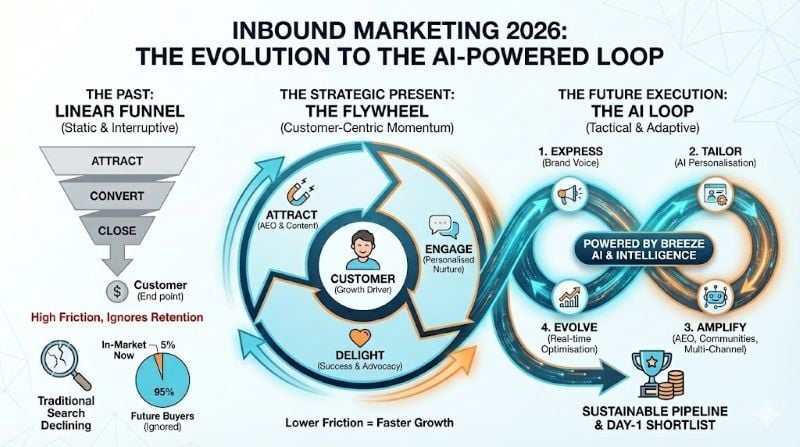
HubSpot's original inbound methodology featured four linear stages: Attract, Convert, Close, and Delight. This framework served businesses well during a period when buyers progressed predictably through awareness to consideration to decision. The funnel model's weakness became apparent as marketers realised it treated customers as an afterthought—the journey ended at purchase, with all energy spent acquiring customers rather than retaining them.
The Flywheel Model (2018-Present)
HubSpot CEO Brian Halligan introduced the Flywheel at INBOUND 2018 to address the funnel's fundamental flaw. The Flywheel places customers at the centre, recognising that their success generates momentum driving future growth through referrals and word-of-mouth. The "Convert" and "Close" stages merged into a single "Engage" phase, creating three interconnected stages: Attract, Engage, and Delight.
The physics of a flywheel matter here: momentum builds as you reduce friction and apply force consistently. Happy customers don't just complete transactions—they become promoters who feed back into the Attract stage, accelerating growth without proportionally increasing marketing spend. Whitehat SEO's HubSpot onboarding services help UK businesses configure this flywheel approach from day one.
Loop Marketing (2025 Addition)
At INBOUND 2025, HubSpot introduced Loop Marketing as a tactical execution layer for the AI era. Loop Marketing doesn't replace the Flywheel—it provides the operational framework for executing flywheel strategies using AI-powered tools. The four Loop stages are:
- Express: Define brand identity, voice, values, and customer personas before AI enters the mix
- Tailor: Use unified customer data and AI for genuinely personal experiences beyond "Hi [First Name]"
- Amplify: Diversify distribution across channels where buyers actually are—including answer engines, creator partnerships, and communities
- Evolve: Optimise continuously with AI-powered insights in days, not quarters
| Aspect | Traditional Funnel | Flywheel | Loop Marketing |
|---|---|---|---|
| Customer Position | End of process | Centre of system | Dynamic, context-aware |
| Momentum Source | Marketing spend | Happy customers | Data-driven, AI-assisted |
| Channels | Owned properties | SEO, email, social | LLMs, creators, communities |
| Planning Cycle | Annual campaigns | Quarterly planning | Live iteration in days |
The Attract Stage Reinvented for 2026
Attracting the right visitors requires a fundamentally different approach in 2026. Traditional SEO remains important—organic search still drives 53.3% of all website traffic according to BrightEdge research—but it's no longer sufficient. UK B2B companies must now optimise for both search engines and AI answer engines to capture visibility across all discovery channels.
The 95-5 Rule: Reaching Future Buyers Today
Research from the LinkedIn B2B Institute and Ehrenberg-Bass Institute reveals that only 5% of B2B buyers are "in-market" at any given time. The other 95% aren't ready to buy—but will be in future. This means traditional funnel thinking, which focuses obsessively on converting the 5% currently shopping, misses the larger strategic opportunity.
The brand most easily remembered becomes the brand that gets bought. If buyers don't know your brand when entering the market, it's already too late—they won't include you on their Day-1 shortlist. Whitehat SEO's approach to content marketing strategy addresses both the 5% in-market and the 95% who'll buy later through educational, brand-building content that creates mental availability.
Answer Engine Optimisation: The New Discovery Channel
Answer Engine Optimisation (AEO) ensures your content appears when prospects ask ChatGPT, Perplexity, or Google AI Overviews about challenges your business solves. Unlike traditional SEO focused on rankings, AEO focuses on being cited and recommended within AI-generated responses.
The statistics are compelling: ChatGPT now has over 400 million weekly active users, AI Overviews appear for 30% of US desktop keywords (up from 10% in March 2025), and over 58% of Google searches result in zero clicks. Princeton University's research on Generative Engine Optimisation found that proper citations and statistics can increase visibility by over 40% in AI responses.
For UK businesses seeking AI visibility, Whitehat SEO's comprehensive AEO guide for B2B marketers provides the technical requirements and content strategies needed to appear in AI-generated answers.
Content That Attracts: What Works in 2026
Effective attract-stage content in 2026 follows specific patterns that both search engines and AI can process effectively:
- Direct answers first: Opening sentences must completely answer the primary question—no burying the lead after contextual preamble
- Question-based structure: Headers that match how people phrase questions to AI assistants
- Standalone sections: Each content section must make sense in isolation, as AI extracts passages independently
- Original data: Proprietary statistics and case study results differentiate your content from generic information
- Brand integration: Reference your solution naturally throughout—otherwise AI learns from your content but recommends competitors
The Engage Stage: Converting Interest into Pipeline
The Engage stage combines what the original funnel separated into Convert and Close. Here, businesses build relationships with visitors, capture their information, and nurture them toward purchase decisions. HubSpot's research shows that companies automating their lead nurturing see a 10% increase in revenue within six to nine months.
Personalisation Beyond "Hi [First Name]"
Modern personalisation uses CRM data to deliver genuinely relevant experiences. With HubSpot's CRM capabilities, businesses can personalise based on company size, industry, buying stage, content consumption patterns, and previous interactions—not just inserting a first name token.
HubSpot Breeze AI, launched at INBOUND 2024, takes personalisation further with AI agents for content, prospecting, customer service, and social media. At INBOUND 2025, HubSpot announced 18 new AI agents in beta, enabling businesses to create context-aware experiences at scale.
Lead Scoring and Intent Data
Effective engagement requires distinguishing between visitors who are browsing and those ready to buy. Lead scoring assigns points based on firmographic data (company size, industry, location) and behavioural signals (email opens, website visits, content downloads). According to HubSpot's 2024 State of Marketing report, companies using lead scoring see 77% higher lead generation ROI than those without.
Intent data platforms like 6sense, Bombora, and Demandbase add another layer, identifying companies actively researching solutions in your category. This intelligence helps sales teams prioritise outreach to organisations showing buying signals, rather than working accounts cold.
Multi-Channel Nurturing
Email remains the highest-performing inbound channel—the DMA UK reports £36 ROI for every £1 spent on email marketing—but effective nurturing extends across multiple touchpoints. Automated email campaigns produce 320% more revenue than non-automated approaches, but prospects also engage through:
- Live chat and chatbots: Immediate assistance when prospects have questions
- Social media: LinkedIn generates the highest visitor-to-lead conversion for B2B at 2.74%
- Video: Product demos and educational content that accelerate understanding
- Webinars: Live events that position your team as subject matter experts
Whitehat SEO's HubSpot workflow automation expertise helps UK businesses orchestrate these touchpoints into coherent nurturing sequences that move prospects through the buying journey.
The Delight Stage: Powering the Flywheel
The Delight stage represents the fundamental shift from funnel thinking to flywheel thinking. Instead of treating customers as transactions completed, delighting customers turns them into promoters who drive referrals, case studies, testimonials, and word-of-mouth that feed back into the Attract stage.
The economics are straightforward: acquiring a new customer costs five times more than retaining an existing one. But delighted customers do more than just repurchase—they reduce acquisition costs for new customers by providing the social proof and recommendations that shortcut buying decisions.
Proactive Customer Success
Delight doesn't happen by accident. It requires systematic approaches to customer success:
- Onboarding programmes: Structured implementation that ensures customers achieve value quickly
- Self-service resources: Knowledge bases, documentation, and chatbots that help customers help themselves
- Proactive outreach: Regular check-ins and business reviews that identify opportunities and prevent churn
- Customer feedback: NPS surveys and voice-of-customer programmes that surface issues early
- Community building: Customer communities and user groups that create peer connections
Whitehat SEO's leadership of the world's largest HubSpot User Group (London HUG) demonstrates this principle in action—building community creates advocates who contribute to the flywheel's momentum.
AI Tools Transforming Inbound Execution
AI has moved from experimental to essential in inbound marketing. According to HubSpot's 2024 research, 67% of marketers already use generative AI in marketing, with another 27% evaluating adoption. The question is no longer whether to use AI, but how to integrate it effectively.
HubSpot Breeze AI Capabilities
HubSpot's Breeze AI ecosystem provides comprehensive AI capabilities within the CRM platform. The three components work together:
- Breeze Copilot: AI companion across all HubSpot applications, providing contextual assistance based on your CRM data
- Breeze Agents: Automated specialists for content creation, prospecting, customer service, social media, data enrichment, and knowledge base management
- Breeze Intelligence: Data enrichment from 200+ million buyer profiles, buyer intent signals, and form shortening to increase conversion rates
For UK businesses implementing these capabilities, Whitehat SEO's AI consulting services ensure proper configuration and governance frameworks that maintain quality whilst capturing efficiency gains.
AI-Assisted Content Creation
Academic research published in ScienceDirect found that consumers perceive AI-generated content as less engaging when AI replacement is disclosed. However, these negative effects are attenuated when AI augments human work rather than substituting for it.
The practical workflow treats AI outputs as first drafts requiring human refinement. A typical 1,500-word blog post that previously required 8-10 hours can now take under 2 hours, delivering productivity gains up to 40%. But quality control frameworks are non-negotiable—AI hallucinations represent documented risks that require human oversight. Whitehat SEO's guidance on AI content limitations helps businesses establish appropriate guardrails.
Getting Started: Your Inbound Implementation Roadmap
Implementing inbound marketing requires strategic planning and consistent execution. Most businesses see meaningful results within three to six months, with the full compounding effect appearing after 12 to 18 months of sustained effort.
Phase 1: Foundation (Weeks 1-4)
- Define buyer personas with detailed documentation of challenges, goals, and research behaviour
- Audit existing content against persona needs and buying journey stages
- Establish marketing technology stack with HubSpot implementation as the central hub
- Configure tracking and attribution to measure impact accurately
Phase 2: Attract (Weeks 5-12)
- Develop content calendar addressing persona questions at each journey stage
- Implement SEO optimisation for search visibility
- Configure technical requirements for AEO (schema markup, AI crawler access, semantic HTML)
- Launch consistent publishing cadence—companies blogging 11+ times monthly generate 3x more traffic
Phase 3: Engage (Weeks 13-24)
- Build conversion paths with calls-to-action, landing pages, and lead capture forms
- Implement lead scoring based on fit and engagement signals
- Create automated nurturing workflows aligned to buying journey stages
- Establish sales-marketing alignment on lead qualification and handoff processes
Phase 4: Delight (Ongoing)
- Develop customer onboarding programmes that ensure early value realisation
- Build self-service resources and knowledge base content
- Implement customer feedback mechanisms and NPS measurement
- Create referral and advocacy programmes that turn customers into promoters
Measuring Inbound Success in 2026
Traditional traffic metrics remain important, but they're no longer sufficient. With 58% of searches ending in zero clicks and AI increasingly mediating discovery, measurement must evolve.
| Metric Category | What to Track | Benchmark |
|---|---|---|
| Visibility | AI citations, brand mentions, organic traffic | 40%+ on priority queries |
| Conversion | Lead-to-customer rate, MQL-to-SQL rate | 10-12% website conversion |
| Efficiency | Cost per lead, CAC payback period | 62% lower than outbound |
| Pipeline | Marketing-sourced pipeline percentage | 20-50% of new business |
| Retention | NPS, customer retention rate, referral volume | NPS 50+ for B2B SaaS |
Whitehat SEO's approach to attribution reporting connects marketing activities to revenue outcomes through HubSpot's closed-loop reporting, providing the visibility needed to demonstrate ROI to leadership and continuously optimise performance.
Frequently Asked Questions
What is the difference between the inbound marketing funnel and the Flywheel?
The traditional funnel treats customers as an output—the journey ends at purchase. The Flywheel places customers at the centre, recognising that their success generates momentum through referrals and word-of-mouth that feeds back into attracting new prospects. This fundamental shift means marketing, sales, and service teams must all focus on customer experience rather than treating handoffs as the end of their responsibility.
How long does inbound marketing take to show results for UK B2B companies?
Most UK B2B companies see initial results within three to six months of consistent execution. HubSpot research shows the average cost per lead drops by 80% after five months of sustained effort. Full ROI typically materialises within 12 to 18 months as content assets compound and organic search rankings strengthen. AI visibility often develops faster, with citation appearances possible within 60-90 days of optimised content publication.
What is Answer Engine Optimisation and why does it matter for inbound marketing?
Answer Engine Optimisation (AEO) ensures your content appears when prospects ask AI assistants like ChatGPT, Perplexity, or Google AI Overviews questions about challenges your business solves. With over 58% of Google searches now ending without clicks and AI-referred visitors converting at 3-15x higher rates than traditional organic traffic, AEO has become essential for the Attract stage of modern inbound marketing.
How does Loop Marketing relate to the Flywheel model?
Loop Marketing doesn't replace the Flywheel—it provides the tactical execution layer for implementing Flywheel principles in the AI era. Introduced at INBOUND 2025, Loop Marketing's four stages (Express, Tailor, Amplify, Evolve) describe how to operationalise Attract, Engage, and Delight using AI-powered tools like HubSpot Breeze. The Flywheel remains the strategic framework; Loop Marketing provides the operational methodology.
What budget do UK B2B companies need for inbound marketing?
Effective inbound marketing budgets vary based on growth objectives and market competitiveness. UK B2B companies typically invest between £3,000 and £15,000 monthly for comprehensive programmes including content creation, SEO, AEO, and marketing automation. The 62% lower cost per lead compared to outbound methods means inbound often delivers superior ROI even with modest initial investments, with returns compounding over time as content assets mature.
Ready to Transform Your Marketing with Inbound?
The inbound methodology continues to evolve, but the core principle remains unchanged: earn attention through value rather than buying it through interruption. For UK B2B companies ready to build sustainable, predictable pipeline growth, the combination of Flywheel strategy, AI-powered execution, and Answer Engine Optimisation offers a proven path forward.
As a HubSpot Diamond Partner running the world's largest HubSpot User Group, Whitehat SEO brings both methodology expertise and hands-on implementation experience to help UK businesses realise the full potential of inbound marketing. Whether you need HubSpot onboarding, SEO services, or AEO strategy, we're here to help.
References and Further Reading
- HubSpot (2025). The Flywheel Model. Available at: https://www.hubspot.com/flywheel
- 6sense (2025). 2025 Buyer Experience Report. Available at: https://6sense.com/science-of-b2b/buyer-experience-report-2025/
- LinkedIn B2B Institute (2024). The 95-5 Rule: Why B2B Marketers Should Invest in Brand. Available at: https://business.linkedin.com/marketing-solutions/b2b-institute
- HubSpot (2025). Loop Marketing vs Inbound Marketing. Available at: https://blog.hubspot.com/marketing/loop-marketing-vs-inbound-marketing
- HubSpot Academy (2025). Growing Your Business With a Flywheel Model. Available at: https://academy.hubspot.com/lessons/flywheel
- HubSpot (2025). Breeze AI. Available at: https://www.hubspot.com/products/artificial-intelligence
- Semrush (2024). Generative Engine Optimization. Available at: https://www.semrush.com/blog/generative-engine-optimization/
- Content Marketing Institute (2025). B2B Content Marketing Trends Research 2025. Available at: https://contentmarketinginstitute.com/research/
About the Author
Clwyd Probert is the CEO of Whitehat SEO, a London-based HubSpot Diamond Partner and inbound marketing agency. He lectures at UCL, leads the world's largest HubSpot User Group, and helps UK B2B companies implement effective inbound marketing strategies. Connect with Clwyd on LinkedIn. view our pricing