
The five content creation mistakes undermining B2B manufacturing and electronics companies' pipelines are: creating generic content that ignores multi-stakeholder buying committees, failing to align with long sales cycles, neglecting SEO and AI search optimisation, producing formats your technical buyers don't consume, and not measuring what matters. Research shows only 20% of manufacturing marketers rate their content strategy as "very effective"—here's how to join them.
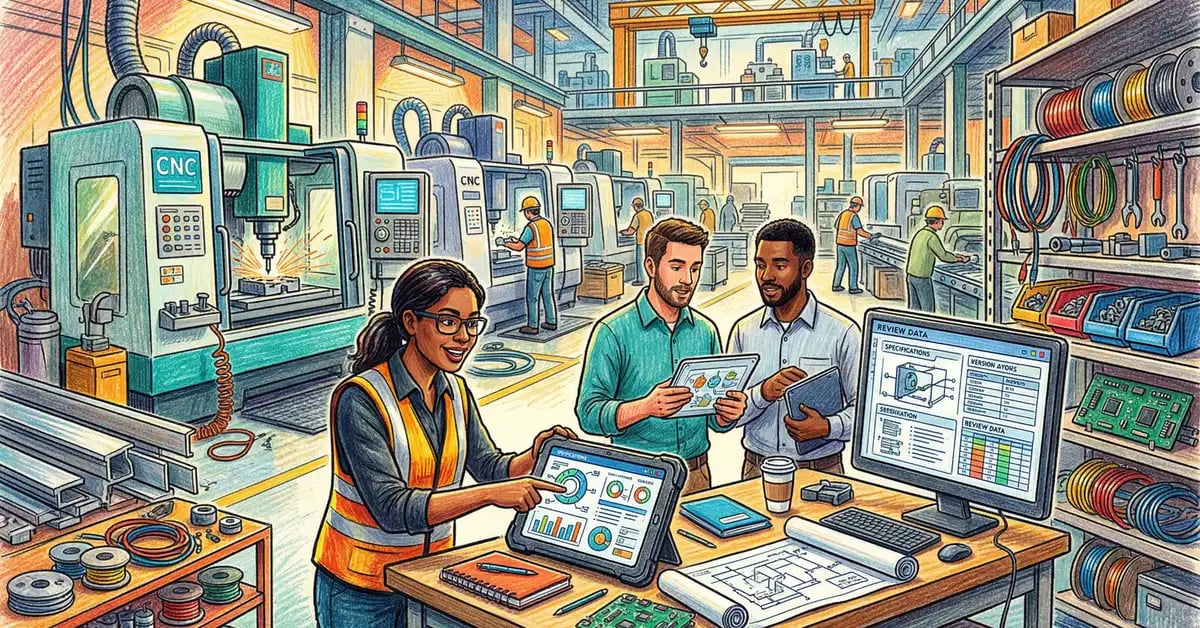
Manufacturing and electronics companies face a unique content marketing challenge. Your buyers aren't impulse purchasers—they're technical experts leading 11-person buying committees through 11.5-month decision journeys. Yet most manufacturing content strategies were designed for simpler, faster sales cycles. The result? Wasted budget, frustrated sales teams, and pipeline that never materialises.
The good news: these mistakes are fixable. Understanding how B2B buyers actually research technical products, combined with proper inbound marketing for manufacturers, transforms content from a cost centre into a pipeline engine.
Let's examine the five critical mistakes—and the evidence-based fixes that work.
Key Takeaways
- • Manufacturing buyers include 11+ stakeholders with different content needs—generic content fails all of them
- • 6–12 month sales cycles require content for the entire journey, not just conversion
- • AI search (ChatGPT, Perplexity, Claude) now influences 67% of the buyer journey—SEO alone isn't enough
- • Video content is 2x more effective than text for manufacturing audiences (74% vs 36%)
- • Multi-touch attribution (not last-click) reveals which content actually drives pipeline
Mistake 1: Generic Content Fails the Buying Committee Test

Here's the reality of manufacturing purchases: the average buying group is 11 people conducting an 11.5-month buying journey, according to 6sense's 2024 Buyer Experience Report. These aren't 11 identical stakeholders—they're engineers, procurement specialists, operations directors, and C-suite executives, each with radically different content needs.
Your technical engineer wants detailed specifications, performance data, and integration requirements. Your procurement manager needs total cost of ownership analyses and supplier qualification criteria. Your CEO wants strategic vision: how this purchase positions the company for the next decade.
Yet most manufacturing companies produce one-size-fits-all "product overview" content that satisfies nobody. The consequence? 89% of manufacturing buyers have fully defined their requirements before ever contacting a seller. They're doing the research without you—and that's where competitors win.
The fix: Map content to stakeholder roles and buying stages. Technical white papers for engineers. ROI calculators for procurement. Strategic vision pieces for executives. With content marketing strategy that attracts ideal manufacturing clients, HubSpot's smart content features let you personalise which content each visitor sees based on their role and engagement history.
Research from Demand Gen Report confirms this approach works: 72% of B2B buyers most engage with content that drills down into specific topical areas rather than broad overviews.
Mistake 2: Your Content Timeline Ignores the 6–12 Month Reality
Manufacturing sales cycles range 6–12 months on average—some extend even longer for complex capital equipment. The average time from database contact to closed customer is 130 days. During this period, B2B buyers engage with 13 pieces of content before making a purchase decision.
Yet many manufacturing companies focus obsessively on bottom-of-funnel conversion content—product brochures, technical specifications, and "request a quote" pages. This creates two problems: you have nothing to nurture early-stage prospects with, and you're invisible during the critical early research phase where buyers form their shortlist.
Here's what makes this worse: manufacturing buyers wait until 65% through the buying journey before connecting with sellers, according to 6sense research. If your content strategy only activates when someone fills out a "contact sales" form, you've missed two-thirds of the influence window.
The fix: Build content for the entire 6–12 month journey. Early-stage content addresses broad challenges ("How to reduce energy consumption in CNC machining"). Mid-stage content helps evaluate approaches ("CNC energy efficiency: Direct drive vs. belt drive comparison"). Late-stage content supports final decisions ("Calculating ROI on CNC equipment upgrades").
HubSpot's workflow automation nurtures prospects across these stages automatically, delivering the right content at the right time based on engagement signals. According to B2B sales strategies that align with content, this approach increases qualified pipeline by matching your content cadence to your buyers' decision timeline.
Mistake 3: You're Invisible to AI Search—and 60% of Your Prospects
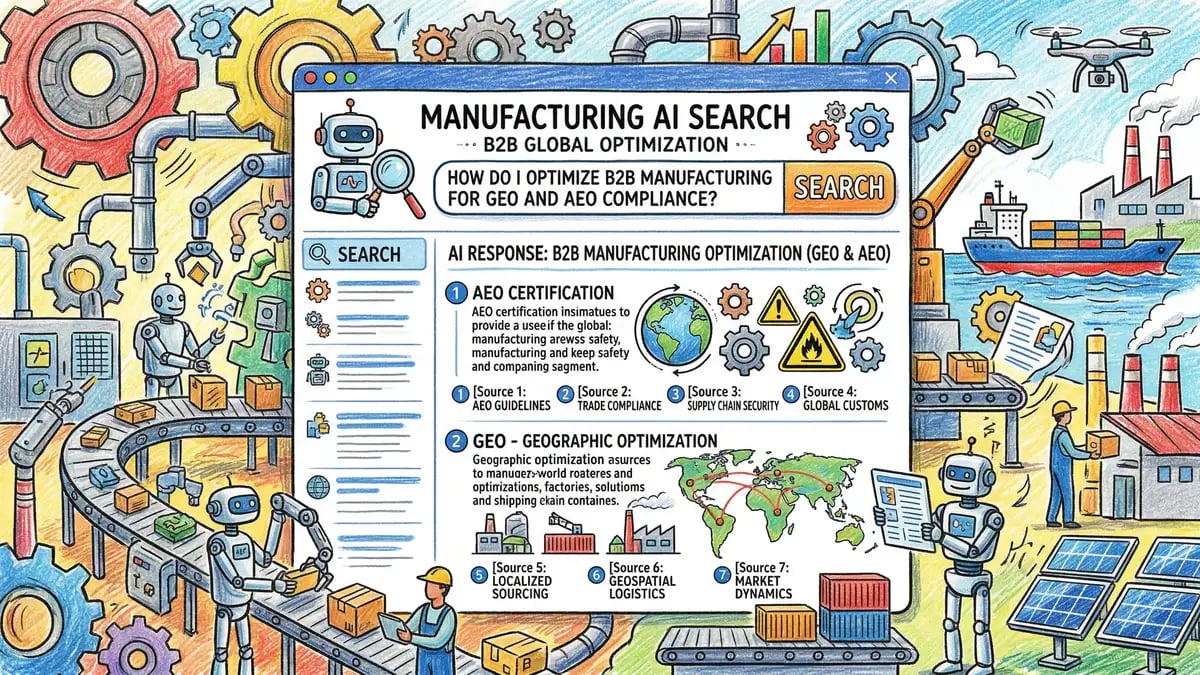
Traditional search engine optimisation isn't dead, but it's no longer sufficient. AI Overviews, ChatGPT, Perplexity, and Claude are fundamentally changing how B2B buyers research suppliers. Instead of clicking through ten blue links, prospects now ask AI engines direct questions and receive synthesised answers from multiple sources.
If your content isn't structured for AI extraction, you're invisible in these conversations. The stakes are significant: 67% of the buyer journey now happens digitally before any human sales contact. Manufacturing buyers are literally asking AI, "What's the best CNC machine for medical device manufacturing?" or "Compare UK industrial automation suppliers"—and your competitors are getting recommended while you're not.
This requires a dual approach. Traditional SEO remains essential—you still need to rank on Google. But you now also need GEO (Generative Engine Optimisation): structuring content so AI can easily extract and cite your expertise. This means clear, direct answers in your opening paragraphs, comprehensive FAQ sections, and proper schema markup that helps AI understand your content's structure.
The fix: Implement Answer Engine Optimisation (AEO) alongside your traditional SEO. Every piece of content needs a direct, quotable answer in the first 40–60 words. Use question-based subheadings. Add detailed FAQ sections. Ensure your robots.txt allows AI crawlers (GPTBot, Google-Extended, Claude-Web, PerplexityBot).
Whitehat combines SEO optimisation for manufacturing websites with cutting-edge GEO techniques, ensuring your expertise appears both in traditional search results and AI-generated recommendations. We've seen this approach increase organic visibility by 40–65% as AI platforms begin dominating search behaviour.
Mistake 4: Wrong Formats Waste Your Technical Expertise
Not all content formats perform equally for manufacturing audiences. Yet many companies default to text-only blog posts because they're familiar and easy to produce. The data tells a different story.
According to the Content Marketing Institute's November 2024 Manufacturing Benchmarks research, video content is rated most effective by 74% of manufacturing marketers, significantly outperforming other formats. Case studies rank second at 45% effectiveness, followed by technical white papers at 43%. Short articles—the default format for many manufacturers—rank fourth at just 36% effectiveness.
The gap is even more pronounced for specific video types: 53% of manufacturing marketers report that how-to videos and product explainers produced their best results. This makes intuitive sense—complex technical products are easier to understand visually than through text descriptions alone. A 3-minute video showing a CNC machine's tool-changing mechanism communicates more effectively than 2,000 words of description.
Yet only 62% of manufacturing marketers plan to increase video investment in 2025, despite video's clear performance advantage. This represents a competitive opportunity: while your competitors continue publishing text-only content, strategic video investment creates immediate differentiation.
The fix: Diversify content formats based on what actually works, not what's easiest to produce. Invest in product demonstration videos, customer success video case studies, and technical explainer content. Complement with detailed written resources for those who prefer to read. Webinars work particularly well for complex B2B sales, combining visual demonstration with live Q&A.
For manufacturers looking to scale content production across formats, our guide to creating quality content for manufacturing explores how to build a sustainable, multi-format content engine that matches how your technical buyers actually prefer to consume information.
Mistake 5: Measurement Gaps Hide What's Actually Working
Perhaps the most damaging mistake: 64% of manufacturing marketers have difficulty attributing ROI to content efforts, according to CMI's 2024 research. Without measurement, you can't optimise. You don't know which content is influencing pipeline, which formats resonate with different stakeholders, or whether your investment is paying off.
This measurement gap explains why only 20% of manufacturing marketers rate their content strategy as "very effective." The remaining 80% are flying blind, making content decisions based on intuition rather than data. The consequence: budgets get cut when results can't be proven, and effective tactics get abandoned while ineffective ones continue.
Long B2B sales cycles compound the measurement challenge. With 6–12 month decision timelines, simple "last-touch" attribution—crediting the final content piece before conversion—systematically undervalues all the early- and mid-stage content that built awareness and consideration. A technical white paper downloaded in month two might be the reason someone becomes a customer in month nine, but last-touch attribution gives it zero credit.
The fix: Implement proper multi-touch attribution that tracks content influence across the entire buyer journey. Key metrics for manufacturing include MQL-to-SQL conversion rates (UK average: 16%), content engagement by stakeholder role, pipeline influence value, and sales cycle velocity.
HubSpot's attribution reporting shows exactly which content pieces influence deals at each stage, enabling you to double down on what works. For manufacturing companies, this typically reveals that technical content drives initial engagement, case studies move prospects from consideration to evaluation, and ROI calculators accelerate final decisions.
According to HubSpot research, businesses using proper marketing automation and attribution report 505% ROI over three years and launch campaigns 68% faster. The measurement infrastructure pays for itself quickly—and ensures your content strategy improves continuously rather than staying stuck in the "moderately effective" majority.
How UK Manufacturers Are Fixing These Mistakes
The UK manufacturing sector is responding to these challenges with renewed content marketing investment. 70% of UK manufacturers ramped up content marketing efforts in 2024, according to BuddyCRM's mid-year manufacturing trends report. This acceleration makes sense: the UK B2B e-commerce market reached £203.9 billion in 2024 and is projected to grow at a 17.29% compound annual growth rate through 2033.
Forward-thinking manufacturers are integrating three critical elements: SEO-optimised content that ranks in both traditional and AI search, HubSpot marketing automation that nurtures across long sales cycles, and proper attribution that proves ROI to finance teams. This integrated approach addresses all five mistakes simultaneously rather than treating them as separate problems.
A practical example: a Midlands-based precision engineering company implemented stakeholder-specific content mapped to their 8-month average sales cycle, combined video product demonstrations with technical white papers, optimised everything for AI search visibility, and used HubSpot's multi-touch attribution to track influence. Within six months, they increased qualified pipeline by 47% while their cost per MQL decreased by 28%.
The pattern repeats across manufacturing sectors. Companies that fix these five mistakes systematically—rather than addressing content quality or SEO in isolation—see compounding improvements as each element reinforces the others.
Frequently Asked Questions
What type of content works best for manufacturing companies?
Video content is rated most effective by 74% of manufacturing marketers, followed by case studies (45%), technical white papers (43%), and short articles (36%). How-to videos and product explainers specifically produce the best results, with 53% of manufacturers reporting strong performance from this format.
How do we create content for multiple stakeholders in the buying committee?
Map content to specific roles: technical specifications and performance data for engineers, ROI calculators and TCO analysis for procurement, strategic vision and competitive positioning for executives. HubSpot's smart content features personalise which content each visitor sees based on their role and engagement, ensuring engineers see technical depth while executives get strategic context.
How often should manufacturing companies publish content?
Consistency matters more than volume for long B2B sales cycles. Aim for 2–4 high-quality pieces monthly addressing specific buyer journey stages. With 6–12 month sales cycles and buyers consuming 13 pieces of content before deciding, build a library that nurtures across the full journey rather than chasing daily publishing schedules.
How do we measure content marketing ROI for long sales cycles?
Track pipeline influence, not just first-touch attribution. Key metrics include content engagement by deal stage, MQL-to-SQL conversion (UK manufacturing average: 16%), influenced pipeline value, and sales cycle velocity changes. HubSpot's multi-touch attribution shows which content influences deals across the entire 6–12 month journey, crediting early-stage awareness content alongside late-stage conversion pieces.
Should manufacturing companies use AI for content creation?
76% of manufacturing marketers already use AI tools, but only 7% have integrated them into daily workflows. AI excels at research assistance, first drafts, and content optimisation, but technical expertise and industry knowledge must come from human subject matter experts. The winning approach combines AI efficiency with deep manufacturing expertise and proper quality control.
How long does content marketing take to show results in manufacturing?
Expect 6–12 months for meaningful pipeline impact, mirroring your sales cycle length. Early indicators—increased organic traffic, higher content engagement, improved rankings—appear within 3–6 months. Compound results accelerate after 12+ months of consistent effort as your content library grows and SEO authority builds. Quick wins like optimising high-performing pages can show results faster.
About the Author
Whitehat SEO specialises in inbound marketing and content strategy for UK B2B manufacturers and electronics companies. As a HubSpot Diamond Partner, we help industrial companies transform content from a cost centre into their primary pipeline driver — connecting marketing spend to revenue with closed-loop attribution.
Turn Content Investment into Pipeline Growth
These five mistakes keep manufacturing companies trapped in the "moderately effective" majority. The path to the high-performing 20% is clear: create stakeholder-specific content, map to your actual sales cycle, optimise for both traditional and AI search, use formats your buyers actually consume, and measure what matters.
This isn't theoretical—it's how UK manufacturers are winning in increasingly digital markets. The integration of content strategy, SEO, and HubSpot automation creates a compounding advantage: each piece of content works harder as your library grows, your SEO authority builds, and your nurturing sequences become more sophisticated.
Whitehat combines HubSpot Diamond Partner expertise with deep manufacturing sector knowledge and cutting-edge SEO/GEO capabilities. We've helped electronics manufacturers, precision engineering firms, and industrial automation companies transform content from a cost centre into their primary pipeline driver. Our approach is simple: diagnose which of these five mistakes are holding you back, fix them systematically, and measure the results with attribution you can defend to your finance team.