
B2B Marketing Strategy
This guide compiles the latest evidence, statistics, and frameworks to inform modern B2B marketing planning—drawing from Gartner, the IPA, LinkedIn B2B Institute, Ehrenberg-Bass Institute, and other authoritative sources. At Whitehat, we've helped B2B companies build marketing strategies grounded in this evidence since 2011. What follows reveals a discipline in transition: AI is transforming execution whilst evidence-based principles are reshaping strategy, budget allocation remains constrained, and the tension between brand building and performance marketing continues to define marketing leadership decisions.
B2B Marketing Planning for 2026: Evidence-Based Frameworks That Drive Growth
Why 95% of your potential buyers matter more than the 5% showing intent signals—and how to plan accordingly.
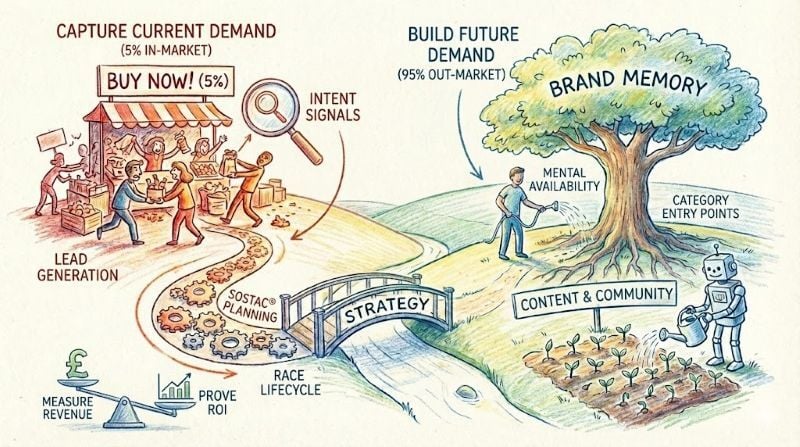
Only 5% of your potential B2B buyers are ready to purchase right now—yet most marketing plans focus almost exclusively on capturing this tiny sliver. This fundamental mismatch between marketing activity and buyer reality explains why the Ehrenberg-Bass Institute's 95-5 rule has become the most influential concept reshaping B2B marketing strategy in 2026. The implications are significant: brands that invest in reaching the 95% who aren't buying today will dominate tomorrow's sales conversations, whilst those chasing only in-market leads face a shrinking share of an increasingly competitive demand capture market.
Marketing Budgets Have Stabilised at 7.7% of Revenue
The Gartner 2025 CMO Spend Survey, polling 402 CMOs across North America and Europe, found marketing budgets holding at 7.7% of company revenue—unchanged from 2024 and significantly below the pre-pandemic peak of 11% in 2020. This stabilisation masks real pressure: 59% of CMOs report insufficient budget to execute their strategies, and 39% are planning agency budget reductions.
Budget allocation varies considerably by business model. The CMO Survey (Duke/Deloitte) reports B2B product companies spend just 6.4% of revenue on marketing, whilst B2B services companies allocate 9.0%. The 6sense Science of B2B 2025 report found the modal B2B marketing allocation at 10% of revenue, with 52.3% of organisations having increased budgets for 2025.
| Channel | % of Budget | YoY Change |
|---|---|---|
| Paid Media (total) | 31% | ↑ 11% |
| Martech | 22% | Lowest in decade |
| Search (within digital) | 13.6% | — |
| Social Advertising | 12.2% | — |
| Digital Display | 10.7% | — |
Source: Gartner 2025 CMO Spend Survey
Channel allocation has shifted decisively toward paid media and digital. Digital channels now represent 61.1% of total spend—the highest since Gartner began tracking in 2013.
UK-specific trends from the IPA Bellwether Report show more volatility. After reaching a decade-high net balance of +15.9% in Q2 2024, UK marketing budgets turned negative in Q1 2025 with a net balance of -4.8%—the first overall decline in four years.
The 95-5 Rule Demands a Fundamental Rethink of B2B Priorities
Professor John Dawes of the Ehrenberg-Bass Institute, working with the LinkedIn B2B Institute, established that at any given time only 5% of B2B buyers are "in-market" actively seeking to purchase. The remaining 95% are "out-of-market"—not currently buying but potentially valuable future customers. The evidence is striking: 75% of companies buy computers once every four years, and 80% change banking services once every five years.
"Advertising mostly hits B2B buyers who aren't going to buy anytime soon... it mainly works by building and refreshing memory links to the brand. These memory links activate when buyers do come into the market."
— Professor John Dawes, Ehrenberg-Bass Institute
This creates a critical strategic insight: the brand that is most easily remembered when buyers enter the market is the brand that gets bought. The implications for marketing planning are significant:
- Lead generation captures demand but doesn't create it—memory generation creates demand
- Investment should skew toward the 95%, not just the 5% showing intent signals
- Advertising works differently than assumed: ads don't move buyers in-market—buyers move themselves based on their needs
- The traditional funnel should be reconceptualised as "in-market/out-market," mapping to how CFOs think about current and future cash flows
This research directly challenges the prevailing performance marketing orthodoxy. Forrester's 2024 Buyers' Journey Survey found that 92% of B2B buyers start with at least one vendor in mind, and 41% have a single preferred vendor before formal evaluation begins. Vendors must earn buyer preference before intent signals appear—traditional demand generation tactics are effectively too late.
Binet and Field's Brand-Performance Split Requires B2B Adaptation
Les Binet and Peter Field's seminal IPA research established the optimal budget split at 60% brand building and 40% sales activation based on analysis of 996 case studies across 700 brands. However, their subsequent B2B-specific research with the LinkedIn B2B Institute found a different ratio: 46% for brand building and 54% for activation. As Binet notes, "B2B is a bit more rational, a bit more activation-heavy."
Current market behaviour diverges substantially from these recommendations. WARC research shows 68.8% of budgets now flow to short-term performance tactics (up from 59.9% in 2023), whilst only 31.2% goes to brand building. This represents a near-inversion of the evidence-based recommendation.
£3.5T
Cumulative brand value missed due to short-term focus (Interbrand)
38%
Tech marketers who cut brand investment saw performance decline (Gartner)
IPA effectiveness research continues to validate long-term investment. The 2024 IPA Effectiveness Awards Grand Prix winner, McCain, demonstrated a nine-year brand-building campaign that reduced price elasticity by 47%, increased base sales by 44%, and delivered profit ROI of £1.50 per £1 invested. The research confirms that long-term effects are, on average, over double the short-term effect.
Mental Availability Determines Which Brands Get Bought
Byron Sharp's concept of mental availability—the propensity for a brand to be thought of in buying situations—has become central to B2B marketing strategy. Developed further by Jenni Romaniuk, the framework emphasises that the same cognitive limitations affecting consumer decisions apply equally in B2B contexts.
Building mental availability requires identifying Category Entry Points (CEPs)—the specific moments, situations, or triggers when buyers think of a product category. The framework for identifying CEPs follows seven dimensions: Why (motivations), When (timing), Where (location), Whilst (activities), With whom (social contexts), With what (product relationships), and How feeling (emotional states).
Key metrics for measuring mental availability include:
- Mental Market Share: your brand's percentage of CEP associations versus the total for the category
- Mental Penetration: percentage of category buyers linking your brand to at least one CEP
- Network Size: how many CEPs your brand is linked to
- Brand Distinctiveness: fame plus uniqueness of brand assets
For B2B marketers, this means focusing less on product features and more on understanding what buyers are thinking when they approach potential suppliers. The goal is ensuring your brand comes to mind in those decisive moments—a fundamentally different objective than optimising for immediate conversion.
AI Has Transformed Marketing Execution But Not Replaced Strategic Thinking
AI adoption in marketing has reached critical mass. 88% of marketers now use AI in their day-to-day roles, with 76% of marketing teams using AI in core operations—a 162% increase from 29% in 2021. Gartner predicts 60% of marketing departments will integrate at least one AI technology by the end of 2026.
The productivity gains are substantial: teams report 44% higher productivity, 11 hours per week saved on average, and 22% higher ROI for companies using AI in marketing. McKinsey research indicates AI delivers 10-20% improvement in sales ROI on average.
However, the strategic balance matters. BCG's 2025 research argues that "as AI takes on more linear elements of the marketing equation, human talent can shift upstream to higher-value work such as strategy, partnerships, business planning, and true creativity." Half of consumers can now spot AI-generated content, and 52% are less engaged when they suspect AI authorship without human input.
The Content Marketing Institute's B2B research reveals the nuance: whilst 81% of B2B marketing teams use generative AI tools, only 19% have AI integrated into daily processes. Only 17% rate AI-generated content as excellent or very good, and just 4% have high levels of trust in AI outputs. The emerging best practice uses AI for research, drafting, and optimisation whilst reserving strategy, editing, and brand voice for human judgment.
Agentic AI represents the next evolution. By 2028, some predict one in five marketing roles will be held by an AI worker. Currently, 23% of organisations are scaling agentic AI systems whilst 39% are experimenting. These systems can autonomously plan, execute, and optimise marketing strategies with minimal human intervention. At Whitehat, our AI consultancy helps businesses navigate this shift strategically.
SOSTAC and RACE Frameworks Provide Complementary Planning Structures
Two frameworks dominate professional marketing planning. SOSTAC (Situation, Objectives, Strategy, Tactics, Action, Control), created by PR Smith in the 1990s and recently updated with a 2025 AI Edition, was voted the third most popular model in a Chartered Institute of Marketing poll. It provides strategic planning structure with recommended time allocation: Situation Analysis (15-20%), Objectives (10%), Strategy (25-30%), Tactics (20%), Action (10%), and Control (10%).
RACE (Reach, Act, Convert, Engage), created by Dr Dave Chaffey of Smart Insights in 2010, offers a customer-lifecycle focus for digital marketing implementation. The framework emphasises practical, action-oriented planning across four stages: building awareness and driving traffic (Reach), encouraging website interactions (Act), achieving conversion (Convert), and building customer relationships (Engage).
Smart Insights recommends using both frameworks together—SOSTAC for strategic planning process and RACE for customer lifecycle focus and tactical activities. Both emphasise data-driven decision-making and continuous optimisation, making them complementary rather than competing approaches.
| Factor | SMART Goals | OKRs |
|---|---|---|
| Focus | Single metric | 3-5 key results per objective |
| Cadence | Typically annual | Quarterly (more agile) |
| Ambition | 100% achievable targets | 60-80% stretch targets |
| Transparency | Private (manager-employee) | Organisation-wide visibility |
| Flexibility | Less adaptable | Highly adaptable |
The emerging best practice combines both approaches: use OKRs for strategic objectives whilst applying SMART criteria to individual Key Results. Microsoft research shows employees who understand their goals are 4x more likely to stay two or more years.
Attribution Faces a Measurement Crisis as Privacy Changes Reshape Tracking
Traditional multi-touch attribution is becoming unreliable as third-party cookies face uncertainty and privacy regulations tighten. In response, Marketing Mix Modelling (MMM) is experiencing a resurgence: 56% of US ad buyers will focus more on MMM in 2025 according to IAB research. The global marketing mix optimisation market is projected to grow from $5.4 billion in 2025 to $14.8 billion by 2035.
MMM appeals because it uses aggregated data without user-level tracking, measures both online and offline channels, and isn't dependent on ad platform self-reporting. Meta's Robyn and Google's Meridian are democratising access through open-source tools.
Self-reported attribution offers complementary insight. Refine Labs analysis found self-reported attribution captures 85% of conversions from Dark Social—private conversations, peer recommendations, podcasts, and community discussions that software-based attribution misses entirely. Software attribution shows 79% of conversions from web search, but customers self-report search driving just 3% of their decisions.
The recommendation: add "How did you hear about us?" as an open text field on lead forms and compare self-reported versus software attribution regularly. For more on building marketing attribution that actually works, see our comprehensive guide.
Account-Based Marketing Has Matured with 71% Adoption and AI Integration
ABM has moved from experimental to mainstream. The Demand Gen Report 2025 ABM Benchmark Survey found 71% of practitioners now utilise an ABM strategy, with 40% integrating ABM directly with demand generation. The ROI evidence is compelling: 99.3% report ABM efforts as successful, with an average ROI of 137% and 208% increase in marketing-generated revenue for companies using ABM.
Companies now dedicate 27-29% of marketing budgets to ABM strategies. The global ABM market reached $1.41 billion in 2024 and is projected to reach $3.8 billion by 2030 at a 17.9% CAGR.
AI integration is becoming standard: 78.7% of organisations use AI in ABM programmes, with 84% leveraging AI and intent data for personalisation. The platform landscape is led by Demandbase (40.5% usage share), followed by 6sense (29.8%) and ZoomInfo (29.8%).
The tiered approach has become best practice: Strategic 1:1 ABM for 5-10 accounts targeting seven-figure deals with hyper-personalisation; ABM Lite (1:Few) for 20-100 accounts with segment-specific content; and Programmatic (1:Many) for hundreds or thousands of accounts using account-level targeting at scale. Most teams begin with one-to-many plays to gauge interest, then concentrate resources on the most engaged accounts.
Content Marketing Delivers ROI But Faces the Zero-Click Challenge
Content marketing generates $7.65 per $1 spent on average, with 87% of B2B marketers reporting it helped create brand awareness in the past 12 months. Companies using blogs generate 55% more website traffic and 67% more leads. Yet only 22% of B2B marketers characterise their content marketing as extremely or very successful, and just 43% have a documented content marketing strategy.
Video content has overtaken case studies as the most effective format, with 58% of B2B marketers rating it highest. Short-form social videos deliver the highest ROI according to LinkedIn research. Case studies (53%), e-books/white papers (45%), and research reports (45%) round out the top performers.
The zero-click challenge is reshaping distribution strategy. 65% of Google searches now end without a click (rising to 75% on mobile), and when AI Overviews appear, click-through rates drop by approximately 40%. Gartner predicts 25% of organic traffic will shift to AI chatbots by 2026.
Answer Engine Optimisation (AEO): The Response to Zero-Click Search
AEO structures content so AI-powered answer engines can extract, cite, and attribute your brand as a trusted source. Best practices include:
- Clear headings and bullet points for AI extraction
- Direct answers to user queries (40-60 words for featured snippets)
- FAQ schema markup for structured data
- Building E-E-A-T signals (Experience, Expertise, Authoritativeness, Trustworthiness)
Topic clusters continue to prove their value: content grouped into clusters drives 30% more organic traffic and holds rankings 2.5x longer than standalone pieces. Sites using topic clusters saw 38% increases in organic traffic over six months and 45% improvement in long-tail keyword rankings.
For distribution, 85% of B2B marketers say LinkedIn delivers best value, with 94% using it as a content distribution channel. LinkedIn produces leads for 62% of B2B marketers with a 2x higher conversion rate and 28% lower cost per lead compared to Google Ads.
Your 2026 B2B Marketing Action Plan
The evidence points toward several strategic priorities for B2B marketing leaders developing annual plans:
1. Rebalance Investment Toward Brand Building
Current budget allocation (roughly 70:30 performance-to-brand) contradicts the evidence base. The B2B-specific research suggests 46:54 brand-to-activation as optimal. At minimum, increase brand investment to capture the 95% of future buyers currently being ignored.
2. Structure Content for AI Extraction
As zero-click searches grow and AI Overviews appear in more queries, optimise for citation and visibility rather than clicks alone. Implement schema markup, write clear answers to common questions, and build topical authority through comprehensive coverage.
3. Integrate ABM with Brand Building
Use programmatic ABM at scale to build awareness and identify engaged accounts, then concentrate resources through one-to-few and one-to-one approaches. Ensure ABM platforms work alongside brand investment rather than replacing it.
4. Measure What Matters for Revenue
Move beyond MQL volume to pipeline velocity, marketing-sourced revenue, and LTV:CAC ratios. Implement self-reported attribution alongside software tracking to capture Dark Social influence. Consider MMM for strategic allocation decisions.
5. Use AI for Execution, Humans for Strategy
Deploy AI tools for content optimisation, personalisation at scale, and workflow automation—but retain human judgment for brand voice, creative strategy, and relationship building. Organisations finding success have clear guidelines for AI use and integration into daily workflows.
6. Apply Proven Frameworks
Use SOSTAC for strategic planning structure and RACE for customer lifecycle optimisation. Set objectives using OKRs for agility and cross-team alignment, with SMART criteria applied to individual Key Results.
The fundamental insight from this research is that B2B marketing effectiveness depends less on tactical execution brilliance and more on strategic clarity about who you're trying to reach and when they'll actually buy. The 95% matter more than the 5%—and marketing plans should reflect that reality.
Frequently Asked Questions
What is the 95-5 rule in B2B marketing?
The 95-5 rule, established by the Ehrenberg-Bass Institute, states that only 5% of B2B buyers are actively in-market at any given time. The remaining 95% are future buyers not currently ready to purchase. Effective B2B marketing must reach both groups—capturing today's demand whilst building memory structures with tomorrow's buyers.
What's the optimal brand-to-activation budget split for B2B?
Research by Binet and Field with the LinkedIn B2B Institute suggests 46% brand building and 54% activation as optimal for B2B companies. This differs from the 60:40 split recommended for B2C because B2B buying involves more rational evaluation. Current practice (approximately 70:30 toward performance) contradicts this evidence.
How much should a B2B company spend on marketing?
The Gartner 2025 benchmark shows marketing budgets averaging 7.7% of revenue. B2B services companies typically allocate 9.0%, whilst B2B product companies spend around 6.4%. The 6sense report found the most common allocation at 10% of revenue, with over half of organisations increasing budgets for 2025.
What is Answer Engine Optimisation (AEO)?
AEO structures content so AI-powered answer engines like ChatGPT, Google AI Overviews, and Perplexity can extract, cite, and attribute your brand as a trusted source. With 65% of searches now ending without a click, AEO ensures visibility in AI-generated responses through clear headings, direct answers, FAQ schema markup, and E-E-A-T signals.
How can Whitehat help with B2B marketing planning?
As a HubSpot Diamond Partner since 2016, Whitehat helps B2B companies build marketing strategies grounded in evidence. We combine SEO services, HubSpot implementation, and attribution reporting that connects marketing activity directly to revenue—so you can prove ROI to your board with confidence.
References & Sources
- Gartner CMO Spend and Strategy Survey 2025
- LinkedIn B2B Institute: The 95-5 Rule
- IPA: The Long and Short of It – Binet & Field Research
- Ehrenberg-Bass Institute: Mental Availability Research
- Content Marketing Institute: B2B Content Marketing Report 2025
- Demand Gen Report: 2025 ABM Benchmark Survey
- IPA Bellwether Report Q1 2025
- Smart Insights: RACE Framework
- The CMO Survey (Duke/Deloitte)
- 6sense: The Science of B2B 2025
Ready to Build an Evidence-Based Marketing Strategy?
As a HubSpot Diamond Partner, Whitehat helps B2B companies connect marketing activity to revenue—not vanity metrics. Let's discuss how we can help you reach the 95%.
Book Your Free Consultation