
What is a B2B marketing plan?
A B2B marketing plan serves as your roadmap for attracting, engaging, and converting business customers over a defined period. Unlike B2C marketing plans that often target individual consumers with shorter decision cycles, B2B plans must account for multiple stakeholders, longer sales cycles, and higher-value transactions. According to Gartner research, the average B2B buying team now includes 11-12 stakeholders—up from 5.4 in 2020—and the typical sales cycle extends 11-12 months.
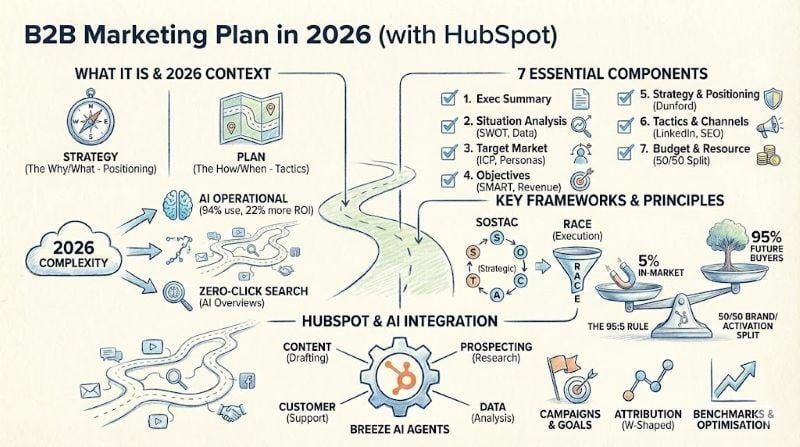
Marketing plan vs marketing strategy: the essential difference
Your marketing strategy defines the "what" and "why"—your positioning, target audience, and competitive differentiation. Your marketing plan addresses the "how" and "when"—the specific tactics, timeline, budget allocation, and measurement approach that will bring your strategy to life.
Think of strategy as choosing which mountain to climb. The marketing plan is your detailed route to the summit, complete with equipment lists, rest points, and contingency options.
Why 2026 demands an updated approach to marketing planning
The B2B marketing landscape has shifted fundamentally since 2023. Three changes demand a fresh approach to planning:
AI has moved from experimental to operational. Some 88-94% of marketers now use AI tools, with 71% using them weekly or more. AI-driven campaigns deliver 22% higher ROI, 32% more conversions, and 29% lower acquisition costs. Your 2026 plan must integrate AI throughout—not as an add-on, but as a core planning and execution tool.
The buyer journey has exploded in complexity. Average B2B touchpoints before purchase have grown from 17 in 2020 to 60-100+ in 2025, with enterprise deals requiring 417 touchpoints and 5,500 impressions. Buyers now complete 70-80% of their research before engaging sales.
Zero-click search is reshaping content strategy. With 65%+ of searches ending without clicks and AI Overviews appearing in 13% of Google searches, content must be optimised not just for rankings but for AI citation and answer engine visibility.
The 7 essential components of a B2B marketing plan
Every effective B2B marketing plan includes seven core components. Skip any of these, and you'll create gaps that undermine execution.
1. Executive summary
A concise overview (typically one page) summarising your marketing objectives, key strategies, budget, and expected outcomes. Write this last—once you've completed the detailed planning—but position it first for stakeholder review.
2. Situation analysis (SWOT and market research)
Document your current position: market conditions, competitive landscape, internal capabilities, and historical performance. Use SWOT analysis and include quantitative data from your CRM and analytics platforms. For HubSpot users, pull attribution reports showing which channels currently drive pipeline.
3. Target market and buyer personas
Define your ideal customer profile (ICP) and develop detailed buyer personas. Include firmographic data (company size, industry, technology stack) and psychographic factors (goals, challenges, decision-making process). Remember that B2B purchases involve multiple stakeholders—map the entire buying committee.
4. Marketing objectives and KPIs
Set SMART objectives tied to business outcomes. Avoid vanity metrics. Good objectives include pipeline contribution targets, cost per acquisition thresholds, and market share goals. Include leading indicators (MQLs, engagement rates) and lagging indicators (revenue, customer acquisition cost).
5. Marketing strategy and positioning
Define how you'll differentiate in the market. Use April Dunford's positioning framework: identify competitive alternatives, unique attributes, value themes, target customer characteristics, and market category. Your positioning should answer: "Why should our ideal customer choose us over the alternatives?"
6. Marketing tactics and channels
Specify the channels, campaigns, and content types you'll deploy. For B2B, LinkedIn remains dominant (86-97% of B2B marketers use it), alongside email marketing (delivering £36-45 ROI per £1 spent), SEO (generating 44.6% of B2B revenue), and content marketing. Include an integrated approach that addresses all stages of the buyer journey.
7. Budget and resource allocation
Allocate resources across channels, campaigns, and timeframes. The 2025 Gartner CMO Spend Survey shows average B2B marketing budgets at 7.7% of company revenue. Within that, plan for a 50/50 split between brand building and sales activation—the optimal ratio for B2B according to LinkedIn B2B Institute research.
How to create a B2B marketing plan: step-by-step guide
Follow these nine steps to develop a marketing plan that connects strategy to execution. Allow 4-6 weeks for thorough planning before your fiscal year begins.
Audit your current performance
Review the past 12-24 months of marketing data. Identify which channels drive qualified pipeline, your actual cost per acquisition, and content that converts. Pull this data from your CRM and analytics platforms before starting any new planning.
Validate your positioning
Before tactical planning, confirm your market positioning remains relevant. Review competitive movements, customer feedback, and market shifts. Use April Dunford's five-component framework to stress-test your positioning.
Set revenue-connected objectives
Work backwards from business goals. If the company needs £5M in new revenue and your average deal size is £50K, you need 100 new customers. Calculate the leads required based on historical conversion rates, then set marketing objectives accordingly.
Map the buyer journey
Document how your ideal customers move from problem awareness to purchase decision. Identify the 60-100+ touchpoints involved, the content they consume at each stage, and the stakeholders involved. This map drives your content and channel strategy.
Allocate budget using the 50/50 principle
Divide your budget between brand building (reaching future buyers) and sales activation (converting in-market buyers). The LinkedIn B2B Institute recommends a 50/50 split for B2B—though technology companies typically under-invest in brand at 33/67.
Select channels based on evidence
Choose channels where your audience actually spends time and where you have historical data showing ROI. For most B2B companies, this means LinkedIn, email, organic search, and selective paid search. Avoid spreading budget too thin—depth beats breadth.
Build your content calendar
Plan content by funnel stage, persona, and keyword cluster. Use topic clusters with pillar pages to build topical authority. Allocate content across awareness (educational), consideration (comparative), and decision (proof) stages.
Define your measurement framework
Establish KPIs for each objective, set up attribution reporting, and schedule regular review cadences. Only 52% of CMOs successfully prove marketing ROI—be in that minority by connecting marketing activities to revenue outcomes.
Document and socialise
Create a clear, shareable document that stakeholders can reference. Include an executive summary for leadership and detailed appendices for execution teams. Schedule quarterly reviews to assess progress and adjust tactics.
Marketing planning frameworks for B2B
Frameworks provide structure without constraining creativity. These six frameworks, used in combination, address strategic planning, digital execution, budget allocation, and brand building.
SOSTAC: the strategic planning foundation
SOSTAC—Situation, Objectives, Strategy, Tactics, Action, Control—was voted one of the top three marketing models worldwide by CIM's Centenary Poll. The framework's creator, PR Smith, released an AI Edition in 2025 that integrates artificial intelligence throughout all planning stages.
For B2B marketers, SOSTAC provides a logical sequence that prevents "tactification"—the common mistake of jumping straight to channel selection before completing strategic groundwork. Start with situation analysis, then progress through each stage sequentially.
RACE: digital execution framework
Smart Insights' RACE framework—Reach, Act, Convert, Engage—provides 25 essential activities for digital marketing mastery. Use SOSTAC for strategic planning and RACE for operational digital execution. The two frameworks complement each other: SOSTAC determines what you're trying to achieve; RACE guides how you execute digitally.
The 95:5 rule: why most B2B buyers aren't ready to buy
Professor John Dawes at the Ehrenberg-Bass Institute demonstrated that only 5% of B2B buyers are in-market at any given time. The other 95% won't purchase for months or years. This insight reshapes resource allocation: marketing's primary job is building mental availability with future buyers, not just capturing the small in-market segment.
Practically, this means investing in brand-building content that creates memory structures—so when buyers eventually enter the market, your brand comes to mind first.
Brand vs performance: the B2B 50/50 split
Binet and Field's famous 60/40 rule (60% brand, 40% activation) applies primarily to B2C. For B2B, LinkedIn B2B Institute research recommends a 50/50 split, reflecting the importance of both brand building and sales activation in longer B2B cycles.
Currently, technology sector companies invest only 33% in brand building versus 67% in activation—significantly below optimal. If your plan skews heavily toward performance marketing, you're likely underinvesting in future demand.
Recommended framework integration sequence
- Start with positioning (Dunford) to establish market foundation
- Use SOSTAC for overall strategic structure
- Apply RACE for digital channel execution
- Budget with Binet & Field 50/50 principle for B2B
- Build brand with Ehrenberg-Bass mental availability principles
- Execute with agile methodology for iteration
- Augment with AI throughout for efficiency
AI and your 2026 marketing plan
AI is no longer optional for B2B marketing planning. With 88-94% of marketers using AI tools and AI-driven campaigns delivering 22% higher ROI, the question isn't whether to integrate AI but how to do so effectively.
How AI is transforming B2B marketing planning
AI impacts every planning stage. During situation analysis, AI tools analyse competitive content, identify market trends, and synthesise customer feedback at scale. For objective setting, predictive analytics forecast realistic targets based on historical data patterns. In tactical planning, AI recommends optimal channel mixes and content topics based on audience behaviour.
Marketers using AI report saving an average of 2 hours 16 minutes daily on routine tasks—time that can be redirected toward strategy and creativity.
AI tools for each planning stage
| Planning Stage | AI Application |
|---|---|
| Situation Analysis | Competitive intelligence tools, sentiment analysis, market research synthesis |
| Audience Research | Intent data platforms, buyer persona generation, journey mapping |
| Content Planning | Topic cluster identification, keyword research, content gap analysis |
| Content Creation | Draft generation, editing assistance, image creation, personalisation |
| Measurement | Predictive analytics, attribution modelling, anomaly detection |
AI prompts for marketing planning
Effective AI use requires effective prompting. Here are starter prompts for key planning activities:
Competitive analysis:
"Analyse the marketing approach of [competitor]. Identify their positioning, key messages, content themes, and apparent target audience. What opportunities does this reveal for differentiation?"
Buyer persona development:
"Based on this customer data [paste relevant data], develop a detailed buyer persona including demographics, goals, challenges, information sources, and objections they might raise."
Content gap analysis:
"Review our existing content [list URLs or topics] against the buyer journey stages. Identify gaps where we lack content addressing specific questions or concerns at each stage."
Creating your marketing plan in HubSpot
As a HubSpot Diamond Solutions Partner, Whitehat has implemented marketing plans within HubSpot for hundreds of B2B companies. The platform offers unique advantages for plan execution—particularly around attribution and AI-powered automation.
Setting up campaigns and goals in HubSpot
HubSpot's Campaign tool groups related marketing assets—emails, landing pages, blog posts, social posts, ads—into unified campaigns with performance dashboards. For each major initiative in your marketing plan, create a HubSpot campaign that tracks all associated assets.
Use HubSpot's goal management to set template-based or custom goals that align with your marketing plan objectives. Goals can track metrics like contacts created, deals won, or revenue generated, with progress visible across your team.
Using Breeze AI for marketing planning
HubSpot's Breeze AI system—launched in late 2024—brings AI capabilities directly into the platform:
| Breeze Agent | Marketing Planning Application |
|---|---|
| Content Agent | Automates blog posts and landing pages whilst maintaining brand voice |
| Prospecting Agent | Researches prospects, identifies buying signals, personalises outreach |
| Customer Agent | Provides 24/7 support, resolving 50%+ tickets automatically |
| Data Agent | Analyses CRM data, answers custom business questions |
| Personalisation Agent | Identifies high-responding segments, creates tailored CTAs |
Measuring marketing plan success with attribution
HubSpot offers seven multi-touch attribution models: First Touch, Last Touch, Linear, U-Shaped, W-Shaped, Full Path, and Time Decay. For B2B marketing plans with long sales cycles, the W-Shaped model often provides the most useful insights—crediting first touch, lead creation, and deal creation equally.
Build custom attribution reports that show marketing's contribution to pipeline and revenue. This data becomes essential for quarterly plan reviews and annual budget discussions.
HubSpot impact statistics
129% more leads acquired after one year
36% more deals closed
37% improvement in ticket closure rates
B2B marketing budget benchmarks for 2026
Budgeting without benchmarks means planning in the dark. These figures from Gartner's 2025 CMO Spend Survey and other authoritative sources provide context for your allocation decisions.
| Benchmark | Value | Source |
|---|---|---|
| Average marketing budget (B2B) | 7.7% of revenue | Gartner 2025 |
| Paid media allocation | 30.6% of budget | Gartner 2025 |
| Digital spend proportion | 61.1% of total | Gartner 2025 |
| Marketing technology spend | 22.4% of budget | Gartner 2025 |
| Growth-stage company budget | 15-25% of revenue | Industry benchmark |
| Optimal B2B brand/activation split | 50/50 | LinkedIn B2B Institute |
Channel-specific ROI benchmarks
| Channel | Key Statistic |
|---|---|
| 86-97% of B2B marketers use it; 13% Lead Gen Form conversion rate | |
| Email marketing | £36-45 ROI per £1 spent |
| SEO | 702% average ROI; 44.6% of B2B revenue from organic |
| Organic vs paid conversion | 5.0% organic vs 1.77% paid display |
Common marketing plan mistakes to avoid
After reviewing hundreds of B2B marketing plans, these are the errors we see most frequently—and they're all avoidable.
Tactification without strategy. Jumping straight to channel selection without completing positioning and audience work. The result: activities that don't connect to business objectives.
Ignoring the 95%. Focusing exclusively on capturing in-market buyers while neglecting the 95% who'll purchase in future. This creates a boom-and-bust pipeline cycle.
Vanity metrics over business outcomes. Measuring impressions and followers rather than pipeline contribution and customer acquisition cost. If you can't connect marketing to revenue, budget cuts follow.
Channel proliferation. Spreading budget across too many channels rather than dominating the few that matter. Depth beats breadth, especially for smaller marketing teams.
Static planning. Creating an annual plan and never revisiting it. Markets shift, campaigns underperform, opportunities emerge. Build in quarterly review points with flexibility to reallocate resources.
Ignoring AI. Planning as if it's still 2023. AI has fundamentally changed what's possible in terms of productivity, personalisation, and insight generation. Your competitors are using it—are you?
Frequently asked questions about B2B marketing plans
What is the difference between a marketing plan and a marketing strategy?
Your marketing strategy defines what you want to achieve and why—your positioning, target audience, and competitive differentiation. Your marketing plan specifies how and when you'll achieve it—specific tactics, timelines, budgets, and measurement approaches. Strategy is the destination; the plan is the route.
How long should a B2B marketing plan be?
A comprehensive B2B marketing plan typically spans 15-30 pages, including a one-page executive summary for leadership, detailed sections covering all seven essential components, and appendices with supporting data. The length matters less than completeness—ensure all critical elements are addressed without padding.
What percentage of revenue should B2B companies spend on marketing?
According to the 2025 Gartner CMO Spend Survey, average B2B marketing budgets sit at 7.7% of company revenue. However, growth-stage companies often invest 15-25% to accelerate market capture, whilst established market leaders may operate efficiently at 5-7%. Your optimal percentage depends on growth targets, competitive intensity, and market maturity.
How often should a marketing plan be updated?
Review your marketing plan quarterly at minimum, with flexibility to make tactical adjustments monthly based on performance data. The strategic elements—positioning, target audience, objectives—should remain stable for 12 months unless significant market shifts occur. Tactical elements—specific campaigns, channel mix, content calendar—benefit from ongoing optimisation.
Should small B2B companies have a formal marketing plan?
Yes—arguably more so than larger companies. Small B2B businesses have tighter budgets and less margin for error, making strategic planning essential. Your plan can be shorter and simpler, but it should still include positioning, target audience definition, prioritised channels, budget allocation, and measurement framework. Without a plan, marketing becomes a series of random acts with unpredictable results.
Need help creating your B2B marketing plan?
As a HubSpot Diamond Solutions Partner, Whitehat helps B2B companies develop marketing plans that connect strategy to measurable pipeline growth. Book a discovery call to discuss your marketing planning needs.
Book a Discovery CallReferences and sources
- Gartner (2025). 2025 CMO Spend Survey. Available at: gartner.com/en/marketing/research/annual-cmo-spend-data-snapshots
- LinkedIn B2B Institute (2024). The B2B Effectiveness Code. Available at: business.linkedin.com/marketing-solutions/b2b-institute
- Ehrenberg-Bass Institute (2024). The 95-5 Rule. Available at: marketingweek.com/ehrenberg-bass-95-5-rule
- PR Smith (2025). SOSTAC® Guide to Your Perfect Digital Marketing Plan. Available at: prsmith.org/sostac
- Smart Insights (2025). RACE Digital Marketing Framework. Available at: smartinsights.com/digital-marketing-strategy/race
- HubSpot (2025). State of Marketing Report 2025. Available at: hubspot.com/state-of-marketing
- Binet, L. and Field, P. (2023). The Long and the Short of It. IPA. Available at: ipa.co.uk/knowledge/publications-reports
About Whitehat SEO Ltd
Whitehat is a London-based HubSpot Diamond Solutions Partner and full-service inbound marketing agency, founded in 2011. We run the world's largest HubSpot User Group (London HUG) and specialise in SEO, Answer Engine Optimisation (AEO), and AI consultancy for B2B companies. Our CEO, Clwyd Probert, is a guest lecturer at UCL and recognised industry figure in inbound marketing. marketing services view our pricing