
SEO Strategy & Industry Analysis
The launch of ChatGPT on 30 November 2022 triggered the most significant disruption to search since Google's founding. Within two months, ChatGPT reached 100 million users—the fastest-growing consumer application in history—and Google executives declared an internal "code red."
The History of SEO: AI, Algorithm Updates and the Rise of GEO
A comprehensive timeline of the most disruptive era in search since Google's founding—and what UK businesses need to understand about the shift from traditional SEO to AI-powered discovery.
Key Takeaway
The period from 2022 to early 2026 fundamentally reshaped SEO. Google shipped 33+ algorithm updates whilst AI search tools grew from zero to over 800 million weekly users. Yet traditional search still sends 345× more traffic than AI tools combined—and AI-referred visitors convert at 4–23× higher rates. The winners are those mastering both traditional SEO and the emerging discipline of Generative Engine Optimisation (GEO).
What followed was an unprecedented four-year period that fundamentally changed how people find information online. Google released over 30 algorithm updates. AI search tools went from zero to billions of weekly users. Zero-click searches climbed past 58%. Publishers watched organic traffic erode under the weight of AI Overviews. And an entirely new optimisation discipline emerged: Generative Engine Optimisation.
Yet here's the counterintuitive reality: traditional search didn't die. Google still processes approximately 14 billion searches daily and sends vastly more traffic to websites than all AI tools combined. The businesses succeeding in 2026 aren't choosing between SEO and AI optimisation—they're integrating both into a unified strategy.
This guide chronicles every major milestone, algorithm change, and statistical shift that marketers need to understand. Whether you're defending existing rankings or building visibility in AI-powered search, this is your essential reference.
33+
Confirmed Google Updates
2022–2026
800M+
ChatGPT Weekly Users
By early 2026
345×
More Traffic from Google
vs AI Tools combined
4–23×
Higher Conversion Rate
AI referral visitors
Google's Algorithm Update Blitz (2022–2026)
Between 2022 and early 2026, Google shipped 33 confirmed algorithm updates—an unprecedented cadence that fundamentally reshaped ranking factors. For UK businesses, understanding this timeline is essential context for any SEO strategy.
| Date | Update | Impact |
|---|---|---|
| Aug 2022 | Helpful Content Update (HCU) | First site-wide ranking signal penalising content "primarily written for search engines." Targeted content mills across education, tech, shopping. |
| Dec 2022 | E-E-A-T Framework & Link Spam | Added "Experience" to E-A-T creating E-E-A-T. SpamBrain deployed for link neutralisation across all languages. |
| Sep 2023 | Helpful Content Update #3 | Devastated small/independent publishers (40–80% losses). Removed "written by people" requirement; accepted AI-assisted content if quality remained high. |
| Mar 2024 | Core Update + Spam Update | 45-day rollout absorbing Helpful Content and Reviews systems. Achieved ~45% reduction in unhelpful content. Hundreds of sites deindexed. Manual actions on Forbes, CNN for expired domain and parasite SEO abuse. |
| Dec 2025 | Core Update (Brutal Year) | 71% impact rate on affiliate sites, 67% on health, 52% on e-commerce. Wikipedia lost 435+ visibility points. E-E-A-T broadened to reviews, tutorials, buying guides. |
| Feb 2026 | Discover-Specific Core Update | First Discover feed-specific ranking ecosystem. Emphasises topical authority; penalises clickbait. Treats Discover as independent ranking system. |
2022: The Helpful Content Era Begins
The landmark moment arrived on 25 August 2022 with the first Helpful Content Update—an entirely new machine-learning classifier applying a site-wide ranking signal that penalised content "primarily written for search engines rather than humans." Initially English-only, the system targeted content mills across education, tech, and shopping verticals. A second Helpful Content Update rolled out on 5 December 2022, expanding the classifier globally.
That December also brought two more consequential changes. On 14 December, a Link Spam Update deployed SpamBrain to neutralise unnatural links across all languages. And on 15 December 2022, Google updated its Quality Rater Guidelines to add "Experience" to E-A-T, creating the E-E-A-T framework (Experience, Expertise, Authoritativeness, Trustworthiness). Trust was placed at the centre of the model, and Google began evaluating whether content creators had genuine first-hand experience with their topics.
2023: Four Core Updates and the Devastating September HCU
Google released an unprecedented four core updates in 2023 (March, August, October, November), alongside the pivotal September 2023 Helpful Content Update (14–28 September). This third HCU iteration proved devastating for small and independent publishers, with many reporting 40–80% traffic losses.
Critically, this update removed the phrase "written by people," now requiring simply "helpful content created for people"—signalling Google's acceptance of AI-assisted content if quality remained high. The April 2023 Reviews Update expanded scope from product reviews to all review types, whilst the November 2023 Reviews Update became the final standalone reviews update as Google folded the system into continuous improvements.
2024: The Great Consolidation and the March Mega-Update
The March 2024 Core Update (5 March – 19 April) was transformative. Running 45 days—one of the longest rollouts ever—it simultaneously absorbed the Helpful Content System and Reviews System into core ranking. Google aimed to reduce unhelpful content by 40% and ultimately achieved approximately 45% reduction. Hundreds of websites were deindexed entirely.
The accompanying March 2024 Spam Update introduced enforcement against expired domain abuse, scaled content abuse (particularly mass AI-generated content), and site reputation abuse—what the industry calls "parasite SEO." Manual enforcement began on 6 May 2024, with major publishers including Forbes and CNN receiving manual actions. Forbes Advisor saw its top-3 keyword rankings plummet from approximately 10,400 to 3,279 between October and November 2024.
2025–2026: E-E-A-T Broadens, Discover Gets Its Own Update
Three core updates landed in 2025: March (13–27 March), June (30 June – 17 July), and December (11–29 December). The December 2025 update was called "the most brutal" of the year, with affiliate sites experiencing a 71% impact rate, health content at 67%, and e-commerce at 52%. Wikipedia lost over 435 visibility points. E-E-A-T signals broadened beyond YMYL topics into product reviews, tutorials, and buying guides.
In February 2026, Google introduced the first-ever Discover-specific core update, treating the Discover feed as an independent ranking ecosystem emphasising topical authority and penalising clickbait content.
The AI Search Revolution (2022–2026)
ChatGPT Ignites the Arms Race (Late 2022)
ChatGPT launched on 30 November 2022, reaching 100 million users within two months. Just days later, on 7 December, Perplexity AI launched its answer engine with inline citations. You.com's YouChat followed on 23 December, becoming the first search engine to combine an LLM with live web results.
Big Tech's Response (Early 2023)
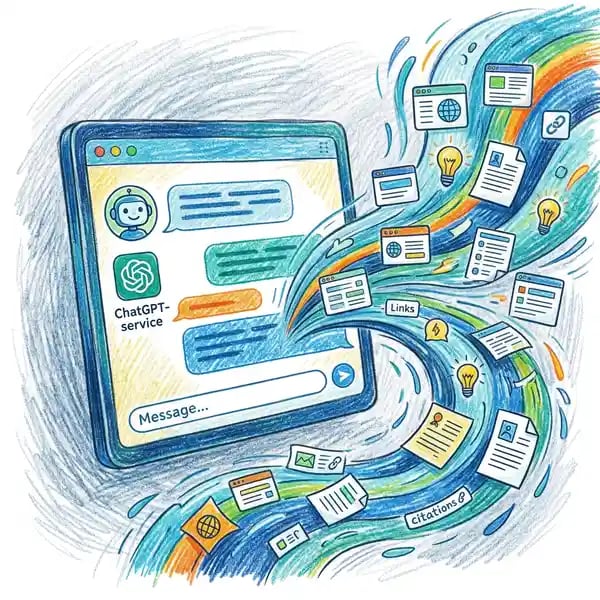
Microsoft moved first. On 7 February 2023, it launched Bing Chat powered by GPT-4, drawing one million waitlist signups in 48 hours and pushing Bing past 100 million daily active users for the first time. Google rushed out Bard on 6 February, but a factual error in its demo wiped $100 billion from Alphabet's market value.
At Google I/O on 10 May 2023, Google unveiled the Search Generative Experience (SGE)—AI-powered summaries at the top of search results, representing the most significant search architecture change in over a decade.
2024: AI Overviews Go Mainstream
At Google I/O 2024 on 14 May, Google rebranded SGE to "AI Overviews" and launched them to all US users by default. The rollout was rocky—within days, AI Overviews generated dangerous responses including recommending glue on pizza and eating rocks, forcing emergency fixes by 30 May. Despite the stumble, AI Overviews expanded to 100+ countries by October 2024.
OpenAI launched SearchGPT as a prototype on 25 July 2024, then integrated it directly into ChatGPT as ChatGPT Search on 31 October 2024. By mid-2025, ChatGPT had grown to 700 million weekly active users, with "seeking information" overtaking writing as the primary use case.
2025: AI Search Diversifies and Matures
Anthropic added web search to Claude on 21 March 2025. At Google I/O 2025, Google announced AI Mode—a full conversational search experience distinct from AI Overviews—powered by Gemini 2.5. AI Mode rolled out to 180+ countries by August 2025. Google reported AI Overviews now served over 1 billion people monthly across 200+ countries and 40+ languages.
Perplexity AI's trajectory was equally striking: from $520 million valuation in January 2024 to $20 billion by September 2025, processing 780 million monthly queries with 45 million active users.
| Platform | Users/Queries | Key Feature | Launch |
|---|---|---|---|
| Google AI Overviews | 1B+ monthly users | Appears on 15–25% of searches, multi-source synthesis | May 2024 |
| ChatGPT Search | 800–900M weekly users | Integrated web search, conversational interface | Oct 2024 |
| Perplexity | 780M monthly queries | Answer engine with inline citations, source transparency | Dec 2022 |
| Claude Search | Growing adoption | Web search integration, source attribution | Mar 2025 |
| Google AI Mode | 180+ countries | Full conversational search, Gemini 2.5 powered | May 2025 |
Generative Engine Optimisation: A New Discipline Emerges
The term "Generative Engine Optimisation" (GEO) was formalised by researchers from Princeton University, Georgia Tech, the Allen Institute for AI, and IIT Delhi in a paper first published on 16 November 2023, then formally presented at KDD 2024 in Barcelona. The research team—Pranjal Aggarwal, Vishvak Murahari, Tanmay Rajpurohit, and colleagues—introduced GEO-bench, a benchmark of 10,000 diverse queries, and tested nine optimisation strategies.
The Princeton Study's Key Findings
Three findings stand out from the research:
- GEO methods can boost content visibility by up to 40% in generative engine responses. The top three strategies—citing sources, adding quotations, and including statistics—improved visibility by 30–40% with minimal content changes.
- Lower-ranked sites benefit most. The "cite sources" method produced a 115.1% visibility increase for websites ranked 5th in SERPs, whilst the top-ranked site's visibility actually decreased by 30.3%. This suggests GEO partially democratises visibility.
- Domain-specific optimisation matters. Strategy effectiveness varies significantly across informational, navigational, and transactional queries, underscoring the need for tailored approaches.
Current Best Practices for AI Search Optimisation
The most effective GEO tactics, synthesised from academic research and industry practice through early 2026, include:
- Structuring content with clear hierarchies and leading sections with 40–60 word direct answers
- Embedding approximately one data point per 150–200 words
- Citing credible sources throughout content
- Using authoritative rather than hedging language
- Implementing FAQ, HowTo, and Article schema markup
- Maintaining content freshness—AI assistants prefer cited URLs averaging 1,064 days old versus 1,432 days for traditional search results
Brand authority has emerged as the strongest predictor of AI citations, with a 0.334 correlation between brand search volume and AI mention frequency. Only 11% of domains are cited by both ChatGPT and Perplexity, meaning each platform has unique citation patterns requiring platform-specific optimisation.
For a deeper dive into implementing these strategies, see our comprehensive guide to Answer Engine Optimisation or our analysis of AEO vs SEO.
Traditional SEO
- Focuses on page rankings
- Backlinks and domain authority
- Technical SEO factors
- Keyword targeting and SERP positioning
- Primary metric: position 1–10 visibility
Generative Engine Optimisation (GEO)
- AI citations and mentions
- Structured answers and quotes
- Source attribution and credibility
- Brand authority signals
- Primary metric: citation likelihood in AI responses
Ready to optimise for AI search engines? Explore our Answer Engine Optimisation service.
Explore AEO ServicesAI Overviews and the Dramatic Shift in Click Behaviour
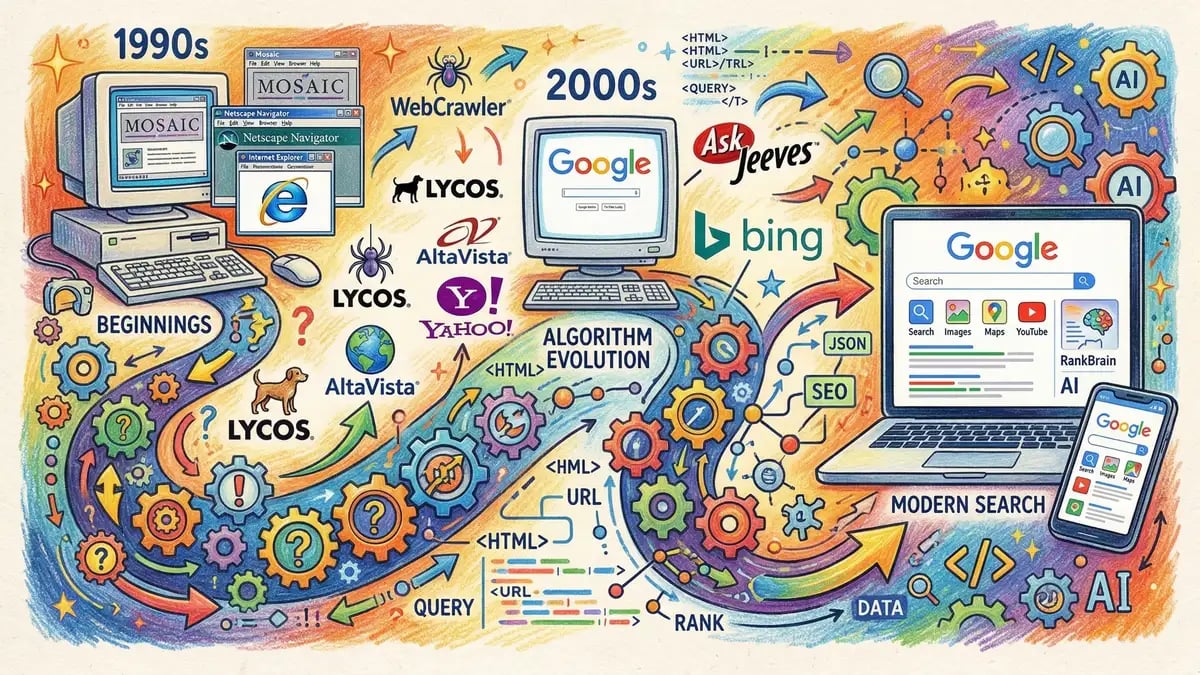
How Many Searches Trigger AI Responses
The percentage of Google searches displaying AI Overviews has fluctuated significantly. Semrush data tracking millions of keywords shows AI Overviews appeared on 6.49% of US desktop queries in January 2025, surging to 13.14% by March 2025, peaking near 25% by mid-2025, then pulling back to approximately 16% of US desktop keywords by late 2025. A Conductor study of 21.9 million queries found 25.11% triggered AI Overviews in early 2026. Our dedicated guide to Google AI Overviews covers the full impact on B2B search strategy.
Industry-specific rates vary enormously: healthcare and education queries show AI Overviews at 87%, whilst B2B technology sits at 70% and insurance at 63%.
Click-Through Rates Have Fallen Sharply
The CTR impact of AI Overviews is substantial and well-documented across multiple studies:
- Ahrefs found a 34.5% CTR decline at position one for keywords triggering AI Overviews
- BrightEdge reported an overall 30% year-over-year CTR decline even as impressions rose 49%
- A Pew Research Center behavioural study found only 8% of users clicked any link when an AI summary appeared, compared to 15% without one—and fewer than 1% clicked links within the AI Overview itself
- UK publishers experienced even steeper drops: 47.5% on desktop and 37.7% on mobile
Zero-Click Searches Continue to Rise
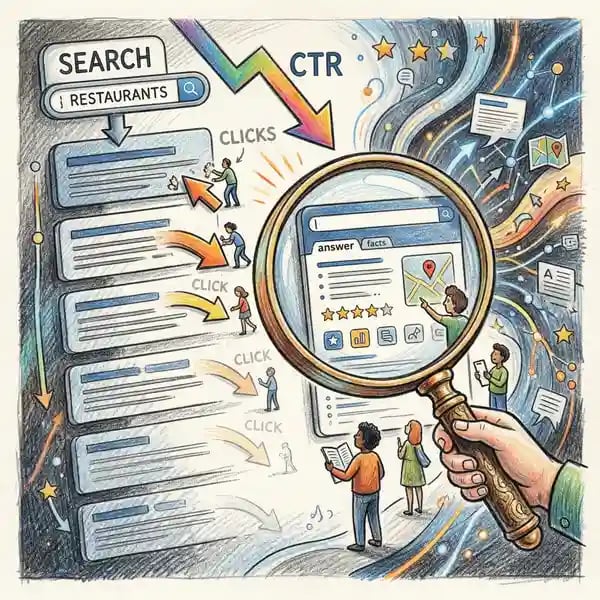
SparkToro's Q4 2025 study using Datos clickstream data found 56% of Google desktop searches ended without a click to any external website. Semrush found that queries triggering AI Overviews show a zero-click rate of approximately 80–83%, whilst Google's newer AI Mode feature sees 93% of sessions conclude without the user leaving Google. For news searches specifically, zero-click outcomes rose from 56% to 69% between May 2024 and May 2025.
The Traffic Picture: Erosion and Opportunity
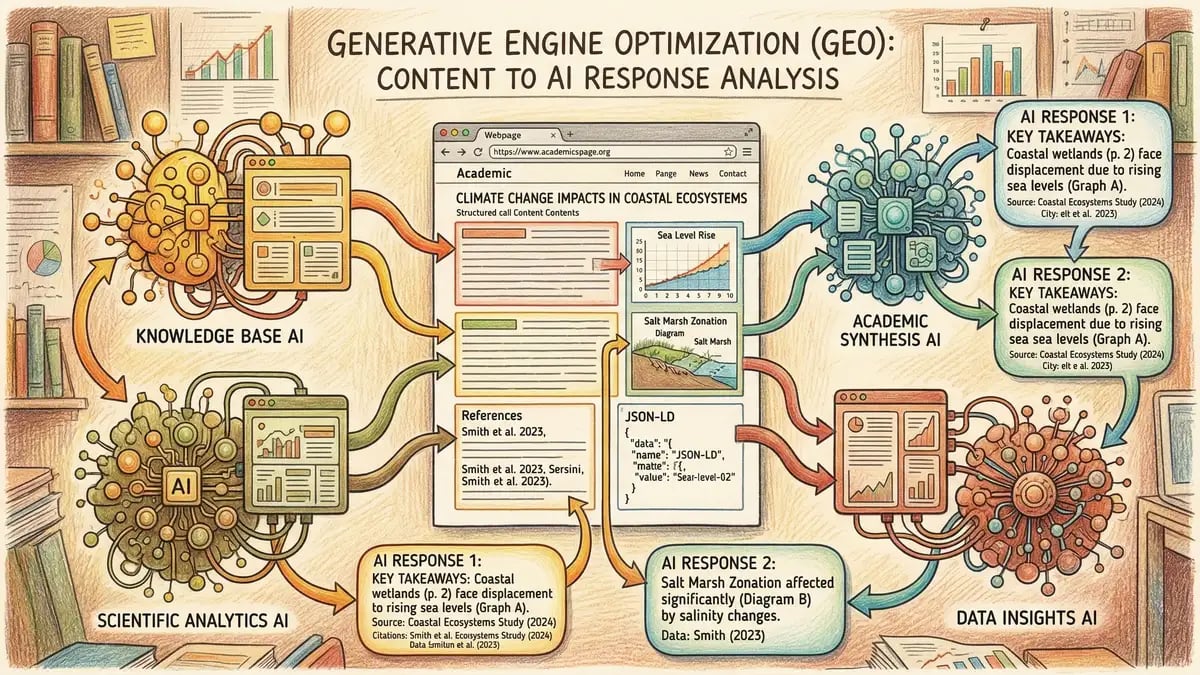
Organic Traffic Erosion Is Real but Nuanced
Publisher traffic data tells a sobering story. Digital Content Next found a median 10% year-over-year traffic decline across 19 major publishers in H1 2025, with non-news sites down 14%. Similarweb tracked news site organic traffic falling from 2.3 billion to under 1.7 billion monthly visits in 12 months—a 26% sector decline. Individual publishers were hit harder: Business Insider lost 55%, Forbes 50%, HuffPost 50%, and the Washington Post 40%.
The Conversion Paradox
Yet here's the counterintuitive finding that should shape your strategy: AI referral traffic is growing explosively from a small base—up 527% year-over-year according to one study and 693% during the 2025 holiday season per Adobe. Conductor's 2026 benchmarks put AI referral traffic at 1.08% of all website traffic, with ChatGPT driving 87.4% of that.
Crucially, this traffic converts far better:
- Ahrefs found AI search visitors convert at 23× higher than traditional organic
- Semrush measured a 4.4× higher conversion rate
- AI-referred visitors generated 12.1% of Ahrefs' signups despite representing only 0.5% of total traffic
This suggests the visitors who do click through from AI-generated responses are significantly more qualified and purchase-ready. For B2B companies, this makes AI visibility particularly valuable.
Don't Panic — But Don't Ignore the Trend
Common mistake: Abandoning SEO investment because of organic traffic declines caused by AI Overviews.
The reality: AI referral traffic converts at 4–23× higher rates, and Google still sends 345× more traffic than AI tools combined. The solution isn't to abandon SEO—it's to integrate both traditional SEO and GEO into a unified strategy that captures value from both channels.
Other Critical Shifts (2022–2026)
Featured Snippets Are Yielding to AI Overviews
Featured snippets are being systematically displaced. SEO researcher Glenn Gabe documented a 57% drop in queries yielding featured snippets between September 2024 and March 2025. Keywords Everywhere data showed featured snippet SERP visibility falling 64% between January and June 2025, from 15.41% to just 5.53%. Featured snippets survive primarily for simple, fact-based queries; complex queries increasingly trigger AI Overviews that synthesise from 5–15+ sources rather than pulling from a single page.
INP Replaced FID as a Core Web Vital
Google announced Interaction to Next Paint (INP) as an experimental metric in May 2022, confirmed it would replace First Input Delay in May 2023, and executed the switch on 12 March 2024. Unlike FID, which only measured the delay before the first interaction's event handler, INP captures the full lifecycle of every interaction throughout a page visit. The current Core Web Vitals are LCP (≤2.5s), INP (≤200ms), and CLS (≤0.1).
Mobile-First Indexing Reached Completion
After a seven-year migration that began in November 2016, Google announced mobile-first indexing was complete on 31 October 2023. The final holdout sites were migrated on 5 July 2024, making mobile-first indexing fully universal. Content not accessible on mobile is no longer indexed.
Google's Third-Party Cookie Reversal
After four years of delays, Google executed a dramatic U-turn on 22 July 2024, announcing it would not deprecate third-party cookies in Chrome. Then in April 2025, Google scrapped plans for even a user-choice prompt, leaving cookies enabled by default. As of early 2026, third-party cookies remain fully functional in Chrome's 67% browser market share.
The May 2024 Google Search Leak
In May 2024, a massive leak of Google's internal search API documentation confirmed many suspected ranking signals, including the importance of clicks, user engagement signals, brand authority, and NavBoost—a system using click data for ranking. This was a watershed moment for the SEO community, validating years of practitioner observations that Google had publicly downplayed.
What This Means for UK Businesses in 2026
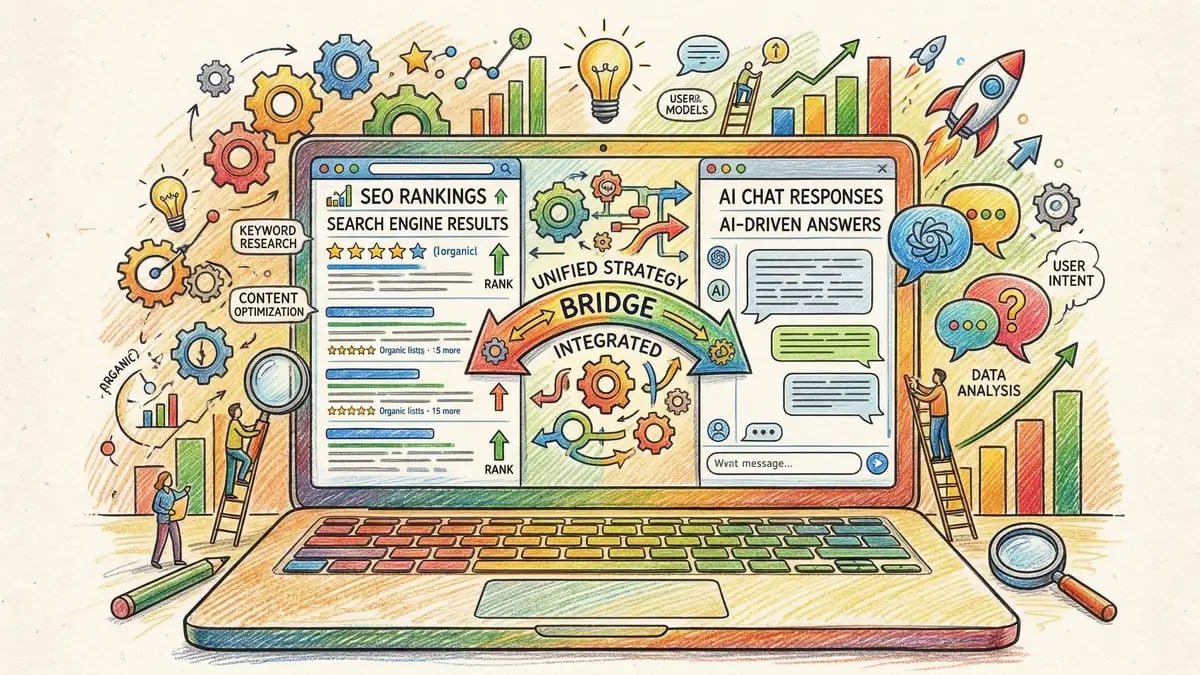
The 2022–2026 period redefined SEO in three fundamental ways:
- Algorithm consolidation around helpful content: Google's aggressive updates—particularly the March 2024 mega-update that absorbed Helpful Content and Reviews systems—consolidated ranking power around genuinely useful, experience-backed content whilst punishing scaled AI content farms and parasite SEO.
- AI search created a new visibility layer: AI Overviews now appear on roughly 15–25% of Google searches, driving zero-click rates above 80% where they appear. ChatGPT, Perplexity, and Claude represent a new discovery channel that requires different optimisation approaches.
- GEO emerged as a distinct discipline: SEO practitioners now optimise for two distinct systems: traditional organic rankings and AI citation likelihood. The tactics overlap but aren't identical.
The most counterintuitive finding across all the data is the conversion quality paradox: AI referral traffic remains tiny (around 1% of total website traffic) but converts at 4–23× higher rates than traditional organic. The visitors who do click through from AI-generated responses are significantly more qualified and purchase-ready.
The Path Forward: Integrated SEO + GEO Strategy
For SEO strategy in 2026, the path forward is clear:
- Strong traditional SEO remains the foundation—Google still sends 345× more traffic than AI tools combined
- Layer GEO tactics including citing sources, embedding statistics, maintaining content freshness, and building brand authority
- Track AI visibility alongside traditional rankings to understand your full search footprint
- Invest in brand building—brand authority is the strongest predictor of AI citations
Frequently Asked Questions
Is traditional SEO dead in 2026?
No. Google still processes approximately 14 billion searches daily and sends 345× more traffic to websites than all AI tools combined. Traditional SEO remains the foundation of organic visibility. However, AI search is growing rapidly—ChatGPT has 800+ million weekly users—so smart businesses are integrating both traditional SEO and Generative Engine Optimisation into a unified strategy.
What percentage of searches show AI Overviews?
AI Overviews appear on approximately 15–25% of Google searches as of early 2026, though this varies significantly by industry. Healthcare and education queries show AI Overviews at 87%, whilst B2B technology sits at 70%. When AI Overviews appear, zero-click rates rise to 80–83%.
What is Generative Engine Optimisation (GEO)?
GEO is the practice of optimising content to be cited by AI systems like ChatGPT, Google AI Overviews, Perplexity, and Claude. Unlike traditional SEO which targets page-one rankings, GEO focuses on getting your brand mentioned and recommended when AI directly answers user questions. Research shows GEO methods can boost visibility in AI responses by up to 40%.
How do I optimise for AI search engines?
Key GEO tactics include: structuring content with clear hierarchies and 40–60 word direct answers, embedding statistics with source attribution, citing credible sources throughout content, implementing FAQ and Article schema markup, maintaining content freshness, and building brand authority through consistent entity associations across the web.
Why does AI referral traffic convert better?
Research shows AI search visitors convert at 4–23× higher rates than traditional organic traffic. This is because AI-referred visitors arrive pre-qualified: they've already received a recommendation from an AI system they trust, their query intent has been clarified through conversational interaction, and they're typically further along in their decision-making process.
References & Sources
- Aggarwal, P., Murahari, V., Rajpurohit, T., et al. (2024). "GEO: Generative Engine Optimization." KDD 2024 Proceedings. arxiv.org/abs/2311.09735
- Google Search Central (2022–2026). Algorithm Update Documentation. developers.google.com/search/updates/ranking
- SparkToro (2025). Q4 2025 Zero-Click Study. sparktoro.com
- Ahrefs (2025). AI Search Conversion Study. ahrefs.com/blog
- Semrush (2025–2026). AI Overviews and Search Trends Research. semrush.com/blog
- Conductor (2026). AI Referral Traffic Benchmarks. conductor.com/academy
- Pew Research Center (2025). Search Behaviour Study. pewresearch.org
- Search Engine Land (2022–2026). Industry News and Analysis. searchengineland.com
Ready to Build Your SEO + AEO Strategy?
Whitehat SEO helps UK businesses integrate traditional SEO with Generative Engine Optimisation. As a HubSpot Diamond Partner, we track every improvement through to revenue.
Clwyd Probert
Founder & Managing Director, Whitehat SEO
Clwyd Probert is the founder and managing director of Whitehat SEO, a HubSpot Diamond Solutions Partner based in London. With over 15 years in digital marketing, Clwyd specialises in helping B2B businesses build pipeline through integrated SEO, AEO, and HubSpot strategies.