
How SEO and Pillar Pages Work: The Complete B2B Guide for 2026
By Clwyd Probert | Updated January 2026 | 8 min read
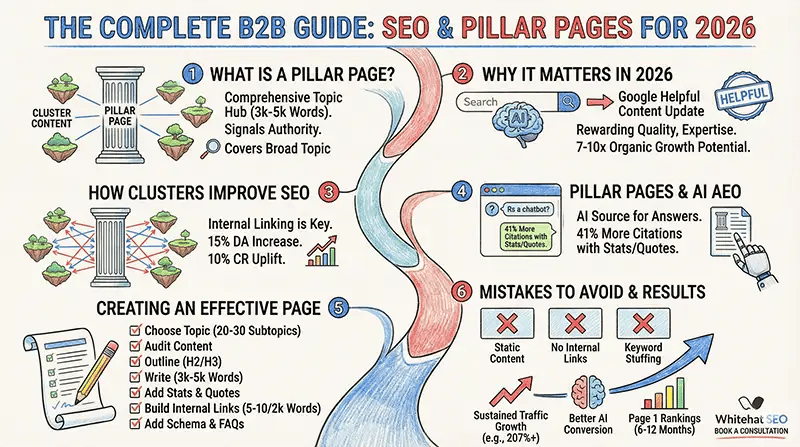
Pillar pages are comprehensive long-form content pieces (typically 3,000–5,000 words) that serve as the central hub for a topic cluster, connecting related blog posts through strategic internal linking. This structure signals topical authority to search engines, with organisations implementing topic clusters seeing an average 43% increase in organic traffic according to HubSpot research.
What Is a Pillar Page and Why Does It Matter in 2026?
A pillar page provides a complete overview of a broad topic in a single, comprehensive resource. Unlike traditional blog posts that target narrow keywords, pillar pages cover an entire subject area at a high level, then link out to cluster content that explores specific subtopics in greater depth. As SEO strategy has evolved, this interconnected approach has become essential for building domain authority.
HubSpot's Leslie Ye offers a practical test: "Would this page answer every question the reader who searched X keyword had, AND is it broad enough to be an umbrella for 20–30 posts?" If yes, you have a pillar page. Research from HubSpot's internal experiments found that sites with well-structured topic clusters experienced improved rankings across 300+ targeted keywords within 12 months.
For UK B2B organisations, pillar pages address a fundamental shift in how Google evaluates content. The March 2024 Helpful Content Update reduced low-quality content by 45%, rewarding comprehensive resources that demonstrate genuine expertise. At Whitehat's HubSpot implementation practice, we've seen clients achieve 7–10x organic growth over 12 months when pillar page strategy is properly executed.
How Do Topic Clusters Improve SEO Performance?
Topic clusters organise content into interconnected groups: one pillar page at the centre, surrounded by 15–30 cluster articles that explore related subtopics. Each cluster article links back to the pillar page using consistent anchor text, creating a network that search engines recognise as comprehensive coverage of a subject. Our guide to understanding topic clusters covers the foundational concepts in detail.
The performance data is compelling. According to Semrush's 2024 analysis, sites implementing topic clusters see a 15% increase in domain authority compared to those using isolated content approaches. Moz research indicates a 10% improvement in conversion rates for websites organised around topic clusters, suggesting the strategy improves user experience alongside search visibility.
| Metric | Result | Source |
|---|---|---|
| Organic traffic increase | 43% average | HubSpot, 2024 |
| Domain authority improvement | 15% higher | Semrush, 2024 |
| Conversion rate uplift | 10% improvement | Moz, 2024 |
| Internal linking traffic lift | 25% uplift | SearchPilot, 2024 |
Internal linking forms the backbone of this strategy. Zyppy SEO's analysis of 23 million links found that URLs with 40–44 internal links receive 4x more clicks than pages with fewer than 5 internal links. However, returns diminish after 45–50 links per page. Our comprehensive guide to internal links for SEO provides implementation best practices.
Why Do Pillar Pages Matter for AI Answer Engines?
With 60% of Google searches now resulting in zero clicks (SparkToro, 2024) and ChatGPT reaching 800 million weekly active users, the content landscape has fundamentally changed. AI systems like ChatGPT and Google's AI Overviews increasingly synthesise information from comprehensive sources rather than serving traditional blue links. Understanding answer engine optimisation is now essential for B2B visibility.
Research from Princeton University's GEO study reveals that adding statistics with sources improves AI visibility by 30–41%, whilst including expert quotations can increase citation likelihood by 41%. Pages that rank for both primary queries and fan-out queries (related questions the AI breaks the original query into) are 161% more likely to be cited in AI Overviews, according to Surfer SEO's analysis of 173,020 URLs.
Ahrefs articulates why this matters: "AI systems like ChatGPT literally map out how close your content is to specific topics... When you build content pillars—clusters of interconnected articles—you're essentially teaching the AI that you're a strong, consistent source on that subject." This architectural approach to content gives pillar pages disproportionate influence in AI-driven search.
McKinsey projects that $750 billion in US revenue will flow through AI search by 2028. Brands unprepared for this shift may see 20–50% traffic decline from traditional search channels. The strategic response is building comprehensive content hubs—exactly what pillar pages provide. At Whitehat, our HubSpot SEO strategy integrates these AI optimisation principles from the outset.
How Do You Create an Effective Pillar Page?
Creating a pillar page that performs requires systematic planning. Begin by identifying a broad topic where your organisation has genuine expertise—this authenticity signals E-E-A-T (Experience, Expertise, Authoritativeness, Trustworthiness) to both search engines and AI systems. The topic should support 20–30 related subtopics that can become cluster content. Our approach at content hub creation details this planning process.
Word count matters, but quality trumps length. Siteimprove's 2025 research recommends 3,000–5,000 words for comprehensive pillar pages, whilst Backlinko's analysis of 912 million posts found that long-form content (3,000+ words) generates 77.2% more backlinks than shorter pieces. Structure content with clear H2/H3 hierarchy, as 100% of top-ranking pillar pages use this formatting according to competitive analysis.
Pillar Page Creation Checklist
- Select a broad topic supporting 20–30 subtopics
- Audit existing content that could become cluster articles
- Create a comprehensive outline with H2/H3 structure
- Write 3,000–5,000 words covering all major aspects
- Add statistics with source citations (minimum 15+)
- Include expert quotes where relevant
- Build internal links to cluster content (5–10 per 2,000 words)
- Add FAQ section with schema markup
Timeline expectations should be realistic. Months 1–3 typically show foundation work with small long-tail ranking improvements. Months 4–6 often represent the inflection point where rankings move from page 3–5 to page 2. Months 7–12 deliver real results with page one rankings and sustained traffic growth. Beyond 12 months, the compounding effect takes hold as your content library attracts visitors continuously.
What Mistakes Should You Avoid with Pillar Pages?
The most common mistake is treating pillar pages as static assets. Content updated within the past three months receives an average of 6 citations in AI answers compared to 3.6 for outdated content (SE Ranking, 2024). Quarterly reviews should be standard practice—checking statistics remain current, internal links function correctly, and the content reflects current best practices. Our SEO audit process includes regular content health checks.
Neglecting internal linking undermines the entire strategy. Semrush research shows 25% of web pages have zero incoming internal links—essentially orphan content invisible to search engines. Each cluster article should link to the pillar page and to 2–3 related cluster articles, creating a web of relevance signals. Pages buried at depth 4 or greater receive 9x less SEO traffic than those at depth 1–3.
Finally, avoid keyword stuffing. Princeton's GEO research found keyword stuffing has negative or no effect on AI visibility. Modern algorithms and AI systems evaluate semantic relevance and comprehensive coverage rather than keyword density. Focus on answering the questions your audience actually asks, structured in formats that AI can easily extract and cite.
What Results Can UK B2B Organisations Expect?
HubSpot's case study with Human Marketing Agency documents 37,900% traffic growth—from 500 to 190,000 monthly visitors—through systematic topic cluster implementation. Whilst results vary by industry and competition, Portent's 2024 case study showed 207% increase in organic sessions for content hub SEO implementations. These figures demonstrate the potential when pillar page strategy is executed correctly.
For UK B2B organisations specifically, the opportunity is significant because most pillar page content online is US-centric. Creating UK-specific content addressing local market nuances, regulatory considerations, and regional case studies provides clear differentiation. As a HubSpot Diamond Partner, Whitehat combines SEO expertise with platform implementation to deliver integrated inbound marketing strategies built on solid content foundations.
AI-referred traffic already converts at 14.2% compared to Google's 2.8% (Exposure Ninja, 2025). Sessions from AI referrals grew 527% between January and May 2025. Building content infrastructure now—before competitors adapt—positions your organisation to capture this emerging traffic source whilst maintaining traditional search performance.
Frequently Asked Questions
How long should a pillar page be?
Pillar pages typically range from 3,000 to 5,000 words, covering a broad topic comprehensively. Research shows content over 3,000 words generates three times more traffic and 77% more backlinks than shorter content, though quality and completeness matter more than hitting a specific word count.
How many cluster articles should support a pillar page?
HubSpot recommends 20–30 supporting cluster articles per pillar page, with a maximum of 100 subtopic keywords per topic. Start with 10–15 cluster articles and expand based on performance data and content gaps your audience is searching for.
How long does it take to see results from pillar pages?
Expect 6–12 months for significant results. Months 1–3 show foundation-building with long-tail improvements, months 4–6 typically bring an inflection point with ranking jumps, and months 7–12 deliver page one positions with sustained traffic growth.
Should pillar pages be gated behind forms?
No—pillar pages must remain ungated for SEO effectiveness. Search engine crawlers cannot access gated content, eliminating any ranking potential. Keep pillar pages open and use cluster content or downloadable resources for lead capture whilst maintaining search visibility.
Do pillar pages help with AI search visibility?
Yes—pillar pages are increasingly important for AI answer engines. Pages ranking for both main queries and related fan-out queries are 161% more likely to be cited in AI Overviews. The comprehensive, well-structured nature of pillar pages aligns with how AI systems identify authoritative sources.
Ready to Build Your Content Strategy?
As a HubSpot Diamond Partner, Whitehat combines SEO expertise with platform implementation to create content strategies that drive measurable results.
Book a Free Consultation