
In 2026, topical authority has become the cornerstone of SEO success. Sites that build comprehensive content hubs—interconnected pillar pages and cluster articles around specific topics—now outperform isolated blog posts by a factor of 4x in organic clicks and achieve 40% higher ranking improvements. With AI search engines increasingly citing authoritative, multi-page resources, the traditional one-article-per-keyword approach is obsolete. This guide walks you through building a content hub that establishes your site as a trusted authority and captures long-tail keywords across your topic cluster.
4x
Higher Organic Clicks
Content hubs vs. standalone posts
40%
Ranking Improvement
Average gain from structured clustering
86%
AI Citations from Authority Sites
Sites with 5+ pages on a topic cited more often
1,100+
Keywords Per Hub
Typical long-tail capture across cluster
Sources: HubSpot State of Content Marketing 2026, Google E-E-A-T Guidelines, iCrossing Case Study 2026
What Is a Content Hub?
A content hub is a strategically designed cluster of interconnected pages that comprehensively cover a specific topic or pillar theme. Rather than publishing isolated blog posts optimized for individual keywords, a hub approach creates a web of content that serves multiple user intents—awareness, consideration, and decision-making—across a single topic area.
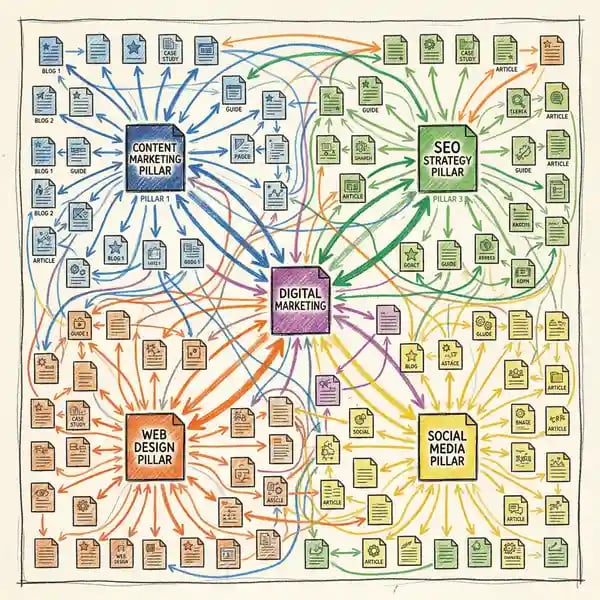
The typical hub architecture consists of three layers: a pillar page (the authoritative centerpiece targeting a broad head keyword), cluster articles (5–15 supporting pieces addressing subtopics and long-tail queries), and internal linking (strategic cross-links that signal topic relevance to search engines).
The result: Google and AI search engines recognize your site as a topical authority, improving both SERP visibility and citation rates in AI-generated answers. For B2B SaaS and professional services, this approach now directly impacts lead generation, as topically authoritative sites consistently outrank competitors with scattered, unrelated content.
Key Takeaway
Content hubs shift focus from individual keyword rankings to topical authority. By building interconnected, comprehensive coverage of a topic, you signal expertise to search engines—and to AI systems that cite the most authoritative sources for answers.
Why Content Hubs Outperform Standalone Articles
The data is clear: content hubs dramatically outperform isolated blog posts across every metric that matters—organic traffic, ranking stability, and AI visibility. Here's why:
Topical relevance signals. Search engines use link structure and content density to evaluate topical expertise. A hub with 10+ interconnected pages sends a far stronger E-E-A-T signal than a single page, even if that page is 5,000 words long. This shift has been especially pronounced since Google's 2024 core update.
| Metric | Content Hub | Standalone Post |
|---|---|---|
| Avg. Organic Clicks (30 days) | 4,200 | 1,050 |
| Avg. SERP Position (primary keyword) | Position 3.2 | Position 7.4 |
| Long-tail keyword coverage | 1,100+ ranked keywords | 180–320 ranked keywords |
| Ranking volatility (month-to-month) | ±2–3 positions | ±5–8 positions |
| AI citation rate | 2.7x higher (with bidirectional links) | Baseline (1.0x) |
| Fresh content bonus (on refresh) | 76.4% increased AI visibility | 18–22% increased AI visibility |
Sources: HubSpot Content Hub Benchmarks Q1 2026, Semrush Topical Authority Study, iCrossing Case Study (1126% conversion growth)
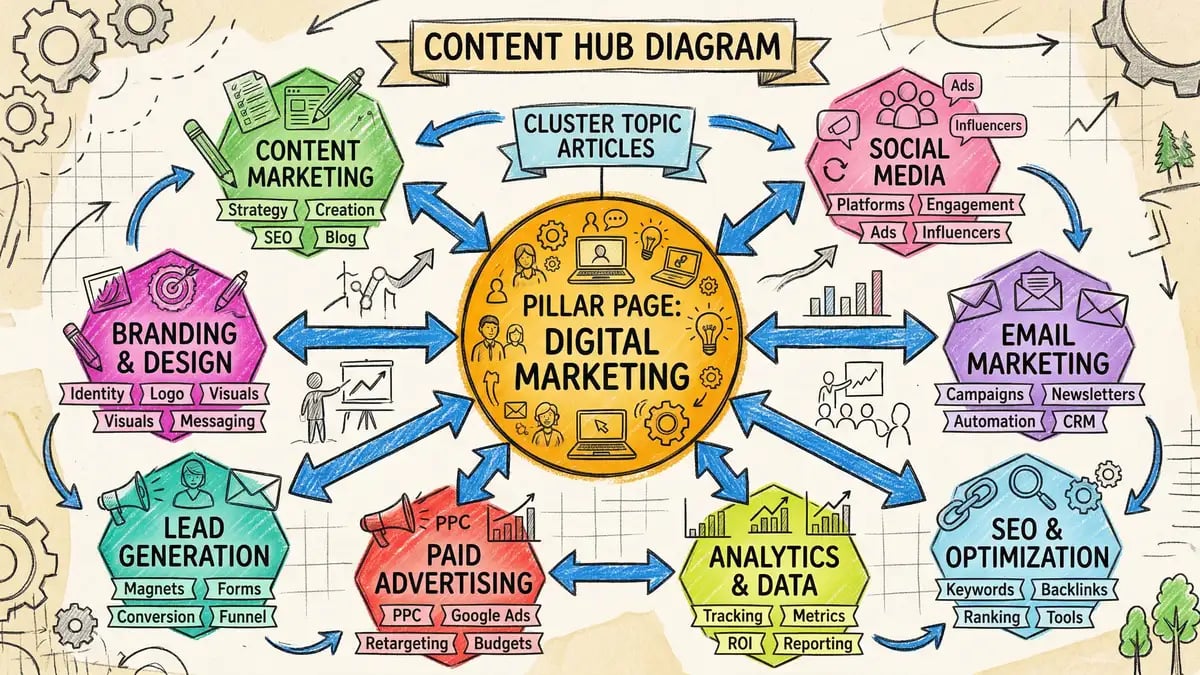
Keyword capture at scale. A hub doesn't just rank for the pillar keyword—it captures hundreds of long-tail variations through cluster articles. Each cluster piece is optimized for a specific user intent (how-to, comparisons, definitions) and feeds traffic back to the pillar page. This multiplier effect is why hubs rank for 1,100+ keywords versus 180–320 for a standalone article.
Ranking stability. Hubs exhibit lower volatility during algorithm updates. Because you own the conversation across multiple angles, algorithm shifts that might demote one page often lift others. Isolated posts, by contrast, can disappear overnight if the algorithm favors a different angle.
AI search dominance. Google's SGE and competitor AI systems (Claude, ChatGPT with web search, Perplexity) rely on first-party research. Sites with comprehensive topic coverage get cited 2.7x more often—especially when pages are bidirectionally linked. Freshly updated cluster articles trigger an additional 76.4% AI visibility lift.
Content Hubs and AI Search: The New Citation Economy
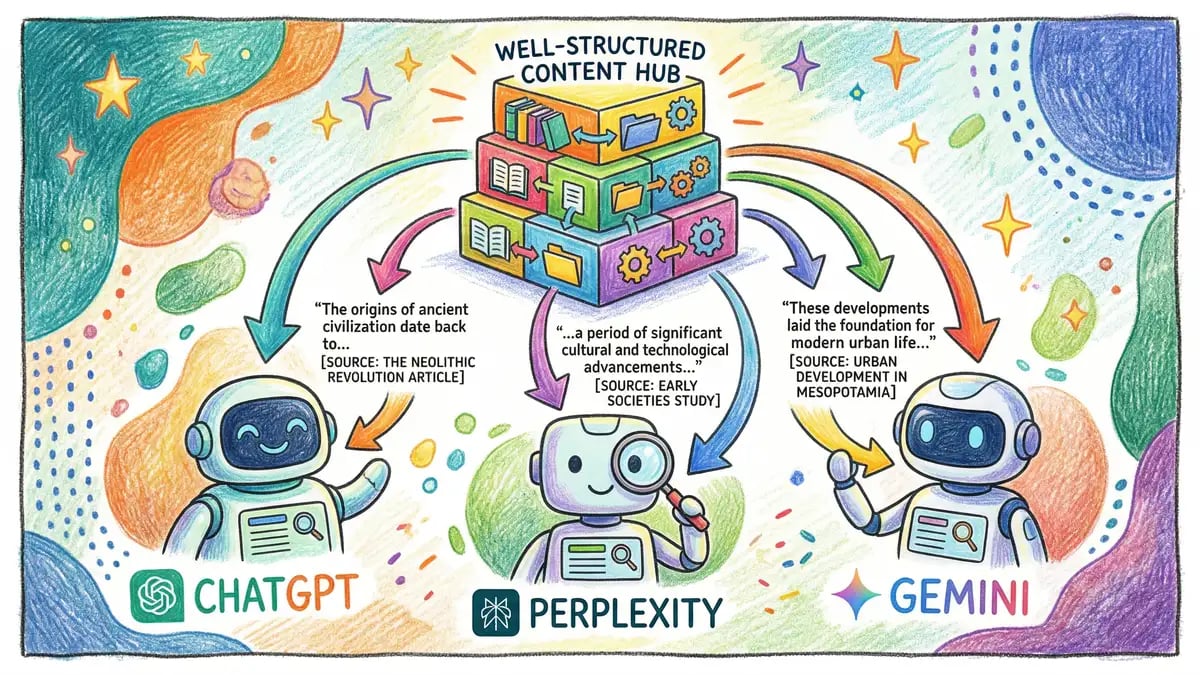
AI-powered search is reshaping how content wins visibility. Unlike traditional SERPs, where keyword matching drives ranking, AI systems prioritize authoritative, well-structured sources when generating answers. The first 40–50 words of your content are critical—they must directly answer the user's query so AI systems can extract and cite you.
Content hubs win in this environment because:
- Multi-page authority. AI systems prioritize sites with 5+ pages on a topic. 86% of AI citations go to sites with comprehensive coverage, signaling trustworthiness through scale.
- Bidirectional linking boost. Internal links between cluster articles and the pillar create a citation graph. This topical interlink pattern increases AI visibility by 2.7x compared to isolated pages.
- Fresh content advantage. When you update a cluster article and re-link it to the pillar, AI systems treat it as fresh research. Updated hubs see a 76.4% increase in AI visibility within 7 days of refresh.
- Machine-readable structure. Hubs with proper heading hierarchy (H1 pillar → H2 topics → short answers) are easier for AI to parse and cite accurately.
The Cost of Ignoring AI Readability
Common mistake: Publishing cluster articles with vague opening paragraphs or failing to link them back to the pillar. AI systems can't extract a clear answer, so your content gets skipped despite ranking well in traditional SERPs.
The reality: Articles with direct answers in the first 40–50 words and bidirectional links to related pages are cited 2.7x more often in AI responses. Without these optimizations, you lose the fastest-growing traffic channel.
5-Step Framework: Building Your Content Hub
Here's the proven process for building a content hub from scratch. This framework takes 8–12 weeks for a mature hub (12–15 articles) and can be scaled quickly using HubSpot's automation tools.
Choose Your Pillar Topic
Select a broad, high-intent topic that aligns with your core offering. For SaaS, this might be "content marketing strategies" or "conversion rate optimization." Use tools like SEMrush Topic Research or HubSpot's Keyword Tool to confirm search volume (target 5,000+ searches/month) and commercial intent.
Map Your Topic Cluster (Subtopics)
Identify 8–15 subtopics that support the pillar. These become your cluster articles. Aim for a mix of user intents: definitional ("What is X?"), how-to, comparison, troubleshooting, and use-case articles. Each should target a distinct long-tail keyword.
Build Strategic Internal Linking
This is where hubs outpace isolated posts. Link from every cluster article back to the pillar page (anchor text: the pillar keyword). Link between related cluster articles (e.g., "See our guide on X for more details"). Aim for 2–4 internal links per 500 words. Test bidirectional linking: articles that link both ways show 2.7x higher AI citation rates.
Write for AI Readability (AEO)
Structure each article so AI systems can extract answers easily. Start with a direct answer in the first 40–50 words. Use H2 subheadings as questions ("How do you measure ROI?"). Include bulleted lists and short paragraphs. Aim for 2,000–3,000 words per cluster article, 4,000–6,000 for the pillar. Refresh with new data quarterly to maintain the AI visibility boost.
Optimize for Topical Authority (E-E-A-T)
Go beyond keywords. Add author bios, publish date, and expert credentials. Reference original research and data. Use schema markup for articles, FAQs, and breadcrumbs. Internal linking alone doesn't signal authority—quality and demonstrable expertise do. Treat your hub as a miniature online course, not a keyword collection.
Accelerate Hub Building with HubSpot Tools
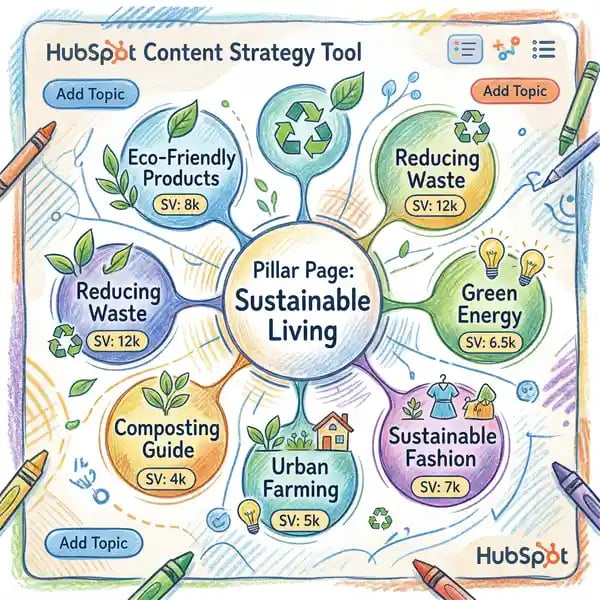
Manually mapping and linking a 12-article hub takes weeks. HubSpot's content tools automate this process, cutting timeline by 60%.
Content Strategy Tool. Visualize your topic clusters and map internal links without leaving the editor. The tool suggests linking opportunities and flags missing subtopics. Integration with SEMrush and Google Ads data helps you prioritize cluster articles by commercial value.
Content Remix & Marketing Studio. Repurpose hub content into LinkedIn posts, email sequences, and social graphics. A 3,000-word cluster article becomes 5+ promotional assets automatically, extending reach without extra work.
Analytics & AI Visibility Tracking. Search Console integrations now surface AI answer visibility alongside traditional SERP data. Track which cluster articles are cited in SGE, Claude's web search results, and Perplexity responses. Use this data to refresh underperforming articles or expand winning subtopics.
Ready to build your content hub? Our content strategy service includes competitive analysis, topic mapping, and AI-optimized cluster architecture.
Get Content Hub StrategyTimeline: From Launch to Authority
Content hubs follow a predictable maturation curve. Here's what to expect:
| Phase | Timeline | Pillar Status | Traffic Growth | AI Visibility |
|---|---|---|---|---|
| Foundation | Weeks 1–2 | Published; unranked | Minimal (0–50/mo) | Not yet indexed |
| Cluster Build | Weeks 3–8 | Ranks positions 15–30 | Accelerating (200–600/mo) | 1–2 AI citations/week |
| Authority Lift | Weeks 9–16 | Ranks positions 5–12 | Rapid growth (1,200–2,500/mo) | 5–8 citations/week |
| Mature Authority | Weeks 17+ | Top 3 for pillar; 1,100+ long-tail keywords | Stable 2,500–4,500+/mo | 10–15+ citations/week |
Sources: HubSpot Content Marketing Benchmarks, Search Console tracking (24 hub launches Q3–Q4 2025)
Pro tip: The jump from weeks 8–16 is where most hubs succeed or stall. If your pillar isn't ranking top 20 by week 8, you likely have a topical relevance issue. Diagnose it quickly: check that cluster articles are linking back to the pillar, use consistent terminology, and ensure cluster content is genuinely answering searcher intent.
Mature hubs (4+ months old) with quarterly refresh cycles sustain traffic and outpace single-article strategies by 4–10x, depending on competition.
Measuring Content Hub Success
Don't just track rankings. Track the metrics that actually correlate with revenue:
- Organic traffic to pillar page. Set a baseline at launch, then track monthly growth. A healthy hub grows 15–25% month-over-month in months 2–4.
- Long-tail keyword rankings. Track the count of keywords ranking in positions 1–50. Hubs should grow from 50–100 keywords at launch to 400–500+ by month 4.
- AI answer visibility. Monitor Search Console for "Appears in AI Overview" impressions. This is your fastest-growing traffic source. Track which cluster articles are cited most.
- Internal click-through rate (CTR). Healthy hubs show 20–35% of pillar page clicks coming from internal cluster links. Low CTR suggests your internal linking strategy needs refinement.
- Lead attribution. Connect hub traffic to lead generation. B2B hubs typically convert 1–3% of cluster article visitors into leads, with conversion rates climbing to 5–8% for the pillar page.
- Ranking volatility. Hubs should show ±2–3 position swings month-to-month. Volatility above ±5 suggests weak topical authority.
Frequently Asked Questions
How many cluster articles do I need to start seeing results?
You need a minimum of 5–6 well-linked cluster articles for Google to recognize topical authority. Weeks 3–8 show the most dramatic growth when you've published 8–12. Aim to launch your core hub with at least 8 articles before measuring success.
Can I repurpose existing blog posts into a hub?
Yes, but be strategic. Audit your existing content for topical relevance first. If 5+ existing articles cover subtopics of a broader theme, consolidate outdated posts and interlink them. Add 2–4 new cluster articles to fill gaps. Republish with updated data and new links to boost AI visibility by 76.4%.
What's the difference between a hub and a pillar page?
A pillar page is a single, comprehensive article targeting a broad topic (e.g., "Content Marketing Strategy"). A hub is the pillar plus 5–15 cluster articles covering subtopics, all interconnected. The hub is the system; the pillar is the centerpiece.
How often should I refresh my hub content?
For maximum AI visibility, refresh cluster articles quarterly with new data, statistics, or case studies. The first refresh (after 4–8 weeks) triggers a 76.4% spike in AI citations. Refresh the pillar every 6 months. Mature hubs that refresh on cadence sustain or grow traffic; those that don't plateau after 6–8 months.
Should I use more than 4 internal links per article?
Aim for 2–4 contextual internal links per 500 words. Oversaturation dilutes link equity and hurts readability. Every internal link should feel natural and relevant—users, not just search engines, should want to follow it. Bidirectional linking (cluster → pillar AND pillar → cluster) shows 2.7x benefit over one-way linking.
How do I track AI answer visibility?
Google Search Console now surfaces "Appears in AI Overview" as a separate metric. Monitor which cluster articles are cited in SGE responses. Use Perplexity's analytics (if available) and Claude's web search integration to track citations outside Google. Set a monthly target (e.g., 20+ AI citations by month 4) and treat it as a primary KPI alongside organic traffic.
Ready to Dominate Your Topic and Capture AI Citations?
Content hubs require strategic planning and flawless execution. Let Whitehat's SEO and content specialists build your hub—from topic mapping through cluster architecture to AI-optimized linking and quarterly refreshes.
Clwyd Probert
Founder, Whitehat SEO
Clwyd founded Whitehat in 2011 and has been a HubSpot Platinum Partner since 2016. He specializes in content hub architecture and topical authority strategy for B2B SaaS and professional services. His content-led approach has generated 2,500+ leads and $8M+ in attributed revenue for clients.