
Digital Marketing Strategy
The old playbook is obsolete. If you're still running your 2024 digital marketing strategy, you're likely watching traffic decline whilst wondering what went wrong. The shift isn't subtle—marketing budgets have risen to 9.4% of company revenues as businesses scramble to invest in first-party data infrastructure, video content, and AI-optimised content strategies.
Digital Marketing in 2026: What's Changed, What Still Works, and What UK Businesses Must Do Nowm
Digital marketing in 2026 has fundamentally changed. AI-powered search engines now answer 60% of queries without any website clicks, whilst 88% of marketing teams use artificial intelligence daily. For UK businesses, this means shifting strategy from "ranking in search results" to "getting cited by AI systems"—whilst maintaining the fundamentals that still drive results: technical SEO, E-E-A-T content, email marketing delivering £36–42 ROI per pound spent, and the 95-5 rule that reminds us brand building with future buyers matters as much as converting today's.
This guide covers everything that's changed—and what fundamentals still matter—for businesses navigating digital marketing in 2026 and beyond. Whether you're a Marketing Director at a B2B SaaS company trying to prove HubSpot ROI, or a RevOps Manager wrestling with Salesforce integration, you'll find actionable frameworks here.
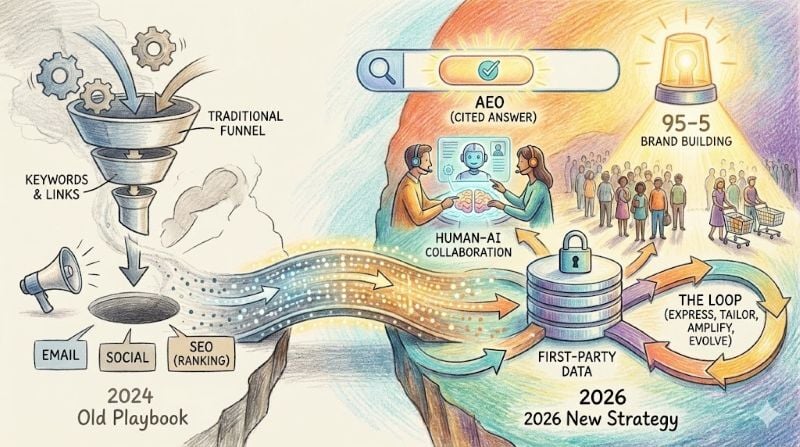
The AI Search Revolution: From Ranking to Being Cited
The most dramatic shift in digital marketing has been the rise of AI-powered search and answer engines. ChatGPT now has 800 million weekly active users. Perplexity processes 780 million queries monthly. Google's AI Overviews appear in 16–47% of searches depending on query type, with informational queries most affected at 88.1%.
Here's the number that should keep you awake: when AI Overviews appear, the zero-click rate jumps to 83%. Only 17% of users click through to any website.
This fundamentally changes how businesses must think about digital visibility. Traditional SEO focused on ranking higher to earn clicks. The new discipline—called Answer Engine Optimisation (AEO) or Generative Engine Optimisation (GEO)—focuses on becoming the source that AI systems trust and cite.
The implications are significant. HubSpot reported 70–80% traffic declines in some content areas. Chegg saw a 49% drop in non-subscriber traffic. Yet some platforms thrive—Reddit achieved a 450% increase in AI citations between March and June 2025. The difference lies in perceived authenticity and authority.
At Whitehat, we've been testing and implementing AEO strategies that actually work. The patterns are clear: content structure is the strongest predictor of AI citation, with a 0.87 correlation. Sites with 50+ referring domains see 5x more AI traffic, and content updated within 30 days receives 3.2x more AI citations.
What AI Systems Look for When Deciding Which Sources to Cite
AI systems favour content that leads with 40–60 word answer capsules directly addressing questions, uses clear H2→H3→bullet point hierarchies (which make content 40% more likely to be cited), and includes FAQ sections, tables, and step-by-step guides.
E-E-A-T signals—Experience, Expertise, Authoritativeness, and Trustworthiness—show a 0.81 correlation with citation rates. Critically, 96% of AI Overview content comes from sources with verified E-E-A-T signals.
Different AI platforms have different preferences:
| Platform | Content Preference | Time to Citation |
|---|---|---|
| ChatGPT | Depth-focused educational content | 60–90 days |
| Perplexity | Freshness and real-time data | 7–14 days |
| Claude | Accuracy and balanced analysis | 30–60 days |
| Google AI Overviews | Authority and semantic completeness | Varies by domain authority |
SEO Fundamentals: What Still Works vs What's Obsolete
Despite the AI transformation, 91% of marketers report SEO improved website performance in 2024, and SEO remains the number one ROI channel for B2B marketers at 748% return. The fundamentals still matter—but what constitutes "fundamentals" has evolved.
Technical SEO Remains Critical
Google stopped indexing non-mobile-friendly websites in July 2024, making mobile-first design mandatory. Core Web Vitals thresholds demand LCP under 2.5 seconds, INP under 200ms (replacing FID in 2024), and CLS below 0.1. A new metric, Engagement Reliability, now measures how consistently users can interact with clickable elements.
Pages ranking at position 1 are 10% more likely to pass Core Web Vitals thresholds. Our SEO services always begin with technical foundations—because brilliant content on a slow, poorly-structured site won't rank.
E-E-A-T Has Become Non-Negotiable
Google's December 2025 Core Update emphasised quality signals more than ever. The "E" for Experience requires demonstrating first-hand knowledge through original photos, case studies, and "What We Tested" sections. Author bios with credentials, clear contact information, and secure HTTPS connections all contribute to trustworthiness.
For YMYL topics (Your Money or Your Life)—health, finance, legal, safety—E-E-A-T requirements are especially stringent.
What's Now Obsolete
Keyword stuffing provides no benefit and may trigger penalties. Mass link building from low-quality sources is ineffective—Google's December 2025 Core Update specifically prioritises quality over quantity in backlinks. Generic AI-generated content without human oversight consistently underperforms. Creating content solely for search engines rather than users violates Google's spam policies.
Local SEO Has Gained Importance
With 46% of all Google searches seeking local information and 88% of mobile local searches resulting in a visit or call within 24 hours, Google Business Profile optimisation is essential. Businesses with GBP photos receive 42% more direction requests and 35% more website clicks. AI-generated overviews now appear for local searches before the map pack, making structured data implementation crucial.
Content Marketing: Human-AI Collaboration Is the New Standard
The content landscape has changed dramatically. By end of 2025, an estimated 90% of online content is AI-generated, yet only 12% of marketers believe AI can manage an entire content strategy alone.
The winning approach is human-AI collaboration: AI handles research, drafting, brainstorming, and repurposing, whilst humans provide strategy, brand voice, expertise, emotional intelligence, and storytelling.
AI-assisted content produces results. Marketers using AI complete 12.2% more tasks at a 25.1% faster rate. Content creation becomes up to 93% quicker and 4.7x less expensive. HubSpot reports that 72% of marketers see higher performance from AI-assisted content.
The key word is "assisted"—56% significantly revise AI drafts, 38% make minor tweaks, and only 7% publish without editing.
Video Has Become Essential
Video content now accounts for 82% of all internet traffic. Among marketers, 91% of businesses use video as a marketing tool, and 93% report positive ROI. Short-form video specifically—TikTok, Instagram Reels, YouTube Shorts—provides the highest ROI according to 35% of marketers.
For B2B, video is equally crucial: 82% of B2B buyers watch more business-related videos than two years ago, 70% of video marketers use LinkedIn for distribution (the most widely-used platform), and 73% of B2B decision-makers prefer videos under 60 seconds on mobile.
Email Marketing: Still Delivering Exceptional ROI
Email remains one of the most effective digital marketing channels, delivering £36–42 for every £1 spent—unmatched by most other channels. With 4.5 billion email users worldwide (projected to reach 4.8 billion by 2027) and 376 billion emails sent daily, the channel continues growing.
The statistics are compelling: 60% of consumers prefer email over social media for brand communication, 42% of marketers say email is their most effective channel, and 50% of consumers made purchases directly from email in 2024. For B2B specifically, 59% of marketers call email their most effective revenue channel, and 77% of B2B buyers favour email as their preferred communication method.
Automation Transforms Effectiveness
Automated emails drive 320% more revenue than non-automated emails. Triggered messages generate 37% of email sales from only 2% of total volume. By 2026, 89% of marketing experts expect up to 75% of email operations to be AI-driven.
Key automation workflows include welcome sequences (sent within 5 minutes of signup), cart abandonment (first message within 30 minutes—reducing abandonment by 8%), lead nurturing sequences, re-engagement campaigns, and post-purchase follow-ups.
This is where HubSpot onboarding becomes critical—getting your workflows configured properly from day one means you capture that 320% revenue uplift immediately, not months into your implementation.
Social Media: LinkedIn Dominates B2B
With 1.2 billion registered members (projected to exceed 1.3 billion in 2026), 85% of B2B marketers rate LinkedIn as their most valuable social platform. The platform delivers 75–85% of all B2B leads from social media, and 62% of marketers say LinkedIn delivers leads at 2x the rate of any other platform.
LinkedIn's 2025–2026 algorithm changes prioritise depth of engagement over vanity metrics. Story-driven, conversational content gets the most visibility. Native formats—video, carousels, text posts—outperform external links. The platform favours niche authority, rewarding content from recognised vertical specialists.
A crucial fact for AI visibility: LinkedIn is now the second most-cited domain by large language models, behind only Reddit and ahead of Wikipedia. LinkedIn Pulse articles receive 131,000+ monthly citations in Google's AI Overviews. This makes LinkedIn presence increasingly important for brand visibility beyond just social engagement.
The 95-5 Rule: Why Brand Building Matters More Than Ever
One of the most important strategic frameworks for 2026 comes from the Ehrenberg-Bass Institute and LinkedIn B2B Institute: the 95-5 rule. At any given moment, only 5% of potential buyers are actively in-market; 95% are out-of-market but will buy in the future.
The research is unambiguous: 75% of companies buy computers once every 4 years. 80% of companies change banking services once every 5 years. 90% of consumers buy new cars every 10 years. Over the next two weeks, only approximately 1% of business banking accounts are likely to be in-market.
As the researchers note: "Marketers don't move buyers in-market—buyers move themselves in-market based on their needs."
The strategic implication is profound: the brand that gets remembered is the brand that gets bought. Most B2B companies over-invest in demand capture (targeting the 5%) and under-invest in demand creation and brand building (nurturing the 95%), leading to short-term wins but long-term pipeline stagnation.
The optimal budget split according to Binet and Field's research: for B2B, approximately 46% should go to brand building and 54% to short-term activation. An alternative framework suggests 70% demand creation (brand awareness, education, nurturing) and 30% demand capture (conversion optimisation, SEO, PPC).
Privacy Changes: First-Party Data Is Now Essential
The privacy landscape has stabilised but with lasting implications. Google reversed its cookie deprecation plans in July 2024, opting instead for a "user choice" model. But the industry had already shifted: Safari, Firefox, and Brave block third-party cookies by default, and 55%+ of users now reject tracking.
UK Data Protection Reform
The Data (Use and Access) Act 2025 received Royal Assent on 19 June 2025—the most significant UK data reform since Brexit. Key changes include PECR fines aligned with UK GDPR (up from £500,000 to £17.5 million or 4% of annual global turnover), new "recognised legitimate interests" for direct marketing and data sharing within company groups, and proposed relaxation of cookie consent requirements for low-risk advertising cookies (final guidance expected August 2026).
Important B2B distinction: B2B marketing to limited companies at corporate email addresses (e.g., info@company.com) doesn't require consent under PECR. However, sole traders and partnerships are treated as individuals—they require consent like B2C. An opt-out mechanism and company identification must always be included.
Companies with strong first-party data strategies see 2x higher ROAS and 2x lower CPA. First-party behavioural data can improve customer acquisition costs by 83% and boost ROI by 72%.
Measurement: Triangulation Is the New Standard
Traditional marketing attribution has fundamentally broken down. 73% of marketers report significant attribution challenges since Apple's iOS 14.5. Today's consumers interact with brands across an average of 9.5 touchpoints before converting, with platform-specific attribution creating conflicting data and walled gardens self-reporting favourable results.
Marketing Mix Modelling (MMM) has experienced a renaissance. Nearly 47% of US marketers will invest more in MMM over the next year, with 27.6% calling it the most reliable measurement methodology. Google's open-source Meridian platform, launched January 2025, has democratised access to sophisticated MMM capabilities.
The best practice is triangulation: modern measurement strategy combines MMM for strategic budget allocation, incrementality testing for validating channel effectiveness, and real-time attribution signals for weekly optimisation. Companies investing in proper tracking setup see 40% more accurate attribution, whilst those using advanced attribution models report 15–30% lower CAC and up to 40% improvement in marketing ROI.
When proving ROI to leadership, speak the language of finance: current versus future cash flows. In-market buyers represent current cash flows; the 95% who are out-of-market represent future cash flows.
Marketing Automation and CRM: The Revenue Engine
Marketing automation has moved from competitive advantage to table stakes. Companies using HubSpot automation report a 72% average increase in marketing-generated revenue. But poor data quality costs businesses £12.9 million annually, whilst companies with well-maintained CRM data see up to 70% increase in conversion rates.
The foundation is clean data and clear processes. Workflows underpin over 70% of automation projects across marketing, sales, and service hubs.
HubSpot's Methodology Has Evolved
In April 2025, HubSpot declared traditional inbound marketing "dead" and introduced Loop Marketing to replace the Flywheel model. The Loop has four stages:
- Express: Define brand identity and voice
- Tailor: AI-driven personalisation at scale
- Amplify: Multi-channel distribution including AI search
- Evolve: Real-time optimisation and continuous feedback
The shift recognises that AI answers questions before prospects click, channels have fragmented (52% of brands run 5–8 channels), and growth happens in dynamic loops rather than straight lines.
Whitehat's HubSpot onboarding methodology reflects this evolution—we configure for Loop Marketing from day one, not as an afterthought. Partner-guided implementations typically complete in 45–60 days versus HubSpot's standard 90-day direct onboarding path, a 20–40% acceleration that delivers faster return on platform investment.
The UK Market: Distinct Characteristics and Opportunities
The UK digital marketing landscape has its own dynamics, with £35.53 billion in digital ad spend in 2024 (up 13% year-over-year) and projected growth to £45 billion by 2026. The UK is the largest digital advertising market in Europe.
UK marketers report specific channel satisfaction levels: brand building (70% satisfied), social media advertising (67%), content marketing (63%), SEO (53% satisfied but 35% not satisfied), and marketing automation (42% satisfied, 36% not satisfied). The gap between satisfaction and dissatisfaction in SEO and automation suggests significant room for improvement—and opportunity for businesses that get it right.
Training needs reveal where the industry is headed: 38% need training on optimising for AI-generated search results, 36% need data analytics training, 32% need SEO training, 31% need training on using AI for automation/agents, and 28% need training on AI for content creation.
What This Means for Your Business
Digital marketing in 2026 operates on new rules. The rise of AI-powered search has shifted the goal from "ranking well" to "being cited as an authoritative source." Privacy changes have made first-party data the foundation of effective targeting, not an optional enhancement. Video has moved from "nice to have" to essential across all channels.
The fundamentals that still matter: Technical SEO foundations (Core Web Vitals, mobile-first, crawlability), quality content that demonstrates E-E-A-T, email marketing delivering exceptional ROI, and understanding your audience deeply enough to provide genuine value.
What's changed: AI must be integrated into content workflows. Content must be structured for AI citation, not just human reading. Measurement requires triangulation. Budget allocation must balance demand capture with long-term brand building.
The key insight for 2026: as AI generates an ever-larger share of online content and answers questions directly, authentic human expertise and genuine brand differentiation become more valuable, not less. The brands that will win are those that combine AI efficiency with demonstrable human expertise—using technology to scale their genuine authority rather than to replace it.
Frequently Asked Questions
What is Answer Engine Optimisation (AEO) and how does it differ from SEO?
AEO focuses on getting your brand cited by AI systems like ChatGPT, Google AI Overviews, and Perplexity, rather than just ranking in traditional search results. Whilst SEO optimises for search engine rankings using keywords and backlinks, AEO prioritises answer clarity, content structure, and trust signals that AI engines use when deciding which sources to cite. Whitehat's approach integrates both disciplines—technical SEO foundations support AEO visibility.
What is the 95-5 rule and why does it matter for B2B marketing?
The 95-5 rule, from the Ehrenberg-Bass Institute and LinkedIn B2B Institute, states that only 5% of potential B2B buyers are actively in-market at any time. The remaining 95% will buy in the future. This means brand building with out-of-market buyers is as important as converting in-market prospects. Companies that only target the 5% face higher acquisition costs and volatile pipelines—the brand remembered when buyers enter the market is the brand bought.
How long does it take to see results from AEO optimisation?
Results vary by platform. Perplexity can begin citing optimised content within 7–14 days. Claude typically takes 30–60 days. ChatGPT generally requires 60–90 days of consistent content quality. Google AI Overviews depend heavily on existing domain authority. Schema implementation and technical fixes show results within 30 days, with meaningful visibility improvements at 60–90 days and substantial traffic increases at 3–6 months.
Do UK businesses need to comply with GDPR for B2B email marketing?
B2B marketing to limited companies at corporate email addresses (e.g., info@company.com) doesn't require consent under PECR. However, sole traders and partnerships are treated as individuals and require consent like B2C contacts. All B2B emails must include an opt-out mechanism and company identification. The Data (Use and Access) Act 2025 increased PECR fines to £17.5 million or 4% of turnover, making compliance essential.
What's the best marketing channel for B2B lead generation in 2026?
SEO delivers the highest B2B ROI at 748%, followed by email marketing at 261%, webinars at 213%, and PPC at 36% (though PPC has the fastest break-even at 4 months). LinkedIn delivers leads at 2x the rate of other platforms for 62% of B2B marketers. The optimal approach combines multiple channels—research shows using 4+ channels delivers 300% better results than single-channel strategies.
References and Further Reading
- HubSpot. (2025). State of Marketing Report 2025. https://www.hubspot.com/state-of-marketing
- LinkedIn B2B Institute & Ehrenberg-Bass Institute. (2025). The 95-5 Rule: Advertising Effectiveness in B2B. https://business.linkedin.com/marketing-solutions/b2b-institute/b2b-research/trends/95-5-rule
- Ehrenberg-Bass Institute. (2025). How B2B Brands Grow. https://marketingscience.info/b2b-reports/
- UK Government. (2025). Data (Use and Access) Act 2025. https://www.legislation.gov.uk
- Google. (2025). Core Web Vitals and Page Experience Documentation. https://developers.google.com/search/docs/appearance/core-web-vitals
- Binet, L. & Field, P. (2023). The Long and the Short of It: Effectiveness 2.0. IPA. https://ipa.co.uk
Ready to Future-Proof Your Marketing?
Whitehat runs the world's largest HubSpot User Group and has been helping UK businesses grow since 2011. Book a free discovery call to see how AEO and HubSpot integration can transform your pipeline.
Book Your Discovery Call