
SEO & Answer Engine Optimisation
Google's algorithm has undergone significant transformation in 2025-2026, with artificial intelligence reshaping both how search engines deliver results and how users find information. According to SparkToro's 2024 zero-click research, 58.5% of Google searches in the US now end without a click, whilst AI search engines have grown referral traffic by 527% in early 2025 alone.
SEO Ranking Factors 2026: What the Data Reveals
The 14 critical ranking factors that separate winners from losers in Google search and AI answer engines—backed by the latest research.
The most important SEO ranking factors for 2026 are demonstrated expertise (E-E-A-T), comprehensive topical authority, Core Web Vitals performance, and content structured for AI citation. With 58.5% of Google searches now resulting in zero clicks and AI Overviews appearing on up to 30% of queries, Whitehat SEO's analysis of the latest research shows that optimising for both traditional rankings and AI answer engines is now essential for UK businesses seeking organic visibility.
What Are SEO Factors? The 14 Elements That Decide Rankings in 2026
SEO factors are the elements Google's algorithm uses to rank a web page in search results — and in 2026, the most important SEO factors are E-E-A-T signals, topical authority, Core Web Vitals, content depth, AI-citation structure, and backlink quality. Google weighs hundreds of individual signals when ordering results, but a much smaller cluster of factors drives the bulk of ranking outcomes. First Page Sage's Q1 2025 analysis puts backlinks at just 13% of algorithm weight — down from more than 50% historically — whilst content quality and topical authority now carry more relative weight than at any previous point.
It helps to separate three terms marketers use interchangeably. SEO factors are the elements you can directly optimise on your site — headings, schema, page speed, internal links, author credentials. Ranking factors are the signals Google evaluates when scoring a page, which include things outside your control like query intent and personalisation. Algorithm signals are the underlying technical mechanism Google uses to combine those inputs. The three overlap heavily, and most practitioners treat them as synonyms in everyday use.
SEO factors changed materially in 2025-2026 for three reasons. AI Overviews redefined what visibility means — appearing in the answer now matters as much as ranking below it. E-E-A-T became Google's primary content quality lens, with the September 2025 rater guidelines expanding to 182 pages of expertise-and-trust criteria. INP replaced FID in Core Web Vitals on 12 March 2024, raising the technical bar. UK businesses still optimising for 2024 factors are missing the signals that decide 2026 rankings — a problem Whitehat's SEO audit is built to surface.
The rest of this guide breaks down 14 SEO factors that shape rankings and AI citations across the next 12-18 months — from algorithm updates and E-E-A-T through Core Web Vitals, AI Overviews, backlinks, content depth, local signals, and visual search. Read straight through, or use the contents nav below to jump to the section you need.
For SEO professionals and marketing directors, the landscape demands a fundamental shift: optimising not just for Google rankings, but for visibility across an expanding ecosystem of AI-powered discovery platforms including ChatGPT, Perplexity, and Google's own AI Overviews.
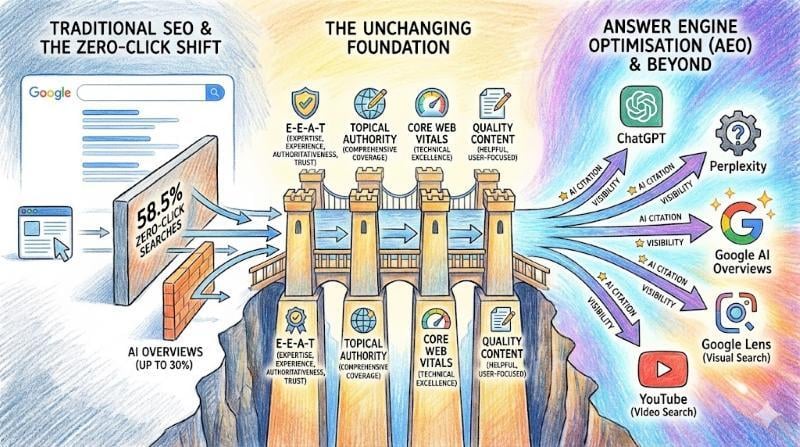
The core message from Google's 2025 algorithm updates is clear—the search giant continues prioritising genuinely helpful content backed by demonstrable expertise. Sites hit hardest by the December 2025 core update were affiliate sites (71% impacted) and health/YMYL content (67%), whilst brands with strong E-E-A-T signals and excellent user experience emerged as winners.
This guide synthesises Whitehat SEO's analysis of the latest research, statistics, and best practices across 14 critical ranking factors for the next 12-18 months.
Google's 2025 Algorithm Updates Signal Quality Over Quantity
Google released four official algorithm updates in 2025, notably fewer than the seven updates in 2024 and nine in 2023. This reduction reflects Google's shift toward more comprehensive, less frequent updates that encompass multiple ranking signal changes simultaneously.
The March 2025 Core Update (rolled out 13-27 March) focused on surfacing content from diverse creators. Google explicitly stated it would surface more content from creators through improvements throughout the year. The June 2025 Core Update brought partial recoveries for sites affected by the September 2023 Helpful Content Update—Raptive data showed approximately 60% of HCU-affected sites saw traffic rebounds, with weekly traffic increasing 20% above pre-update levels.
The December 2025 Core Update proved most significant, running 11-29 December and causing substantial volatility. Analysis from ALM Corp examining 847 affected websites revealed which site types were most impacted:
| Site Type | Impact Rate |
|---|---|
| Affiliate sites | 71% impacted |
| Health/YMYL sites | 67% impacted |
| E-commerce sites | 52% impacted |
| Wikipedia | Lost 435+ visibility points |
Major health publishers faced significant drops, whilst e-commerce and retail brands emerged as winners. High-authority medical institutions like Mayo Clinic and Cleveland Clinic initially dropped but rebounded after update completion.
Google also confirmed it releases unannounced "smaller core updates" throughout the year. Their documentation states these updates are not announced because they aren't widely noticeable, meaning sites can see ranking changes outside major update windows. For UK businesses, Whitehat SEO recommends regular website audits to identify technical issues before they compound during algorithm updates.
E-E-A-T Has Evolved from Checklist to Strategic Foundation
Google's John Mueller clarified at Search Central Live NYC in late 2025 that E-E-A-T (Experience, Expertise, Authoritativeness, and Trustworthiness) is not a direct ranking factor nor a checklist for SEOs. Instead, it serves as a framework for assessing content quality in areas where trust and reliability are critical. Quality raters use E-E-A-T to evaluate search results, which then informs algorithm training.
The January 2025 Search Quality Rater Guidelines update introduced significant changes: formal definitions for AI-generated content, new guidance on rating generative AI content, and expanded spam definitions covering scaled content abuse, expired domain abuse, and site reputation abuse. The September 2025 update expanded the guidelines to 182 pages, adding AI Overview rating criteria.
For practical implementation, the data shows E-E-A-T signals correlate with rankings through several mechanisms. URLs with high engagement metrics showed nearly 4x more user ratings and 3x more comments compared to declining URLs. Content demonstrating first-hand experience through original media, testing results, and specific details consistently outperforms theoretical content.
Key E-E-A-T Implementation Priorities
- Comprehensive author bios with verifiable credentials
- Connected profiles linking to LinkedIn and professional directories
- Transparent contact information and company details
- For YMYL topics—demonstrable professional qualifications
- Original research, case studies, and first-hand experience
Google's John Mueller stated in November 2025: "Our systems don't care if content is created by AI or humans. We care if it's helpful, accurate, and created to serve users rather than just manipulate search rankings." This underscores why ethical SEO services that prioritise genuine expertise consistently outperform manipulation tactics.
Core Web Vitals Thresholds Remain Stable but INP Demands Attention
The current Core Web Vitals thresholds remain unchanged from their 2024 benchmarks, but INP (Interaction to Next Paint) officially replaced FID on 12 March 2024 and presents a more demanding standard for sites to meet.
| Metric | Good | Needs Improvement | Poor |
|---|---|---|---|
| LCP (Largest Contentful Paint) | ≤2.5 seconds | 2.5-4 seconds | >4 seconds |
| INP (Interaction to Next Paint) | ≤200ms | 200-500ms | >500ms |
| CLS (Cumulative Layout Shift) | ≤0.1 | 0.1-0.25 | >0.25 |
The critical distinction with INP is that it measures all interactions throughout the page lifecycle, not just the first input. This captures the full interaction latency including input delay, processing time, and presentation delay—making it substantially harder to pass than the previous FID metric.
Only approximately 47% of websites currently pass their Core Web Vitals assessment, creating significant competitive opportunity. WordPress sites lag notably at just 43.44% passing on mobile, whilst Shopify achieves approximately 83% and Duda leads CMS rankings at 83.63%.
The ranking impact data is compelling. Core Web Vitals account for approximately 10-15% of ranking signals, functioning as what industry experts describe as a quality tiebreaker when content is comparable. Case studies demonstrate substantial business impact:
- Vodafone: 31% LCP improvement drove an 8% sales increase
- Rakuten: CWV optimisation delivered 33% conversion rate increase and 53% revenue per visitor increase
- Yahoo! JAPAN: CLS fixes generated 15.1% more page views per session
Pages with LCP above 3 seconds experienced 23% more traffic loss than faster competitors with similar content during the 2025 algorithm updates. Meanwhile, 53% of mobile users abandon sites taking more than 3 seconds to load. Whitehat SEO's website design services prioritise Core Web Vitals performance from the ground up.
AI Search Engines Capture Growing Share Despite Google's Dominance
The AI search landscape has experienced explosive growth, though Google maintains commanding traditional search market share at 89-90.7% globally. The real shift is in how users are distributing their queries across platforms.
ChatGPT now serves 800-900 million weekly active users with 5.72 billion monthly website visits, processing over 1 billion queries daily. This represents a doubling from 400 million weekly users in February 2025. ChatGPT commands 81% market share in the AI chatbot sector.
Perplexity has achieved 780 million queries per month with 22-45 million active users, growing an extraordinary 800% year-over-year. Google Gemini reached 400 million monthly active users by May 2025 with 170% YoY growth. Claude serves approximately 18.9-30 million monthly active users, with 164.82 million monthly visits by August 2025—representing a 10.3x increase from January 2025.
AI Traffic Distribution (2025)
- ChatGPT: 77.97-87.4% of AI referral traffic
- Perplexity: 15.10% of AI referral traffic
- Gemini: 6.40% of AI referral traffic
- Total AI share: ~0.15% of global internet traffic (7x increase from 2024)
Crucially, LLM visitors convert 4.4x better than organic search visitors, making AI traffic particularly valuable despite lower volume. ChatGPT now sends more referral traffic than Reddit and LinkedIn combined. This is why Whitehat SEO's Answer Engine Optimisation (AEO) services have become essential for forward-thinking UK businesses.
AI Citation Patterns Reveal What Gets Referenced by LLMs
Research analysing 680 million AI citations reveals distinct patterns in how different AI platforms source information. Understanding these patterns is essential for optimising content for AI visibility.
ChatGPT favours Wikipedia heavily, with 7.8% of total citations going to Wikipedia (47.9% of its top 10 citation sources). Commercial (.com) domains receive over 80% of ChatGPT citations. Other frequently cited sources include G2, Forbes, and Amazon.
Perplexity heavily favours Reddit at 6.6% of citations, along with YouTube at 2% and industry-specific directories. Google AI Overviews similarly favour Reddit (2.2%), YouTube (1.9%), and Quora (1.5%), with more distributed sourcing patterns.
AI Citation Correlation Factors
| Factor | Correlation |
|---|---|
| Brand search volume | 0.334 (strongest) |
| Content depth (word count) | Strong positive |
| Domain Rating | 0.161 |
| Total backlinks | Negative |
| Keyword density | Negative |
The data shows brand authority matters more than backlinks for AI citations. Content updated within 30 days gets 3.2x more AI citations, whilst sites with structured heading hierarchies (H2→H3→bullet point structures) are 40% more likely to be cited.
High-performing content formats include comparative listicles (32.5% of all AI citations), with listicles achieving a 25% citation rate versus blogs at 11%. For optimal citation, structure content with 40-60 word paragraphs designed for chunk extraction. Only 11% of domains are cited by both ChatGPT and Perplexity, suggesting platform-specific optimisation may be necessary. Learn more in our guide on how to optimise content for AI search.
AI Overviews Now Appear in Up to 30% of Searches with Major CTR Impact
Google AI Overviews have rolled out aggressively, now reaching 1.5-2 billion monthly users across 200+ countries. Appearance rates vary by study: 13% globally according to Exposure Ninja, 16% of US desktop searches per SE Ranking, and up to 30% of US desktop keywords by September 2025 according to seoClarity. Mobile AI Overview appearances increased 474.9% year-over-year between September 2024 and September 2025.
The CTR impact is substantial. Seer Interactive's study of 3,119 queries across 42 organisations found organic CTR dropped 61% when AI Overviews appeared (from 1.76% to 0.61%). Paid CTR declined 68% (from 19.7% to 6.34%). Ahrefs' study of 300,000+ keywords showed a 34.5% CTR decline for top-ranking pages with AI Overviews present.
The upside for cited brands: Those appearing in AI Overviews earn 35% more organic clicks and 91% more paid clicks than non-cited competitors.
AI Overviews predominantly trigger for informational queries (88-91.3% of AIOs), with queries of 8 words or longer having a 57% chance of triggering an AI Overview. Science queries are most impacted at 25.96%, followed by Computers & Electronics at 17.92%.
Most AI Overview responses include 6-14 sources, with 97% citing at least one source from the top 20 organic results. Optimisation factors include semantic completeness (r = 0.87 correlation), E-E-A-T signals (96% of AIO content comes from sources with verified E-E-A-T), content freshness, and page speed—pages with First Contentful Paint under 0.4 seconds average 6.7 citations versus 2.1 for pages over 1.13 seconds.
Mobile-First Indexing Is Complete but Technical Excellence Differentiates
Google completed its transition to 100% mobile-first indexing on 5 July 2024. Googlebot Smartphone is now the default crawler for all sites, with the mobile version determining how Google views and ranks content across both desktop and mobile search results. Desktop is still indexed, but mobile is the baseline for all ranking signals.
With 62-64% of global web traffic originating from mobile devices, sites must ensure complete content parity between mobile and desktop versions. This includes identical meta tags, structured data, headings, and metadata. Google's recommendation is responsive design, with explicit guidance against blocking resources with robots.txt or using noindex tags on mobile versions.
For JavaScript-heavy sites, Google clarified in December 2025 that pages with non-200 HTTP status codes may skip rendering entirely, and canonical URLs must remain consistent before and after JavaScript rendering. Google's evergreen Chromium-based Web Rendering Service runs only a few versions behind the latest Chrome, but rendering can be delayed by days—making server-side rendering (SSR) the recommended approach for SEO-critical content.
Technical Requirements for 2026
- XML sitemaps with maximum 50,000 URLs per file
- robots.txt configured to allow CSS/JavaScript that Google needs for rendering
- "Flat" site architecture keeping pages only a few links apart
- HTTPS as a required baseline
- Structured data focus on Organisation, LocalBusiness, Product, Article, Review/AggregateRating, FAQ, and HowTo schemas (JSON-LD format)
Pages featuring rich results see 20-30% higher CTR. For comprehensive technical SEO support, explore Whitehat SEO's SEO services for UK businesses.
Backlinks Matter Less but Quality Signals Matter More
The importance of backlinks has measurably decreased, though they remain relevant. First Page Sage's Q1 2025 study shows backlinks dropped from 15% to 13% of algorithm weight and were once more than 50% of the algorithm.
Google's Gary Illyes stated in April 2024: "We need very few links to rank pages... Over the years, we've made links less important." He clarified that links are no longer in Google's top three ranking factors. Google's March 2024 algorithm update removed the word "important" from documentation regarding links. However, PageRank remains active—Google confirms it's one of their core ranking systems.
Quality indicators have shifted significantly. Link relevance and topical authority now outweigh volume. The #1 result in Google has an average of 3.8x more backlinks than positions #2-#10, but the type of links matters enormously. Businesses earning backlinks from high-DR domains (70+) see 42% faster keyword growth.
Digital PR has emerged as the dominant link building strategy, with 48.6% of SEOs ranking it the most effective tactic—far ahead of guest posting at 16%. John Mueller stated: "I love some of the things I see from digital PR; it's a shame it often gets bucketed with the spammy kind of link building." Journalists are 3.2x more likely to cover stories backed by exclusive research versus traditional press releases.
For anchor text, maintain branded anchors at 20-40%, naked URLs at 15-25%, generic anchors at 10-20%, and keep exact match anchors under 5-20% depending on industry. Google's 2025 link spam updates specifically warn against overuse of exact match anchors.
Content Depth Wins Only When Matched with Comprehensive Topic Coverage
The consensus from 2025 research is clear: word count is not a direct ranking factor, but comprehensiveness is. Google's John Mueller stated: "From our point of view the number of words on a page is not a quality factor, not a ranking factor."
However, correlation studies show the average first page result contains approximately 1,447-1,500 words, and content exceeding 7,000 words gets 3x more shares and links. SurferSEO's 2025 study of 1 million pages revealed a crucial insight: when pages used at least 50% of suggested terms, text length stopped mattering entirely—with a slight preference for shorter, more focused content.
Topical authority has become a primary ranking factor, holding steady at 13% of algorithm weight in First Page Sage's analysis. Google's June 2025 Core Update reinforced this, rewarding sites covering subjects thoroughly, consistently, and credibly. Content grouped into topic clusters drives approximately 30% more organic traffic and holds rankings 2.5x longer than standalone pieces.
Content freshness matters for time-sensitive queries under Google's Query Deserves Freshness (QDF) system, but not for evergreen content. Sites publishing at least weekly show 3.2x better ranking improvements than monthly publishers. Updated content delivers 2.7-4.1x ROI compared to creating entirely new content, and updated pages can appear in search results 76% faster than un-optimised ones.
The strategic approach: cover topics comprehensively using semantically relevant terms rather than padding word count. Use pillar pages of 1,500-3,000 words supported by cluster pages diving deep into subtopics, all connected through strategic internal linking. Learn more about our approach to HubSpot content strategy for SEO.
Zero-Click Searches Dominate as AI Reshapes User Behaviour
58.5% of US Google searches now result in zero clicks, with 59.7% in the EU/UK according to SparkToro's comprehensive clickstream analysis. For every 1,000 US Google searches, only 360 clicks go to the open web. Nearly 30% of all clicks go to Google-owned properties including YouTube, Maps, and Images.
The mobile-desktop gap is stark: 77.2% of mobile searches end without clicks versus 46.5% on desktop. Almost 50% of mobile searches end the browsing session entirely—2x higher than desktop.
AI Overviews have accelerated this trend dramatically. Searches triggering AI Overviews show an 83% zero-click rate versus 60% for traditional queries. Even queries without AI Overviews saw 41% CTR decline year-over-year. Multiple analysts predict zero-click searches will reach 70% by late 2025 or early 2026.
Position #1 CTR has dropped from 28% to 19% (a 32% decline) from 2024 to 2025 across a study of 200,000+ keywords. For news-related searches, zero-click outcomes rose from 56% to approximately 69% between May 2024 and May 2025.
Strategic Implications for UK Businesses
- Track Share of Voice and AI visibility as new KPIs alongside traffic
- Create content optimised for 40-60 word direct answers designed for featured snippet and AI citation
- Use FAQ schema and HowTo markup to increase visibility in zero-click features
This shift underscores why Answer Engine Optimisation has become essential—your brand needs to appear in the answer, not just the results.
Local SEO Factors Shift Toward Reviews and GBP Optimisation
The Whitespark/BrightLocal 2026 Local Search Ranking Factors Survey (November 2025) reveals the current weighting for Local Pack/Maps rankings:
| Factor | Weight |
|---|---|
| Google Business Profile | 32% |
| Reviews (up from 16% in 2023) | 20% |
| On-page signals | 15% |
| Behavioural signals | 9% |
| Links | 8% |
| Citations | 6% |
| Personalisation | 6% |
Reviews have grown in importance, whilst link signals continue to decline for local pack rankings. The primary GBP category remains the single most important local pack factor, followed by keywords in business description and high-quality backlinks from relevant sources.
Consumer behaviour underscores local search importance: 46% of all Google searches have local intent, 80% of US consumers search for local businesses weekly, and 76% of "near me" searches result in a business visit within 24 hours. The Map Pack captures 44% of local search clicks—businesses in the local 3-pack get 126% more traffic and 93% more actions.
AI is reshaping local search as well: 40.2% of local business queries now trigger Google's AI Overviews. AI search results now interpret themes within reviews such as speed, quality, and friendliness, making review sentiment increasingly important alongside volume and recency.
Video and Visual Search Represent Major Growth Opportunities
YouTube has solidified its position as a critical search platform with 3.5 billion daily searches and 2.85 billion monthly active users. Crucially, 70% of views now come from YouTube recommendations rather than search, making optimisation for the recommendation algorithm essential.
YouTube Shorts has surpassed TikTok and Instagram Reels with 2 billion monthly users and over 200 billion daily views—up from 70 billion in March 2024. Shorts engagement rate of 5.91% exceeds TikTok's 3.15%. Channels using Shorts alongside long-form content grow 41% faster, and 74% of Shorts views come from non-subscribers, making it the primary discovery format.
YouTube ranking factors prioritise watch time, audience retention, CTR (thumbnail and title effectiveness), engagement signals, and session time. Video results are 50x more likely to rank organically versus text, with video search results achieving 41% higher CTR. Blog posts with videos get 157% more search traffic and attract 3x more inbound links.
Visual search through Google Lens has grown dramatically to 20+ billion visual searches per month—a 250% increase compared to 2023. Recognition accuracy now exceeds 95% for common objects, with Lens able to identify up to 1 billion different items. For image optimisation, 32.5% of Google Lens results have matching keywords in the page title, emphasising the importance of on-page SEO for visual search visibility.
Key Priorities for the Next 12-18 Months
The SEO landscape of 2026 demands a dual-track approach: maintaining technical excellence for traditional rankings whilst preparing for an AI-mediated discovery future. Whitehat SEO's analysis of the evidence points to several clear priorities.
Quality Signals Compound Across Channels
Strong E-E-A-T, comprehensive topical coverage, and excellent user experience correlate with success across Google rankings, AI citations, and zero-click visibility. Sites investing in genuine expertise and helpful content are positioned to win regardless of how discovery evolves.
Technical Baselines Are Now Table Stakes
With only 47% of sites passing Core Web Vitals, technical excellence provides competitive advantage. Mobile-first indexing is complete; sites with poor mobile experience face fundamental disadvantage.
AI Visibility Requires New Optimisation Approaches
The 527% growth in AI referral traffic and 4.4x higher conversion rate makes AI citation optimisation worthwhile. Focus on brand authority, content freshness (30-day updates get 3.2x more citations), structured heading hierarchies, and 40-60 word "citation blocks" that answer queries directly.
Measurement Must Evolve Beyond Traffic
With 58.5% zero-click searches and AI Overviews suppressing CTR by 61%, traditional traffic metrics miss significant brand exposure. Track Share of Voice, AI visibility, and attribution in featured snippets and AI Overviews alongside organic sessions.
The sites that thrive in 2026 will be those treating SEO not as a channel-specific tactic, but as a foundation for discoverability across an expanding ecosystem of search experiences—from traditional SERPs to AI chatbots to visual search. The fundamentals remain constant: create genuinely helpful content, demonstrate real expertise, and deliver excellent user experiences. The distribution channels are multiplying.
Frequently Asked Questions
What are SEO factors?
SEO factors are the elements you can optimise on your website to improve how Google ranks your pages in search results. The most influential SEO factors in 2026 are E-E-A-T signals (demonstrated expertise, authoritativeness, trust), topical authority across content clusters, Core Web Vitals performance, content comprehensiveness, AI-citation-ready structure (40-60 word direct answers, schema markup, clear heading hierarchy), and high-quality backlinks. Whitehat SEO's 2026 ranking analysis identifies 14 critical SEO factors UK businesses must address to maintain organic visibility as AI search reshapes user behaviour.
What are the most important SEO ranking factors in 2026?
The most important SEO ranking factors in 2026 are demonstrated expertise (E-E-A-T), topical authority (13% of algorithm weight), Core Web Vitals performance, content comprehensiveness, and AI-optimised content structure. Backlinks remain relevant but have decreased to 13% of algorithm weight, with quality now far outweighing quantity.
How do I optimise content for AI search engines like ChatGPT?
To optimise content for AI search engines, structure content with clear heading hierarchies (H2→H3→bullet points), write 40-60 word direct answer paragraphs that can be extracted as standalone citations, include statistics with source attribution, update content within 30 days for 3.2x more AI citations, and build brand authority through review platforms and third-party mentions.
What is the impact of Google AI Overviews on organic traffic?
Google AI Overviews significantly reduce organic click-through rates—organic CTR drops 61% when AI Overviews appear. However, brands cited within AI Overviews earn 35% more organic clicks than non-cited competitors. AI Overviews now appear on up to 30% of searches, making optimisation for AI citation essential for maintaining organic visibility.
Are backlinks still important for SEO in 2026?
Backlinks remain a ranking factor but have decreased in importance to approximately 13% of algorithm weight, down from over 50% historically. Quality now dramatically outweighs quantity—backlinks from high-DR domains (70+) drive 42% faster keyword growth. Digital PR has emerged as the most effective link building strategy, with 48.6% of SEOs ranking it the top tactic.
What percentage of Google searches result in zero clicks?
According to SparkToro's 2024 research, 58.5% of US Google searches and 59.7% of EU/UK searches result in zero clicks. On mobile devices, this rises to 77.2%. Searches triggering AI Overviews show an 83% zero-click rate. These statistics underscore why optimising for visibility within search results—not just rankings—is now critical for UK businesses.
References & Sources
- SparkToro & Datos (2024) — Zero-Click Search Study
- Search Engine Land (2024) — Google Zero-Click Search Analysis
- Search Engine Land (2025) — Zero-Click Searches Rise, Organic Clicks Dip
- Datos & SparkToro (2025) — State of Search Q1 2025 Report
- Semrush (2025) — AI Overviews Impact on Search
- BrightLocal & Whitespark (2025) — Local Search Ranking Factors Survey
- First Page Sage (2025) — Google Ranking Factor Weights
Ready to Optimise for SEO and AI Search?
Whitehat SEO helps UK B2B companies build organic visibility that works across Google, ChatGPT, and emerging AI platforms. As a HubSpot Diamond Partner, we connect your SEO performance directly to revenue.
Book a Discovery Call