
Answer Engine Optimisation (AEO)
AI-mediated product discovery has shifted from emerging trend to present reality, with e-commerce marketing directors now facing a strategic imperative to optimise for ChatGPT, Google AI Mode, Perplexity, and Amazon Rufus. Whitehat's analysis of this rapidly evolving landscape reveals that brands treating AI engines as a distinct channel—with their own technical, content, and distribution requirements—are capturing citation real estate that will define product discovery for the next decade. Gartner predicts organic search traffic will decline by 25% by 2026 and 50% or more by 2028 as consumers embrace AI-powered discovery, creating both urgency and first-mover opportunity for businesses prepared to act now.
AI Is Rewriting E-commerce Product Discovery: What Marketing Directors Must Do Now
AI referral traffic to retail sites has surged 4,700% year-over-year, with visitors converting at 31% higher rates than all other traffic sources. The strategic question is no longer whether to optimise for AI answer engines, but how urgently to act.
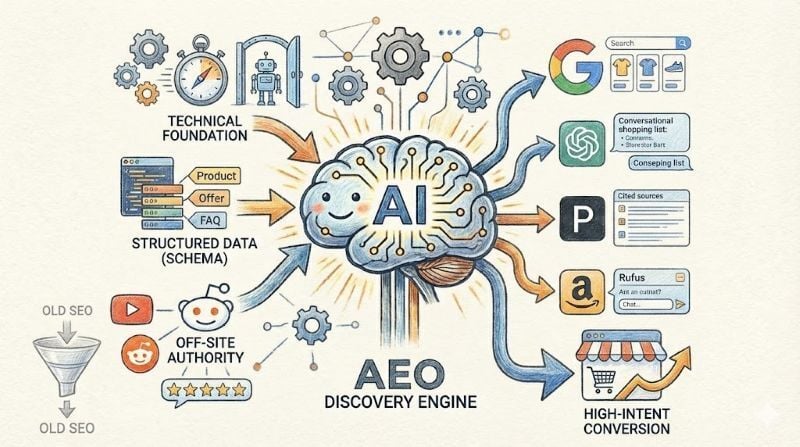
The Five Platforms Reshaping How Consumers Find Products
The conversational commerce landscape in early 2026 is defined by five major AI platforms, each approaching product discovery differently and creating distinct optimisation requirements for e-commerce businesses.
Google AI Mode
Google AI Mode represents the most significant evolution of search since mobile. The Shopping Graph underpinning it now contains over 50 billion product listings, updated more than 2 billion times per hour. Users can ask natural-language questions like "I need running shoes for flat feet under £120" and receive dynamic product panels with images, pricing, reviews, and real-time inventory. At NRF 2026, Google unveiled the Universal Commerce Protocol (UCP)—an open-source standard enabling native checkout directly within AI Mode.
ChatGPT Shopping
ChatGPT has evolved into a formidable shopping platform serving approximately 50 million shopping queries daily across its 800 million weekly user base. OpenAI launched product recommendation features in April 2025, followed by Instant Checkout in September 2025. ChatGPT's product feeds can refresh every 15 minutes—significantly faster than Google Shopping's 24-hour default—making real-time inventory accuracy a competitive advantage for participating merchants.
Perplexity and Amazon Rufus
Perplexity differentiates through citation-forward responses that always attribute sources, with its partnership with PayPal enabling in-chat purchases from over 5,000 merchants. Amazon's Rufus has reached over 300 million customers and drove £9.5 billion in incremental annualised sales in 2025. Customers who engage with Rufus are 60% more likely to complete a purchase.
How AI Engines Decide Which Products to Recommend
Understanding the citation mechanics of each platform is essential for any Answer Engine Optimisation (AEO) strategy, and the differences are stark.
BrightEdge analysis reveals: ChatGPT cites retailers approximately 36% of the time for shopping queries, whilst Google AI Overviews cite retailers only about 4%—a ninefold difference.
This divergence exists because Google's AI Overviews sit above Shopping carousels that handle transactions, so they focus on research and user-generated content. ChatGPT must serve as both research assistant and shopping guide in a single response.
The sources each platform trusts vary considerably. Google AI Overviews for product queries lean heavily on YouTube reviews (the single most-cited domain at roughly 32%), Reddit discussions, and Quora answers—reflecting a preference for authentic user perspectives over commercial content. ChatGPT, by contrast, favours direct retailer sources.
One critical finding deserves attention: there is a less than 1-in-100 chance that ChatGPT, if asked the same product question 100 times, will return the same list of brands in any two responses. AI recommendations are inherently variable, which means consistent brand presence across multiple authoritative sources matters far more than optimising for a single citation opportunity. Indeed, brand mentions correlate with AI visibility at 0.664—three times more predictive than traditional backlinks at 0.218.
The Technical Foundation Every E-commerce Site Needs
The most immediate and actionable AEO opportunity for most e-commerce sites is also the most overlooked: 68% of enterprise websites inadvertently block at least one major AI crawler. Before optimising content or schema, marketing directors must ensure their sites are even visible to AI engines.
Critical Technical Discovery
AI crawlers do not execute JavaScript. Unlike Googlebot, which renders JavaScript-heavy pages, GPTBot, ClaudeBot, and PerplexityBot read only the initial HTML response. E-commerce sites built on JavaScript frameworks that render product descriptions, pricing, and reviews client-side are effectively invisible to AI engines. Server-side rendering of all critical product content is non-negotiable.
AI crawlers also have very short timeouts of 1-5 seconds, making page speed a citation factor. The robots.txt configuration requires careful attention. E-commerce sites wanting AI visibility should explicitly allow OAI-SearchBot (ChatGPT's citation crawler), PerplexityBot, and ClaudeBot, whilst also checking that web application firewalls and CDN settings haven't automatically blocked these user agents.
Schema Markup Amplifies AI Citation Rates
Products with detailed structured data appear in AI recommendations 3-5 times more often than those without. Adding FAQ schema has been shown to boost ChatGPT citations by up to 140% in controlled tests, and pages using three or more schema types show measurably higher AI citation rates.
The priority implementation order for e-commerce:
- Product and Offer schema (critical)
- AggregateRating and Review schema (high priority)
- FAQPage schema (high priority)
- BreadcrumbList schema for category hierarchy context
All schema should be implemented in JSON-LD format, and the data must exactly match visible page content—discrepancies between schema and displayed information create trust issues with AI systems.
UK E-commerce Faces a Distinct AI Adoption Curve
The UK market presents both urgency and opportunity for e-commerce businesses. Adyen's UK Retail Report 2025 found that 35% of UK consumers now use AI tools to shop online, with adoption surging 39% in a single year. Among 16-27 year olds, adoption reaches 54%, and the 44-59 age group recorded the biggest year-over-year increase—suggesting AI shopping is rapidly moving beyond early adopters into the mainstream.
| UK Market Indicator | Current Status |
|---|---|
| UK consumers using AI shopping tools | 35% (up 39% YoY) |
| AI Overviews in UK searches | 12.5% (vs 16% US) |
| UK retailers investing in AI for marketing | Only 35% |
| Consumer trust in AI recommendations (UK) | 43% (up from 40% in 2024) |
| Open to AI shopping assistants | 66% |
UK publishers have already experienced CTR declines of 10-25% year-over-year despite stable or improving rankings, with one UK lifestyle publisher seeing CTR collapse from 5.1% to 0.6%. This gap between consumer adoption and retailer investment creates significant first-mover opportunity for businesses prepared to act.
Disintermediation Is Real, But Your Website Still Matters
The most existential threat to e-commerce businesses is disintermediation—AI platforms completing purchases without consumers ever visiting a retailer's website. This threat materialised rapidly throughout 2025. ChatGPT's Instant Checkout, Google's agentic checkout via Google Pay, and Perplexity's PayPal-powered in-chat purchasing all enable transactions within the AI interface itself.
BCG's September 2025 white paper warned explicitly: "Merchants will face challenges as their customer relationships and brand relevance erode" as AI agents compare products. Gartner projects that by 2028, 90% of B2B buying will be AI agent-intermediated, pushing over £12 trillion through AI agent exchanges.
However, the picture is not entirely bleak for brand owners. Research from Future Commerce found that when AI recommends a product, 77% of shoppers still prefer to leave the platform and visit the brand's website to purchase. The website remains the centre of context, trust, and information for generative engines—it is both the destination consumers want and the source AI engines need to generate recommendations.
Case Study: NerdWallet
NerdWallet demonstrated this dynamic powerfully, reporting 35% revenue growth despite a 20% decrease in site traffic by ensuring its content and brand expertise reached consumers through AI snippets and other channels. Traffic volume may decline, but the traffic that arrives via AI channels converts at significantly higher rates and delivers more engaged visitors who spend 32% longer on site, view 10% more pages, and bounce 27% less often.
A Practical Roadmap for E-commerce AEO Adoption
Conductor's recommendation to allocate 20-30% of existing SEO budget to AEO/GEO initiatives provides a useful starting framework. The competitive landscape for AI citations remains far less crowded than traditional SEO—fewer than 1 in 5 brands currently achieve both frequent mentions and consistent citations in AI results, and 77% of marketing professionals lack a clear AI discovery strategy.
Whitehat's Five-Point AEO Implementation Framework
Audit and Unblock AI Crawlers
Review robots.txt and WAF settings, ensure all product content renders server-side, and verify page load times under 5 seconds.
Implement Comprehensive Schema Markup
Deploy Product, Offer, AggregateRating, and FAQPage schema across all product and category pages in JSON-LD format.
Submit Product Feeds to AI Platforms
Register with ChatGPT's merchant portal and ensure Google Merchant Centre data is complete and accurate.
Create Comparison and Buying Guide Content
Target "best [product] for [use case]" queries, including honest competitor comparisons that AI engines can cite.
Build Off-Site Brand Presence
Develop presence through Reddit community participation, YouTube review coverage, and earned media—remembering that up to 90% of citations driving brand visibility in AI come from earned media sources.
The off-site dimension is particularly critical. AI systems build confidence scores from consensus across multiple independent sources. A product with 500 Amazon reviews that ChatGPT cannot access performs worse than one with 50 verified reviews scattered across the brand's own site, Reddit, and independent review platforms. YouTube product reviews are the single most-cited source for Google AI Overviews in e-commerce, making video content strategy an unexpectedly high-priority AEO investment.
The New Discovery Economics Demand Action Now
The data points toward a clear conclusion: AI-mediated product discovery is not a future trend but a present reality reshaping e-commerce economics. The conversational commerce market, valued at £7-10 billion in 2025, is projected to reach £16-26 billion by the early 2030s. AI referral traffic, whilst still representing roughly 1% of total website traffic, is growing at rates exceeding 700% annually and now converts better than every other traffic source.
Meanwhile, traditional organic search traffic is eroding—zero-click searches have grown from 56% to 69% since AI Overviews launched, and organic CTR drops 61% when an AI Overview appears for a query.
The strategic implication for e-commerce marketing directors is that AEO is not a replacement for traditional SEO but an essential parallel discipline. The brands that will thrive are those treating AI engines as a distinct channel with its own technical requirements, content requirements, and distribution requirements.
The first-mover window remains open—competition for AI citations is still low relative to traditional search—but it is closing as retailers begin redirecting budgets from SEO to AEO consultancy. The comparison to the mobile-first transition is apt: structured data is becoming a baseline requirement, not a competitive advantage, and marketing teams will soon be held accountable for "agent readiness" in the same way they were once accountable for mobile responsiveness.
The time to begin is not next quarter. It is now.
Frequently Asked Questions
What is Answer Engine Optimisation (AEO) for e-commerce?
AEO is the practice of optimising product content, technical infrastructure, and off-site presence to be cited and recommended by AI platforms like ChatGPT, Google AI Mode, and Perplexity when consumers ask shopping-related questions. Unlike traditional SEO which targets ranking positions, AEO focuses on getting your brand mentioned directly within AI-generated responses.
How much should e-commerce businesses invest in AEO?
Conductor recommends allocating 20-30% of existing SEO budget to AEO and GEO initiatives. Because competition for AI citations remains far less crowded than traditional search, this investment can yield disproportionate returns during the current first-mover window.
Does AEO replace traditional SEO for online retailers?
No. AEO complements SEO—it doesn't replace it. Traditional SEO still captures the majority of search traffic, but AI search is growing rapidly. The tactics overlap significantly, so the incremental investment is modest whilst preparing your business for the future of product discovery.
Which schema types matter most for AI visibility?
Product and Offer schema are critical foundations. AggregateRating and Review schema are high priority for building trust signals. FAQPage schema can boost ChatGPT citations by up to 140%. All schema should be implemented in JSON-LD format with data matching visible page content exactly.
How do I check if AI crawlers can access my e-commerce site?
Review your robots.txt file for disallow rules affecting GPTBot, OAI-SearchBot, PerplexityBot, and ClaudeBot. Check WAF and CDN settings for automatic AI bot blocking. Test your site with JavaScript disabled to verify product content renders server-side. Monitor server logs for 403 errors from AI user agents.
Ready to Optimise for AI Product Discovery?
Whitehat's AEO and SEO services help e-commerce businesses capture the AI citation opportunities that will define product discovery for the next decade.
Book a Free AEO ConsultationReferences and Further Reading
- Gartner (2024). Gartner Predicts Search Engine Volume Will Drop 25% by 2026. Gartner Newsroom.
- BrightEdge (2025). Who Does AI Trust? Google vs. ChatGPT Citation Patterns. BrightEdge AI Search Insights.
- Search Engine Land (2025). Google AI cites retailers 4% vs. ChatGPT at 36%. Search Engine Land.
- BrightEdge (2025). AI Search Visits Surging in 2025. BrightEdge Research Reports.
- Search Engine Journal (2025). Research Shows How To Optimise For Google AIO And ChatGPT. Search Engine Journal.
About Whitehat SEO
Whitehat is a London-based HubSpot Diamond Partner and full-service inbound marketing agency specialising in SEO, AEO, and AI optimisation. We run the world's largest HubSpot User Group (London HUG) and have delivered search marketing results for B2B companies since 2011.