
SEO Strategy Guide
This guide synthesises the latest data across all key research areas to help B2B marketers navigate this transition. At Whitehat SEO, we've been testing these approaches with our clients since AI Overviews launched—and the results confirm that ethical, user-first SEO isn't just viable in 2026, it's essential.
The Complete Guide to Ethical Search Strategy in the AI Era
How to build visibility across Google, AI Overviews, ChatGPT, and Perplexity—without gaming the system
Honest SEO remains the most effective digital marketing strategy in 2026, delivering a median ROI of 748% despite AI disruption. The fundamentals—quality content, genuine expertise, technical excellence—haven't just survived the AI revolution; they've become the only reliable approach that scales across Google, AI Overviews, ChatGPT, Perplexity, and emerging answer engines.
The SEO landscape has shifted more in the past 12 months than in the previous five years combined. Google shipped four confirmed algorithm updates in 2025, AI Overviews now appear on roughly 13–18% of all queries globally (and up to 99.9% of informational queries by some measures), and zero-click searches have climbed to 58–65% of all Google searches.
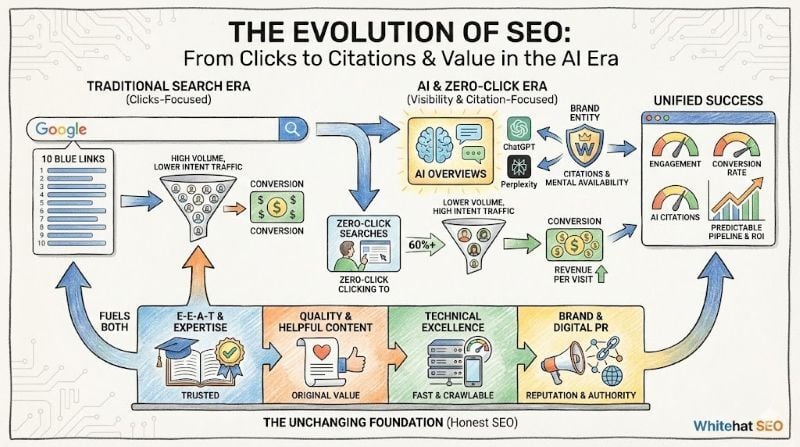
Yet organic search still drives 53.3% of all website traffic according to BrightEdge research. The opportunity hasn't disappeared—it's evolved.
Google Algorithm Updates Reshaped Quality in 2025
Google launched four confirmed updates in 2025—down from seven in 2024, but described by analysts as "super volatile" despite the lower count. The key shift: the Helpful Content System is now fully integrated into core ranking logic. There are no standalone Helpful Content Updates any longer.
2025 Update Timeline
- March 2025 Core Update (14 days): Reversed visibility gains for forums, continued rewarding Reddit. Sites relying on mass-generated programmatic pages saw noticeable drops.
- June 2025 Core Update (16 days): Some sites previously hit by the September 2023 Helpful Content Update saw partial recoveries for the first time.
- August 2025 Spam Update (27 days): SpamBrain-powered, targeting link spam (especially PBN networks), thin/scraped content, cloaking, and scaled content abuse.
- December 2025 Core Update (18 days): Described as "decisively raising the minimum quality threshold required to compete."
The December update hit hard on product pages with manufacturer-only descriptions, thin category pages, and affiliate sites without original testing. E-commerce sites with detailed product testing and verified customer reviews performed well. This aligns with what Whitehat SEO has observed across our client base: original value—not content volume—is what differentiates winners from losers.
AI Overviews Are Reshaping Click Behaviour
The prevalence of AI Overviews varies significantly by methodology. Semrush tracked AIOs rising from 6.49% of queries in January 2025 to approximately 25% by July, before retreating to under 16% by November. Ahrefs found AIOs in 99.9% of informational keywords specifically.
61%
Drop in organic CTR when AI Overviews are present (from 1.76% to 0.61%)
Source: Seer Interactive, September 2025
The CTR impact is severe—but there's a silver lining. Brands cited within AIOs see +35% organic clicks and +91% paid clicks compared to non-cited brands. The question isn't whether AI Overviews exist; it's whether your brand appears in them.
Which Queries Trigger AI Overviews?
Understanding trigger patterns helps focus your optimisation efforts:
- Between 88–99% of AIO-triggering queries are informational
- Queries of 8+ words are 7× more likely to trigger an AIO
- Only 7.9% of local searches trigger them
- Highest-prevalence industries: healthcare (87%), education (87%), B2B tech (70%)
For B2B companies, this means informational content is most at risk of zero-click erosion, while commercial and transactional content retains more click potential. Whitehat SEO's Answer Engine Optimisation service helps clients structure content for AI citation rather than competing against it.
How AI Engines Cite Sources (And How to Earn Citations)
The citation patterns of ChatGPT, Perplexity, and Google AI Overviews differ meaningfully, but share common threads that honest SEO practitioners can leverage.
| Platform | Citation Rate | Key Characteristic |
|---|---|---|
| ChatGPT | 16% | Favours high-authority domains (65.3% have DR 81+) |
| Perplexity | 97% | Heavily rewards content freshness (50% from 2025) |
| Google AI Overviews | 34% | 92.36% of citations from top-10 ranking domains |
The GEO Research: What Actually Works
The Princeton/Georgia Tech GEO study (published at KDD 2024, 10,000 queries) found that Generative Engine Optimisation can boost visibility by up to 40% in AI engine responses. The three most effective strategies were:
- Citing sources—delivering 30–40% improvement
- Adding quotations—delivering 30–40% improvement
- Including statistics—delivering 30–40% improvement
Keyword stuffing performed poorly. Lower-ranked websites benefited most: the "cite sources" strategy led to a 115.1% visibility increase for 5th-ranked sites.
"SEO for AI is still SEO. GEO is a subset of SEO, not a separate discipline."
— Danny Sullivan, Google Search Liaison (before departing August 2025)
This aligns with Whitehat SEO's approach: we don't treat AEO as a separate service, but as an extension of honest SEO practice. Content that genuinely helps users—with clear structure, attributed data, and real expertise—naturally performs well across both traditional search and AI engines.
Zero-Click Searches Hit New Highs—But AI Traffic Converts Better
Zero-click searches reached 58.5% in the US and 59.7% in the EU according to Semrush's 2025 data. On mobile, zero-click rates hit 75–77%. Google AI Mode produces a staggering 93% zero-click rate.
The publisher impact has been dramatic. News sector organic traffic plummeted from 2.3 billion monthly visits to under 1.7 billion (May 2024 to May 2025). Business Insider lost 55% of organic traffic; HuffPost lost 50% of search referrals.
The Silver Lining
AI referral traffic, while small (under 1% of total web traffic), is growing explosively at 527% year-over-year and converts at dramatically higher rates. Microsoft Clarity found AI traffic converts at 3× the rate of other channels. Semrush data shows LLM visitors convert 4.4× better than organic search.
This reframes the opportunity. Even as organic click volumes decline, the visitors who do arrive—whether from traditional search or AI engines—are increasingly high-intent. Smart B2B marketers should recalibrate success metrics away from pure traffic volume toward engagement, conversion, and revenue per visitor. This is exactly the measurement approach we implement for clients using HubSpot's attribution tracking.
E-E-A-T and Content Quality Standards Tightened Significantly
E-E-A-T (Experience, Expertise, Authoritativeness, Trustworthiness) remains Google's central quality evaluation concept, used by approximately 16,000 external quality raters. Trust remains the most important pillar.
The Quality Rater Guidelines saw two updates in 2025. The January update was major: it added a formal definition of generative AI content, updated guidance on spam and scaled content abuse, and clarified that AI content where "all or almost all" main content is AI-generated and lacks effort, originality, and added value can receive the "Lowest" rating.
Google's Stance on AI Content
Google's official position: Google does NOT penalise content simply because it's AI-generated. The line is manipulation: "Using automation—including AI—to generate content with the primary purpose of manipulating ranking in search results violates our spam policies."
"I wouldn't think about it as AI or not, but about the value that the site adds to the web. Just rewriting AI content by a human won't change that, it won't make it authentic."
— John Mueller, Google Search Advocate
The consensus for 2026: AI as a tool is fine; AI as a content farm is not. Content performing best is "the kind AI can't easily imitate: opinionated commentary, first-hand experience, data-rich insights, and multimedia storytelling." This is why Whitehat SEO's approach to AI focuses on augmenting human expertise rather than replacing it.
Technical SEO Benchmarks: Stable Thresholds, Tighter Crawl Budgets
Core Web Vitals thresholds remain unchanged: LCP ≤2.5s (good), INP ≤200ms (good), CLS ≤0.1 (good). Only approximately 47% of websites meet all three CWV thresholds, and only 43.4% of mobile sites pass versus 68.8% on desktop. This represents a competitive advantage for sites that invest in performance.
Technical SEO Checklist for 2026
- Core Web Vitals: LCP ≤2.5s, INP ≤200ms, CLS ≤0.1
- Crawl budget: Googlebot's maximum crawl limit reduced from 15MB to 2MB per resource in February 2026
- Schema markup: JSON-LD for Product, Article, Organisation, Review, LocalBusiness, Event
- AI crawler access: Allow GPTBot, Google-Extended, Claude-Web, PerplexityBot in robots.txt
- Mobile-first: 62–64% of global web traffic comes from mobile devices
Schema markup remains critical, especially for AI search. Pages with structured data get up to 30–40% more clicks according to BrightEdge. Microsoft's Fabrice Canel confirmed at SMX March 2025: "Schema Markup helps Microsoft's LLMs understand content."
Link Building Has Shifted Toward Digital PR and Brand Reputation
Digital PR is now the #1 link building tactic, with 48.6% of SEOs rating it most effective. 74% of SEOs plan to increase investment in digital PR over guest posting. An Ahrefs study found over 90% of paid link placements fail to improve rankings, making PR-earned links far more valuable.
Backlink quality metrics have evolved. In 2026, entity strength matters more than Domain Rating or Domain Authority. Topical relevance is paramount: five links from DR 30 niche blogs outperform one link from a DR 80 non-relevant site.
Reddit's Rise and the Authenticity Imperative
Reddit became the #2 most visible site in Google US results (behind Wikipedia), driven partly by Google's $60M/year data deal. However, the December 2025 core update increased pressure on authenticity, reducing exposure for low-quality long-tail threads. The shift is toward "reputation engineering"—building brand presence rather than just links—especially as LLMs are trained on media coverage.
Keyword Strategy in 2026 Centres on Topical Authority and Intent Matching
Long-tail keywords drive 70% of all search traffic and convert 2.5× better than short-tail keywords. They align naturally with voice search (8.4 billion voice assistant devices in active use globally) and AI search, which favours conversational, specific queries.
Topical authority has overtaken broad domain authority as a ranking differentiator. Google rewards sites with deep expertise in specific subjects over scattered topic coverage. The practical framework: create content hubs with pillar pages supported by 10–20 cluster pages, using strategic internal linking.
Key Keyword Strategy Shifts
- Google's Knowledge Graph handles 800 billion facts about 8 billion entities
- Sites using semantic analysis see 2× more featured snippet placements
- Content optimised for E-E-A-T earns 28% more visibility over time (Moz)
- Pages matching search intent see 52% lower bounce rates (Semrush)
AI Overviews now appear for approximately 84% of informational searches. Intent-mismatched content experiences significant ranking drops. The industry perspective: "Keywords still open the door. But intent decides who stays, who trusts, and who comes back."
The SEO ROI Case Remains Compelling Despite Disruption
Organic search still delivers extraordinary returns. SEO returns a median 748% ROI, with £22 returned for every £1 spent. SEO leads close at 14.6% versus 1.7% for outbound. Industry-specific ROI ranges from 317% for e-commerce to 1,389% for real estate over a 1–3 year timeframe.
748%
Median SEO ROI
14.6%
SEO Lead Close Rate
53.3%
Traffic from Organic Search
Google holds 93.35% of UK search market share across all devices, with mobile approaching 98%. Most UK SMEs spend £500–£1,500/month on SEO, with national/international campaigns reaching £5,000+. For a detailed breakdown of current pricing, see our guide to SEO costs in 2026.
Positive ROI typically arrives in 6–12 months, with peak results in years 2–3. This is why Whitehat SEO structures client engagements around realistic timelines rather than promising overnight results that honest SEO simply cannot deliver.
Your Honest SEO Action Plan for 2026
The research reveals a paradox at the heart of SEO in 2026. The mechanics of search are changing faster than ever—AI Overviews, zero-click searches, LLM citation patterns, Discover algorithms—but the strategy that works is the same one that has always worked for honest practitioners.
Three Novel Insights for 2026
- GEO is not a separate discipline from SEO. Sites that rank well in traditional search are overwhelmingly the same ones cited by AI engines (92% of AIO citations come from top-10 results). The best GEO strategy is excellent SEO plus citing sources, adding statistics, and structuring content clearly.
- Brand building has become the most durable SEO strategy. AI recommendations are "highly inconsistent"—less than 1 in 100 chance of getting the same brand list twice. But domains with strong brand signals are cited 3–3.5× more often.
- AI-referred traffic suggests a silver lining. Sites converting AI referral traffic at 3–4.4× the rate of organic search should recalibrate success metrics away from pure traffic volume toward engagement, conversion, and revenue per visitor.
Immediate Actions
- Audit your AI visibility: Ask ChatGPT, Perplexity, and Claude questions your buyers ask. Document which brands appear and which sources get cited.
- Restructure high-traffic pages for AI citation: Add direct answer blocks (40–60 words), ensure sections stand alone, include statistics with source attribution.
- Build third-party presence: Focus on review platforms (G2, Capterra, Trustpilot), industry publications, and Reddit communities relevant to your market.
- Update robots.txt: Allow GPTBot, Google-Extended, Claude-Web, and PerplexityBot.
- Recalibrate metrics: Track revenue per visitor and AI citation share alongside traditional traffic metrics.
The bottom line for 2026–2027: honest SEO hasn't just survived the AI era. It's the only approach that scales across Google, AI Overviews, ChatGPT, Perplexity, and whatever comes next.
Frequently Asked Questions
Is SEO still worth investing in during 2026?
SEO delivers a median 748% ROI and drives 53.3% of all website traffic despite AI disruption. While zero-click searches have increased, the visitors who do click convert at higher rates than ever. For B2B companies, SEO remains the highest-ROI digital marketing channel, with leads closing at 14.6% compared to 1.7% for outbound.
What is Answer Engine Optimisation (AEO)?
AEO is the practice of optimising content to appear in AI-generated search responses from ChatGPT, Google AI Overviews, Perplexity, and Claude. Unlike traditional SEO which aims for clicks, AEO aims for citations and recommendations within AI responses. The key techniques include adding statistics with sources, structuring content in extractable blocks of 40–60 words, and building brand presence on third-party platforms that AI engines trust.
How do I optimise for AI Overviews?
Google AI Overviews draw 92.36% of citations from existing top-10 ranking domains. The best strategy is excellent traditional SEO combined with clear content structure: direct answers first, standalone sections that don't require prior context, statistics with attribution, and FAQ sections addressing natural language questions. Ensure AI crawlers can access your content by allowing GPTBot and Google-Extended in your robots.txt.
Does Google penalise AI-generated content?
Google does not penalise content simply because it's AI-generated. The line is manipulation: using AI to generate content with the primary purpose of manipulating rankings violates spam policies. Content where "all or almost all" main content is AI-generated without effort, originality, or added value can receive the lowest quality rating. The consensus: AI as a tool is fine; AI as a content farm is not.
How long does SEO take to show results?
Positive ROI from SEO typically arrives in 6–12 months, with peak results in years 2–3. Industry-specific ROI ranges from 317% for e-commerce to 1,389% for real estate over a 1–3 year timeframe. Quick wins (positions 4–10 to top 3) can show results faster, while competitive keywords require sustained investment over longer periods.
Ready to Build an Honest SEO Strategy?
Whitehat SEO helps B2B companies build visibility across Google, AI Overviews, and answer engines—with full attribution tracking in HubSpot.
Get Your Free SEO AuditReferences & Citations
- BrightEdge (2025). Organic Channel Share Expands to 53.3% of Traffic. BrightEdge Research Reports.
- Semrush (2025). How to Win in a Zero-Click Search Market. Semrush Blog.
- BrightEdge (2025). AI Search Visits Surging in 2025. BrightEdge Research Reports.
- Semrush (2025). Google AI Mode's Early Adoption and SEO Impact. Semrush Blog.
- Search Engine Land (2025). Zero-click searches rise, organic clicks dip. Search Engine Land.
- Search Engine Land (2019). Organic search responsible for 53% of all site traffic. Search Engine Land.
- Princeton/Georgia Tech (2024). GEO: Generative Engine Optimization. Proceedings of KDD 2024.