
SEO & Answer Engine Optimisation
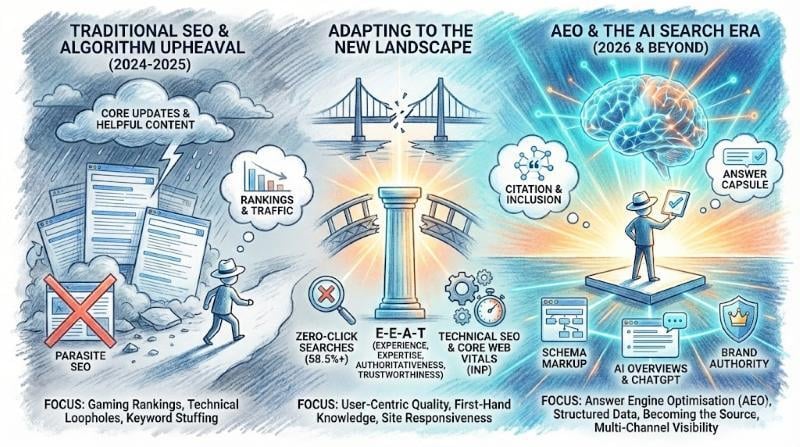
The past two years have seen Google launch its most consequential algorithm changes since Panda and Penguin. The March 2024 Core Update stands as the most significant, running 45 days and permanently integrating the Helpful Content System into Google's core algorithm. Google promised this would reduce low-quality, unoriginal content by 45%—and delivered.
The Complete Guide to Thriving in the AI Search Era
How to adapt your organic strategy for Google's AI Overviews, ChatGPT Search, and the rise of Answer Engine Optimisation
The SEO landscape has fundamentally transformed. With 58.5% of searches now ending without a click and ChatGPT serving 800 million weekly users, success in 2025-2026 requires optimising for both traditional rankings and AI citation. Whitehat SEO's research shows that traditional SEO metrics predict only 4-7% of AI citation behaviour—meaning businesses must now master Answer Engine Optimisation (AEO) alongside conventional search strategies to remain visible where buyers actually research.
Google's Algorithm Upheaval: 2024-2025 Updates Reshaping Search
For businesses relying on organic traffic, understanding these updates is essential. The Site Reputation Abuse policy (the "Parasite SEO crackdown") launched on 5 May 2024, targeting third-party content hosted on high-authority domains purely to exploit ranking signals. Forbes Advisor became the poster child, losing 1.4 million in traffic with top-3 keyword positions dropping from 10,402 to 3,279.
Core Updates Timeline (2024-2025)
| Update | Dates | Key Impact |
|---|---|---|
| March 2024 Core | 5 Mar – 19 Apr 2024 | Absorbed Helpful Content System; 1,400+ manual actions |
| August 2024 Core | 15 Aug – 3 Sep 2024 | Rewarded improved sites after previous penalties |
| November 2024 Core | 11 Nov – 5 Dec 2024 | Continued helpful content emphasis |
| March 2025 Core | 13–27 Mar 2025 | "Regular update" language from Google |
| June 2025 Core | 30 Jun – 17 Jul 2025 | Some sites saw partial recovery from 2023 penalties |
| December 2025 Core | 11–29 Dec 2025 | Third core update of 2025 |
Google's November 2024 policy update made enforcement even stricter, stating that no amount of first-party involvement alters the fundamental third-party nature of content hosted primarily to exploit ranking signals. The message is clear: the days of gaming search through technical loopholes are ending.
AI Overviews Are Transforming the Search Results Page
Google AI Overviews (formerly Search Generative Experience) officially launched in the US on 14 May 2024 and now operates in over 200 countries and 40+ languages. This represents the single largest change to how Google presents search results since the introduction of featured snippets.
Semrush's analysis of 10 million keywords throughout 2025 reveals fluctuating presence: approximately 16% of queries triggered AI Overviews in January 2025, peaking at nearly 25% in July before pulling back to below 16% by November. The impact on organic visibility is substantial.
The Click-Through Rate Impact
Seer Interactive's September 2025 study found organic CTR dropped 61% (from 1.76% to 0.61%) for queries with AI Overviews. However, brands cited within AI Overviews earn 35% higher organic CTR and 91% higher paid CTR than non-cited competitors.
Source: Seer Interactive Research, September 2025
Which queries trigger AI Overviews most frequently? Informational queries dominate, though navigational queries rose from under 1% in January to over 10% by November 2025. Critically, only 7% of local searches trigger AI Overviews—making local SEO a relatively protected category for UK businesses.
Key Statistics for UK Businesses
- 46% of all Google searches have local intent
- 76% of local searches result in a business visit within 24 hours
- Complete Google Business Profile listings get 7x more clicks than incomplete ones
- Google's August 2024 "Diversity Update" limits single-domain dominance across local and organic results
E-E-A-T Evolution: Experience Becomes the Differentiator
Google's January 2025 Quality Rater Guidelines update intensified focus on Experience—the first "E" in E-E-A-T. Google now aggressively favours content demonstrating real-world, firsthand knowledge over content simply researched online.
A 2024 Semrush study found pages with strong E-E-A-T signals had a 30% higher chance of ranking in the top 3 positions. For YMYL (Your Money Your Life) topics—finance, health, legal—these standards apply even more stringently.
Signals Google Now Prioritises
- Language patterns indicating first-hand experience: "in my testing," "when I tried," "our research found"
- Specificity markers: exact measurements, unique details, proprietary data
- Author credentials: verifiable expertise with demonstrable track record
- Behavioural signals: engagement patterns, dwell time, return visits
The practical implication is clear: AI-generated content without human oversight, personal experience, or original thinking will struggle to rank. Content must demonstrate why your brand uniquely qualifies to discuss the topic. This aligns with Whitehat SEO's long-standing approach to content marketing—quality and expertise always outperform quantity.
Answer Engine Optimisation: The Essential New Discipline
Answer Engine Optimisation (AEO) and Generative Engine Optimisation (GEO) represent the most important strategic shift for SEO professionals. With approximately 60% of searches now ending without clicks and AI tools rapidly gaining adoption, being cited in AI-generated answers has become as critical as ranking in traditional results.
Traditional SEO optimises for ranking in blue links. AEO optimises for citation in synthesised answers. The success metric shifts from position to inclusion. At Whitehat SEO, our AEO service combines proven SEO expertise with citation-focused content structure, schema markup for AI extraction, and authority signals that AI engines trust.
The Platforms That Matter
| Platform | Scale | Why It Matters |
|---|---|---|
| Google AI Overviews | 200+ countries, 2B+ monthly users | Most widespread AI search feature |
| ChatGPT Search | 800 million weekly users | Market leader for conversational AI search |
| Perplexity AI | 22 million MAUs, 780M monthly queries | 12.8% conversion rate (6x Google organic) |
| Bing Copilot | Integrated across Microsoft 365 | Deep enterprise workflow embedding |
How AEO Differs from Traditional SEO
Research from Search Engine Land reveals that 86.8% of pages cited by ChatGPT contain "answer capsules"—40-60 word direct answers positioned under question-mirroring headers. Pages using clear structure earn 2.8x higher AI citation rates.
Critically, 90%+ of cited answer capsules contained no internal or external links—suggesting AI systems prefer extractable, self-contained facts. This means your content structure must deliver standalone value in each section.
Schema Markup Dramatically Boosts AI Visibility
- Pages with FAQ schema are 3.2x more likely to appear in AI Overviews
- Pages using 3+ schema types have ~13% higher citation likelihood
- Schema markup contributes approximately 10% of Perplexity's ranking factors
Priority schema types for 2025-2026 include FAQPage, Article (with author and datePublished), Organization/LocalBusiness, VideoObject, Product, and BreadcrumbList. For HubSpot users, implementing these correctly ensures your CRM-connected content gets the visibility it deserves.
Zero-Click Searches Demand Strategic Adaptation
SparkToro's 2024-2025 research reveals the scope of the zero-click challenge: 58.5% of US Google searches and 59.7% of EU Google searches end without a click to any website. When AI Overviews appear, zero-click rates climb to approximately 83%.
The trajectory is clear: zero-click searches increased from 56% to 69% between May 2024 and May 2025. Mobile exacerbates the trend—almost half of mobile searches end the session entirely, twice the desktop rate.
The New Metrics Framework
The traditional traffic-focused model is breaking down. NerdWallet provides an instructive case study: despite a 20% traffic decline, the company grew revenue 35% by focusing on brand visibility and conversion optimisation. The lesson? Visibility inside AI answers provides brand value even without clicks.
Practical adaptations for UK businesses include:
- Tracking citations and AI mentions alongside traffic metrics
- Optimising for featured snippets (often sources for AI Overviews)
- Prioritising conversion rate optimisation to maximise value from reduced traffic
- Focusing on local SEO where only 7% of queries trigger AI Overviews
For businesses using HubSpot, Whitehat's attribution reporting approach connects organic visibility directly to pipeline—so you can demonstrate ROI even as click patterns evolve.
AI Content Policies: What Google Actually Allows
Google's official position, stated in February 2023 and reinforced throughout 2024-2025: "Appropriate use of AI or automation is not against our guidelines." The focus is on content quality, not production method.
Acceptable vs Spam: The Distinction
✓ Acceptable AI Content
- Created primarily to help users
- Provides original, helpful information
- Has human oversight and editing
- Demonstrates expertise and real value
✗ Spam Violations
- Created to manipulate rankings
- Mass-produced with no real value
- Expired domain abuse
- Site reputation abuse ("Parasite SEO")
The March 2024 Core Update specifically targeted low-quality AI content, with Google estimating a 40% reduction in low-quality content in search results. However, Ahrefs found that 74.2% of new webpages (April 2025) contain some AI-generated content—and 13.08% of top-performing Google content is AI-generated.
Best practice: Use AI as a tool for efficiency and ideation, but ensure final content reflects human expertise, voice, and experience. Google can identify content lacking personal insight or original thinking. This aligns with Whitehat SEO's ethical approach to marketing services—quality and authenticity always win long-term.
Technical SEO Changes: INP, Mobile-First, and Core Web Vitals
INP Replaced FID on 12 March 2024
Interaction to Next Paint (INP) is now the responsiveness metric within Core Web Vitals, replacing First Input Delay. Unlike FID (which only measured the first interaction), INP measures the latency of all click, tap, and keyboard interactions throughout a visit.
INP Thresholds:
- Good: ≤200 milliseconds
- Needs Improvement: 200-500 milliseconds
- Poor: >500 milliseconds
Mobile-First Indexing Completed 5 July 2024
Google now crawls all websites using Googlebot Smartphone exclusively. Sites completely inaccessible on mobile devices will not be indexed. However, John Mueller clarified that sites don't need a dedicated mobile version—they just need to be accessible on mobile devices.
Current Core Web Vitals (2025)
| Metric | What It Measures | Good Threshold |
|---|---|---|
| Largest Contentful Paint (LCP) | Loading performance | ≤2.5 seconds |
| Interaction to Next Paint (INP) | Responsiveness | ≤200 milliseconds |
| Cumulative Layout Shift (CLS) | Visual stability | ≤0.1 |
Core Web Vitals primarily serve as tie-breakers between pages of similar content quality, but strong scores provide competitive advantage in tight niches. For HubSpot websites, Whitehat's website design services ensure these technical foundations are built in from the start.
Strategic Guidance: What to Do in 2026
Tactics Becoming Less Effective
- Mass AI-generated content without editing — triggers scaled content abuse penalties
- Keyword stuffing and over-optimised anchor text — signals manipulation
- Private Blog Networks (PBNs) — easily identified and devalued
- Thin content at scale — filtered by SpamBrain
- 100% Google traffic dependence — single-channel risk now acute
- Generic, undifferentiated content — AI doesn't cite what it can replicate
Tactics Becoming Essential
Immediate Priorities (This Week)
- Audit AI visibility: Check if your brand appears in ChatGPT, Perplexity, and Google AI Overviews
- Update content freshness signals (50% of top-cited AI content is less than 13 weeks old)
- Implement FAQPage, Article, and Organization schema markup
- Address Core Web Vitals issues, especially INP
Short-Term (1-3 Months)
- Create AI-optimised content with clear answer capsules (40-60 word direct answers)
- Build topic clusters organised by user intent
- Optimise for featured snippets (primary source for AI Overviews)
- Establish subject matter expert profiles with verifiable credentials
Long-Term (6-12 Months)
- Diversify traffic sources: email lists, social platforms, YouTube, podcasts
- Develop original research programme with proprietary data
- Build brand authority through digital PR and earned media
- Create video content library with full transcripts for indexing
Recommended Budget Allocation
40%
Content Quality & Original Research
25%
Technical SEO & Site Experience
20%
Brand Building & Digital PR
15%
AI/LLM Visibility Monitoring
What Industry Leaders Are Saying
"Relying 100% on Google traffic isn't smart anymore."
Brian Dean, Backlinko — Reports LLM traffic up 800% year-over-year
"The future of SEO lies in authenticity, original research, strong personal brands, and building trust—focusing on strategies that search engines can't take away."
Lily Ray, Amsive — Found traditional SEO metrics predict only 4-7% of AEO citation behaviour
"Go figure out where your audience pays attention and be present in those places. That is your new job."
Rand Fishkin, SparkToro — Despite AI competition, Google search volume grew 22% in 2024
The Imperative Shift to Answer Engine Optimisation
The SEO discipline has entered its most consequential transformation. Google remains dominant at 90%+ market share, but the rise of AI search tools—with ChatGPT serving 800 million weekly users and Perplexity processing 780 million monthly queries—demands strategic evolution.
The key insight from Whitehat SEO's research: traditional SEO metrics predict only 4-7% of AI citation behaviour. Success in 2025-2026 requires optimising for citation-worthiness alongside rankings—through clear content structure, demonstrated expertise, fresh information, and strong brand signals.
For businesses, the path forward involves three concurrent tracks:
- Maintaining traditional SEO foundations — technical excellence, E-E-A-T, quality content
- Building AEO/GEO capabilities — answer capsules, schema markup, AI-citation optimisation
- Diversifying discovery channels — video, social, email to reduce single-platform dependency
The companies that thrive will be those that shift from asking "How do we rank?" to "How do we become the authoritative answer?"—a question Answer Engine Optimisation is specifically designed to address.
Ready to Optimise for the AI Search Era?
Whitehat SEO helps B2B companies build organic visibility that works across Google, ChatGPT, and emerging answer engines—with attribution your CFO will trust.
Explore Our SEO ServicesFrequently Asked Questions
What is Answer Engine Optimisation (AEO)?
Answer Engine Optimisation is the practice of structuring content so AI tools like ChatGPT, Google AI Overviews, and Perplexity can extract, cite, and recommend it. Unlike traditional SEO which focuses on ranking in search results, AEO optimises for inclusion in synthesised AI answers—ensuring your brand appears when AI systems respond to user questions.
Does AEO replace traditional SEO?
No—AEO complements traditional SEO rather than replacing it. Google still commands over 90% of search market share, and organic rankings remain essential for traffic and authority. AEO expands your visibility to include AI-generated answers, which now influence over 50% of B2B buying research. The most effective strategy combines both disciplines.
How quickly can we see results from AEO?
AI visibility can improve faster than traditional rankings because answer engines index and cite content more dynamically. Many businesses see citation improvements within 4-8 weeks of implementing AEO-optimised content structure and schema markup. However, building sustained authority requires ongoing content development and typically shows compounding results over 6-12 months.
What percentage of searches trigger AI Overviews?
According to Semrush's 2025 research, AI Overviews appear on approximately 16-25% of Google queries, varying by month and query type. Informational queries trigger AI Overviews most frequently, while only 7% of local searches show AI-generated answers—making local SEO a relatively protected channel for UK businesses.
Is AI-generated content penalised by Google?
Google's official position is that "appropriate use of AI or automation is not against our guidelines." The focus is on content quality, not production method. AI-assisted content with human oversight, genuine expertise, and original value performs well. Mass-produced AI content without editing or value triggers scaled content abuse penalties.
References & Sources
- Semrush (2025). AI Overviews Study: Analysis of 10 Million Keywords. Semrush Blog.
- SparkToro/Datos (2025). Zero-Click Search Study: US and EU Data. SparkToro Research.
- Seer Interactive (2025). AI Overviews CTR Impact Study. Seer Interactive Insights.
- Search Engine Land (2024). ChatGPT Search Citations Study: Answer Capsule Analysis. Search Engine Land.
- Ahrefs (2025). AI-Generated Content in Search Results Study. Ahrefs Blog.
- Google (2024). Core Web Vitals Documentation. Google Search Central.
- Backlinko (2024). How to Optimize for ChatGPT Search: Complete AEO Guide. Backlinko.
- HubSpot (2025). State of Marketing Report 2025. HubSpot Research.
Related Articles from Whitehat SEO
- What is AEO? How to Optimise Your Brand for AI Search Engines
A practical guide to getting your brand cited by ChatGPT, Perplexity, and Google AI Overviews.
- The History of SEO: From 1990 to AI Search in 2026
Understanding SEO's evolution reveals patterns that predict where search is heading next.
- SEO vs PPC: Total Search Strategy for B2B Growth
Integrate PPC and SEO for a unified search strategy that maximises ROI in an AI-driven landscape.