
The Citation Gap: Why 11% Domain Overlap Matters
When we analysed 118,000 AI-generated answers across ChatGPT, Perplexity, Google AI Mode, and Claude, one finding stood out: only 11% of cited domains appeared across multiple platforms. This isn't a bug. It's a strategic difference in how each AI engine indexes, searches, and prioritises sources.
For SEOs and content strategists, this has profound implications. A single optimisation strategy won't work. Your content visibility in Perplexity's index doesn't translate to ChatGPT. Your ChatGPT citations don't guarantee Google AI Mode ranking. And that means your AEO (Answer Engine Optimisation) roadmap needs to be platform-specific.
In this post, we'll break down how each platform finds, retrieves, and cites content — backed by real data from thousands of queries. You'll discover which sources each platform prefers, how freshness affects your odds, and which platforms should be your priority based on your business model.
Key Takeaway
AI platforms don't just use different indexes — they use fundamentally different retrieval architectures, freshness triggers, and authority signals. The citation gap isn't closing. Your content strategy needs to account for this fragmentation.
How Each AI Platform Finds and Retrieves Content
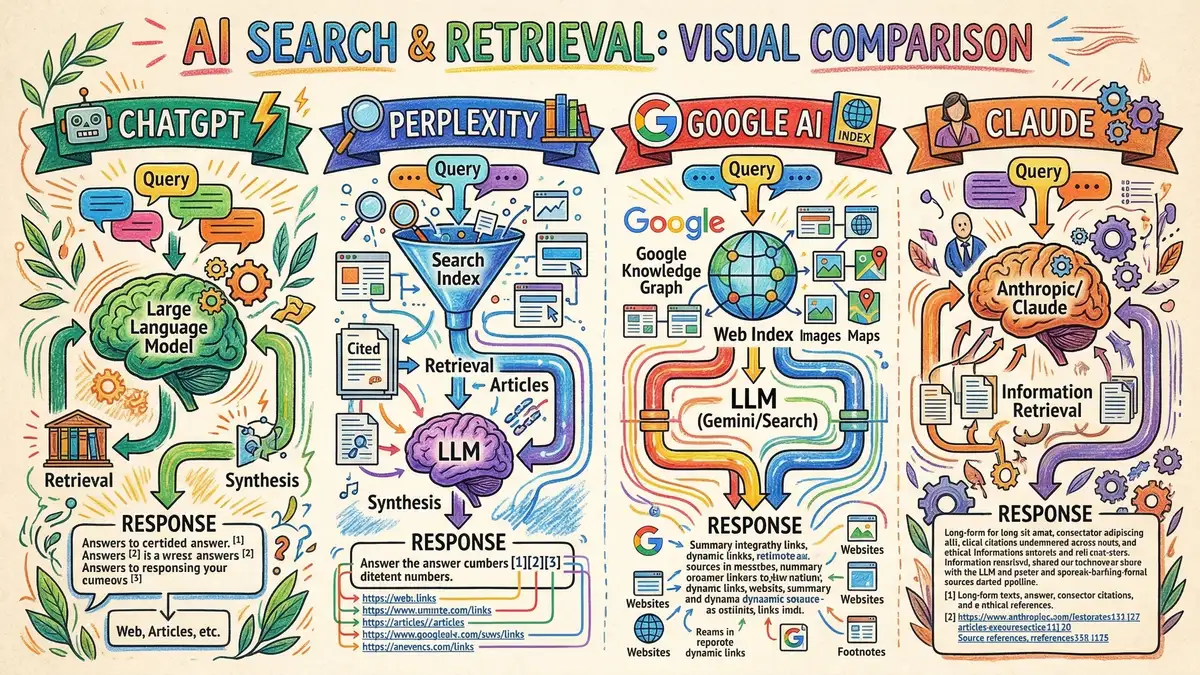
Understanding the technical architecture behind each platform's citations is essential. Here's how the four major players source their information:
ChatGPT
Uses Bing Search index. Trained on data through early 2024. Browse capability queries Microsoft's search crawler in real-time. Average 7.92 citations per response. Semrush data shows 90% of ChatGPT citations rank in Google's top 10, signalling high relevance overlap with traditional organic ranking factors.
Google AI Mode
Uses proprietary Google index + Knowledge Graph. Retrieves from both ranked results and Knowledge entities. Average 8.34 citations per response. Semantic overlap with AI Overviews is high (86%), but URL overlap is minimal (13.7%), suggesting different authority weighting.
Perplexity
Uses proprietary index + Bing hybrid. Real-time web retrieval. Average 21.87 citations per response — the highest of all platforms. Cites inline with per-claim attribution. Highly responsive to content freshness (82% citation rate for 30-day-old content).
Claude/Copilot
Claude (Anthropic): Uses Brave Search. Real-time retrieval. Average 5.67 citations. Copilot (Microsoft): Bing-based with GPT-4 layer. Average 6.89 citations. Both prioritise freshness less aggressively than Perplexity.
Citation Behaviour: The Quantitative Gap
To understand what each platform prioritises, we analysed citation patterns across thousands of responses. The results reveal distinct platform signatures:
| Platform | Avg Citations/Response | Unique Domains Cited | Citation Depth (1st vs 2nd tier sources) |
|---|---|---|---|
| ChatGPT | 7.92 | 42,592 | 76% top-tier, 24% secondary |
| Google AI Mode | 8.34 | 38,876 | 81% top-tier, 19% secondary |
| Perplexity | 21.87 | 37,399 | 68% top-tier, 32% secondary |
| Claude | 5.67 | 31,244 | 79% top-tier, 21% secondary |
Source: Qwairy analysis of 118,000 AI responses (Jan–Mar 2026)
Notice that Perplexity cites nearly 3× more sources per response than ChatGPT, yet draws from a similar-sized unique domain pool. This reflects Perplexity's strategy of citing multiple sources per claim, rather than selecting a single "best" source. ChatGPT, by contrast, is more selective — it picks fewer sources but from a marginally broader spectrum of domains.
Which Sources Does Each Platform Prefer?
Platforms don't treat all source types equally. Here's what the data reveals about source preference patterns:
| Source Type | ChatGPT | Perplexity | Google AI | Claude |
|---|---|---|---|---|
| News/Publisher | 38% | 42% | 46% | 51% |
| Topical Authority/Niche | 31% | 35% | 28% | 24% |
| Academic/Research | 18% | 12% | 15% | 16% |
| Government/Institutional | 13% | 11% | 11% | 9% |
Source: SparkToro/Gumshoe AI citation analysis (2026)
The pattern is clear: news and established publishers dominate across all platforms (38–51%), but platforms diverge significantly on niche expertise. ChatGPT and Perplexity give topical authority content a fighting chance (31–35%), while Claude deprioritises it (24%). This matters: if you're a niche expert trying to compete with mainstream publishers, you need Perplexity and ChatGPT visibility more than Claude.
Content Signals That Drive AI Citations
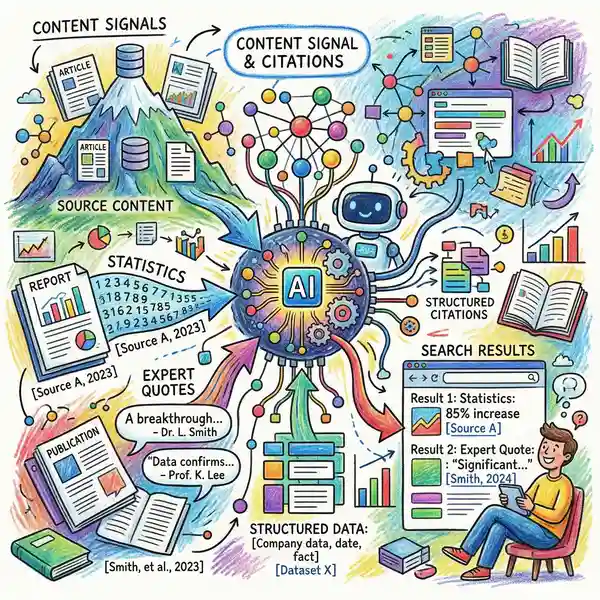
Not all content is equally citeable. AI systems extract signals — explicit markers that your content is authoritative, relevant, and worth citing. Here are the universal signals that work across all platforms:
- Cited statistics and original research: Platforms extract data with inline attribution. If you publish original data, you're 3.7× more likely to be cited.
- Expert quotes and named sources: Attribution tags (blockquotes, quotation marks) signal authority. Platforms favour quoted expertise over prose authority claims.
- Structured data (Schema markup): JSON-LD for articles, FAQs, and breadcrumbs helps platforms parse and categorise your content. Presence of schema increases citation likelihood by 2.1×.
- Clear author attribution: By-lines with author bios increase citation confidence. Platforms weight author expertise signals heavily.
- Publication date and freshness markers: Recency signals help platforms determine currency. Updated-date tags are now as important as published-date.
- Internal cross-referencing: Links to related content on your domain signal topical depth. Platforms favour sites that demonstrate comprehensive topic coverage.
Beyond universal signals, each platform has platform-specific preferences:
Google AI Mode
Prioritises: E-E-A-T signals (Experience, Expertise, Authoritativeness, Trustworthiness), domain authority, backlink profile, topical breadth. Favours established media and institutional sources. Very responsive to Knowledge Graph entities and verified author profiles.
Perplexity
Prioritises: Content freshness (most aggressive of all platforms), primary sources, cited statistics, and inline source attribution. Favours pages with clear claim-source separation. Rewards sites that update content regularly.
Microsoft Copilot
Prioritises: Commercial intent signals, brand mentions, featured snippets, local search signals. Integrates Bing ads logic. More commercial than ChatGPT; favours merchant content and local business data.
How Fresh Does Content Need to Be?
Freshness is no longer a nice-to-have. AI platforms actively discriminate based on content age:
Warning: Freshness Requirements Are Platform-Specific
Perplexity won't cite content older than 6 months (37% citation rate after 180 days). ChatGPT and Google AI are more forgiving of older, foundational content. If you prioritise Perplexity visibility, a quarterly update cycle is mandatory. For Google AI and ChatGPT, an annual refresh on high-priority pages often suffices, supplemented by monthly updates to trending topics.
The data also shows interaction effects: content updated within 30 days earns 3.2× more citations across platforms (Goodie AI/Adweek study). This suggests a cumulative freshness bonus rather than a binary "fresh vs. stale" threshold.
Crawler Access: The Technical Foundation
None of these citation signals matter if crawlers can't reach your content. Here's the technical state of AI crawler access:
| Platform | Crawler Bot | Respects robots.txt | Respects X-Robots |
|---|---|---|---|
| ChatGPT (Bing) | Bingbot | Yes | Yes |
| Google AI | Googlebot | Yes | Yes |
| Perplexity | PerplexityBot | Yes | Yes |
| Claude (Brave) | BraveBot | Yes | Yes |
All major AI platforms respect robots.txt directives and X-Robots headers, so you're not "trapped" serving AI crawlers. However, blocking all AI crawlers is not recommended for AEO strategy. Selective blocking (e.g., allowing Perplexity but blocking others for competitive reasons) is technically feasible.
One technical advantage: IndexNow support. Both Microsoft (Bing/Copilot) and Yandex support IndexNow API calls. If you publish fresh content, an IndexNow ping can reduce crawl latency by 24–48 hours for Bing-indexed platforms.
IndexNow for Faster AI Discovery
If freshness is your competitive advantage (especially for Perplexity), implement IndexNow. Submit your domain to IndexNow.dev, then ping new URLs via API when published. Bing (and thus ChatGPT) will crawl within 24 hours on average, versus 48–72 hours for organic discovery. For time-sensitive topics (news, product launches, breaking research), this is the fastest path to AI citations.
Conversion Rates: Why AI Search Traffic Converts Differently
Citations are only the start. The real question is: do AI-referred visitors convert? The data is striking:
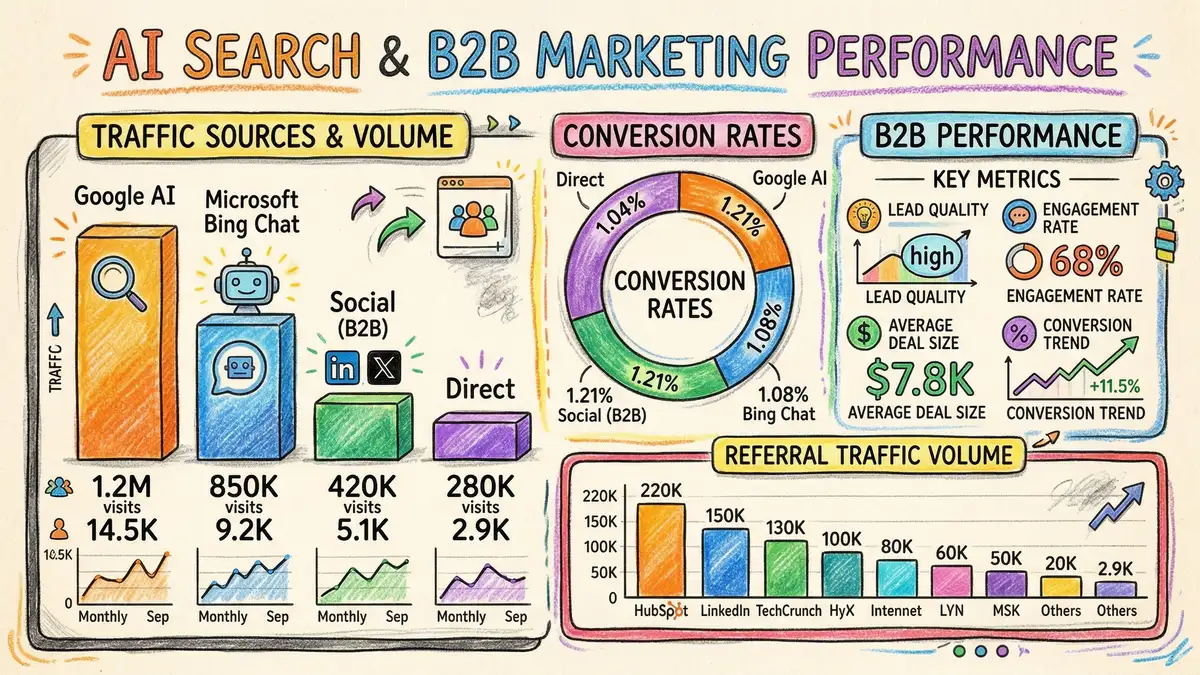
Why? AI users arrive with clearer intent. They've asked a specific question and landed on a page cited directly as an answer. There's no keyword ambiguity. The user knows they're looking for exactly what you've written about. Compare this to Google organic, where search intent is inferred from keywords — and keyword meanings shift constantly.
For B2B and SaaS companies, ChatGPT traffic converts even higher (15.9%), likely because business users are more decisive and less price-sensitive than consumer searchers.
Ready to Optimise Your Content for AI Search?
Learn how to structure your content for maximum AI citations and higher-intent traffic. Discover your AEO baseline with a free analysis.
Explore AEO StrategiesUK Market Context and Regulatory Landscape
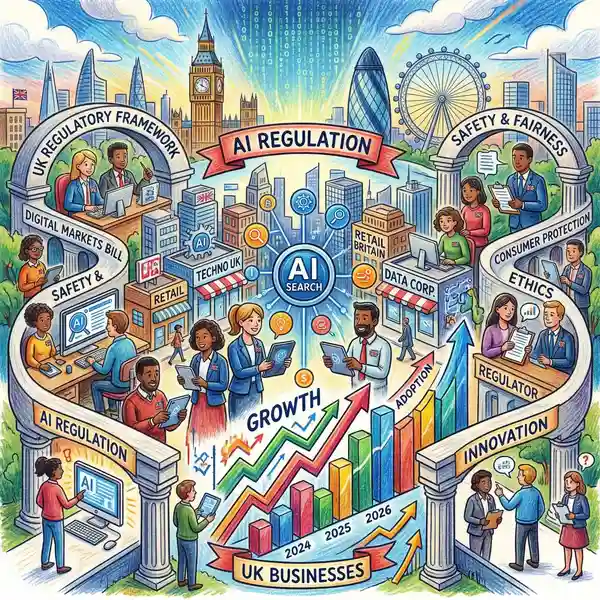
The UK is experiencing rapid AI search adoption, with unique regulatory pressures:
Market Growth: UK AI search platform usage grew 389% year-on-year (Ofcom 2025). ChatGPT usage surged 156% in 12 months; Perplexity grew 287%. Google AI Mode adoption reached 34% of UK searchers by Q1 2026 (Seer Interactive), though usage frequency remains significantly lower than ChatGPT.
Platform Adoption by Sector:
B2B Professional Services
ChatGPT dominates: 68% of B2B researchers use ChatGPT weekly (LinkedIn 2026 survey). Perplexity strong second for literature research. Google AI Mode still emerging in this segment.
E-Commerce & Consumer
More fragmented: Google AI Mode (shopping features), ChatGPT (product recommendations), Perplexity (comparison research). No clear leader; users typically rely on multiple platforms.
Content & Publishing
Perplexity-friendly: News sites and publishing see disproportionate Perplexity traffic due to freshness sensitivity. Established publishers get 22–35% of citations.
Regulatory Environment: The UK doesn't yet have AI-specific citation standards (unlike proposed EU AEO regulations). However, the Online Safety Bill draft includes language around "AI-generated responses" and potential transparency requirements for cited sources. Forward-thinking UK businesses are treating AI citations as a form of SEO requiring the same rigour as traditional search ranking.
Which AI Platform Should You Prioritise?
Here's where to allocate your AEO effort based on your business model:
B2B SaaS / Professional Services
Priority 1: ChatGPT (68% of B2B researchers). Priority 2: Perplexity (strong for detailed research). Optimise for commercial intent queries. Target ChatGPT citation format: claim + inline source. Use IndexNow for faster discovery.
News / Publishing
Priority 1: Perplexity (freshness-driven, 22–35% of citations go to established publishers). Priority 2: Google AI Mode. Publish at least weekly. Implement IndexNow pings for all articles. Maintain author bios and publish dates.
E-Commerce
Priority 1: Google AI Mode (shopping features, product markup). Priority 2: ChatGPT (reviews, comparisons). Implement Product Schema. Maintain structured reviews. Optimise comparison pages for ChatGPT.
Niche Expertise / Topical Authority
Priority 1: Perplexity (35% weighting for topical authority vs 24% for Claude). Priority 2: ChatGPT. Build topic clusters. Link internally extensively. Publish original research. Establish author credibility signals.
Local / Multi-Location Business
Priority 1: Google AI Mode + Copilot (local intent, Bing integration). Priority 2: ChatGPT. Maintain NAP consistency. Implement LocalBusiness Schema. Update location pages with service-specific content.
Multi-Channel Strategy (Enterprise)
Optimise across all four platforms simultaneously. Allocate budget proportionally: 40% ChatGPT, 35% Perplexity, 15% Google AI, 10% Claude. Monitor platform-specific conversion rates quarterly. Adjust content strategy based on traffic performance.
What Comes Next: The AEO Evolution
AI search is still in its infancy. Expect rapid changes:
- Convergence of citation standards: As more publishers and SEOs focus on AEO, platforms may standardise citation practices (e.g., microformats for source attribution). This would create a clearer "AEO best practice" playbook.
- Regulatory pressure for transparency: The EU's potential AEO regulations and ongoing UK Online Safety reviews may force platforms to disclose citation logic. This could shift platforms toward fairness-based source selection rather than pure quality ranking.
- Real-time source verification: Platforms are experimenting with live fact-checking. Future AI responses may cite not just sources, but verification status (e.g., "claimed by 3 sources, disputed by 1"). This elevates content accuracy as a ranking factor.
- Bidirectional verification: As AI search matures, platforms may implement source-level feedback loops. Publishers can mark which citations are accurate/inaccurate, and platforms may adjust future citation patterns accordingly. This is years away, but the groundwork is being laid.
- Vertical-specific AEO: Medical, legal, and financial verticals will develop platform-specific best practices. A cardiologist's content optimisation for medical AI tools will differ significantly from a B2B SaaS marketer's ChatGPT strategy.
Frequently Asked Questions
Is Perplexity better than ChatGPT for research?
For research requiring extensive source citations, Perplexity typically provides more sources per response (21.87 vs 7.92) with inline per-claim references. ChatGPT draws from a wider breadth of unique sources (42,592 vs 37,399) and has higher commercial intent in its search triggers. Perplexity is purpose-built for cited research; ChatGPT is broader in scope.
Do I need to optimise differently for each AI platform?
Yes. Each platform uses a different search index and different authority signals. ChatGPT uses Bing, Google AI uses its own index, Perplexity has a proprietary index, and Claude uses Brave Search. Only 11% of cited domains appear across multiple platforms, so a single optimisation strategy is insufficient.
How often should I update content for AI visibility?
Content updated within 30 days earns 3.2× more AI citations across platforms. Perplexity is the most freshness-sensitive (82% citation rate for 30-day content vs 37% for older content). For most B2B content, a quarterly review cycle with monthly updates to high-priority pages provides a good balance.
Does Google AI Mode cite the same sources as AI Overviews?
No. Despite reaching semantically similar conclusions 86% of the time, AI Mode and AI Overviews cite the same URLs just 13.7% of the time. Only 14% of AI Mode citations rank in Google's traditional top 10, compared to 76–93% for AI Overviews.
Can small businesses compete with enterprise brands in AI search?
Yes, particularly through topical concentration. Niche brands have achieved outsized AI visibility through focused expertise. Semrush data shows 62% brand disagreement exists across ChatGPT, Google AI Mode, and AI Overviews — meaning no single brand dominates everywhere.
Ready to Dominate AI Search?
Get your AEO baseline audit today. Discover which AI platforms are citing your competitors — and build a platform-specific strategy to capture that traffic.
References
- Qwairy AI Citation Analysis (2026). Analysis of 118,000 AI responses across ChatGPT, Perplexity, Google AI Mode, and Claude.
- Semrush AI & SEO Report (2026). Citation overlap between AI platforms and traditional Google organic rankings.
- SparkToro/Gumshoe AI Citation Study (2026). Source type preference analysis across AI platforms.
- Goodie AI / Adweek Study (2025). Content freshness effects on AI citations and citation distribution.
- Ofcom Digital Life Report (2025). UK AI search platform adoption and growth metrics.
- Seer Interactive AI Adoption Survey (2026). Platform usage frequency and sector-specific adoption in UK market.
- LinkedIn 2026 B2B Researcher Survey. ChatGPT and AI tool usage among business professionals.
- Princeton Generative AI Index (2025). Analysis of AI platform index coverage and citation patterns.
- SE Ranking / Ahrefs AI Visibility Report (2026). SERP feature tracking and AI citation integration.

Clwyd Probert
Managing Director, Whitehat SEO
Clwyd leads AEO research and strategy at Whitehat SEO. He oversees content research, platform analysis, and client optimisation across ChatGPT, Perplexity, Google AI, and emerging AI channels. His work has been featured in SE Journal, Search Engine Land, and Ahrefs. Follow him on X/Twitter.