
SEO & Technical
Google officially retired the term "rich snippets" in December 2017, consolidating all terminology under "rich results"—defined as "experiences on Google surfaces, such as Search, that go beyond the standard blue link" and "can include carousels, images, or other non-textual elements." Despite this change, "rich snippets" remains widely used interchangeably in the industry.
Rich Snippets and Structured Data for SEO: The Complete 2026 Guide
The short answer: Structured data remains one of the most reliable ways to earn enhanced visibility in Google Search, with CTR improvements of 20–82% documented across multiple studies. However, Google has significantly reshaped the landscape between 2023–2025, deprecating popular schema types like HowTo and FAQPage whilst adding new features for product variants, loyalty programmes, and AI-powered search. The shift toward "rich results" now serves dual purposes: earning enhanced SERP visibility and powering AI search engines like Google AI Overviews and ChatGPT.
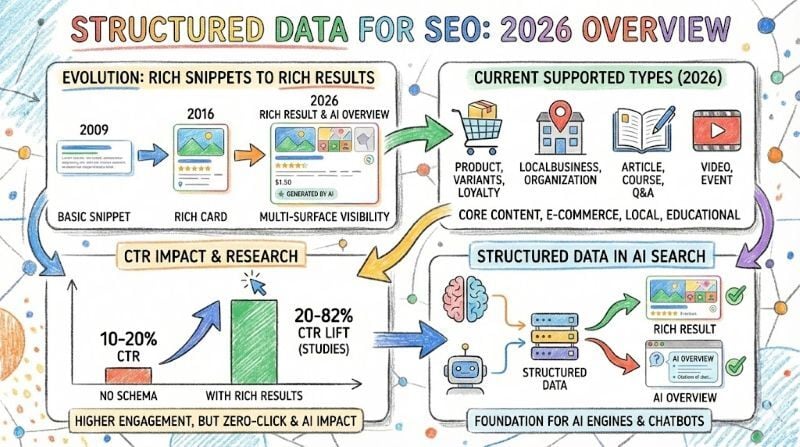
How rich snippets became rich results
The journey from 2009's original review and recipe snippets to today's sophisticated results reflects Google's progressive investment in structured data. Key evolutionary milestones include the 2016 Rich Cards launch, the 2017 Rich Results Test tool introduction, the 2020 sunset of data-vocabulary.org markup in favour of schema.org exclusively, and the significant 2023–2025 simplification that removed several schema types entirely.
"Google uses structured data to understand the content on the page and show that content in a richer appearance in search results, which is called a rich result."
— Google Search Central Documentation
For businesses investing in SEO services, understanding this evolution is crucial. The terminology change signalled Google's broader ambition: structured data isn't just about enhancing search listings anymore—it's becoming the foundation for how machines understand your content across multiple platforms.
Currently supported rich result types in 2026
Here's what actually works as of January 2026:
| Category | Rich Result Types |
|---|---|
| Core content | Article, Recipe, Video, Event, Job Posting |
| E-commerce | Product, Merchant Listing, Product Variants (new Feb 2024), Loyalty Programme (new June 2025), Review Snippet |
| Local/Organisation | LocalBusiness, Organization (expanded Nov 2023), Profile Page (new Nov 2023) |
| Navigation | Breadcrumb (desktop only), Carousel |
| Educational | Course List, Math Solver, Education Q&A |
| Other | Discussion Forum (new Nov 2023), Vacation Rental (new Dec 2023), Dataset, Fact Check, Software App |
New additions in 2024–2025
Google hasn't just been removing features—they've added several new schema types that reflect evolving business models:
- Product Variants (February 2024): Supports ProductGroup with hasVariant, variesBy, and productGroupID properties—essential for e-commerce sites with size/colour variations
- Loyalty Programme (June 2025): MemberProgram and MemberProgramTier markup for UK, US, and six other countries
- Profile Page and Discussion Forum (November 2023): For creator pages and user-generated content platforms
- Vacation Rental (December 2023): For property listings with location, ratings, and reviews
⚠️ Critically deprecated or restricted types
- HowTo: Fully deprecated September 2023—no longer displays anywhere
- FAQPage: Restricted to "well-known, authoritative government and health websites" only
- Book Actions, Course Info, Estimated Salary, ClaimReview, Learning Video, Special Announcement, Vehicle Listing: All deprecated June 2025
- Practice Problem: Deprecated November 2025
Google's stated rationale: "We're phasing out these specific structured data types because our analysis shows that they're not commonly used in Search." Translation: if you're still using HowTo schema hoping for rich results, you're wasting your time.
CTR impact data: What the research shows
Multiple studies confirm substantial click-through rate improvements from rich results implementation. Here's what the evidence says:
20–82%
CTR improvement documented across Google's official case studies
Google's official case studies reveal:
- Nestlé: 82% higher CTR on pages with rich results versus without
- Food Network: 35% increase in visits after converting 80% of pages
- Rotten Tomatoes: 25% higher CTR on 100,000 pages with structured data
- Rakuten: 1.5× longer time on page; 3.6× higher interaction rate
The landmark Milestone Research study analysing 4.5 million queries found rich results achieved 58% CTR compared to 41% for non-rich results. FAQ rich results performed exceptionally well at 87–91% CTR, though this data predates the 2023 restrictions.
seoClarity's controlled A/B testing demonstrated approximately 25% traffic improvement when FAQ schema was applied, with combined content optimisation plus schema yielding 350% traffic increases. Industry consensus places general CTR improvements in the 20–35% range for properly implemented structured data.
Important caveats to consider
Featured snippets can "steal clicks" from the #1 organic result (reducing its CTR from 26% to 19.6%), and the rise of zero-click searches—now at 60–65%—partially offsets rich result gains. AI Overviews appear in approximately 7.5% of searches. This is precisely why Answer Engine Optimisation (AEO) has become essential alongside traditional SEO.
Major Google updates in 2024–2025
Keeping track of Google's structured data changes has become a job in itself. Here's your executive summary:
2024 highlights
- February 2024: Product Variants support launched
- May 2024: AI Overviews documentation introduced; Product structured data documentation restructured into three separate guides
- August 2024: AVIF image format support added
- October 2024: Certification markup added; EnergyConsumptionDetails replacement announced
- November 2024: Sitelinks search box deprecated; C2PA metadata support added
2025 highlights
- January 2025: Breadcrumb markup limited to desktop only (removed from mobile)
- February 2025: Complex pricing support with priceType property added
- March 2025: AI Mode added to robots meta tag documentation
- June 2025: Seven structured data types deprecated; Loyalty Programme markup launched
- November 2025: Practice Problem deprecated; Merchant shipping policies documentation added
Schema.org version updates progressed from v24.0 (January 2024) through v29.4 (December 2025), adding significant vocabulary including Financial Incentives (v29.0), Member Programs (v28.0), Certification type (v25.0), and IPTCDigitalSourceEnumeration for AI-generated content (v24.0).
This pace of change is exactly why working with an agency that stays current with SEO best practices matters. By the time you've implemented last year's recommendations, Google may have deprecated them.
Implementation best practices for 2026
Google officially recommends JSON-LD as the preferred format: "In general, Google recommends using JSON-LD for structured data if your site's setup allows it, as it's the easiest solution for website owners to implement and maintain at scale."
All three formats (JSON-LD, Microdata, RDFa) remain equally valid for Google processing, but JSON-LD's separation from HTML markup makes it less error-prone and easier to maintain dynamically.
Essential validation tools
- Rich Results Test (search.google.com/test/rich-results): Tests Google eligibility and previews display
- Schema Markup Validator (validator.schema.org): Validates syntax without Google-specific checks
- Google Search Console: Site-wide monitoring with error notifications
Common mistakes to avoid
- Marking up content invisible to users
- Content mismatch between schema and visible page (particularly pricing)
- Using deprecated schema types (HowTo, FAQPage for non-authoritative sites)
- Improper nesting—Google recommends nesting related items under the main entity
- HTML tags in structured data fields; incorrect ISO 8601 date formats
- Template-wide misuse applying page-specific schema to all pages
Google's nesting guidance states: "If you put recipe and review at the same level, it's not as clear as telling us that the page is a recipe with a nested review." The same principle applies to products with offers, articles with authors, and events with locations.
If you're running HubSpot, our HubSpot onboarding service includes schema implementation as standard—because structured data done wrong can be worse than no structured data at all.
Structured data's role in AI search visibility
Here's where things get genuinely interesting for forward-thinking marketers.
Structured data increasingly influences visibility across AI-powered search platforms. A September 2025 Search Engine Land experiment found that only pages with well-implemented schema appeared in AI Overviews—pages with poor or missing schema ranked but never achieved AI Overview inclusion.
Microsoft's Fabrice Canel confirmed at SMX Munich 2025: "Schema Markup helps Microsoft's LLMs understand content." OpenAI has similarly acknowledged structured data's role in ChatGPT Search shopping results.
22%
Median citation lift in AI search results from schema markup
Source: Relixir study
Answer Engine Optimisation (AEO) strategies
- Lead sections with 40–60 word direct answers
- Use bullet points, numbered lists, and tables for extractable content
- Structure Q&A formatting explicitly
- Implement FAQPage (where authoritative), Article, and Organization schema
- Add Speakable schema for voice assistant prioritisation
Generative Engine Optimisation (GEO) strategies
- Include structured data in initial HTML (not via JavaScript injection)
- Build entity relationships using @id references
- Maintain consistent taxonomy and metadata across content
- Focus on semantic richness and topical authority
"Context, not content, now drives AI visibility, making structured data the strategic data layer every enterprise must prioritise."
— Martha van Berkel, CEO, Schema App
This is precisely why we developed our Answer Engine Optimisation service—combining classic technical SEO foundations with "citation-ready" content architecture designed to be quoted by AI systems.
UK-specific structured data considerations
UK businesses should prioritise several region-specific implementation details:
LocalBusiness markup requirements
- Use addressCountry: "GB" (not "UK")
- Format postcodes correctly (e.g., "M1 1AA")
- Include telephone in international format: +44 prefix
- Use 24-hour opening hours format
Currency and pricing
- Use ISO 4217 code "GBP" (not £ symbol)
- Include VAT-inclusive pricing as required by UK consumer law
- Use decimal point (not comma) for prices
- Apply eligibleRegion property for multi-currency sites
{
  "@type": "Offer",
  "price": "99.99",
  "priceCurrency": "GBP",
  "eligibleRegion": {
    "@type": "Country",
    "name": "GB"
  }
}
Regulatory considerations
Prices displayed in structured data must match visible on-page prices, comply with ASA advertising standards for review claims, and ensure GDPR/UK GDPR compliance regarding personal information exposure.
With Google holding approximately 93% UK search market share, prioritising Google's supported schema types remains essential. Growing voice search adoption makes Speakable schema increasingly relevant for UK publishers.
Your action steps
The 2024–2025 period marks a definitive shift in Google's structured data strategy—streamlining rich result types whilst expanding support for e-commerce, AI-readiness, and membership features.
Product, Recipe, Article, Video, Event, LocalBusiness, and Organization schema types remain the most stable and impactful investments.
✅ Your immediate to-do list
- Audit your current schema implementation using the Rich Results Test
- Remove any deprecated schema types (HowTo, FAQPage unless you're a government/health authority)
- Implement JSON-LD for all supported rich result types relevant to your business
- Ensure UK-specific formatting (GBP, GB country code, +44 phone format)
- Add answer-first content blocks (40–60 words) to key pages for AI visibility
- Set up Search Console monitoring for structured data errors
The deprecation of HowTo and restriction of FAQPage represent significant losses, but the emergence of structured data as a factor in AI search visibility creates new strategic importance. Sites implementing quality schema markup can expect 20–82% CTR improvements whilst simultaneously improving visibility in Google AI Overviews, ChatGPT Search, and Perplexity.
For UK businesses specifically, proper LocalBusiness implementation with correct currency, address formatting, and VAT-inclusive pricing remains foundational for local search success.
Key statistics summary
| Metric | Value | Source |
|---|---|---|
| CTR improvement range | 20–82% | Google case studies |
| Rich results vs non-rich CTR | 58% vs 41% | Milestone Research |
| Nestlé CTR improvement | 82% | Google Search Central |
| AI citation lift from schema | 22% median | Relixir study |
| Zero-click searches | 60–65% | SparkToro 2024 |
| AI Overviews prevalence | 7.47% of searches | SE Ranking 2024 |
References
All statistics and claims in this article are verified against the following sources:
Google Official Documentation
- Google Search Gallery – Structured Data Features
- Introduction to Structured Data – Google Search Central
- Simplifying the Search Results Page – Google Blog (June 2025)
- Rich Results Test Tool
Industry Research
Need help implementing structured data?
Our SEO team can audit your current schema implementation, fix technical issues, and ensure you're capturing both traditional search and AI visibility opportunities.
Book a Free Website Audit