
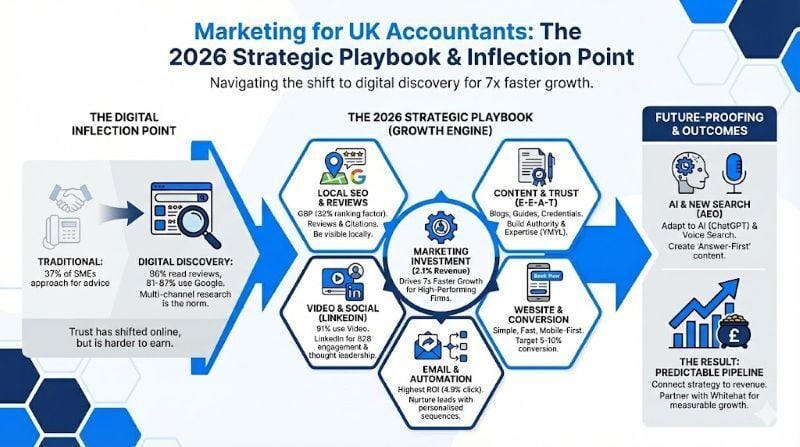
UK accounting firms face a critical digital inflection point. While 37% of SMEs approach accountants for business advice according to the UK Government's Longitudinal Small Business Survey 2024, the discovery process has shifted decisively online. BrightLocal's 2025 research reveals that 98% of people read online reviews for local businesses, with 81-87% using Google specifically for this purpose. explore our digital marketing FAQs
Marketing for UK Accountants: The 2026 Strategic Playbook
The highest-growth UK accounting firms invest 2.1% of revenue in marketing and achieve 7x faster growth than competitors. With 81% of consumers researching businesses online before contact and 64% of Google searches now ending without clicks, accountants must embrace digital marketing strategies spanning local SEO, content marketing, video, LinkedIn, and AI search optimisation to remain competitive in 2025.
This comprehensive playbook synthesises 2024-2025 data from BrightLocal, the Content Marketing Institute, HubSpot, Wyzowl, and UK government surveys to provide accounting firms with actionable intelligence across eight critical areas. Whether you're struggling with declining organic traffic, can't prove marketing ROI, or want to future-proof your practice for AI-driven search, Whitehat's analysis reveals exactly where opportunities lie.
How clients find and choose their accountants in 2026
The path to hiring an accountant has become decidedly digital. Accountants remain the number-one source UK SMEs approach for business advice, with 37% of UK SME employers seeking guidance from accounting professionals according to the UK Government's Longitudinal Small Business Survey 2024. However, the discovery process has fundamentally shifted online.
Online reviews now function as a critical gatekeeper for accounting firms. BrightLocal's 2025 Local Consumer Review Survey reveals striking statistics: 88% of consumers would use a business that replies to all reviews, compared to just 47% for firms that ignore feedback. Meanwhile, 94% of potential clients report that negative reviews have convinced them to avoid a business entirely.
Trust dynamics have evolved significantly. While 49% still trust online reviews as much as personal recommendations, this represents a substantial decline from 79% in 2020—reflecting growing consumer sophistication and scepticism. The review response window has also tightened, with more than half of consumers expecting replies within 2-3 days.
Multi-channel research is now standard behaviour, with 77% of consumers consulting two or more review sites before making decisions. Beyond Google, Facebook (45%), Yelp (44%), YouTube (34%), and local news outlets (48%) all influence the selection process. For accounting firms, this means maintaining consistent presence and reputation across multiple platforms.
The investment case for digital marketing
The correlation between marketing investment and growth is unambiguous. The AAM/Hinge Research Institute's 2025-26 Marketing Budget Benchmark Study—covering 87 firms representing £13+ billion in combined revenue—found that high-growth accounting firms invest 2.1% of revenue in marketing (excluding compensation), compared to just 1.0% for average performers. These high-growth firms achieve 38.5% revenue growth, outpacing peers by a factor of seven.
Marketing priorities are shifting across the profession. CPA Site Solutions research indicates that 49% of accounting firms rank their website as the most important marketing technique, followed by word of mouth (40%). Emerging channels are gaining traction: email marketing importance has risen from 13% to 23%, while PPC advertising jumped from 5% to 19%.
Understanding cost-per-lead benchmarks helps firms allocate marketing budgets effectively. First Page Sage's analysis of January 2022 to June 2025 data reveals that financial services leads cost £400-600 through organic channels and £550-610 via paid advertising. These costs substantially exceed typical B2B benchmarks but reflect the high lifetime value of accounting clients.
Conversion rates provide additional context. Unbounce's 2024 analysis of 57 million conversions across 41,000 landing pages found professional services websites achieve a 6.1% median conversion rate, with the top quartile reaching 14.1%. Email traffic converts highest at approximately 14%, while paid social trails at 4.4%.
Local SEO dominates accounting firm discovery
Local search represents the highest-value opportunity for most accounting firms. BrightLocal's November 2025 Local Search Ranking Factors survey confirms that Google Business Profile signals account for 32% of all local pack ranking factors—the single most influential element for local visibility. Reviews have grown to represent 20% of local pack factors, up from 16% in 2023.
Google Business Profile optimisation essentials
The essential Google Business Profile optimisation checklist begins with category selection. Primary category options include "Accountant," "Certified Public Accountant," or "Accounting Firm," with secondary categories such as Tax Consultant, Financial Advisor, and Bookkeeping Service. BrightLocal research indicates businesses using four additional categories achieve the highest average map ranking of 5.9. Complete profiles with quality photos receive 35% more click-throughs than incomplete listings.
NAP (Name, Address, Phone) consistency across the web accounts for 7% of local ranking factors. Firms with consistent information are 40% more likely to appear in the local pack, while 73% of users lose trust when encountering incorrect listing information. Priority platforms for UK accountants include Google Business Profile, Bing Places, Yell.com, Thomson Local, and professional directories from ICAEW, ACCA, and CIMA.
The review generation imperative cannot be overstated. Beyond ranking benefits, reviews drive conversion. A single positive review can increase conversions by 10%, while accumulating 100 reviews can boost conversions by 37%. Whitehat recommends combining systematic post-engagement review requests with rapid, professional responses to all feedback.
E-E-A-T requirements for financial content
Accounting content falls under Google's YMYL (Your Money or Your Life) classification, triggering heightened quality evaluation standards. The E-E-A-T framework—Experience, Expertise, Authoritativeness, and Trustworthiness—directly influences rankings for financial services content.
Demonstrating expertise requires visible credentials. Staff bio pages should prominently display ICAEW, ACCA, CIMA, AAT, or other relevant qualifications. Author bylines on all content establish individual expertise, while case studies and client testimonials provide evidence of real-world experience. Trust signals including SSL certificates, ICO registration, and GDPR compliance statements have become baseline expectations.
Technical SEO requirements continue evolving. Core Web Vitals remain critical, with targets of LCP under 2.5 seconds, INP under 200ms (which replaced FID in March 2024), and CLS under 0.1. Mobile-first indexing means the mobile version of websites determines rankings, making responsive design and mobile optimisation non-negotiable.
Link building for accountants should prioritise locally-relevant, authoritative sources. Effective strategies include local Chamber of Commerce listings, partnerships with complementary professionals (solicitors, estate agents), sponsorships of local events, guest posts on UK finance and business publications, and listings in professional association directories. Quality significantly outweighs quantity—links from locally-relevant authoritative sites provide far more value than generic national backlinks.
Content marketing drives authority and leads
Content marketing effectiveness for accounting firms is well-documented. The Content Marketing Institute's 2024 research found 58% of B2B marketers report increased sales and revenue from content marketing, while 84% identify LinkedIn as delivering the best value. Clients typically consume 3-5 pieces of content before engaging with a firm.
The most effective content formats for accounting firms include blogs (used by 79% of B2B marketers), email newsletters (73%, tied for second-highest ROI), video (61% plan to increase investment), and thought leadership pieces (52% plan to increase investment). Practical tools like tax calculators, budget templates, and downloadable guides consistently generate high engagement.
Content frequency matters significantly. Research from Orbit Media suggests biweekly publishing as the minimum threshold for meaningful performance impact, with bloggers spending 6+ hours per article reporting substantially stronger results than those producing faster content. The average blog post now runs approximately 1,400 words and takes 3 hours 48 minutes to create.
High-performing topics for UK accountants
High-performing topics for UK accountants align with search demand and client pain points: Making Tax Digital compliance, self-assessment preparation, VAT guidance, year-end planning, cash flow management for SMEs, business startup financial guidance, and industry-specific advice. Seasonal content planning should align with the tax calendar—January-April for self-assessment, March-April for company year-end, and September-October for year-end planning.
Video has become essential, not optional
Video marketing has crossed the threshold from nice-to-have to necessity. Wyzowl's 2026 State of Video Marketing survey (conducted late 2025) reveals 91% of businesses now use video as a marketing tool, with 93% viewing it as strategically important. The ROI case is compelling: 85% report video helps generate leads, 83% credit video with directly increasing sales, and 82% say it improves ROI.
Consumer preferences heavily favour video. 78% prefer watching short video to learn about products and services, compared to just 9% for text articles and 5% for e-books. More significantly, 82% report being convinced to buy after watching a video, while 91% say video quality directly impacts their trust in a brand.
For accounting firms, the most applicable video formats include explainer videos (91% of people have watched these to learn about services), client testimonials (builds trust and social proof), educational content (tax tips, deadline reminders), and team introduction videos (humanises the firm). The optimal length for most marketing videos is 30 seconds to 2 minutes, with shorter videos achieving 200% higher completion rates.
Platform selection should prioritise LinkedIn and YouTube. LinkedIn video posts are shared at 20x the rate of other content types, while LinkedIn Live generates 24x more engagement than regular video. YouTube remains essential for searchable, long-form educational content. The critical tactical note: 79% of LinkedIn videos are watched without sound, making captions essential.
Production budgets need not be prohibitive. 85% of brands spend £4,000 or less per video, with 42% spending under £400. Fifty-five percent create video in-house, and 63% now use AI tools to assist with creation and editing.
LinkedIn dominates B2B social strategy
The platform hierarchy for B2B professional services is clear. 97% of B2B marketers use LinkedIn for content marketing, with 84% reporting it delivers the best value. LinkedIn generates 80% of B2B social media leads and delivers 2x higher conversion rates compared to other platforms. For UK accountants targeting business owners and finance directors, no other platform approaches this effectiveness.
LinkedIn success requires strategic execution. Pages with complete information receive 30% more weekly views, while companies posting weekly see 200% increases in engagement and 5.6x greater follower growth. The algorithm now emphasises knowledge-based content and insights, with text-based posts outperforming pure visual content.
Optimal posting frequency falls between 3-5 times weekly, with peak engagement occurring Tuesday through Thursday between 10 AM and 2 PM UK time. Content should prioritise educational and informative material—the number-one way LinkedIn users want brands to engage. Thought leadership proves particularly valuable: 55% of decision-makers use it for vendor vetting.
Employee advocacy amplifies reach dramatically. Content shared by employees receives 8x more engagement than brand content, while leads generated through employee social marketing convert 7x more frequently. Building a culture of professional sharing across the firm multiplies marketing investment returns.
Facebook retains value for local SME community building, capturing approximately 41% of B2B social budgets. X/Twitter continues declining—UK user numbers fell 1.7% in 2024 with further 2.1% decline expected—making it increasingly marginal for professional services.
Website conversion requires simplicity and speed
Professional services websites should target 5-10% conversion rates, well above the 2.35% all-industry average. Unbounce's 2024 benchmark report reveals the path to higher conversion: pages using simple copy at the 5th-7th grade reading level convert at 11.1%—56% higher than those written at 8th-9th grade level. Complex language correlates negatively with conversion at a 24.3% rate.
Essential website conversion elements include: clear headlines and value propositions (visitors form opinions in 0.05 seconds), primary calls-to-action above the fold, visible trust signals (ICAEW, ACCA badges, client logos, testimonials), simple and scannable copy, mobile-responsive design, and service-specific landing pages for each key offering.
Mobile optimisation represents a significant opportunity gap. While 83% of landing page visits occur on mobile, mobile converts 8% worse than desktop. Given that mobile devices influence over 40% of revenue for top B2B organisations, closing this gap offers substantial returns. Core Web Vitals targets apply particularly to mobile: LCP under 2.5 seconds, INP under 200ms, CLS under 0.1.
Page speed directly impacts conversions. The optimal target is under 3 seconds—pages loading one second faster experience up to 27% higher conversion rates. At six-second load times, bounce rates increase by 106%. Currently, only 44% of WordPress sites on mobile pass all three Core Web Vitals tests.
Trust signals specific to UK accountants should include professional accreditation badges (ICAEW, ACCA, CIMA, AAT, ICAS), client testimonials with full names and company details, case studies with measurable outcomes, ICO registration confirmation, GDPR compliance statements, and industry awards or recognition.
Email marketing delivers exceptional ROI for professional services
Email marketing benchmarks for professional services exceed general industry averages. MailerLite's 2025 analysis of 3.6 million campaigns shows legal and professional services achieving a 4.90% click rate—the highest across all industries. The consulting sector achieves 45.96% open rates with 2.41% click rates. Business and finance content performs at 43.34% open rates with 2.37% click rates.
Best practices for accounting firm email include segmentation (campaigns are 28% more likely to achieve top performance when segmented), personalisation (boosts conversion rates by up to 80%), and automation (achieves significantly higher engagement than manual campaigns). Optimal send times fall between 3 PM and 7 PM.
Effective lead nurturing sequences for accountants
- Welcome series introducing the firm, services, and team
- Tax deadline reminders covering MTD compliance and self-assessment dates
- Educational drip campaigns with monthly financial tips
- Re-engagement campaigns targeting inactive contacts
- Event follow-ups after webinars or consultations
Marketing automation adoption continues accelerating. 91% of companies with 10+ employees now use CRM software, with the UK CRM market projected to reach £8 billion by 2029. The ROI case is compelling: businesses report 300% increases in conversion rates, 5-10 hours saved per employee weekly, and 27% improvements in customer retention. HubSpot has emerged as the preferred platform for mid-market UK accounting firms seeking integrated marketing automation and CRM capabilities.
AI is reshaping search and client expectations
The impact of generative AI on search behaviour is accelerating. ChatGPT now handles approximately 37.5 million search-equivalent queries daily across 800 million weekly users—double the February 2024 figure. Traffic from AI chatbots rose 80.9% year-over-year (from 30.5 billion to 55.2 billion visits), while traditional search engine traffic declined 0.51%.
Zero-click searches present both challenge and opportunity. 64% of Google searches now end without clicks to external websites, with AI Overviews reducing click-through rates for top organic results by 34.5%. Only 8% of users click standard listings when AI summaries appear, compared to 15% without. Gartner projects that by 2026, 25% of organic search traffic may shift to AI chatbots.
Answer Engine Optimisation (AEO) essentials
Answer Engine Optimisation (AEO) has emerged as a critical discipline for forward-thinking accounting firms. Effective AEO requires answer-first content formatting (concise 40-60 word answers to questions), question-based headers mirroring search queries, structured data implementation (LocalBusiness, FAQPage, HowTo schemas), and regular content updates with visible modification dates.
Voice search compounds these trends. 8.4 billion voice assistants are now in use globally, processing over 3.5 billion searches daily. In the UK, 29.2% of internet users aged 16-64 use voice assistants weekly. For local businesses, the opportunity is significant: 76% of voice searches have local intent, and 58% of consumers use voice to find local business information. Businesses with complete Google Business Profiles are 70% more likely to attract voice queries.
The accounting profession is engaging with AI unevenly. Karbon's 2024 survey of 595 accounting professionals found 71% believe AI will bring substantial change, and 82% are intrigued or excited. However, only 25% are actively investing in AI training for their teams, suggesting a window of competitive advantage for early movers who optimise for AI-driven search and implement AI tools in their marketing operations.
Strategic priorities for UK accounting firms
The research points to clear priorities for firms at different stages of digital maturity.
Immediate actions
- Claim and fully optimise Google Business Profile with correct categories and complete information
- Implement a systematic review generation and response programme
- Ensure website meets Core Web Vitals standards with mobile-first design
- Establish consistent NAP across all citations and directories
Short-term development
- Create dedicated service pages for each offering with proper schema markup
- Build a content calendar aligned with the tax year and seasonal search trends
- Establish LinkedIn presence with 3-5 weekly posts of educational content
- Implement email marketing automation with welcome sequences and nurture campaigns
- Begin video content production with explainer videos and client testimonials
Ongoing investment
- Regular publication of original, expert content demonstrating E-E-A-T
- Building authoritative local backlinks through partnerships and community involvement
- Optimising content for featured snippets and AI-generated answers
- Monitoring and adapting to AI search evolution
- Measuring and optimising conversion rates across all channels
The accounting firms that will thrive in 2025 and beyond recognise that digital marketing is not a cost centre but a growth driver. With high-growth firms achieving 7x better results through doubled marketing investment, the strategic choice is clear. The question is not whether to invest in digital marketing, but how quickly and effectively to do so.
Key benchmarks at a glance
| Metric | Target | Source |
|---|---|---|
| Marketing spend (high-growth firms) | 2.1% of revenue | AAM/Hinge 2025 |
| Website conversion rate | 5-10% | Unbounce 2024 |
| LinkedIn engagement rate | 2-3% | Hootsuite 2024 |
| Email open rate (professional services) | 43-46% | MailerLite 2025 |
| Email click rate (legal/professional) | 4.9% | MailerLite 2025 |
| Google Business Profile completeness | 100% | BrightLocal 2025 |
| Review response time | Within 2-3 days | BrightLocal 2025 |
| Page load speed | Under 3 seconds | Google 2024 |
| LinkedIn posting frequency | 3-5 times weekly | LinkedIn 2024 |
| Content publication frequency | Weekly minimum | CMI 2024 |
Frequently asked questions
How much should an accounting firm spend on marketing?
High-growth accounting firms invest 2.1% of revenue in marketing, according to the AAM/Hinge 2025-26 benchmark study. This is double the 1.0% average and correlates with 7x faster revenue growth. Smaller firms should start with at least 1.5% of revenue and increase investment as ROI becomes measurable through proper attribution tracking.
What is the most effective digital marketing channel for accountants?
Local SEO delivers the highest ROI for most accounting firms, with Google Business Profile signals accounting for 32% of local pack ranking factors. LinkedIn is the most effective social platform, generating 80% of B2B social media leads. Email marketing achieves the highest click rates (4.9%) among all industries for professional services. Whitehat recommends an integrated approach combining all three channels.
How do I optimise my accounting firm for AI search?
Answer Engine Optimisation (AEO) requires answer-first content formatting with concise 40-60 word direct answers, question-based headers matching how clients phrase queries, schema markup implementation (LocalBusiness, FAQPage schemas), and regular content updates. Ensure your Google Business Profile is 100% complete, as AI assistants reference this data for 76% of local intent queries.
How important are online reviews for accounting firms?
Online reviews are critical gatekeepers for accounting firms. Research shows 94% of potential clients avoid businesses with negative reviews, while a single positive review increases conversions by 10%. Firms that respond to all reviews see 88% of consumers willing to use their services, compared to 47% for firms that ignore feedback. Whitehat recommends systematic review generation with responses within 2-3 days.
Should accountants use video marketing?
Yes—video has become essential rather than optional. Wyzowl's 2026 research shows 91% of businesses use video as a marketing tool, with 82% of consumers reporting they've been convinced to purchase after watching a video. For accountants, effective formats include explainer videos, client testimonials, and educational content on tax topics. Budget needn't be prohibitive: 85% of brands spend £4,000 or less per video.
Ready to grow your accounting practice?
Whitehat helps UK accounting firms build digital marketing strategies that connect directly to your pipeline. As a HubSpot Diamond Partner, we track every improvement through to revenue—so you know exactly which efforts drive business, not just traffic.
Get Your Free Website AuditReferences and citations
- BrightLocal (2025). Local Consumer Review Survey 2025. https://www.brightlocal.com/research/local-consumer-review-survey/
- UK Government (2024). Longitudinal Small Business Survey 2024. https://www.gov.uk/government/collections/small-business-survey-reports
- Hinge Research Institute (2025). 2025-26 Marketing Budget Benchmark Study. https://hingemarketing.com/library/article/2025-high-growth-study
- Content Marketing Institute (2024). B2B Content Marketing Research 2024. https://contentmarketinginstitute.com/articles/b2b-content-marketing-trends-research/
- Wyzowl (2025). The State of Video Marketing 2026. https://www.wyzowl.com/video-marketing-statistics/
- BrightLocal (2025). Local Search Ranking Factors. https://www.brightlocal.com/research/local-search-ranking-factors/
- Unbounce (2024). Conversion Benchmark Report 2024. https://unbounce.com/conversion-benchmark-report/
- LinkedIn (2024). B2B Marketing Benchmark Report. https://business.linkedin.com/marketing-solutions/b2b-marketing
About Whitehat: Founded in 2011, Whitehat is a London-based HubSpot Diamond Solutions Partner and full-service SEO agency. We lead the world's largest HubSpot User Group (London HUG) and help B2B professional services firms—including accountants, solicitors, and consultancies—build digital marketing strategies that connect directly to pipeline and revenue. Contact us to discuss your firm's growth objectives. marketing services view our pricing