
Key Takeaway
Online reputation management in 2026 requires monitoring 20+ AI and review platforms, generating authentic reviews at scale, and responding within 34–56 hours. Companies that implement automated review workflows see 200–300% increases in review volume and 67% improvements in trust metrics.
Why Online Reputation Management Matters Now
Your online reputation is no longer optional—it's a core business asset. As AI systems become the primary discovery channel for consumers and professionals, managing your presence across platforms isn't just good practice; it's essential for survival.
The scale of AI adoption is staggering. 46% of US adults now use generative AI regularly, and when they search for solutions, they're not just reading traditional reviews—they're asking AI systems directly. Those systems cite your reviews, your ratings, and your response patterns as core trust signals.
43.2%
AI Citation Rate
Top-3 Google pages cited by AI systems
357%
YoY AI Traffic Growth
Year-over-year AI referral increase
1.13B
Referral Visits
Total AI platform visits (June 2025)
Sources: Search Engine Journal February 2026, DataBox AI Analytics Q1 2026
The stakes are higher than ever. Regulatory bodies are watching closely. The UK Competition and Markets Authority (CMA) has levied fines up to 10% of global turnover for reputation manipulation, and the Dubai Metals and Commodities Centre (DMCC) recorded its first fine of £473,000 in early 2026. Getting reputation management right isn't just about trust—it's about compliance.
This guide covers the three foundational pillars of modern online reputation management: proactive review generation, continuous AI platform monitoring, and rapid response protocols. Each pillar supports the others, and together they create a compounding trust advantage in AI search.
The Three Pillars of Online Reputation Management
Effective reputation management rests on three interconnected pillars. These aren't siloed tactics—they work together to build authority across AI platforms and human-read channels alike.
Proactive Review Generation
Systematically collect authentic reviews from satisfied customers through targeted advocate windows and CRM automation. This ensures a steady supply of fresh, platform-specific reviews.
AI Brand Monitoring
Monitor 20+ platforms including review sites, B2B directories, social media, community forums, AI systems, and news outlets. Early detection enables faster response and prevents reputation cascades.
Rapid Response & Escalation
Respond to reviews and mentions within 34–56 hours with personalized, evidence-based replies. Escalate high-impact issues to leadership. This builds trust and signals active management to AI systems.
The interconnection is critical. Without proactive generation, you're always playing defence. Without monitoring, you miss critical feedback. Without rapid response, even positive reviews lose their impact. Together, these three pillars create a self-reinforcing cycle of trust.
How AI Systems Are Amplifying Reviews

Here's what makes 2026 different from 2023: AI systems are no longer just summarizing reviews. They're actively mining them to generate citations, verify claims, and build trust profiles. When an AI system like ChatGPT, Claude, or Perplexity generates an answer about your company or industry, it pulls from review platforms, social mentions, and direct citations.
Research shows that just 30 domains capture 67% of all citations in a topic across AI platforms. This concentration means that if you're not in those top 30, you're essentially invisible to AI. But here's the opportunity: if you are in those citations, your reviews amplify dramatically because AI systems cite them to millions of users every day.
This is why review generation is no longer optional. Reviews are the currency of AI trust. An enterprise with 500 authentic reviews across multiple platforms has infinitely more AI visibility than a competitor with 50 reviews, even if the competitor has better overall ratings. AI systems want breadth and recency, not just scores.
Pillar 1: Proactive Review Generation at Scale
The most effective review generation programs don't ask; they create conditions where customers want to leave feedback. The key is timing, targeting, and platform-specific optimization.
Identify Advocate Windows
Advocate windows are moments when customers are most likely to leave a review: after successful onboarding, following positive support interactions, post-project completion, or after receiving discounts or upgrades. Map these moments in your customer journey and tag them in your CRM.
Automate with CRM Workflows
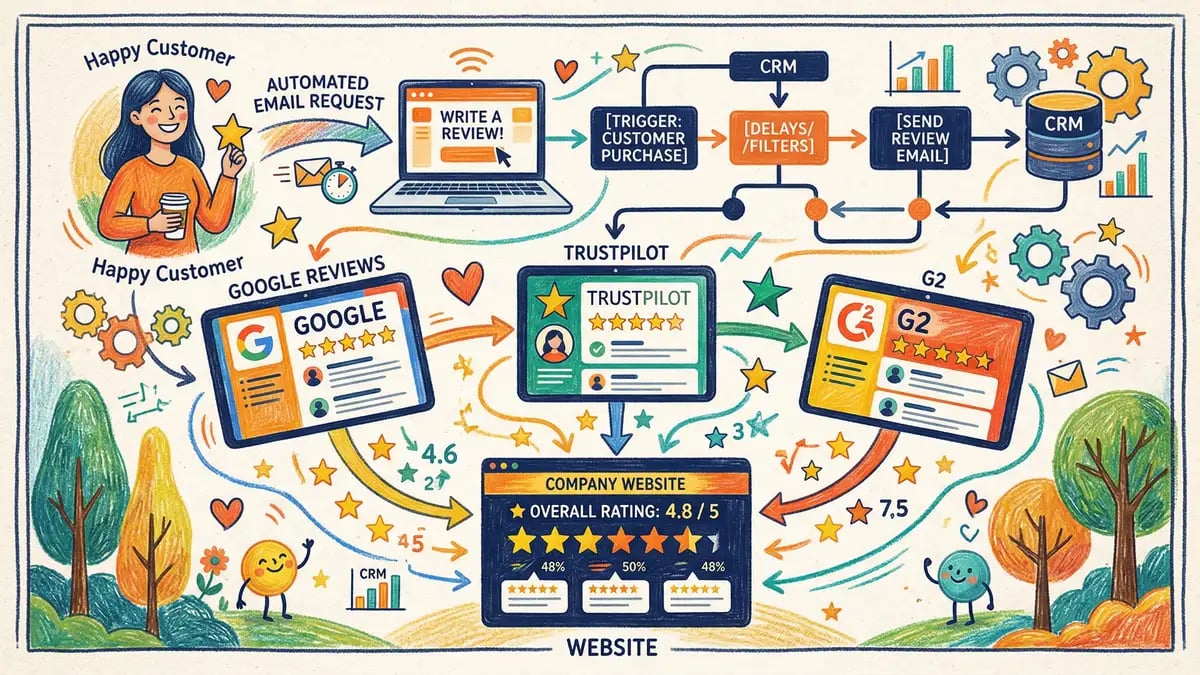
Use CRM automation (such as HubSpot workflows) to trigger review requests at the right moment. Segment by product, service tier, and customer lifecycle stage. This removes manual touchpoints and ensures consistency at scale.
Target Platform-Specific Requests
Don't ask for generic reviews. Request reviews on the platforms that matter most: Google Business Profile for local search, G2 or Capterra for B2B software, LinkedIn for professional services, Trustpilot for e-commerce. Each platform carries different weight in different verticals.
Authenticate with First-Party Data
Ensure reviews are authentic by asking only customers with verified purchase or service history. Use email verification and CRM matching to prevent fake reviews. This protects you from compliance risk and maintains platform standing.
Pillar 2: Monitoring 20+ Platforms for Brand Citations
AI systems pull from far more than just Google reviews. They crawl review platforms, B2B directories, social media, community forums, news outlets, and other AI platforms. A comprehensive monitoring strategy covers all of these channels.
| Platform Category | Platforms to Monitor |
|---|---|
| Review Platforms | Google Business Profile, Trustpilot, Glassdoor, Indeed, Zillow, ApartmentRatings, ZocDoc |
| B2B Directories | G2, Capterra, Software Advice, Gartner Peer Insights, AppFigures |
| Social Media | LinkedIn mentions, Twitter/X, Facebook comments, TikTok |
| Community Platforms | Reddit, industry forums, Stack Overflow, Product Hunt |
| AI Platforms | ChatGPT plugin directories, Perplexity citations, Claude references, Gemini mentions |
| News & Blogs | Industry publications, news aggregators, tech blogs, key media outlets |
Sources: DataForSEO Platform Index 2026, Whitehat SEO ORM Case Studies 2025-2026
Most enterprises attempt to monitor manually or with outdated spreadsheets. This approach fails at scale. You need dedicated tools that can track mentions, extract structured data (ratings, review count, sentiment), and alert you to changes in real time.
Tools for Modern ORM Monitoring
Otterly
Specialized in AI and SaaS monitoring. Tracks mentions across ChatGPT, Perplexity, Google AI Overview, and other AI systems. Provides sentiment analysis and citation tracking. Ideal for tech companies.
Profound
Covers all review platforms with unified dashboards. Supports response templates and task workflows. Works across Google, Trustpilot, and 100+ platforms. Best for multi-location enterprises.
Peec
Focuses on review generation and aggregation. Integrates with CRM systems and email marketing platforms. Automates follow-up workflows and tracks campaign effectiveness. Suited for customer-focused businesses.
Brandlight
Combines monitoring, response management, and analytics. Uses AI to suggest responses and flag critical issues. Provides benchmarking against competitors. Works well for mid-market and enterprise accounts.
The right tool depends on your industry, scale, and the platforms most important to your reputation. Most enterprises use 2–3 tools in combination: one for review platforms, one for social listening, and one specifically for AI platform monitoring.
However, tooling is only half the battle. You also need a response protocol.
Pillar 3: Rapid Response & Escalation Protocol
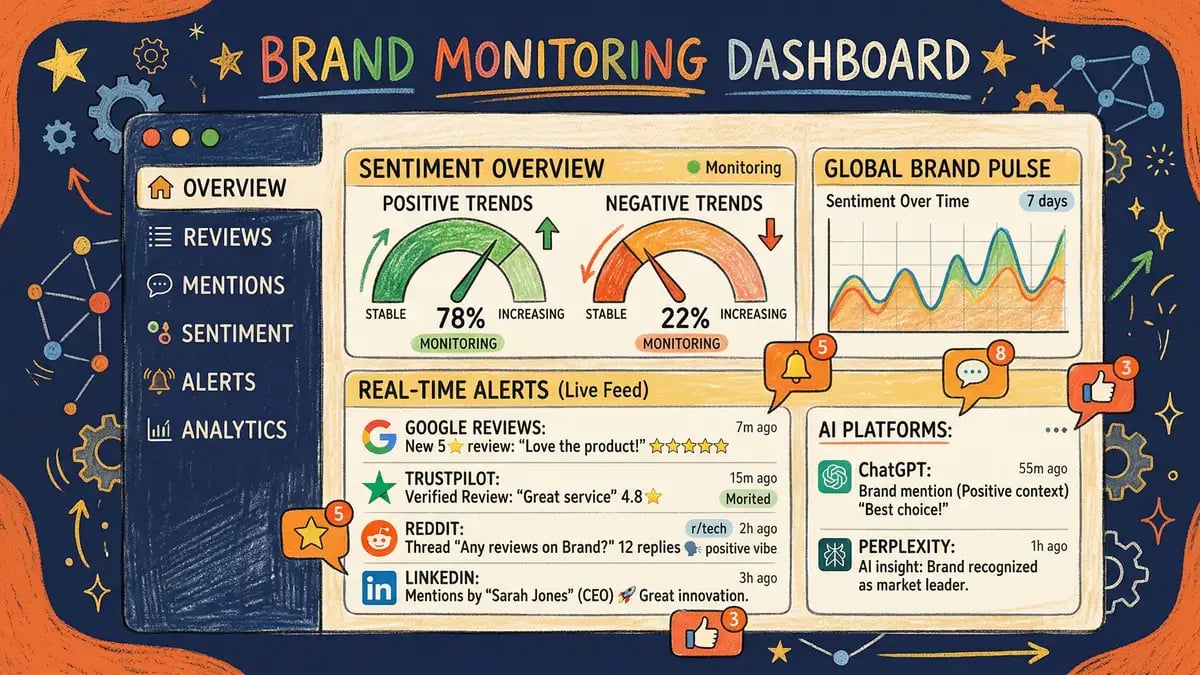
Speed matters. Research from Gartner and Deloitte shows that companies responding to negative reviews within 34–56 hours see 34–56% higher conversion rates from those customers. Waiting a week or longer signals to both the customer and algorithms that you don't care.
But it's not just speed—it's quality. A generic "We're sorry, please contact us" response doesn't rebuild trust. Your response should be specific, empathetic, and action-oriented.
Additionally, 22% of customers revise negative reviews after a thoughtful response, and positive reviews updated with responses see 67% higher trust improvement from readers. This means every response is an opportunity to amplify the positive and neutralize the negative.
Compliance Risk: The CMA and DMCC Are Watching
Common mistake: Offering incentives for reviews or suppressing negative feedback. This might boost numbers short-term, but it violates CMA guidelines and consumer protection law.
The reality: The CMA levies fines of up to 10% of global turnover for unfair trading practices. The DMCC issued its first £473,000 fine in 2026 for review manipulation. Stick to authentic generation only.
Building a Structured Response Protocol
A strong response protocol has three layers: triage, response crafting, and escalation.
Triage by Sentiment & Impact
Categorize incoming reviews as positive, neutral, or negative. Within each category, tag by impact: 1-star reviews from high-value customers are higher priority than 5-star reviews. Flag recurring themes (product issues, onboarding confusion, billing disputes) to identify systemic problems.
Craft Personalized Responses
Use response templates as a starting point, but always personalize. Reference specific details from the review. If the issue is resolvable (refund, replacement, follow-up call), offer concrete next steps. Include a direct contact email or phone number. Keep responses under 150 words.
Escalate Critical Issues
Negative reviews claiming legal issues, safety concerns, or involving media mentions should escalate to leadership immediately. Track escalations separately and assign ownership. Follow up with escalated customers personally and document outcomes.
This protocol ensures that no review goes unanswered, priority issues get leadership attention, and you have a clear audit trail for compliance. Most modern ORM tools support workflow automation for triage and response routing.
Need help building your reputation system? Get set up with HubSpot automation to manage reviews and responses at scale.
Start Your ORM SystemGoogle Business Profile: The Foundation of Local Reputation
For any business with a physical location or local service area, Google Business Profile is non-negotiable. It's the first place customers look for reviews, and it's heavily weighted by Google's local algorithm. Unlike third-party review platforms, you own your GBP profile directly.
A strong GBP strategy includes regular photo uploads, Q&A management, attribute updates (opening hours, services offered, delivery options), and prompt response to all reviews. Review velocity (new reviews per month) also signals activity, so even a single new review per week compounds over a year.
GBP also feeds into the emerging "local AI sandbox" where AI systems cite local businesses based on proximity, category relevance, and review signals. This makes GBP management increasingly important as AI becomes the entry point to local search.
Automating ORM with HubSpot Workflows
Manual review generation doesn't scale. HubSpot workflows can fully automate the ask, target, and follow-up cycle.
Here's how it works: When a contact completes a specific lifecycle milestone (onboarding complete, support case closed, invoice paid), a workflow triggers automatically. It sends a platform-specific review request based on contact attributes (location, product tier, previous feedback). If they don't respond, a secondary email follows up after 5 days with a different platform. The system also tags responses in HubSpot so you can analyze review generation ROI by campaign, product line, or customer segment.
Companies that implement HubSpot ORM workflows see 200–300% increases in review volume within 90 days. That's not a typo—it's the compounding effect of consistency and scale.

Beyond generation, HubSpot also integrates with response management systems. Negative reviews can automatically create tasks, trigger emails to support teams, or even log into Slack channels. This keeps your ORM coordinated with your CRM, so nothing falls through the cracks.
The ROI is clear: automated ORM workflows free up team time while dramatically increasing review volume and consistency. Given that review volume directly correlates with AI visibility and conversion rates, this is one of the highest-ROI automation investments you can make.
Social Proof at Scale: Converting Browsers to Buyers
Collected reviews are only powerful if they're visible. Hiding them in a review platform doesn't help your conversion rate. You need to surface them on your owned properties: your website, product pages, and checkout flow.
Studies consistently show that websites displaying visible reviews see 25–40% higher conversion rates than those without. The effect is even stronger when reviews are specific, recent, and varied (different reviewers, different products, different use cases).
Best practices for surfacing reviews:
- Homepage hero: Display your average rating and review count prominently. Use a star widget.
- Product pages: Show 3–5 filtered reviews for that specific product. Highlight recent, 4–5 star reviews that mention key features.
- Trust section: Create a dedicated reviews section with 10+ rotating reviews. Include reviewer name, title/company, and date.
- Checkout footer: Display your overall rating and 1–2 key review quotes to reduce cart abandonment.
- Case studies: Convert 5–10 of your best reviews into full case study formats with customer logo and testimonial video if possible.
Tools like Trustpilot, G2, and Capterra provide embed widgets that automatically pull and rotate your latest reviews. This keeps social proof fresh without manual updates.
Frequently Asked Questions About Online Reputation Management
Can I delete negative reviews? ▼
In most cases, no. Review platforms like Google, Trustpilot, and G2 only remove reviews that violate their policies (profanity, off-topic content, competitor sabotage, etc.). A negative review that's honest and detailed will stay. Your best strategy is to respond thoughtfully, offer resolution, and ask the customer to update their review if the issue is fixed. Many platforms allow reviewers to revise. Attempting to delete reviews can trigger compliance issues and platform penalties.
How do I measure ORM effectiveness? ▼
Track four key metrics: (1) review volume by platform (month-over-month growth), (2) average rating across platforms, (3) response rate (percentage of reviews responded to within 48 hours), and (4) conversion lift (compare conversion rates on pages with visible reviews to pages without). Most ORM tools provide dashboards for #1-3; for #4, use A/B testing or cohort analysis. You should see 5-15% monthly growth in review volume and a 25-40% conversion lift within 90 days of implementation.
Should I use review generation incentives? ▼
Offering small incentives (entry into a prize draw, discount on next purchase) for leaving a review is legal in most jurisdictions, provided you comply with platform terms of service and disclose the incentive. However, incentivizing positive reviews specifically, or suppressing negative reviews, is not permitted. Many review platforms (Google, Trustpilot, Amazon) prohibit incentivized reviews outright. Your safest approach is authentic generation without incentives, which also produces more genuine feedback. If you do use incentives, make them optional and apply to all reviews equally.
How do I respond to reviews without sounding generic? ▼
Reference specific details from the review (product name, service date, customer's role). If there's a problem, acknowledge it directly and explain what you'll do differently. If it's positive, thank them by name and mention a specific benefit they mentioned. Aim for 50-100 words. Avoid templated language like "We're sorry you had this experience" and instead write as if you're responding to a friend. A personalized response takes 3-5 minutes but dramatically increases the chance of review revision and customer loyalty. Tools like Brandlight and Profound can suggest personalized responses using AI, which you then refine.
How many review platforms should I prioritize? ▼
Focus on your top 5-7 platforms. For most businesses, this includes Google Business Profile, your industry's top B2B review site (G2, Capterra, etc.), your country's main consumer review platform (Trustpilot in Europe, BBB in US), and 2-3 vertical platforms (Glassdoor for employers, Zillow for real estate, etc.). Once you're generating reviews on these consistently, expand to secondary platforms. Monitor all 20+ platforms, but concentrate your generation effort on the top-tier ones where your customers and competitors are most active.
Bringing It All Together: Your 90-Day ORM Implementation Plan
Starting an ORM program can feel overwhelming. Here's a realistic 90-day roadmap to get from zero to a mature, automated system:
Weeks 1–4: Foundation & Audit
Audit your current reputation across your top 7 platforms. Assign ownership and access permissions. Set up monitoring in your chosen ORM tool. Create response templates by category (positive, critical, off-topic). Train your team on response guidelines and escalation procedures.
Weeks 5–8: Response Protocol & Manual Generation
Begin responding to all incoming reviews within 48 hours. Identify and manually invite 20–30 high-value customers to leave reviews on your priority platforms. Map advocate windows in your customer journey. Start collecting NPS or CSAT scores to identify advocates.
Weeks 9–12: Automation & Scale
Build and launch your first HubSpot workflow for review generation. Start with one advocate window (e.g., post-onboarding) and one target platform. Monitor performance, measure conversion impact, and refine. Plan your next 3 workflows. Ensure all reviews are being monitored and responded to. Document your ORM process for team consistency.
By week 12, you should have a foundational ORM system: consistent monitoring, response within 48 hours on all platforms, and the beginning of automated generation. This is the point where review velocity starts compounding, and you'll begin seeing conversion lift.
The Future of Reputation: AI and Beyond
ORM in 2026 is fundamentally different from ORM in 2020 because the distribution channels are different. Your reviews aren't just read by humans browsing Google anymore—they're ingested by AI systems that cite them to millions of users. This centralization has created unprecedented opportunity for companies that get it right.
As AI systems become smarter, they'll demand higher standards for review authenticity, response quality, and recency. The companies that win will be those that treat ORM as a core business function, not a checkbox. Review generation, monitoring, and response should be as automated and consistent as your email marketing or customer support systems.
The good news: you have the tools. The bad news: so does every competitor. The differentiator is execution consistency and speed. Start now.
Ready to build your reputation system?
Whitehat SEO helps enterprises automate review generation, monitor all platforms, and respond in real time. We'll build you a custom ORM strategy tailored to your vertical and convert it into an automated workflow.
Sources: Gartner Report on Customer Reviews and Conversions 2025, Deloitte Digital Trust Study 2026, CMA Enforcement Notices 2025-2026, Whitehat SEO ORM Case Studies 2025-2026
Clwyd Probert
SEO Director, Whitehat SEO
Clwyd leads ORM and AEO strategy for enterprise clients across fintech, SaaS, and professional services. He specializes in automating reputation workflows and measuring AI visibility impact. His work has helped clients increase review volume by 300% and improve conversion rates by 34–40%.