
When a patient in your area searches "dentist near me," who appears first? In 2026, nearly 79% of patients research reviews and local listings before choosing a dental practice, and the top three Map Pack positions capture over 70% of all clicks. If your practice isn't dominating that local three-pack, you're losing new patients to competitors who may be further away but more visible online.
Local SEO for dentists goes far beyond having a website. It's the combination of your Google Business Profile, online reviews, directory citations, and location-specific content that determines whether patients find you or your competitor when they need treatment. This guide covers every element UK dental practices need to build genuine local search dominance — from GBP optimisation through to the AI search platforms now influencing how patients discover dental services.
79%
Read Reviews First
Patients research reviews before choosing a dentist
53%
Won't Consider <4 Stars
Patients refuse practices rated below 4 stars
17.6%
Map Pack #1 CTR
Click-through rate for the first Map Pack position
900%+
"Near Me" Growth
Increase in "dentist near me" search volume
Sources: BrightLocal Consumer Review Survey 2025, Whitespark Local Search Ranking Factors 2025
What Is Local SEO and Why Does It Matter for Dental Practices?
Local SEO is the process of optimising your dental practice's online presence to appear in location-based search results — particularly the Google Map Pack (the three-listing box with map that appears above organic results) and local organic rankings. It differs from general SEO for dentists because every signal is tied to geographic relevance, physical location, and community trust.
The stakes are significant. The UK dental market comprises approximately 12,223 dental practices, with growing migration from NHS-only to mixed and private models creating intensifying competition for patient acquisition. Most patients search for dentists within a 3-mile radius and make decisions based on what they see in those first few seconds of search results. Practices appearing in positions 4+ in the Map Pack are effectively invisible to the majority of prospective patients.
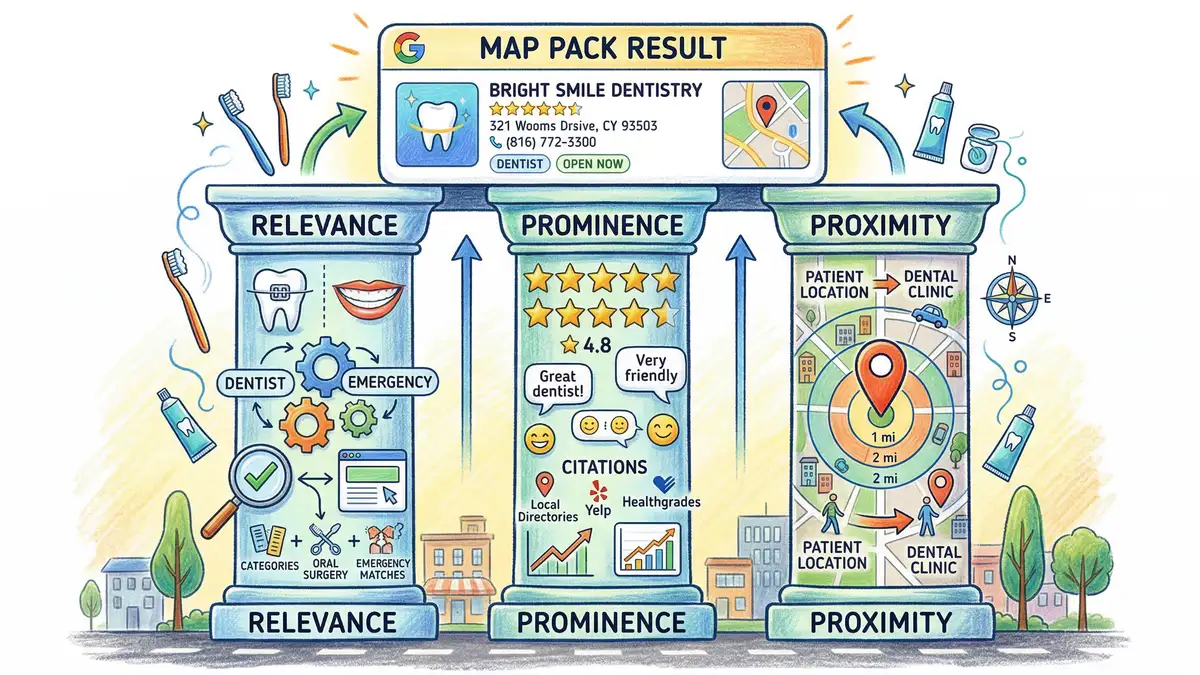
Google determines local rankings through three core factors: relevance (how well your profile matches the search query), prominence (your overall trust, authority, and review signals), and proximity (physical distance from the searcher). The critical insight for 2026 is that prominence has become increasingly influential — practices with significantly stronger review profiles and citation networks regularly outrank geographically closer competitors with weaker online authority.
How Do You Optimise Your Google Business Profile for a Dental Practice?
Your Google Business Profile functions as the digital shopfront of your practice. Approximately 64% of patients use GBP specifically to find contact information, and a fully optimised profile can generate hundreds of phone calls and dozens of booked appointments monthly. In 2026, GBP optimisation extends well beyond basic completion — successful practices treat their profile as a dynamic marketing channel requiring weekly attention.
Category Selection and Services
Your primary category must be "Dentist" without exception. Using alternatives like "Cosmetic Dentist" or "Dental Clinic" as your primary category substantially reduces visibility for foundational searches. Add secondary categories only when they correspond to services you actively provide: "Cosmetic Dentist," "Emergency Dental Service," "Orthodontist," or "Paediatric Dentist" as appropriate. Each secondary category should map directly to a service page on your website.
NAP Consistency: The Foundation
Your Name, Address, and Phone number must appear identically across your GBP, website, and every directory citation. Even minor variations — "St." versus "Street," different phone number formatting — trigger algorithmic uncertainty that impacts rankings. Standardise your format once and enforce it everywhere: the same suite number presentation, the same street spelling, the same phone format across all platforms.
Photos, Posts, and Q&A
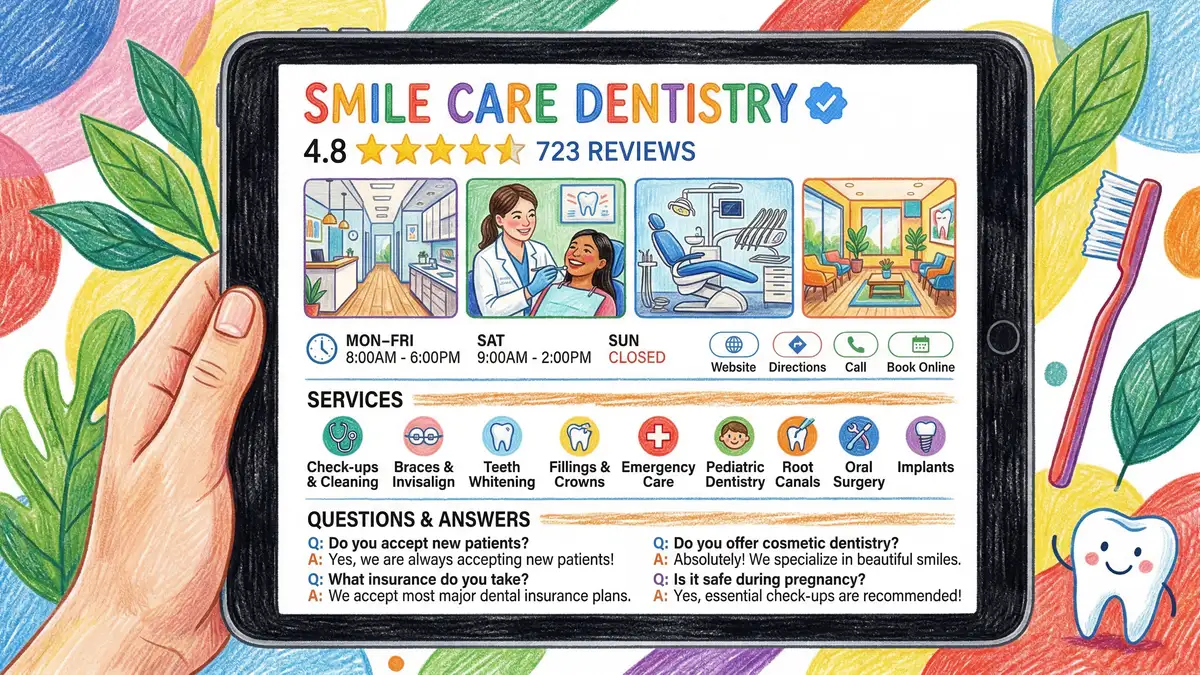
Profiles with 100+ high-quality photos receive substantially higher engagement. Upload a structured mix: exterior shots showing accessibility, reception and waiting areas demonstrating cleanliness, treatment rooms with modern equipment, team headshots, and before-and-after clinical photographs (with written patient consent, per GDC guidance). Upload fresh images monthly and geotag photos taken at your practice location.
Google Posts appear directly in search results at the moment of patient intent — far more valuable than social media posts competing with algorithmic feeds. Post weekly across four categories: promotional offers ("New Patient Exam, £99"), emergency availability, educational content, and seasonal announcements. The Q&A section is equally powerful: proactively add and answer your 10-15 most common patient questions covering insurance, sedation options, emergency procedures, and pricing.
Key Takeaway
Google Business Profile is your most powerful local SEO asset. A complete, actively managed profile with 100+ photos, weekly posts, pre-populated Q&A, and consistent NAP generates more patient enquiries than any other single channel. Treat it as a weekly marketing activity, not a one-time setup.
What Are the Most Important Map Pack Ranking Factors in 2026?
Research from Whitespark, BrightLocal, and Moz consistently identifies the same ranking signals, though their relative weighting continues to shift. Understanding these factors helps prioritise your local SEO investment where it matters most.
| Ranking Factor | Impact | What This Means for Dental Practices |
|---|---|---|
| GBP Signals | Highest | Category accuracy, completeness, post frequency, photo quantity, Q&A engagement |
| Review Signals | Very High | Volume, velocity (rate of new reviews), star rating, response rate, sentiment analysis |
| On-Page Signals | High | NAP on website, location-specific content, Dentist schema markup, local keywords in titles |
| Citation Signals | High | NAP consistency across directories, volume of structured citations, data aggregator accuracy |
| Behavioural Signals | Growing | Click-to-call rate, direction requests, website visits from GBP, booking completions |
| Proximity | Moderate | Distance from searcher — less controllable, but overcome by stronger prominence signals |
Source: Whitespark Local Search Ranking Factors 2025, BrightLocal Local Consumer Review Survey 2025
The most notable shift in 2026 is the growing weight of behavioural signals. Google now monitors how patients interact with your listing — phone calls, direction requests, website clicks, and appointment bookings from your profile. Practices designed to encourage action (prominent call buttons, integrated scheduling, clear directions with parking information) outrank those serving purely as information repositories.
AI search platforms including ChatGPT, Google Gemini, and Perplexity have also created a parallel visibility channel. These platforms synthesise information from reviews, directories, and website content to recommend practices directly — making review volume and multi-source citation consistency more important than ever.
How Should Dentists Build and Manage Online Reviews?
Reviews function simultaneously as the strongest ranking factor for local search and the primary trust signal influencing patient decisions. The data leaves no ambiguity: 88% of patients trust online reviews as much as personal recommendations, and practices with 500+ five-star reviews consistently outrank competitors with superior clinical credentials but fewer reviews.
Not sure where your practice stands in local search?
Our SEO audit identifies exactly where you're losing visibility and what to fix first.
Building Review Velocity Ethically
Review velocity — the rate at which new reviews accumulate — matters more than total count. A practice receiving 10 reviews monthly demonstrates stronger engagement signals than one with 100 historical reviews and nothing recent. The GDC's Standards of Practice permit review requests provided they are truthful, non-coercive, and don't imply guaranteed positive outcomes.
Time Your Request Right
Send review requests within 48 hours of a positive treatment experience, when patient satisfaction is highest. Text messages achieve 15-20% response rates versus 3-5% for email.
Use Honest, Open Language
Ask "We'd love to hear about your experience if you're willing to share" — never "Please leave a 5-star review." Directing the outcome violates GDC guidance and undermines authenticity.
Automate the Process
Integrate review requests with your practice management software to automatically identify completed appointments and send SMS prompts. This removes reliance on staff remembering to ask.
Respond to Every Review
Thank positive reviewers specifically. For negative reviews, acknowledge the concern without defensiveness, offer resolution, and invite private discussion. 70% of patients who see thoughtful negative-review responses improve their opinion of the practice.
GDC Compliance Warning
Never discuss clinical details publicly. If a negative review contains clinical claims, your response must acknowledge the patient's concern without confirming or denying specific treatments. GDC patient confidentiality rules apply to all public communications.
Before-and-after photos in reviews: Practices must ensure any clinical images shared by patients or used in review responses comply with GDC guidance on informed consent and do not create unjustified treatment expectations.
Which UK Directories Should Dental Practices Be Listed On?
Citations — consistent mentions of your practice name, address, and phone number across online directories — function as trust signals that validate your practice's legitimacy to search engines. Both structured citations (formal directory listings) and unstructured citations (mentions on blogs, news sites, and community pages) contribute to local ranking authority.
| Directory | DA | Link Type | Priority | Notes |
|---|---|---|---|---|
| Google Business Profile | 94 | N/A | Tier 1 | Essential foundation for all local search |
| Apple Business Connect | 99 | NoFollow | Tier 1 | Critical for iOS/Siri users |
| Bing Places UK | 93 | NoFollow | Tier 1 | Powers Microsoft Copilot AI recommendations |
| NHS.uk Find Services | 85+ | NoFollow | Tier 1 | Essential for NHS-contracted practices |
| Yell.com | 72-78 | NoFollow | Tier 1 | UK's largest business directory, 92% UK traffic |
| Trustpilot | 92 | NoFollow | Tier 1 | Major consumer trust signal for UK patients |
| FreeIndex | 56-57 | DoFollow | Tier 2 | Valuable DoFollow link that passes SEO authority |
| Thomson Local | 57 | NoFollow | Tier 2 | 85% UK traffic, strong local signal |
| Foursquare | 92 | NoFollow | Tier 2 | Powers 60-70% of AI search local recommendations |
| BDA Directory | Varies | DoFollow | Tier 2 | Industry-specific trust signal from British Dental Association |
Source: Whitehat SEO UK Citation Directory Analysis 2026
One directory deserves special attention: Foursquare. Its location database powers an estimated 60-70% of local recommendations made by AI search platforms including ChatGPT and Perplexity. Practices missing from Foursquare are effectively invisible to AI-powered search — a channel now handling 56% of global search volume.
The Bottom Line
Build citations in three phases: Tier 1 directories in week one (Google, Apple, Bing, NHS.uk, Yell, Trustpilot), Tier 2 in weeks two to three (FreeIndex, Thomson Local, Foursquare, 192.com), then dental-specific directories in month two. This phased approach delivers 80% of citation benefit without overwhelming your team.
How Do You Create Location-Specific Content That Ranks?
Generic service pages fail to generate local ranking authority. Location-specific content — pages targeting individual neighbourhoods, service areas, and community-relevant topics — creates multiple ranking opportunities and far stronger relevance signals for local searches.
Neighbourhood Landing Pages
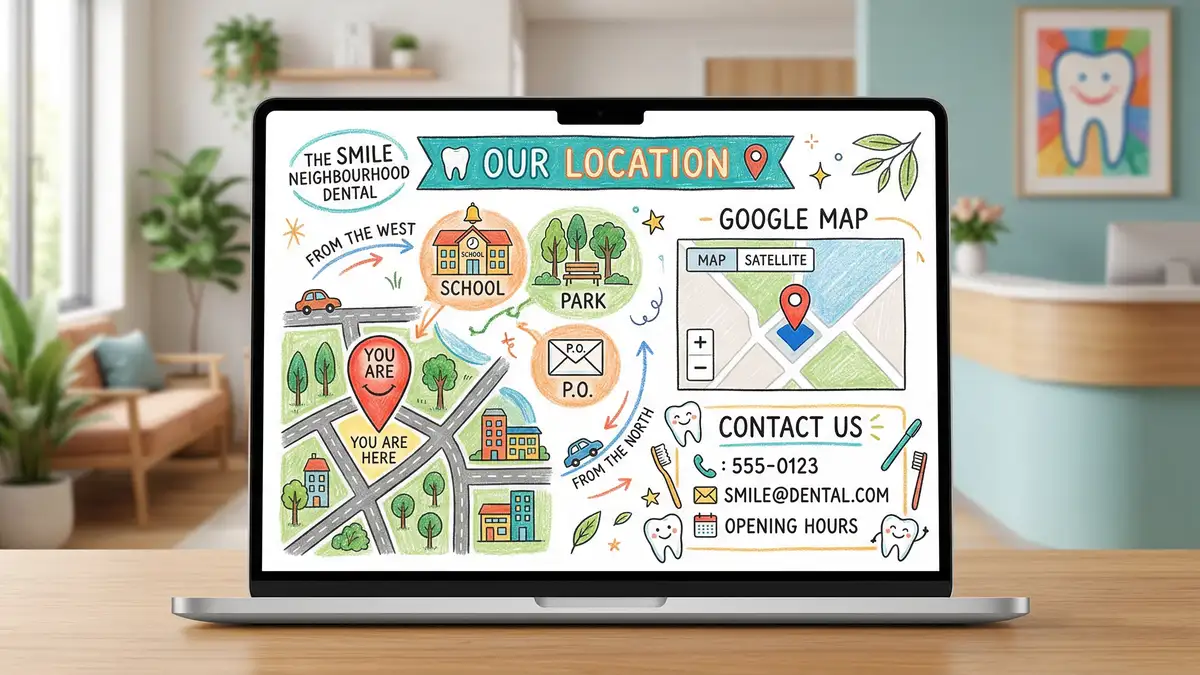
Create distinct pages for each major area your practice serves. A Manchester practice covering multiple neighbourhoods should build separate pages for "Dental Implants Didsbury," "Dental Implants Withington," and "Dental Implants Stockport" rather than relying on a single citywide page. Each neighbourhood page needs unique content — not templated text with location names swapped in. Include references to local landmarks, community characteristics, embedded Google Maps with driving directions, and locally relevant imagery. Target 800-1,200 words per location page.
Blog Content with Local Angles
Your dental marketing strategy should include blog topics that combine educational value with geographic specificity. "Root Canal Treatment in Manchester: What to Expect" will outperform generic "What Is a Root Canal?" content for local searches. FAQ-style posts addressing questions patients actually ask — "Is Invisalign painful?" or "What should I do if I lose a filling?" — generate strong traffic and establish topical authority through natural language patterns that align with voice search queries.
What Technical SEO Do Dental Websites Need for Local Search?
Your dental website's technical foundation directly impacts local rankings. Three elements require specific attention: schema markup, mobile performance, and structured data for AI search platforms.
LocalBusiness and Dentist Schema
Implement JSON-LD structured data using the Dentist schema type (a specific variant of LocalBusiness). Include your exact business name, precise address with suite number, phone number, website URL, opening hours with holiday variations, services offered, and accepted payment methods. Add FAQPage schema for your FAQ sections and AggregateRating schema if you display review summaries. This structured data helps Google understand your practice information without relying on natural language processing — and it's essential for technical SEO compliance in 2026.
Mobile Performance and Core Web Vitals
Over 60% of dental service searches occur on mobile devices. Your pages must meet Core Web Vitals thresholds: Largest Contentful Paint under 2.5 seconds, First Input Delay under 100 milliseconds, and Cumulative Layout Shift under 0.1. Beyond these metrics, ensure text is readable without zooming, buttons are minimum 44×44 pixels for thumb tapping, forms auto-fill from saved data, and appointment booking works seamlessly on small screens.
NHS Practice SEO
List on NHS.uk Find Services for immediate authority. CQC registration status must display prominently. Marketing claims face stricter restrictions — avoid competitive positioning or pricing comparisons. Focus on accessibility, availability, and service range within NHS terms.
Private Practice SEO
Greater marketing freedom but higher CMA scrutiny on pricing transparency. Build authority through Doctify, Top Doctors, and specialist directories. Display GDC registration numbers for every dentist. Focus on treatment outcomes, technology investment, and patient experience differentiation.
How Should Multi-Location Dental Practices Handle Local SEO?
Dental groups operating multiple locations face additional complexity. Each location requires its own independent local SEO infrastructure to build location-specific authority and proximity signals.
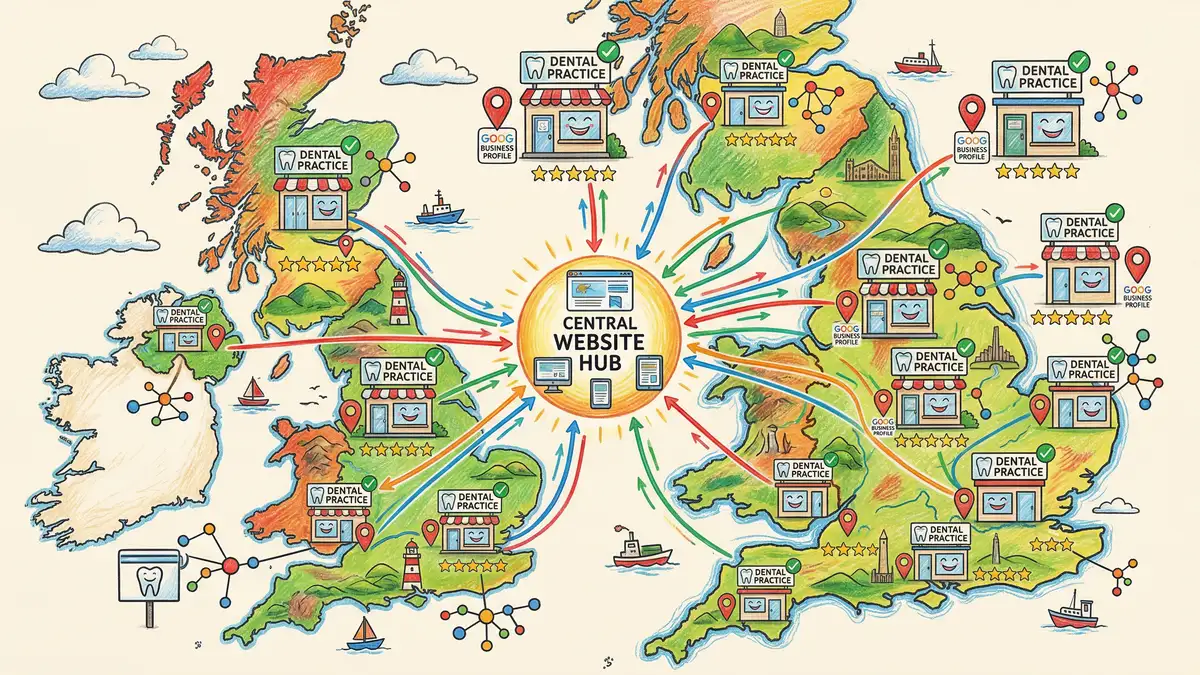
Create separate Google Business Profiles for each physical location with unique addresses, dedicated phone numbers (or location-specific extensions), individual opening hours, location-specific photos showing each practice's team and facilities, and independent review management. Manage all profiles through a single account dashboard to prevent duplicate listings.
On your website, use a centralised domain structure with location pages as subdirectories (yourpractice.co.uk/manchester, yourpractice.co.uk/leeds) rather than separate subdomains. This concentrates domain authority on the main domain. Each location page must contain genuinely unique content addressing that specific area — not templated copy with the location name swapped. Link each location page to its corresponding GBP, and ensure the GBP references that specific location page.
| Element | Per-Location Requirement | Common Mistake |
|---|---|---|
| GBP Listing | Unique profile with location-specific photos, hours, and phone number | Using a single GBP for all locations or sharing the same phone number |
| Website Pages | Unique location page at /location-name with original content | Template pages with only the city name changed — Google detects and penalises this |
| Citations | Full NAP citation set for each location across all tier 1 and 2 directories | Inconsistent NAP between locations or using HQ address for satellite offices |
| Reviews | Independent review generation and response per location | Directing all patients to review a single "main" location profile |
| Schema Markup | Unique Dentist schema on each location page with that location's NAP | Using identical schema across all pages or omitting schema from location pages |
Frequently Asked Questions
How long does local SEO take to show results for a dental practice?
Most dental practices see measurable improvements in Map Pack visibility within 90 days of implementing a structured local SEO programme. The first 2-4 weeks focus on Google Business Profile optimisation and tier-1 citation building, which often produces quick visibility gains. Review generation, content development, and citation expansion continue building authority over 6-12 months, with compounding returns as prominence signals strengthen.
How many Google reviews does a dental practice need to rank in the Map Pack?
There's no fixed threshold, as the number depends on your local competition. However, research consistently shows that practices with 40+ Google reviews see 33% higher click-through rates than those with fewer. Review velocity matters more than total count — aim for at least 8-10 new reviews per month rather than pursuing a one-time target. Practices with 500+ reviews and active velocity consistently dominate their local Map Pack.
Should dental practices invest in local SEO or Google Ads for patient acquisition?
Both channels serve different purposes. Local SEO builds sustainable visibility that generates patients month after month without per-click costs. Google Ads delivers immediate visibility for high-intent searches but stops producing results the moment you pause spending. Most successful practices use both: local SEO as the foundation for long-term growth, and targeted PPC campaigns for immediate impact during launches or for high-value treatments like implants and Invisalign.
Can a dental practice rank in the Map Pack outside its immediate area?
Yes. While proximity is a ranking factor, practices with significantly stronger prominence signals (more reviews, better citation networks, higher authority) regularly outrank geographically closer competitors. Building location-specific landing pages, generating reviews that mention specific neighbourhoods, and creating content addressing adjacent service areas all help extend your Map Pack reach beyond your immediate postcode.
What's the difference between local SEO for NHS and private dental practices?
NHS practices benefit from listing on NHS.uk Find Services (a high-authority trust signal) but face stricter restrictions on competitive marketing claims. Private practices have greater marketing freedom but face CMA scrutiny on pricing transparency. Mixed practices must clearly communicate which treatments are available under NHS terms versus private fees. Both require GDC registration display and CQC compliance, and both benefit equally from GBP optimisation, review generation, and citation building.
How important is social media for dental local SEO in 2026?
Social media has become more important than many practices realise — not because it directly impacts Google rankings, but because AI search platforms (ChatGPT, Gemini, Perplexity) now factor social media presence into their local recommendations. Regular posting on Facebook, Instagram, and TikTok feeds the AI systems that an increasing number of patients use to discover dental services. Social media also drives review generation, builds community authority, and supports the behavioural engagement signals Google monitors.
Ready to Dominate Local Search for Your Dental Practice?
We'll audit your local SEO presence, identify the gaps costing you patients, and build a plan to get your practice into the Map Pack. Book a free consultation to see where you stand.
Clwyd Probert
Founder & MD, Whitehat SEO
Clwyd has helped UK dental practices, healthcare providers, and professional services firms build sustainable organic growth through data-driven SEO and content strategy for over 15 years. He specialises in local SEO, technical audits, and AI search optimisation. dental SEO agency