
Conversion Rate Optimisation
Conversion rates in B2B vary dramatically depending on industry, channel, and funnel stage. According to Ruler Analytics' analysis of over 100 million data points published in August 2025, the median B2B conversion rate is 2.9%, with a range of 1-7.4% depending on sector. First Page Sage data covering January 2022 through August 2025 shows legal services leading at 7.4%, whilst B2B SaaS and software development trail at 1.1%—the lowest across all B2B sectors.
The Complete Guide to AI-Powered CRO in 2026
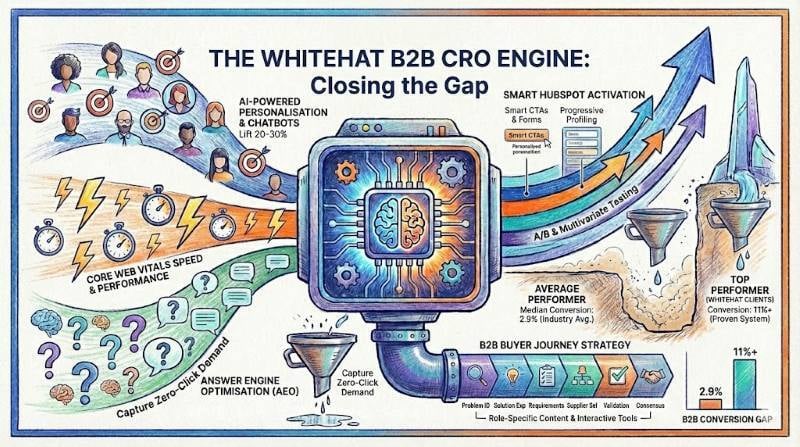
B2B conversion rate optimisation in 2026 centres on three converging forces: AI-powered personalisation that lifts conversions by 20-30%, Core Web Vitals compliance that creates a 40-50% advantage over slower competitors, and Answer Engine Optimisation for the 58.5% of searches that now end without a click. Whitehat's analysis of the latest industry data shows the median B2B conversion rate remains at 2.9%, yet top performers using HubSpot Smart CTAs, AI chatbots, and predictive analytics consistently achieve rates exceeding 11%—nearly four times the industry average.
Key CRO Benchmarks for 2026:
- 2.9% — Median B2B website conversion rate (Ruler Analytics, August 2025)
- 202% — Improvement from personalised CTAs vs. generic (HubSpot research)
- 23% — Higher conversion rates from AI chatbot implementation
- 40-50% — Conversion rate advantage from meeting Core Web Vitals thresholds
- 58.5% — Google searches ending without a click to any website
What Are the Latest B2B Conversion Rate Benchmarks?
The channel through which visitors arrive dramatically impacts conversion likelihood. Email marketing delivers the highest conversion rates, with 16.9% for SaaS according to Unbounce's 2024 benchmark report analysing 57 million conversions. Paid search delivers 5.1% for SaaS, paid social 2.9%, and display advertising performs worst at just 0.3%. This data suggests B2B marketers should prioritise email-to-landing-page journeys over purely acquisition-focused paid channels.
The funnel stages where leads are lost matter enormously. The MQL-to-SQL conversion rate averages just 13%, representing the biggest leak in most B2B pipelines. However, companies implementing behavioural lead scoring achieve 39-40% MQL-to-SQL conversion—roughly three times the average. Whitehat's HubSpot onboarding services prioritise lead scoring configuration precisely because of this performance gap.
| Industry | Avg. Conversion Rate | Top Performer Range |
|---|---|---|
| Legal Services | 7.4% | 10-15% |
| Professional Services | 4.6% | 8-12% |
| Healthcare | 3-4% | 7-10% |
| Manufacturing | 3-5% | 6-9% |
| B2B SaaS | 1.1-3% | 5-11% |
| B2B eCommerce | 1.8% | 4-6% |
How AI-Powered Personalisation Transforms Conversion Rates
AI-powered personalisation has shifted from competitive advantage to table stakes. According to McKinsey, fast-growing companies derive 40% more revenue from personalisation than slower-growing competitors, and organisations using AI personalisation report 2x higher customer engagement with 1.7x higher conversion rates. The Glassix study found websites using AI chatbots achieve 23% higher conversion rates than those without.
The chatbot revolution offers the clearest evidence of AI's impact. Chatbot leads convert at 3x the rate of traditional website forms, and businesses report up to 67% sales increases after implementation. For B2B companies already using HubSpot, the platform's native chatbots offer the significant advantage of CRM integration—every conversation enriches contact records and triggers appropriate workflows.
AI personalisation engines are delivering remarkable results. Mutiny, backed by Sequoia and Tiger Global, enables no-code website personalisation and ABM microsites—Brex reported 3x more signups using Mutiny's personalised outreach. Pathmonk's cookieless intent-based personalisation achieves an average 50% boost in conversions, with top performers seeing 180-200% lifts.
For landing page optimisation, Unbounce's Smart Traffic feature automatically routes visitors to the highest-converting variant and delivers 30%+ higher conversions on average. VWO's Copilot AI generates test ideas and creates variations, with documented case studies showing Unilever boosting conversions by 15% and Dell increasing leads by 20%. Whitehat's conversion optimisation strategies incorporate these AI tools alongside our core HubSpot expertise.
HubSpot's Breeze AI and Smart Features for B2B CRO
HubSpot has significantly expanded its CRO capabilities with Breeze AI, launched at INBOUND 2024. The platform now includes four specialised AI agents: Content Agent for landing pages and blogs, Prospecting Agent for automated outreach, Social Media Agent for content scheduling, and Customer Agent for support. Breeze Intelligence provides data enrichment from over 200 million profiles and crucially enables form shortening that increases conversions by 30-40% by auto-filling fields based on email lookup.
Smart Content and Smart CTAs remain HubSpot's core personalisation features. Smart rules allow targeting by lifecycle stage, contact list membership, country, device type, referral source, and preferred language. The data is compelling: personalised CTAs convert 202% better than default versions according to HubSpot's analysis of over 330,000 CTAs, and list-based personalisation increases conversion rates by up to 42%.
HubSpot Smart CTA Best Practices:
- Use only one piece of smart content per page to maintain clear analytics
- Avoid smart content in blog posts (it harms SEO crawlability)
- Always create default generic content for non-matching visitors
- Maintain CTA copy of 1-3 words with action verbs like "Get," "Download," or "Start"
- Emails with a single CTA boost clicks by 371% compared to multiple CTAs
HubSpot's form capabilities benefit significantly from progressive profiling—asking new questions on repeat visits rather than front-loading fields. Companies combining lead scoring with progressive profiling achieve 79% higher MQL-to-SQL conversion. Best practices include limiting TOFU forms to three fields (name, email, company), expanding to 5-7 fields for MOFU assets, and reserving extended qualification questions for BOFU conversions.
Platform-wide performance metrics demonstrate HubSpot's effectiveness: users report 505% ROI over three years, 129% more inbound leads, and 50% more deals closed. Eight out of ten customers see ROI within three months. For teams looking to maximise these results, Whitehat's HubSpot onboarding services ensure proper Smart CTA configuration from day one.
How Page Speed and Core Web Vitals Directly Determine Conversion Rates
The relationship between page speed and conversions is now definitively established through large-scale studies. The Deloitte/Google "Milliseconds Make Millions" research found that a mere 0.1-second improvement in mobile site speed yields 8.4% more conversions in retail, 10.1% in travel, and crucially for B2B, a 21.6% improvement in users progressing to form submission pages.
Portent's analysis of 27,000+ landing pages confirms that B2B sites loading in one second have 3x higher conversion rates than those loading in five seconds, and 5x higher than ten-second loads. Sites with poor LCP (Largest Contentful Paint) see 40-50% lower conversion rates—a performance gap that compounds across every visitor.
Core Web Vitals now serve as both ranking factors and conversion predictors. For LCP, the threshold is 2.5 seconds, but performance improves dramatically as load times decrease. At 2.5 seconds LCP, conversion rates drop below 3%; at 1.1 seconds, they exceed 6%—a relative lift of roughly 50%. Vodafone achieved 8% more sales from a 31% LCP improvement, whilst Rakuten 24's optimisation correlated with a 61% increase in conversion rate and 26% increase in revenue per visitor.
Interaction to Next Paint (INP), which replaced First Input Delay in March 2024, measures responsiveness. The "good" threshold is 200 milliseconds, but peak conversion occurs closer to 50ms. At 200ms INP, one analysis showed 3.91% conversion; at 50ms, this rose to 4.44%—a 13.5% relative lift. Sites meeting all CWV standards see 24% lower abandonment rates. Whitehat's Core Web Vitals guide for B2B provides detailed implementation steps.
Mobile optimisation presents a paradox for B2B: 83% of B2B website traffic comes from desktop, yet mobile research is increasingly important. Google/BCG research shows 73% of B2B decision-makers research at least partially on mobile devices. The mobile conversion gap remains significant—desktop converts at approximately 5% versus mobile at 1.6-2.9%—representing a substantial optimisation opportunity.
B2B-Specific Strategies for Long Cycles and Multiple Stakeholders
B2B buying cycles average 2-11 months, with buyers completing 67-75% of their journey digitally before ever contacting sales. This reality demands fundamentally different CRO approaches than B2C. Gartner's framework identifies six distinct buying stages: problem identification, solution exploration, requirements building, supplier selection, validation, and consensus creation. Each stage requires tailored content and conversion opportunities—expecting a single "Contact Sales" form to serve the entire journey ignores how modern B2B purchasing works.
The multi-stakeholder dynamic creates additional complexity. Average buying committees include 6-10 stakeholders, reaching up to 20 for enterprise deals. Marketing must create role-specific content: economic buyers need ROI calculators and business outcome data; technical evaluators require detailed specifications and integration documentation; end users want usability demonstrations; and champions need materials to sell internally.
Account-Based Marketing demonstrates measurable conversion impact. Gartner's 2024 research shows ABM increases pipeline conversion rates by 14%, MQL-to-SAL conversion by 25%, and overall account engagement by 28%. A TOPO study found ABM achieves 75% higher conversion rates for target accounts, with top performers converting 25-35% of accounts to meetings versus 5-10% for traditional approaches. However, execution matters: poorly executed personalisation can actually decrease purchase likelihood by 15%.
Lead scoring amplifies conversion effectiveness dramatically. Companies implementing effective scoring see 138% ROI versus 78% without, and machine learning-based scoring achieves 75% higher conversion rates. The speed-to-lead metric proves particularly critical: responding within five minutes makes qualification 21x more likely than responding after 30 minutes.
Form Optimisation Rules for B2B Conversion
Form optimisation for B2B follows specific rules backed by extensive testing. Each additional field reduces conversion by 4-11%, with forms exceeding seven fields experiencing 67.8% abandonment rates. Optimal B2B form length is 3-5 fields for top-of-funnel offers.
Progressive profiling solves the data collection challenge by asking new questions on subsequent visits, increasing conversion by approximately 30% whilst gathering significantly more qualified data over time. Offering immediate meeting scheduling after form submission doubles conversion rates from 30% to 66.7%, yet only 8% of top B2B SaaS companies implement this.
Form Length by Funnel Stage:
- Top of Funnel (TOFU): 3 fields maximum — name, email, company
- Middle of Funnel (MOFU): 5-7 fields — add job title, phone, company size
- Bottom of Funnel (BOFU): 7+ fields acceptable — include budget, timeline, specific needs
Conversational landing pages—pages where chatbots replace traditional forms as the primary conversion mechanism—achieve 17-35% conversion rates versus 3% baseline for traditional pages. Six exchanged messages makes a visitor 250% more likely to convert. The key is deploying chatbots not just on one page but across maximum pages to capitalise on traffic.
Answer Engine Optimisation: Converting in the Zero-Click Era
The search landscape is shifting fundamentally. According to SparkToro's 2024 analysis, 58.5% of US Google searches now end without any click—and this figure exceeds 70% globally for 2025 projections. B2B searches ending without clicks rose from 35% in 2024 to approximately 57% by October 2025. Gartner predicts 25% of organic search traffic will shift to AI chatbots by 2026.
Answer Engine Optimisation (AEO) focuses on structuring content so AI systems can extract, understand, and cite it. The principles differ from traditional SEO: lead with direct answers in the first 50-100 words, use question-based headers, structure content with bullet points and tables that AI can easily parse, and write at accessible reading levels. Unbounce data confirms that 5th-7th grade reading level achieves 11.1% conversion versus 5.3% for college-level complexity.
Zero-click strategies require measuring different metrics. Track SERP feature appearances and brand mentions in AI responses rather than just clicks. Monitor brand search volume increases as an indicator of awareness from zero-click exposure. Create "second-click magnets"—calculators, frameworks, assessments—that capture intent when users do need depth beyond what AI summaries provide. Whitehat's AI consultancy services help businesses adapt to this new search landscape.
Interactive Content and Video: The Highest-Impact Conversion Levers
Interactive content converts 2x better than passive content, with quiz completion rates reaching 40.1% on average. Calculators, assessments, and configurators solve specific B2B pain points whilst qualifying leads. Mint's Debt Payoff Calculator increased conversions by 220%, and Warby Parker's glasses quiz drives 35% of their email signups. For B2B specifically, ROI calculators prove instantly useful by helping users answer specific questions that support the buying committee's decision process.
Video demonstrates similarly dramatic impact. Landing pages with video achieve up to 86% higher conversion rates than text-only pages, and 38.6% of experienced marketers cite videos as having the biggest impact on landing page conversions. Video testimonials outperform text testimonials by 80-86%, creating emotional connection and trust that static content cannot match.
Privacy-first CRO strategies are becoming essential as third-party cookies phase out. With Safari and Firefox already blocking third-party cookies and Chrome prompting opt-out, reliance on third-party data is increasingly untenable. The solution: collect zero-party data through interactive content, preference centres, and surveys. First-party data enables the personalisation that drives 6x higher transaction rates from personalised emails whilst maintaining compliance and user trust.
Implementation Priorities for 2026 Success
The evidence points to clear priorities for B2B CRO investment. Based on Whitehat's analysis of the latest research, here are the six highest-impact actions:
- Implement AI-powered chatbots and personalisation — The 23% conversion lift from chatbots and 20-30% improvement from AI personalisation represent the highest-impact opportunities available today.
- Optimise Core Web Vitals ruthlessly — Target sub-2-second LCP and sub-200ms INP to capture the 40-50% conversion advantage over slower competitors.
- Restructure forms around progressive profiling — Cutting forms to 3-5 fields with progressive data collection and instant meeting booking can triple conversion rates.
- Develop role-specific content — Address all stakeholders in the buying committee: economic buyers, technical evaluators, end users, and internal champions each need tailored materials.
- Invest in AEO and structured data — Lead content with direct answers, implement FAQ and HowTo schema, and track AI citation alongside traditional metrics.
- Add interactive content — ROI calculators and assessment tools support consensus building and capture high-intent leads with dramatically higher conversion rates.
The B2B websites that thrive in 2026 will master this convergence: AI-powered optimisation, technically excellent performance, buyer journey sophistication, and adaptation to the new search landscape. The gap between average performers (2.9% conversion) and top performers (11%+) has never been wider—and the tools to close that gap have never been more accessible.
Frequently Asked Questions
What is a good B2B conversion rate in 2026?
The median B2B conversion rate is 2.9% according to Ruler Analytics' August 2025 data, but this varies significantly by industry—from 1.1% for B2B SaaS to 7.4% for legal services. Top performers consistently achieve 11%+ by implementing AI personalisation, optimised Core Web Vitals, and progressive profiling. Rather than targeting arbitrary benchmarks, focus on systematic improvement through A/B testing.
How do HubSpot Smart CTAs improve conversion rates?
HubSpot's Smart CTAs personalise calls-to-action based on visitor characteristics like lifecycle stage, list membership, country, and device type. HubSpot's research analysing over 330,000 CTAs found personalised versions convert 202% better than generic alternatives. This dramatic improvement occurs because Smart CTAs present relevant offers aligned with each visitor's stage in the buyer journey.
What Core Web Vitals thresholds should B2B sites target?
Google's "good" thresholds are: LCP under 2.5 seconds, INP under 200 milliseconds, and CLS under 0.1. However, conversion data shows peak performance at more aggressive targets—LCP under 1.5 seconds and INP under 50ms. B2B sites loading in one second achieve 3x higher conversion rates than five-second sites, making speed optimisation one of the highest-ROI CRO investments.
How does Answer Engine Optimisation affect B2B conversion?
With 58.5% of Google searches ending without a click, AEO ensures your brand appears in AI-generated answers from ChatGPT, Google AI Overviews, Perplexity, and Claude. Whilst traditional SEO focuses on driving clicks, AEO builds brand awareness and trust with the 95% of B2B buyers not currently in-market—creating future demand that converts when buying cycles begin.
What form length optimises B2B conversion rates?
Optimal form length varies by funnel stage: 3 fields maximum for top-of-funnel offers, 5-7 fields for mid-funnel content, and 7+ fields acceptable for bottom-of-funnel actions. Each additional field reduces conversion by 4-11%, and forms exceeding seven fields see 67.8% abandonment. Progressive profiling—asking new questions on repeat visits—increases conversion by approximately 30% whilst capturing richer data over time.
Ready to Transform Your B2B Conversion Rates?
Whitehat's team of HubSpot Diamond Partners and CRO specialists help B2B companies close the gap between average and top-tier performance. From Smart CTA configuration to Core Web Vitals optimisation, we build conversion systems that compound over time.
Get Your Free CRO AssessmentReferences and Further Reading
- Ruler Analytics — Average Conversion Rate by Industry and Marketing Source 2025
- HubSpot — Personalised CTAs Convert 202% Better (330,000 CTA Analysis)
- Unbounce — B2B Conversion Rate Optimisation: 2025 Strategies & Benchmarks
- Google Web.dev — Core Web Vitals Documentation
- McKinsey — The Value of Getting Personalisation Right (or Wrong) Is Multiplying
- SparkToro — 2024 Zero-Click Search Study