
Technical SEO
Semrush's 2025 guidance is explicit: "A flat website architecture allows users to reach content in as few clicks as possible. This lowers user effort and can create a better experience. Aim for a click depth of three clicks or fewer." Backlinko reinforces this, noting that flat architecture ensures link authority flows from pages that attract backlinks (typically your homepage) to the pages you actually want to rank.
Website Architecture SEO: The Complete 2026 Guide for B2B Marketers
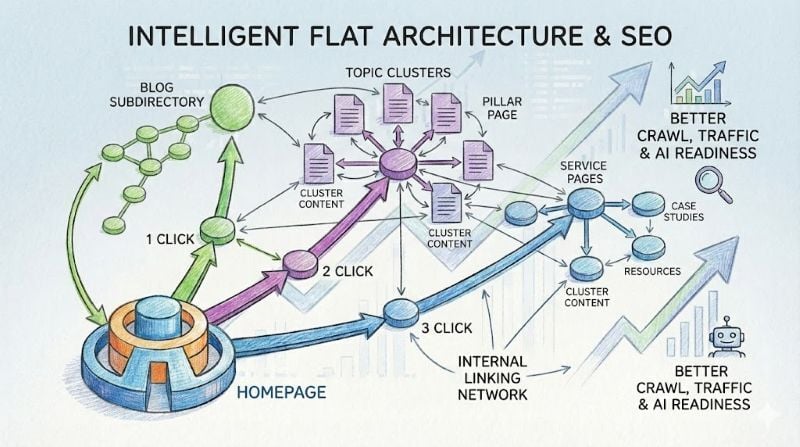
Website architecture determines how effectively search engines and AI systems crawl, understand, and recommend your content. The optimal approach in 2026 is "intelligent flat" architecture—keeping revenue-critical pages within three clicks of your homepage whilst using topic clusters to establish topical authority. Whitehat SEO's analysis of enterprise sites shows this strategy delivers 18–34% uplift in non-branded organic clicks within 90 days.
Why "Intelligent Flat" Architecture Wins in 2026
The debate between flat and deep site structures has evolved. Modern SEO best practice favours a hybrid approach: keep your most important pages within three clicks of the homepage whilst allowing deeper structures for archives, historical content, or specialised resources that don't drive commercial outcomes.
However, context matters. Search Engine Land's August 2025 analysis introduces important nuance: "For very large sites—such as ecommerce catalogues or news archives—deep structures can be practical. They help prevent choice overload by breaking navigation into manageable chunks."
The practical implication for B2B marketing directors: audit your click depth immediately. Pages buried four or more clicks from your homepage receive significantly less crawl attention and link equity. If your most valuable service pages or lead-generating content sits at depth 4+, you're leaving traffic on the table. Tools like Screaming Frog can identify these buried assets in minutes—and at Whitehat SEO, our website audit service prioritises exactly this kind of structural analysis.
The Subdirectory Advantage for Topical Authority
The subdomain versus subdirectory debate has been resolved decisively in favour of subdirectories for most B2B use cases—despite Google's John Mueller stating both are technically acceptable.
The case study evidence is compelling. Embarque's analysis shows that Flick reached 9.6 million in yearly traffic within 12 months of migrating content from a subdomain to a subdirectory. That's not an incremental improvement—it's a transformation.
HawkSEM explains the mechanism clearly: "When you split a blog onto a subdomain, you are splitting the topical authority across two websites, instead of bundling it together." Cloudflare's technical analysis confirms this: "The subdirectory strategy concentrates your keywords onto a single domain... resulting in better root domain authority."
Whitehat recommendation: Consolidate your blog, resources, and lead magnets on subdirectories (e.g., whitehat-seo.co.uk/blog) rather than subdomains (e.g., blog.whitehat-seo.co.uk). The case for subdomains is rarely justified for content that should build collective authority.
If you're currently running content on a subdomain, the migration effort is almost always worth it. Work with a technical SEO services provider who can manage redirects properly—a botched migration can temporarily tank your traffic before you see gains.
Internal Linking: Google's Explicit Priority
Google's John Mueller has been unusually direct on this topic: the number of slashes in your URL doesn't signal hierarchy to Google. What does matter is internal linking.
"For us, we don't care so much about the folder structure, we really essentially focus on the internal linking," Mueller stated in a Google Office Hours session. "Just looking at the number of slashes, for example, in a URL doesn't tell us that this is lower level or higher level. It's really like from the homepage or from the primary page how quickly can we reach that specific page?"
Mueller personally recommends a pyramid structure over super-flat layouts: "If we know this category is associated with these other subcategories, then that's a clear connection that we have between those parts. And that definitely helps us to understand how these things are connected... Whereas if it's very flat, then we think, oh, all of these are equally important."
His guidance on internal linking importance is emphatic: "Internal linking is super critical for SEO. I think it's one of the biggest things that you can do on a website to kind of guide Google and guide visitors to the pages that you think are important. And you have to tell Google which parts of your website are important."
The practical takeaway: stop obsessing over URL structure and invest that energy in strategic internal linking. Every blog post should link back to its relevant pillar page. Every service page should link to related case studies and resources. Every cluster of related content should be interconnected.
The Helpful Content Integration Factor
The March 2024 Core Update integrated the Helpful Content System into Google's core algorithm. According to Google, this "involves changes to multiple core systems and marks an evolution in how Google identifies the helpfulness of content."
Sites affected by earlier Helpful Content Updates commonly exhibited confusing navigation, poor user experience, and content structure prioritising search engines over users—making architecture a factor in site-wide assessment. If your site structure confuses humans, it likely confuses Google too.
Quantified Impact: What the Research Shows
Zyppy's landmark study analysed 23 million internal links across 1,800 websites and 520,000 URLs, revealing precise correlations between internal linking and organic performance:
- URLs with 0–4 internal links averaged only 2 clicks from Google Search
- URLs with 40–44 internal links received 4× more clicks (8 average)
- Pages with at least one exact-match anchor text internal link had 5× more traffic than those without
- After approximately 45–50 internal links per page, traffic begins declining—there's an optimal range
| Organisation | Change | Result |
|---|---|---|
| Atlassian | Site architecture rebuild | +150% organic traffic, +40% conversions |
| Online Auto Marketplace | Crawl budget optimisation | 19× increase in Google crawl, doubled traffic |
| Outdoor Equipment E-commerce | Flattened URL structure | +92% traffic, +104% revenue |
| Visit Seattle | Technical SEO overhaul | 850% site health improvement |
SearchPilot's controlled A/B tests (May 2024) isolated internal linking as a causal factor: adding geographic cross-links yielded +7% organic traffic uplift, whilst homepage footer link expansion produced +5% uplift—results not attributable to seasonality, algorithm updates, or competitor changes.
Click Depth and Crawl Probability
Botify's enterprise data reveals pages deeper than 5 clicks see "significantly reduced crawl rates," with crawl ratio decreasing at each additional level. Their recommendation: position strategic webpages at depth "no greater than 5." For large sites, this matters significantly. Google analyst Gary Illyes defines crawl budget as "the number of URLs Googlebot can and is willing or is instructed to crawl"—making efficient architecture essential for sites with thousands of pages.
Technical Foundations: Sitemaps, Canonicals, and Core Web Vitals
XML Sitemaps: Essential, With Caveats
Google's official documentation (updated October 2025) specifies that sitemaps are the "second most important source Google uses to crawl and discover URLs." Key requirements include a maximum of 50MB or 50,000 URLs per sitemap, UTF-8 encoding, and only indexable URLs.
An important detail many overlook: Google ignores <priority> and <changefreq> values but does use <lastmod> if consistently accurate. Don't waste time tweaking priority values.
HTML sitemaps have fallen from favour. Search Engine Journal notes: "If you have a good user experience and well-crafted internal links, do you need an HTML sitemap? Check the page views of your HTML sitemap in Google Analytics. Chances are, it's very low."
Canonical Implementation and Breadcrumb Schema
Google Search Central recommends self-referencing canonical tags on every page, using full absolute URLs with HTTPS protocol. Critically, canonicals are suggestions, not directives—Google may choose differently based on other signals.
Search Engine Land's 2026 Guide notes: "Self-referencing canonicals remain a foundational best practice. They establish a clear preferred URL and prevent search engines—and generative systems—from guessing."
Breadcrumbs require JSON-LD schema (Google's preferred format) with visible on-page breadcrumbs matching the markup exactly. Benefits include enhanced SERP appearance with breadcrumb trails, improved click-through rates, and clearer content hierarchy signals.
Core Web Vitals Thresholds (Updated December 2025)
| Metric | Measures | Good Score |
|---|---|---|
| LCP (Largest Contentful Paint) | Loading performance | < 2.5 seconds |
| INP (Interaction to Next Paint) | Responsiveness | < 200 milliseconds |
| CLS (Cumulative Layout Shift) | Visual stability | < 0.1 |
Note that INP replaced First Input Delay as of March 2024. Architecture impacts these metrics through server response times, JavaScript execution, and content delivery efficiency. If your site relies heavily on JavaScript frameworks, test with JavaScript disabled to see what search engines and AI crawlers actually see.
AI Search Optimisation: Semantic Clarity, Not New Tactics
Google's official documentation on AI features (June 2025) states clearly: "The best practices for SEO remain relevant for AI features in Google Search. There are no additional requirements to appear in AI Overviews or AI Mode, nor other special optimisations necessary."
However, the Princeton GEO study (accepted KDD 2024) demonstrates that content structure significantly affects AI visibility. Analysing generative engine responses, researchers found "GEO can boost visibility by up to 40% in generative engine responses." Traditional keyword tactics "often perform worse" in generative engines, whilst adding statistics and citations improved citation rates by 22–37%.
The resolution to this apparent contradiction: good content practices serve both traditional and AI search, with citation-heavy, statistic-rich content performing marginally better in generative contexts. You don't need separate "AI SEO"—you need thorough, well-structured content.
Semantic HTML Matters More Than Ever
A WebsiteAIScore.com audit of 1,500 websites found "60% of sites skipped directly from <h1> to <h4> simply to make text smaller." The impact: "LLMs rely on header hierarchy to 'chunk' information. When you break the hierarchy, you break the semantic relationship, causing the AI to misunderstand which concepts belong to which topics."
Critical HTML5 elements for AI readability:
<main>for primary content (use only once per page)<article>for main content pieces<section>for distinct page sections- Proper
<h1>–<h6>hierarchy without skipped levels <figure>and<figcaption>for media with descriptions
Schema Markup Provides Competitive Advantage
Only 12.4% of websites implement structured data, yet 72% of sites on Google's first page use schema. CMSWire reports that FAQ schema increases Google AI Overview appearance probability by approximately 40%. Microsoft Bing's Fabrice Canel confirmed at SMX Munich (March 2025): "Schema Markup helps Microsoft's LLMs understand content."
Key schemas for AI visibility include FAQPage (3.2× more likely to appear in AI Overviews), HowTo, Article/BlogPosting, Organisation, and Person schema for author expertise signals.
If you want your content cited by ChatGPT, Perplexity, and Google's AI Overviews, explore Whitehat's Answer Engine Optimisation (AEO) services—we structure content specifically for AI citation alongside traditional ranking.
HubSpot Topic Clusters: Methodology, Not Magic
HubSpot's official definition frames topic clusters as "a way of organising a site's content pages using a cleaner and more deliberate site architecture." The model comprises a pillar page (comprehensive hub for a broad topic) supported by cluster content (specific subtopics) interconnected through strategic internal linking.
Critically, HubSpot's documentation explicitly states: "Creating topic clusters in HubSpot does not affect your website's SEO directly." The benefit comes from the architectural discipline the methodology enforces, not the tool itself. This matters because many teams implement topic clusters expecting algorithmic favour—when the real value is structural.
Pillar Page Requirements
- Sit on the top level of your website (not buried in subdirectories)
- Have no gated content (forms or passwords blocking crawlers)
- Be broad enough to serve as "umbrella for 20–30 posts"
- Reference the topic in title, URL, and H1 tag
HubSpot's internal research found "the more interlinking they did, the better the placement in SERPs. Impressions also increased with the number of links they created."
Documented Results
- HubSpot's own blog: +50% organic traffic in one year, improved rankings across 300+ keywords
- Agency clients: 7–10× organic growth over one year
- E-commerce case study: 500 to nearly 190,000 monthly visitors (37,900% increase)
The HubSpot CMS provides technical SEO advantages including built-in CDN (Cloudflare), automatic SSL certificates, auto-generated sitemaps, redirect tools with bulk CSV import, AMP support for blog content, and real-time SEO recommendations during editing. As a HubSpot Diamond Partner, Whitehat helps teams implement topic cluster architecture properly from day one.
Your 6-Step Action Plan
Based on the evidence reviewed, here are the priorities for B2B marketing directors looking to improve site architecture:
1. Audit Click Depth Immediately
Pages beyond 3 clicks from homepage receive significantly less crawl attention and link equity. Use Screaming Frog or similar tools to identify buried content. Prioritise bringing high-value pages closer to the surface.
2. Consolidate on Subdirectories
The case for subdomains is rarely justified for content that should build collective authority. Blog, resources, and service pages belong on the main domain. Plan migration carefully with proper redirects.
3. Implement Topic Clusters as Architectural Discipline
Regardless of CMS, the pillar-and-spoke model enforces flat architecture, strategic internal linking, and topical focus simultaneously. The value is structural, not algorithmic.
4. Prioritise Semantic HTML for AI Readiness
Proper heading hierarchy, semantic elements, and schema markup position content for both current SERP features and emerging AI citation patterns. Don't skip heading levels.
5. Measure Internal Linking Impact
The Zyppy study provides a benchmark (optimal range 40–45 internal links). SearchPilot's methodology demonstrates how to isolate internal linking as a causal factor. Track before and after.
6. Address Technical Foundations Before Content Expansion
Canonical tags, breadcrumb schema, mobile parity, and Core Web Vitals form the infrastructure that allows content architecture to function. Fix the foundation before building more.
Frequently Asked Questions
How many internal links should each page have?
Based on Zyppy's analysis of 23 million internal links, pages with 40–44 internal links perform best—receiving 4× more clicks than pages with fewer than 5 links. However, traffic begins declining after approximately 45–50 internal links, suggesting a quality-over-quantity approach within the optimal range.
Does crawl budget matter for smaller websites?
Google states crawl budget is primarily relevant for sites with 1 million+ pages or 10,000+ pages updated very frequently. Smaller sites may over-invest in crawl budget optimisation when focusing on internal linking structure and content quality would deliver greater returns.
Should I use a subdomain or subdirectory for my blog?
Use subdirectories in almost all cases. Case study evidence shows dramatic improvements when migrating from subdomains—Flick reached 9.6 million yearly traffic after consolidating. Subdomains split your topical authority across two separate entities instead of concentrating it on a single domain.
Do I need different SEO strategies for AI search engines?
Google's official guidance states no additional optimisations are necessary for AI Overviews. However, research shows content with statistics and citations performs 22–37% better in AI responses. The best approach is thorough, well-structured content with proper semantic HTML—this serves both traditional and AI search.
How quickly can I expect results from improving site architecture?
OnwardSEO's 2025 analysis across 19 enterprise sites documented a median 18–34% uplift in non-branded clicks within 90 days when teams prioritised crawl depth and internal linking. SearchPilot's A/B tests showed 5–7% traffic uplifts from targeted internal linking changes within similar timeframes.
Ready to Audit Your Site Architecture?
Whitehat SEO's website audit identifies exactly what's preventing your site from ranking—and prioritises fixes by commercial impact, not just SEO best practice checklists.
Get Your Website Audit →References
- Google Search Central. Mobile-First Indexing Best Practices. developers.google.com
- Google Search Central. Core Web Vitals Report. developers.google.com
- Google Search Central. Breadcrumb Structured Data. developers.google.com
- Google Search Central. Build and Submit a Sitemap. developers.google.com
- Google Search Central. AI Features in Google Search. developers.google.com
- Semrush Blog. Website Structure: How to Build Your Site Architecture for SEO. semrush.com
- Backlinko. Site Architecture: The Complete Guide. backlinko.com
- Ahrefs Blog. Internal Links for SEO: An Actionable Guide. ahrefs.com
- Search Engine Journal. XML Sitemaps Guide. searchenginejournal.com
- HubSpot Blog. Topic Clusters: The Next Evolution of SEO. blog.hubspot.com
- Zyppy. SEO Study: 23 Million Internal Links. zyppy.com
- SearchPilot. Internal Linking A/B Test Case Studies. searchpilot.com
- Princeton/Georgia Tech. GEO: Generative Engine Optimization Research. arxiv.org