
SEO Strategy
Surfer SEO's analysis of one million SERPs reinforces this finding. Top-10 pages covered approximately 74% of relevant subtopics versus just 50% for lower-ranking pages. The study declared keyword density effectively "dead" as a ranking factor, finding near-zero correlation with performance. Instead, pages using keyword variations across H2-H4 headers consistently outperformed those repeating exact-match keywords.
On-Page SEO Best Practices for 2025-2026: What Actually Works Now
Content quality now dominates rankings, AI Overviews appear in 15-16% of searches, and INP has replaced FID. Here's how to adapt your on-page strategy.
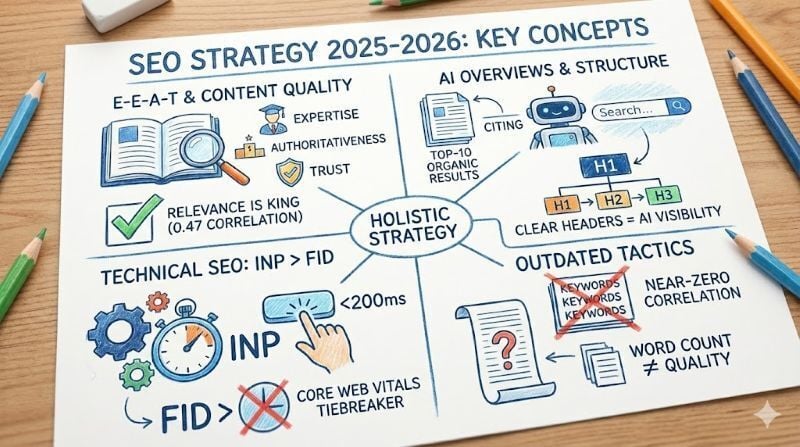
On-page SEO in 2025-2026 centres on content quality, genuine expertise, and technical performance—not keyword manipulation. Semrush's analysis of 300,000+ search results found text relevance achieves a 0.47 correlation with rankings, the highest of any measured factor. Google's integration of the Helpful Content System into its core algorithm means demonstrating real E-E-A-T (Experience, Expertise, Authoritativeness, Trust) is now essential, whilst the replacement of FID with INP for Core Web Vitals demands renewed attention to page responsiveness. For UK B2B companies, the path forward is clear: create content that showcases genuine expertise, structure it for both human readers and AI extraction, and maintain technical excellence.
Content Quality Now Dominates Ranking Factors
The shift toward content quality represents the most significant change in SEO since mobile-first indexing. First Page Sage's Q1 2025 study quantifies this precisely: "Consistent Publication of Satisfying Content" now accounts for 23% of ranking weight, whilst traditional signals like backlinks have declined to 13% (down from 15% in 2024).
Whitehat SEO's analysis of client sites confirms this trend. Pages demonstrating genuine expertise through original insights, specific data, and practical guidance consistently outperform those relying on comprehensive keyword coverage alone. The difference is particularly stark in B2B sectors where professional SEO services must balance technical optimisation with substantive value.
| Algorithm Update | Date | Key Impact |
|---|---|---|
| March 2024 Core Update | 5 Mar – 19 Apr 2024 | Integrated Helpful Content System; 45% reduction in unhelpful content |
| August 2024 Core Update | 15 Aug – 3 Sep 2024 | Quality refinements |
| March 2025 Core Update | 13 – 27 Mar 2025 | Standard refinements |
| December 2025 Core Update | 11 – 29 Dec 2025 | Most recent core update |
Gary Illyes stated that backlinks haven't been in the "top three" ranking factors "for some time," whilst John Mueller emphasised there's no definitive list: "We use so many factors for ranking, it really depends on a lot of things." This ambiguity shouldn't paralyse action—it should redirect focus toward what demonstrably works: comprehensive, expert content.
Title Tags and Meta Descriptions Need Fresh Thinking
Google now rewrites 76% of title tags—up significantly from 61% in 2023—according to Q1 2025 analysis by Search Engine Land. When titles are modified, Google retains only 35% of the original content on average, removing approximately 2.7 words. The most common change is brand name removal, occurring in 63% of modifications.
Despite this rewriting behaviour, longer titles retain SEO value for ranking purposes. Gary Illyes confirmed: "The title length, that's an externally made-up metric." Google uses the original HTML title tag regardless of what appears in SERPs. However, titles between 30-60 characters are most likely to remain unchanged. Matching your H1 to your title tag reduces rewriting to approximately 20.6%.
Whitehat's title tag guidance: Write titles between 30-60 characters that match your H1, front-load your primary keyword, and include your brand name. Accept that Google may rewrite it, but your ranking signals remain intact.
For meta descriptions, Google rewrites 62.78% of them, often pulling from the first paragraph of content instead. The optimal length remains 150-160 characters for desktop and 110-120 characters for mobile. Custom meta descriptions can increase click-through rate by 5.8%, making them worth optimising even with high rewrite rates. Our website audit services include comprehensive meta tag analysis to identify these opportunities.
Header Structure Signals Topical Relevance
John Mueller has called header tags a "really strong signal" for understanding page topics, though he's also clarified that multiple H1 tags won't technically hurt rankings: "Your site is going to rank perfectly fine with no H1 tags or with five H1 tags." Despite this flexibility, using one clear H1 per page remains best practice for user experience and clarity. The H1 should stay under 60-80 characters and include the primary keyword naturally.
Proper hierarchy matters for passage ranking—Google's ability to extract and rank specific sections of content. Headers should follow a logical sequence (H1 → H2 → H3) without skipping levels. Making headings descriptive rather than clever supports featured snippet extraction and helps AI-powered search understand your content structure.
Header best practices for 2025-2026:
- Use one H1 per page containing your primary keyword
- Structure H2s as topic sections that could stand alone
- Use H3s for sub-points within each H2 section
- Never skip heading levels (H2 → H4)
- Make headers descriptive—"How to Set Up Lead Scoring" beats "Getting Started"
Content Depth Trumps Word Count
The correlation between content length and rankings exists but is nuanced. Backlinko's study of 11.8 million search results found the average first-page result is 1,447 words, whilst extremely long content (10,000+ words) can actually hurt rankings if it misses search intent. Surfer SEO's research concluded that word count alone doesn't matter when pages achieve at least 50% of suggested term coverage—depth and comprehensiveness matter more than raw length.
The optimal keyword density has dropped significantly. BrightEdge found top-10 pages now have 50% lower keyword density than two years ago, with the recommended range settling at 0.5-1% (approximately 1-2 mentions per 100 words). John Mueller has explicitly stated keyword density is not a direct ranking factor.
Information Gain: The New Frontier
Google's "Information Gain" patent, granted in June 2024, codifies what many suspected: content offering unique, additional information beyond what's already ranking will be favoured. This penalises the "skyscraper" technique of simply aggregating existing content. Pages with original data, quotes, or statistics have 30-40% higher visibility in AI-generated answers according to Backlinko research.
For B2B companies, this creates opportunity. Whitehat SEO consistently finds that client case studies with specific metrics, original survey data, and expert commentary outperform generic "comprehensive guides" that merely synthesise existing information. The investment in original insight pays dividends in both traditional rankings and answer engine optimisation.
E-E-A-T Implementation Has Become Non-Negotiable
Google's Quality Rater Guidelines were updated multiple times in 2024-2025, with the September 2025 revision adding examples for evaluating AI Overviews and expanding YMYL categories to include election and civic information. The guidelines explicitly state that Trust is the most important E-E-A-T component—"untrustworthy pages have low E-E-A-T no matter how Experienced, Expert, or Authoritative they may seem."
A 2024 Semrush study found pages with strong E-E-A-T signals had a 30% higher chance of ranking in top-3 positions. For B2B agencies, practical implementation includes author bio pages with Person schema markup, publication and update dates on all content, case studies with measurable results, industry certifications displayed prominently, and clear contact information including physical address.
Author Attribution Deserves Special Attention
Google's Danny Sullivan flagged "byline leads to no bio info" as a quality issue, indicating clear author pages are now expected. Best practice includes professional headshots, credentials, areas of expertise, and LinkedIn profile links—implemented with Person schema markup. This is particularly important for ethical SEO practices that build long-term authority.
Core Web Vitals: The INP Transition
The most significant technical change of 2024 was INP (Interaction to Next Paint) replacing FID on 12 March 2024. Unlike FID, which measured only the first interaction, INP measures all interactions throughout the page lifecycle, providing a more comprehensive responsiveness assessment.
| Metric | Good | Needs Improvement | Poor |
|---|---|---|---|
| LCP (Largest Contentful Paint) | ≤2.5s | 2.5s – 4s | >4s |
| INP (Interaction to Next Paint) | ≤200ms | 200ms – 500ms | >500ms |
| CLS (Cumulative Layout Shift) | ≤0.1 | 0.1 – 0.25 | >0.25 |
Only 47% of sites currently meet Google's "Good" threshold for all three metrics. However, pages ranking at position 1 are 10% more likely to pass Core Web Vitals than those at position 9. The business impact is substantial: Vodafone achieved an 8% sales increase from a 31% LCP improvement, whilst Rakuten saw 53% higher revenue per visitor after optimising all metrics.
Core Web Vitals function as a "tiebreaker" rather than a primary ranking factor—content quality remains paramount. Google uses real user data (field data) from the Chrome User Experience Report, measured over a 28-day rolling window at the 75th percentile. Lab scores from Lighthouse do not directly affect rankings. For a detailed assessment of your site's technical performance, Whitehat's Core Web Vitals guide for B2B provides comprehensive optimisation strategies.
Internal Linking Delivers Measurable Results
Authority Hacker's study of over one million websites found proper internal linking can boost rankings by up to 40%. SearchPilot's A/B testing confirmed specific impacts: adding geographic region links yielded a 7% organic traffic increase, whilst homepage footer links produced a 5% uplift for destination pages.
Click depth proves critical—pages at depths 1-3 generate 9x more SEO traffic than deeper pages according to My Rankings Metrics. The practical guideline is 5-10 internal links per 2,000 words (approximately one link every 200-300 words), using descriptive anchor text with 1-2 relevant keywords rather than generic "click here" phrases.
Link Equity Distribution
For link equity distribution, high-authority pages like the homepage pass more PageRank. New content should receive internal links from established high-traffic pages within 24-48 hours of publishing, and broken links should be fixed immediately to prevent wasted link equity. This is why HubSpot onboarding includes proper site architecture setup from day one.
AI Search Optimisation: Structure, Not Special Tactics
Google's official May 2025 guidance states unequivocally: "There are no additional requirements to appear in AI Overviews or AI Mode, nor other special optimisations necessary. The best practices for SEO remain relevant for AI features in Google Search."
Semrush's study of 10+ million keywords found AI Overviews now appear in approximately 15-16% of searches (November 2025), down from a July 2025 peak of 24.6%. Critically, 74% of AI Overview citations come from top-10 organic results—ranking well remains the primary path to AI visibility.
Citation Patterns by Platform
- ChatGPT: Favours Wikipedia (47.9% of top citations) and .com domains
- Perplexity: Cites Reddit more frequently (6.6%), favours niche authority sites
- Gemini: Prefers brand-owned websites (52.15% of citations)
- Google AI Overviews: 74% from top-10 organic results; freshness matters
Content structuring for AI extraction follows logical principles: one idea per paragraph, clear H2/H3 headings, direct answers in the first sentence after headings, specific data over vague claims, and comparison tables where relevant. For comprehensive guidance on optimising for AI engines, explore Whitehat's answer engine optimisation service.
Featured Snippets: Displaced but Not Dead
A significant shift occurred in 2025: 83% of Featured Snippets have been replaced by AI Overviews for queries where both could appear. Featured snippets now primarily appear for simpler, direct-answer queries whilst AI Overviews handle complex, multi-source topics.
However, Featured Snippets retain value: they captured 35.1% of all clicks in recent studies and power over 40% of voice search answers. Optimisation techniques remain consistent—target question-based keywords, answer directly below headings in 40-60 words for paragraph snippets, use lists for step-by-step content, and ensure you already rank in the top 10 (99% of snippets come from page 1).
Search Intent Matching Determines Format Success
The four intent types—informational, navigational, commercial, and transactional—require matched content formats. Ahrefs' 3 Cs framework (Content Type, Content Format, Content Angle) provides the clearest methodology: search your target keyword, analyse top-10 results for dominant patterns, then match your content accordingly.
AI Overviews trigger most frequently on informational queries (57.1%), followed by commercial (18.57%), transactional (13.94%), and navigational (10.33%). Longer, more specific queries (5+ words) have the highest AI Overview presence, suggesting comprehensive, question-answering content will perform best in AI-augmented search.
Schema Markup: Essential for AI Visibility
Whilst schema markup is not a direct ranking factor, its value has shifted toward AI search. Frase.io analysis found pages with FAQ schema are 3.2x more likely to appear in Google AI Overviews, and Data World's benchmark study showed LLMs grounded in knowledge graphs achieve 300% higher accuracy versus unstructured data.
Google recommends JSON-LD format for implementation. John Mueller clarified in January 2026 that "Google is not killing schema... schema markup types are not static checklists. They are a living framework." Priority schema types for B2B sites include Organization (homepage), Article/BlogPosting (all content), Person (author pages), LocalBusiness (if location-relevant), and Review (client testimonials).
What This Means for UK B2B Content Strategy
The 2025-2026 SEO landscape rewards genuine expertise over technical manipulation. The integration of the Helpful Content System into Google's core algorithm, combined with AI search's preference for authoritative, well-structured content, creates a clear path forward: create content that demonstrates real experience and expertise, structure it for easy extraction by both featured snippets and AI systems, and maintain technical excellence through Core Web Vitals compliance.
The sites that struggled through 2024's updates were those producing generic, aggregated content—the opportunity lies in providing genuine value that AI systems will want to cite and users will want to share. For UK B2B companies, this means investing in original research, expert commentary, and practical guidance that competitors can't easily replicate.
Whitehat SEO's approach to SEO services has always prioritised sustainable, quality-focused strategies. The 2025-2026 algorithm updates simply validate this approach—and create opportunity for businesses willing to invest in genuine expertise rather than shortcuts.
Frequently Asked Questions
What is the ideal keyword density for on-page SEO in 2025?
Keyword density is no longer a meaningful metric. BrightEdge research shows top-ranking pages have 50% lower keyword density than two years ago. Focus instead on topical coverage and using keyword variations naturally across your headers and content. John Mueller has explicitly confirmed keyword density is not a direct ranking factor.
How do I optimise content for AI Overviews?
Google's official guidance confirms no special optimisations are needed for AI features. Focus on standard SEO best practices: rank in the top 10 (74% of AI Overview citations come from there), structure content with clear headers, provide direct answers in the first sentence after headings, and include specific data over vague claims.
What replaced FID in Core Web Vitals?
INP (Interaction to Next Paint) replaced FID on 12 March 2024. Unlike FID, which only measured the first interaction, INP measures all interactions throughout the page lifecycle. Target under 200ms for good scores. Currently, only 47% of sites meet all three Core Web Vitals thresholds.
Are backlinks still important for SEO?
Backlinks remain a ranking factor but have declined in relative importance. Gary Illyes stated they're no longer in Google's "top three" ranking factors. First Page Sage's 2025 study shows backlinks at 13% of ranking weight (down from 15% in 2024), whilst content quality has risen to 23%. Quality and relevance matter more than quantity.
How long should blog posts be for SEO?
Word count alone doesn't drive rankings. Backlinko found the average first-page result is 1,447 words, but Surfer SEO's research shows word count correlation disappears when pages achieve adequate topical coverage. Focus on comprehensively answering the user's query rather than hitting arbitrary word counts. Extremely long content (10,000+ words) can actually hurt rankings if it misses search intent.
References & Sources
- Semrush Ranking Factors Study 2024 – Analysis of 300,000+ search results
- First Page Sage: Google Algorithm Ranking Factors Q1 2025
- Surfer SEO: Ranking Factors Study – Analysis of 1 million SERPs
- Search Engine Land: Google Title Tag Rewriting Analysis Q1 2025
- Google: Creating Helpful Content Guidelines
- web.dev: Core Web Vitals
- Google: AI Features in Search Documentation
- Semrush: AI Overviews Study – Analysis of 10+ million keywords
- Backlinko: Generative Engine Optimization Guide
- Google: Introduction to Structured Data