
Social Media Marketing
This guide from Whitehat SEO, drawing on analysis of 1.8 million LinkedIn posts and research across major B2B platforms, provides the complete playbook for mid-market SaaS companies ready to transform social media from a brand awareness checkbox into a measurable growth channel.
B2B Social Media Strategy for SaaS in 2026: The Complete Playbook
How to navigate algorithm collapse, AI saturation, and the attribution gap—whilst actually proving ROI
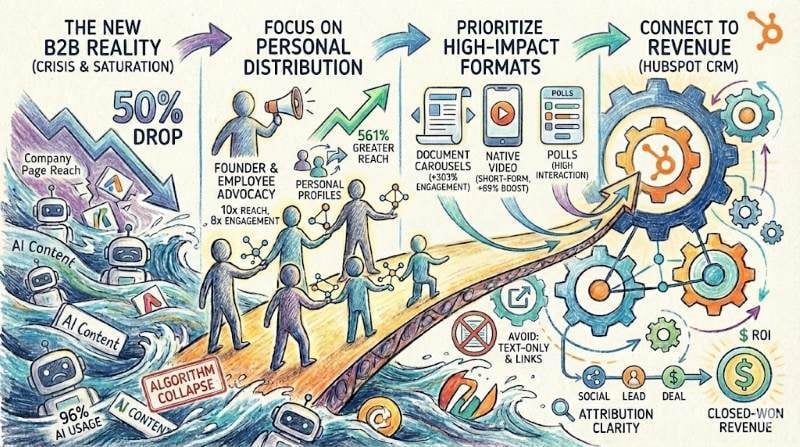
B2B SaaS companies face a social media paradox in 2026: organic reach has collapsed by 50% on LinkedIn, yet companies with effective social selling programmes are 51% more likely to hit their revenue targets. The difference lies in strategy—specifically, the shift from company-page publishing to personal distribution, algorithm-native content formats, and CRM integration that finally proves ROI.
The Organic Reach Crisis Demands a Strategic Pivot
The numbers paint a stark picture for B2B marketers. According to Richard van der Blom's Algorithm Insights 2025 report analysing 1.8 million posts, LinkedIn organic reach has declined 50% year-over-year, with engagement down 25% and follower growth collapsing by 59%. Company pages now appear in only 2% of users' feeds, whilst personal profiles still achieve 20-30% reach.
But Whitehat SEO's analysis of client social programmes reveals this isn't a death sentence—it's a filter. The algorithm changes of 2025-2026 systematically penalise volume-chasers whilst rewarding substance. LinkedIn's November 2025 update reduced reach on "viral but content-empty" posts by 76%, whilst boosting substantial, industry-relevant content by 124%.
The strategic implication: Comments now carry 3× more algorithmic weight than likes, interactions from industry experts receive 7-9× more value than random connections, and the first 30 minutes after posting influences 75% of total reach. Fewer, better posts distributed through people—not pages—now defines success.
Why LinkedIn Remains the Undisputed B2B Champion
LinkedIn generates 80% of all B2B social media leads and delivers 277% more leads than Facebook and Twitter combined. For SaaS companies targeting other businesses, no platform comes close. Understanding its 2025-2026 algorithm is therefore essential for any serious social media strategy.
Content Formats That Actually Work
Buffer's 2025 analysis reveals document carousel posts generate 303% more engagement than images and 596% more than text-only posts, achieving an average engagement rate of 24.42%. Native video earns a 69% performance boost, with short-form content growing 2× faster than other formats.
| Format | Engagement Lift | Best Practice |
|---|---|---|
| Document carousels | +303% vs images | 5-10 slides optimal; engagement drops after slide 6 |
| Native video | +69% vs standard posts | Vertical format; key info in first 4 seconds |
| Multi-image posts | 6.60% engagement rate | Strong for visual case studies and data |
| Polls | Highest impressions | Excellent for engagement; limited conversion value |
Posting Cadence and Timing
LinkedIn's algorithm promotes only one post per account per 24-hour period, making strategic timing critical. The sweet spot for company pages is 8-12 posts monthly (2-3 per week), with audience fatigue setting in above 12-15 monthly posts. Peak engagement windows cluster around Tuesday through Thursday, 8:00-11:00 AM, with a secondary peak at 12:00-2:00 PM.
The LinkedIn Newsletter Opportunity
LinkedIn now hosts over 184,000 newsletters, with publishing increasing 59% in 2024 and engagement up 47% year-over-year. Average newsletter open rates hover around 27%—substantially higher than typical email marketing. Critically, 98% of the top 100 newsletters are written by individuals, not companies, reinforcing the algorithm's preference for personal voices.
Employee Advocacy Has Become Non-Negotiable
The data overwhelmingly favours personal distribution over brand channels. Employee-shared content achieves 8× more engagement than brand posts, with brand messages reaching 561% further when shared by employees versus company channels. Content is reshared 24× more frequently when employees share it, and the click-through rate doubles.
The Business Impact of Employee Advocacy
- Leads from employee advocacy convert 7× more frequently than other leads
- Companies with social selling programmes are 58% more likely to attract top talent
- Dropbox achieved a 91% reduction in paid media spend through employee advocacy
- 82% of people are more likely to trust companies when senior executives are active on social
Founder-led content performs exceptionally well. The Edelman-LinkedIn Thought Leadership Impact Report found that 73% of decision-makers trust thought leadership more than traditional marketing materials, and 86% are likely to invite a company to bid on an RFP if that company consistently produces high-quality thought leadership.
For mid-market SaaS companies, Whitehat SEO recommends activating 5-10 key executives and subject matter experts—posting 2-3 times weekly each—which typically outperforms heavy investment in company page content. Learn more about increasing engagement on LinkedIn through personal profiles.
AI Transforms Workflows Without Replacing Strategy
AI adoption in social media marketing has reached near-universal saturation: 96% of social media professionals now use AI tools, with nearly three-quarters relying on them daily. Only 3.6% avoid AI entirely. ChatGPT dominates at 90% usage among marketers, followed by Google Gemini at 51% and Claude at 33%.
What AI Does Well
The primary applications include idea generation (90% of marketers), draft creation (89%), and headline writing (86%). AI tools can multiply content velocity by a factor of 100, with one company reporting they cut content creation time by 60% using ChatGPT for automating first drafts.
Major platforms have embedded AI deeply into their feature sets. HubSpot's Breeze AI includes a Social Media Agent (beta) that generates posts aligned with brand voice, recommends optimal posting times, and analyses performance patterns. HubSpot reported customers like Agicap saving 750 hours weekly and achieving 20% increased deal velocity with Breeze AI tools.
The Saturation Problem
Here's the catch: 71% of images shared on social media are now AI-generated, and over 54% of long-form LinkedIn posts are likely AI-created. More than 80% of consumers believe AI-generated content will make social feeds more saturated, and 78% say explicit AI labelling is "very important" for maintaining trust.
Differentiation now comes from sources AI cannot easily replicate: original research, proprietary data, authentic founder perspectives, customer stories with quantifiable results, and "sunk-cost differentiators" like high-production-value video that competitors can't quickly match.
Attribution Remains the Industry's Biggest Unsolved Problem
Only 30% of marketers believe they can measure social media ROI effectively, yet 67% say revenue attribution from social is their top measurement goal. The challenge is structural: the average consumer interacts with brands across 9.5 touchpoints before converting, whilst typical B2B buying teams have more than 4,000 digital and human interactions during their journey.
Dark Social Dominates but Can't Be Measured
A staggering 84% of all content shares happen via dark social channels—private messages, Slack, email, and other untrackable paths. Among B2B buyers specifically, 77.5% share business content through private channels. This represents "modern word-of-mouth at scale" but creates massive attribution gaps.
Proving ROI to CFOs
Whitehat SEO's work with B2B SaaS clients has identified the most effective methodologies for demonstrating social ROI:
- Track cost per qualified opportunity (CPO), not just cost per lead—LinkedIn's higher CPL (£85-270) is justified by 10-15% lead-to-opportunity conversion versus Facebook's 2-5%
- Self-reported attribution on high-intent forms ("How did you hear about us?")
- CRM integration with UTM parameters tracking social touchpoints to closed deals
- Multi-touch attribution models connecting engagement to pipeline
LinkedIn delivers 192% ROI for paid social and 229% ROI for organic over three years, with costs-per-lead 28% lower than Google AdWords for B2B campaigns when downstream conversion quality is factored in.
HubSpot's Social Tools Excel at CRM Integration
For mid-market SaaS companies already invested in HubSpot, the platform's social media capabilities centre on its native CRM integration—a genuine differentiator from standalone tools that Whitehat SEO leverages for client implementations.
Core Strengths
HubSpot's social tools provide deep contact association, linking every social interaction to individual CRM records. This enables contact-create attribution tracking (which posts generate leads), deal-create attribution (Enterprise), and revenue attribution (Enterprise). Social posts integrate with marketing campaigns, enabling unified reporting across email, ads, landing pages, and social in a single dashboard.
Acknowledged Limitations
HubSpot does not support TikTok or Pinterest publishing, lacks Google Business Profile integration, and offers basic social listening compared to dedicated tools like Sprout Social. Post data is only collected for 30 days after publication, and LinkedIn data retention is limited to 1 year. The pricing threshold is significant: social media features require Marketing Hub Professional (from £702/month).
When to Supplement
For clients with heavy TikTok/Pinterest requirements, advanced social listening needs, or where social represents the primary marketing channel, hybrid approaches work well—using standalone tools like Hootsuite or Buffer for publishing breadth whilst leveraging HubSpot for attribution and CRM integration through proper onboarding and configuration.
Content Strategy That Converts: What the Data Shows
The Content Marketing Institute's 2026 research reveals that video content (58%) has surpassed case studies for the first time as the most effective B2B content type. Short-form video delivers the highest ROI according to 41% of B2B marketers, with 78% now using video in their marketing mix.
Educational Content Dramatically Outperforms Promotional
Educational content drives 3× more leads than promotional material. Blogs prioritising educational approaches see 52% more organic traffic than company-focused content. The recommended ratio is 80% educational, 20% promotional—a professional services firm that shifted to 70/30 educational-to-promotional increased engagement by 3× and nearly doubled self-qualified opportunities.
This aligns with Whitehat SEO's approach to content marketing strategy: lead with value, establish expertise, then invite conversation.
Thought Leadership Has Become Essential
96% of B2B marketers now create thought leadership content, but only 11% operate at advanced maturity levels. The Edelman-LinkedIn research shows 95% of hidden buyers become more receptive to sales outreach after encountering strong thought leadership, and 75% of decision-makers say it prompted research into products they hadn't previously considered.
Budget Benchmarks for Mid-Market SaaS
Marketing budgets for B2B companies represent approximately 7.7% of overall company revenue according to Gartner's 2025 CMO Spend Survey—flat year-over-year, with 59% of CMOs reporting insufficient budget to execute their strategy. For mid-market SaaS specifically, companies typically allocate 10-30% of revenue to marketing when in growth phase, declining to 5-15% at maturity.
Social Media's Share of the Budget
Social media accounts for 10-20% of overall marketing budgets for B2B companies, with the average across all CMOs at 11.3%. The recommended allocation within social budgets follows a 60/25/15 split: 60% content creation, 25% paid advertising, 15% tools and analytics.
UK-Specific Considerations
UK digital ad spend reached £18.7 billion in H1 2025, with forecasts projecting £45 billion by 2026. UK B2B companies spend 7-12% of annual revenue on marketing, with high-growth companies allocating 12-15% and established businesses more conservative at 5-8%.
UK B2B marketing budgets typically range from £3,000-8,000/month for consistent, meaningful results. LinkedIn costs remain aligned with global benchmarks. For companies seeking to maximise their marketing services investment, focusing on fewer channels with greater depth consistently outperforms spreading thin.
Five Strategic Priorities for 2026
Based on Whitehat SEO's analysis of research across 1.8 million posts and work with mid-market SaaS clients, here are the five highest-impact actions:
1. Shift Resources from Company Pages to Personal Distribution
Activate 5-10 founders, executives, and subject matter experts with personal profiles posting 2-3 times weekly each. Personal accounts now outperform company pages by 10× or more in reach and engagement.
2. Prioritise Carousels, Native Video, and Documents on LinkedIn
These formats dominate engagement metrics by wide margins. Limit text-only posts and external links, which algorithms systematically penalise.
3. Implement Formal Employee Advocacy Programmes
The ROI data is overwhelming: 561% greater reach, 8× engagement, 7× lead conversion improvement. Native HubSpot features make execution manageable.
4. Integrate Social Data with CRM for Attribution
The inability to prove ROI remains the industry's biggest credibility gap. HubSpot's native integration provides a genuine advantage here, tracking social touchpoints through to closed revenue.
5. Use AI for Velocity, Differentiate Through Substance
With 96% adoption, AI-generated content is table stakes. Competitive advantage comes from original research, founder perspectives, customer evidence, and high-production content that AI cannot easily replicate.
The Bottom Line
The 2026 B2B social media landscape rewards focus over spray-and-pray. LinkedIn dominates B2B lead generation so thoroughly—generating 80% of all B2B social leads—that mid-market SaaS companies should concentrate resources there rather than spreading thin across platforms. Algorithm changes systematically favour quality over quantity, personal voices over brand channels, and substantive expertise over viral stunts.
The twin forces of organic reach collapse and AI content saturation have created a paradox: reaching audiences is harder than ever, yet companies that solve the problem gain disproportionate advantages because competitors struggle equally. Employee advocacy programmes, founder-led content strategies, and tight CRM integration for attribution now separate successful B2B social programmes from those generating engagement metrics disconnected from business results.
For HubSpot users, the platform's deepest value lies not in publishing features—where standalone tools often excel—but in connecting social activity to pipeline and revenue. That connection, properly implemented, transforms social media from a brand awareness checkbox into a measurable growth channel that CFOs can actually evaluate.
Ready to Transform Your B2B Social Media Strategy?
As a HubSpot Diamond Partner running the world's largest HubSpot User Group, Whitehat SEO helps mid-market SaaS companies build social programmes that actually connect to revenue. Whether you need help with HubSpot onboarding, ABM implementation, or comprehensive marketing strategy, we'd love to talk.
Frequently Asked Questions
How much should a mid-market SaaS company spend on social media marketing?
Social media typically accounts for 10-20% of overall marketing budgets, with the average at 11.3%. For UK B2B companies, this translates to £3,000-8,000/month for consistent, meaningful results. Within that budget, Whitehat SEO recommends a 60/25/15 split: 60% content creation, 25% paid advertising, and 15% tools and analytics.
What's the best posting frequency for B2B LinkedIn in 2026?
The optimal posting frequency for company pages is 8-12 posts monthly (2-3 per week), with audience fatigue setting in above 12-15 posts. For personal profiles in employee advocacy programmes, 2-3 posts weekly per person achieves the best results. LinkedIn's algorithm promotes only one post per account per 24-hour period.
How do I prove social media ROI to my CFO?
Focus on cost per qualified opportunity (CPO) rather than cost per lead, implement self-reported attribution on high-intent forms, use UTM parameters with CRM integration to track social touchpoints to closed deals, and leverage HubSpot's native revenue attribution features. LinkedIn delivers 229% ROI for organic social over three years when properly tracked.
Should I use AI tools for social media content creation?
Yes—96% of social media professionals now use AI tools, making it table stakes. However, differentiation comes from what AI cannot replicate: original research, proprietary data, authentic founder perspectives, and customer stories with quantifiable results. Use AI for velocity and efficiency, but invest in human-created substance for competitive advantage.
Is employee advocacy worth the investment for a 50-100 person SaaS company?
Absolutely. Employee-shared content reaches 561% further than brand posts, achieves 8× more engagement, and leads convert 7× more frequently. For mid-market SaaS, activating 5-10 executives and subject matter experts posting 2-3 times weekly typically outperforms heavy investment in company page content—often with lower total cost.
References & Further Reading
- Richard van der Blom — LinkedIn Algorithm Insights 2025
- Buffer — LinkedIn Carousel Posts Performance Analysis 2025
- Content Marketing Institute — B2B Content Marketing Research 2026
- Edelman & LinkedIn — Thought Leadership Impact Report
- Gartner — CMO Spend Survey 2025
- HubSpot — Breeze AI Platform Overview