
Social Media Marketing
If you're building your social media strategy, this data fundamentally changes the approach. Company pages alone simply cannot generate sufficient organic reach—employee advocacy has become structurally mandatory.
B2B Social Media Strategy in 2026: What Actually Works Now
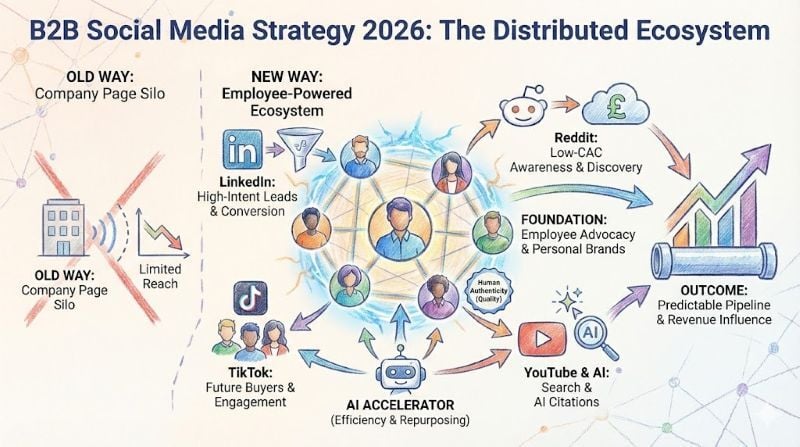
The rules of B2B social media have fundamentally shifted. LinkedIn's organic reach has collapsed to just 1.6% of followers, yet the platform still generates 80% of all B2B social leads. AI now powers content creation, platform algorithms, and discovery. Here's what Whitehat SEO's analysis of the latest research reveals about building a B2B social strategy that actually delivers pipeline.
LinkedIn remains essential, but the game has changed entirely
LinkedIn crossed 1.2 billion members in late 2025, with approximately 310 million monthly active users. It remains the undisputed B2B platform: 97% of B2B marketers use it, 85% say it delivers the best value, and it achieves a 2.74% visitor-to-lead conversion rate compared to just 0.77% for Facebook.
But the organic opportunity has contracted dramatically. Richard van der Blom's Algorithm Insights 2025 report (analysing 1.8 million posts) found views down 50% year-on-year, engagement down 25%, and follower growth down 59%. Company page posts now occupy just 1–2% of the feed, down from 7% in 2021.
LinkedIn's algorithm underwent its most significant change in January 2026 with the deployment of a 150-billion-parameter language model that replaces traditional signal-based ranking with semantic reasoning. The algorithm now measures a "Depth Score" (how long users engage, not just whether they clicked) and actively suppresses AI-sounding generic content.
What's Working on LinkedIn in 2026
| Content Format | Engagement Rate |
|---|---|
| Multi-image posts | 6.60% |
| PDF carousels | 5.85% |
| Native video | 5.60% |
| Polls (underused at 1.4% of content) | 1.99x reach multiplier |
The practical implications are clear: specificity wins. Posts with concrete details—company names, exact metrics, named individuals—get 3–4x more reach than generic advice. External links still suffer a roughly 60% distribution penalty. The "Golden Hour" remains critical: the first 60–90 minutes determine distribution trajectory based on engagement velocity.
Personal brands now outperform company pages by an order of magnitude
This is perhaps the single most important strategic shift since 2023. The data is overwhelming and consistent across multiple studies: personal profiles generate 561% more reach than company pages sharing identical content. Employee posts achieve 2.75x more impressions and 5x more engagement than company pages despite having 46% fewer followers.
CEO content generates 4x more engagement than average posts. Leads from employee social content convert 7x more frequently than paid channel leads. Brand messages shared by employees reach 561% further, receive 8x more engagement, and are reshared 24x more frequently.
Companies with active employee advocacy programmes see 20% higher revenue growth and report a 30% reduction in paid social spend. Yet only 17% of companies have formalised, comprehensive advocacy programmes—a massive execution gap that represents a genuine competitive advantage for those who act.
Whitehat's Recommended Approach
For startups and scale-ups: Allocate 80% of effort to founder personal branding, 20% to the company page.
For mature B2B companies: Implement a hybrid strategy with employees as primary distribution and the company page reserved for official communications, recruitment, and paid advertising.
Company pages still matter for conversion-oriented content—one analysis suggests they may have a 111x higher conversion rate per impression because visitors have higher purchase intent. But for reach and trust-building, personal profiles are now structurally superior. This directly connects to how HubSpot workflows can amplify employee advocacy through coordinated social distribution.
TikTok and Reddit are the emerging B2B opportunities you can't ignore
TikTok's regulatory uncertainty largely resolved in early 2026. Its 170 million US monthly active users were never significantly disrupted. More importantly for B2B marketers: 47% of corporate decision-makers use TikTok weekly, and 67% of B2B decision-makers use it for information gathering—a 22% year-on-year increase.
The 35–54 age group is the fastest-growing segment (+32% YoY). Professional and technical content now represents 23% of all TikTok content, up from 9% in 2023. CPMs dropped 80% year-on-year due to ban uncertainty, making TikTok currently the cheapest major social advertising platform. B2B lead generation campaigns on TikTok achieve a 3.2% conversion rate.
Reddit is the breakout opportunity. With 116 million daily active users and a Google partnership worth approximately £50 million annually, Reddit content appears in Google search results at unprecedented rates—50.3% of Google searches now include at least one social platform in the top 10, with Reddit appearing most frequently at 37%.
More critically, Reddit is the number one most-cited user-generated content platform across major AI answer engines. B2B SaaS companies report customer acquisition costs 15–30% lower on Reddit versus LinkedIn, with a cost per qualified lead of £35–70 versus £100–160 on LinkedIn.
YouTube: The AI Citation Leader
YouTube accounts for approximately 23.3% of all social citations in AI Overviews—the largest share of any social platform. Channels using Shorts combined with long-form content grow 41% faster. For B2B, YouTube offers the unique combination of search discoverability (second-largest search engine), AI citation potential, and a discovery-to-depth content funnel.
AI has become embedded in every layer of social strategy
95% of B2B marketers now use AI-powered applications, with 89% using AI specifically for content creation. AI saves marketers approximately 13 hours per person per week. The key tools are ChatGPT (76% adoption among AI-using marketers), Jasper for brand voice customisation, and Canva AI for visual content.
But the performance data reveals a critical nuance. A Buffer study of 1.2 million posts found AI-assisted posts achieved higher median engagement across all platforms—but the improvement comes from volume and consistency, not content quality. Conversely, FT Strategies found human-created content generates 3.5x more engagement than pure AI content. Half of consumers can correctly identify AI-generated copy, and 25% find brands using it "impersonal."
The consensus is clear: AI as accelerator, not author. AI handles first drafts, repurposing, and variations; experienced humans own strategy, voice, and editorial control. LinkedIn's algorithm actively suppresses AI-sounding generic content. The EU AI Act (effective August 2026) will mandate labelling of AI-generated content with fines up to €15 million.
This is directly relevant to how you approach content marketing strategies—the hybrid approach of AI efficiency with human authenticity is what separates high-performing programmes from the noise.
Social content is being pulled into AI answer engines at scale
A Goodie study analysing 6.1 million citations across 10 AI platforms (August–December 2025) found social citations grew 4x during this period. By November 2025, social citations were 4.17x the volume of owned content citations in AI-generated answers.
YouTube accounts for the largest share of social citations in AI Overviews at approximately 23.3%, growing from 18.9% to 39.2% of social citations between August and December 2025. Reddit was the initial leader but is declining in share. X/Twitter citations appeared almost exclusively through Grok (99.75% coupling), while Instagram citations come almost entirely through Google AI Overviews.
For B2B marketers, the implications are significant. Google's AI Overviews include social content in 20% of queries, rising to 36% in Google's AI Mode. This means social content now has a direct path to appearing in AI-generated search answers. The optimisation strategy mirrors traditional SEO principles: authoritative, specific, educational content with visible credentials performs best.
B2B influencer marketing has reached mainstream adoption with extraordinary ROI
The global influencer marketing industry reached £27 billion in 2025 and is projected to exceed £33 billion by 2026. For B2B specifically, 85% of marketers now run influencer programmes (up from 34% in 2020), reporting an average ROI of 520%.
Critically, 99% of B2B marketers using an always-on influencer approach rate their programmes as effective, while those using campaign-based approaches are 17x more likely to report ineffectiveness. This mirrors what we see in inbound marketing methodology—sustained relationship-building outperforms sporadic campaigns.
Micro and nano-influencers dominate B2B effectiveness. A consultant with 5,000 engaged followers consistently outperforms a generic business influencer with 500,000 followers. LinkedIn creators, podcast hosts, newsletter writers, and industry analysts represent the highest-value B2B influencer categories.
However, only 28% of marketers can effectively measure influencer ROI—representing both a gap and an opportunity for sophisticated B2B teams who invest in proper attribution.
What contradicts conventional wisdom
Several findings directly challenge strategies that were best practice in 2023:
- Video isn't always king. On X/Twitter, text posts get 30% more engagement than video. On LinkedIn, carousels outperform video. On Instagram, static images (6.2% engagement) are outperforming Reels (3.5%) in some measurements.
- Posting frequency should decrease, not increase. All platforms now reward depth and dwell time over volume. LinkedIn's algorithm specifically penalises multiple posts within 24 hours.
- Hashtags barely matter on LinkedIn. The platform's LLM-based algorithm detects topics semantically, making hashtag strategy largely obsolete. More than 5 hashtags actively hurts performance.
- Facebook is relevant for B2B again. Meta's AI-powered intent targeting can now infer professional intent, and Facebook referral traffic quadrupled year-on-year for some publishers.
- Comments are declining across all platforms despite rising overall engagement—TikTok comments down 24%, Instagram down 16%. The shift is toward passive engagement (saves, shares, DMs), which platforms increasingly weight more heavily.
Budget and measurement need a 2026 upgrade
Average B2B marketing spend reached 9.4% of revenue in 2025, up from 7.7% in 2024. Forrester reports 83% of B2B marketing decision-makers expect budgets to grow in 2026. Social media advertising typically represents 25–40% of paid media spend for B2B companies.
LinkedIn's share of B2B ad budgets grew from 31% to 39% by end of 2024, making it the largest single B2B advertising platform. Despite higher cost per lead (£50–£165+), LinkedIn Ads deliver 113% ROAS—outperforming Google Search (78%) and Meta (29%). LinkedIn Lead Gen Forms convert at 6–13% versus 2–5% for external landing pages.
Recommended 2026 KPI Framework
C-suite reporting: Marketing-influenced revenue, pipeline velocity, CAC payback period
Marketing leadership: Buying group engagement scores, MQL-to-SQL conversion, weighted pipeline value
Social teams: Attention from target accounts, share of voice, view duration
Self-reported attribution ("How did you hear about us?" with AI engine options) is increasingly important for capturing dark social influence—which accounts for an estimated 70% of all B2B content sharing. The average B2B customer journey spans 211 days with 76 touchpoints, 6.8 stakeholders, and 3.7 channels. Last-click attribution dramatically under-credits social media.
Frequently Asked Questions
Is LinkedIn still worth investing in for B2B marketing?
Absolutely. Despite the 50% drop in organic reach, LinkedIn still generates 80% of all B2B social leads and achieves a 2.74% visitor-to-lead conversion rate. The strategy needs to shift from company page posting to employee advocacy, personal branding, and paid promotion of high-value content. The platform remains essential—the tactics have changed.
Should B2B companies use TikTok?
Yes, particularly if you're targeting decision-makers under 55. With 47% of corporate decision-makers using TikTok weekly and CPMs 80% lower than other platforms, it's become a viable B2B channel. Focus on educational, keyword-optimised short-form content that serves both human viewers and search discovery.
How much should we budget for B2B social media marketing?
Average B2B marketing spend is 9.4% of revenue, with social media typically representing 25–40% of paid media spend. Allocate 10% of total marketing spend for experimentation with new AI tools and emerging channels. Employee advocacy and executive social programmes should receive approximately 20% of brand awareness budget.
How do we measure B2B social media ROI effectively?
Move beyond platform-level engagement metrics to pipeline influence. Use multi-touch attribution through platforms like HubSpot, track self-reported attribution to capture dark social sharing, and measure marketing-influenced revenue rather than last-click conversions. The average B2B journey spans 211 days and 76 touchpoints—single-touch attribution will dramatically under-credit social.
What's the biggest mistake B2B companies make with social media?
Relying solely on company page organic posting. With company pages receiving just 1–2% feed allocation, this approach is structurally broken. The 83% of companies without formalised employee advocacy programmes are leaving significant reach and pipeline on the table. The solution is treating social as a distributed, multi-platform content ecosystem with employees as primary distribution.
Strategic priorities for your 2026 B2B social strategy
The core strategic shifts demand action in specific areas. First, employee advocacy programmes must move from "nice-to-have" to foundational infrastructure—company pages simply cannot generate sufficient organic reach alone.
Second, AI should be deployed for efficiency (drafting, repurposing, scheduling, analytics) while human authenticity remains the competitive moat—especially as platforms actively penalise generic AI content.
Third, multi-platform presence is no longer optional: YouTube for AI citation visibility, LinkedIn for lead generation, Reddit for cost-effective awareness, and TikTok for reaching emerging B2B buyers.
Fourth, social content must be optimised for AI answer engines, not just human feeds—this means authoritative, specific, well-attributed content that AI systems can cite.
The B2B brands that win in 2026 are those that treat social media as a distributed, multi-platform content ecosystem rather than a collection of separate channels to post on. Remove the random acts of marketing. Build a system that compounds.
References & Citations
- DemandSage – LinkedIn Statistics 2025
- Sprout Social – LinkedIn Statistics for Marketers
- Agorapulse – LinkedIn Algorithm 2026
- TopRank Marketing – B2B Influencer Marketing Statistics 2025
- Influencer Marketing Hub – Benchmark Report 2025
- Backlinko – LinkedIn Statistics
- Buffer – LinkedIn Statistics 2025
- Richard van der Blom – Algorithm Insights Report 2025
Ready to transform your B2B social strategy?
Let's discuss how Whitehat can help you build a social media programme that actually delivers pipeline. view our pricing
Book a Discovery Call